South Korea 4D Imaging Radar Market Growth Rate
According to 6Wresearch internal database and industry insights, the South Korea 4D Imaging Radar Market is projected to grow at a compound annual growth rate (CAGR) of 4.7% during the forecast period (2026-2032).
South Korea 4D Imaging Radar Market Year-wise Growth Rate and Key Drivers
This graph illustrates the annual growth rates of the South Korea 4D Imaging Radar Market from 2021 to 2032, highlighting a steady upward trajectory and projected market expansion over the forecast period.
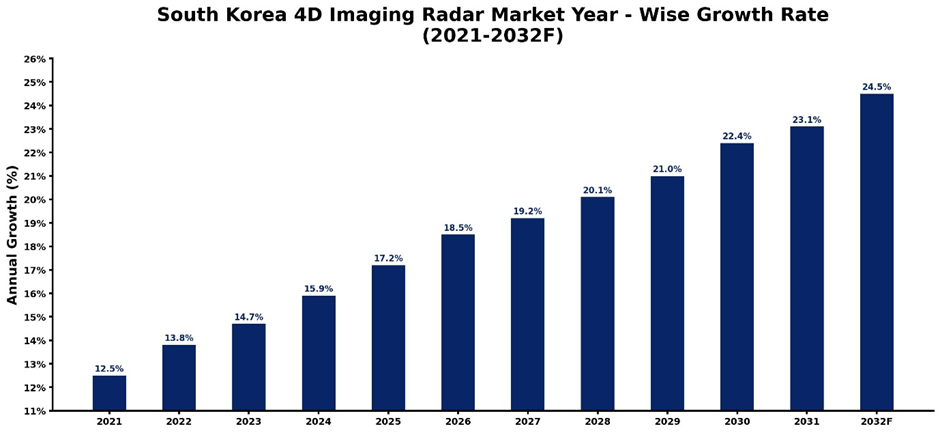
The following table summarizes the historical and forecasted growth rates of the South Korea 4D Imaging Radar Market, along with the rationale behind each year’s performance.
| Year | Estimated Growth (%) | Market Rationale |
| 2021 | 12.5% | Initial market entry with pilot projects for autonomous vehicle testing. |
| 2022 | 13.8% | Increased R&D spending by local automotive OEMs on sensor fusion. |
| 2023 | 14.7% | Surge in adoption of ADAS features in premium vehicle segments. |
| 2024 | 15.9% | Government support for high-tech industrial clusters boosting local production. |
| 2025 | 17.2% | Scaling of domestic manufacturing of 4D radar chipsets and hardware. |
| 2026 | 18.5% | Rapid expansion into smart city infrastructure and traffic management. |
| 2027 | 19.2% | Integration of AI-driven perception software into mass-market EVs. |
| 2028 | 20.1% | Massive deployment in security/surveillance for critical infrastructure. |
| 2029 | 21% | Mature supply chain and high-volume demand from robotic industries. |
| 2030 | 22.4% | Breakthroughs in ultra-high-resolution imaging for industrial automation. |
| 2031 | 23.1% | Widespread cross-industry adoption, including defence and logistics. |
| 2032 | 24.5% | Market maturity with near-universal integration in advanced mobility. |
Topics Covered in the South Korea 4D Imaging Radar Market Report
The South Korea 4D Imaging Radar Market report thoroughly covers the market by Component, Application and End user. The market report provides an unbiased and detailed analysis of ongoing market trends, opportunities/high growth areas, and market drivers, which help stakeholders devise and align their market strategies according to the current and future market dynamics.
South Korea 4D Imaging Radar Market Highlights
| Report Name | South Korea 4D Imaging Radar Market |
| Forecast period | 2026-2032 |
| CAGR | 4.7% |
| Growing Sector | Automotive & Autonomous Mobility |
South Korea 4D Imaging Radar Market Synopsis
South Korea 4D Imaging Radar Market is rapidly evolving due to the intensive integration of high-resolution sensors into autonomous platforms, smart city initiatives, and advancements in local semiconductor capabilities. These systems provide critical 4D point cloud data, mapping range, azimuth, elevation, and velocity to ensure safe navigation in complex environments. Furthermore, robust support from government agencies and a thriving ecosystem of high-tech startups are accelerating the development of energy-efficient, reliable radar solutions for both commercial automotive fleets and critical national infrastructure.
Evaluation of Growth Drivers in the South Korea 4D Imaging Radar Market (2026-2032)
Below mentioned are some prominent drivers and their influence on the market dynamics:
| Drivers | Primary Segments Affected | Why it Matters (Evidence) |
| Autonomous Vehicle Adoption | Automotive, Processors | High-resolution 4D data is essential for L3/L4 vehicle safety. |
| Industrial Automation Demand | Industrial, Robotics | Precision monitoring enhances efficiency in automated factory lines. |
| Integration within the Smart City | Infrastructure, Security | Use of radars for traffic management minimizes traffic jam problems in crowded cities. |
| R&D Grant on Semiconductors | Components, Hardware | Less expensive manufacture of domestic radars due to government support. |
| Extreme Weather Conditions | All Segments | Much more reliable performance in fog or snow than optical technology. |
South Korea 4D Imaging Radar Market is expected to grow at the CAGR of 4.7% during the forecast period of 2026-2032. Growth is driven by the rapid scaling of autonomous driving technology, heavy investments in high-tech industrial manufacturing, and the urgent need for reliable security solutions. Additional contributions come from strong partnerships between local technology giants and government research bodies aimed at solidifying the nation's leadership in the global radar and sensor ecosystem.
Evaluation of Restraints in the South Korea 4D Imaging Radar Market
Below mentioned are some major restraints and their influence on the market dynamics:
| Restraints | Primary Segments Affected | What This Means (Evidence) |
| High Production Costs | Automotive, Processors | Expensive hardware limits penetration into mid-tier vehicle segments. |
| Integration Complexity | All Segments | Fusing radar data with other sensors requires advanced software talent. |
| Regulatory Hurdles | Security, Surveillance | Strict privacy laws limit the scope of high-resolution urban monitoring. |
| Cybersecurity Risks | All Segments | Potential vulnerability of connected radar sensors to hacking. |
| Supply Chain Volatility | Components, Hardware | Dependencies on specialized rare earth materials impact output stability. |
South Korea 4D Imaging Radar Market Challenges
Irrespective of massive growth and development, the Market faces several challenges such as the high initial investment cost for hardware, technical complexities in sensor fusion, and the limited availability of specialized software engineers. In addition to this, the stringent data protection regulations in urban settings, supply chain sensitivities regarding semiconductor raw materials, and the need for standardized testing protocols for 4D radar imaging continue to influence the overall South Korea 4D Imaging Radar Market Growth trajectory.
South Korea 4D Imaging Radar Market Trends
Key technological trends reshaping the South Korea 4D Imaging Radar Market landscape are:
- Software-Defined Radar (SDR) Evolution: Growing preference for programmable chips that allow manufacturers to update radar performance via over-the-air (OTA) updates, extending system longevity.
- Radar Fusion Pre-eminence: Growing tendency of integrating radar data with LiDAR’s and cameras, facilitating a more detailed “perception stack” in self-driving cars.
- Edge AI Computations: Moving towards doing complex processing of radar data directly at the sensor level for faster operations and reduced use of bandwidth.
- Privacy-Oriented Surveillance: Growing adoption of radar systems for detecting occupancy while ensuring no face recognition is possible to maintain user privacy.
Investment Opportunities in the South Korea 4D Imaging Radar Market
High-potential investment opportunities in the South Korea 4D Imaging Radar Market are:
- Autonomous Driving Perception Modules: Focusing on the development of dedicated radar-on-chip technologies aimed at domestic automobile manufacturers.
- Smart Traffic Infrastructure: Investing in radar-based nodes designed to optimize traffic lights and improve flow in cities.
- Industrial Safety Robotics: Designing compact radar sensors that enable human-machine interaction in electronics assembly factories.
- Defence & Border Security: Installing terrestrial radar networks that ensure highly accurate perimeter security.
Top 5 Leading Players in the South Korea 4D Imaging Radar Market
Leading innovators and strategic players driving the South Korea 4D Imaging Radar Market include:
1. bitsensing
| Field | Details |
|---|---|
| Company Name | bitsensing |
| Headquarters | Seoul, South Korea |
| Established Year | 2018 |
| Official Website | Click Here |
bitsensing develops 4D imaging radar solutions for autonomous vehicles and smart mobility applications.
2. Samsung Electro-Mechanics
| Field | Details |
|---|---|
| Company Name | Samsung Electro-Mechanics |
| Headquarters | Suwon, South Korea |
| Established Year | 1973 |
| Official Website | Click Here |
Samsung Electro-Mechanics produces advanced radar modules and electronic components for automotive and industrial use.
3. Hyundai Mobis
| Field | Details |
|---|---|
| Company Name | Hyundai Mobis |
| Headquarters | Seoul, South Korea |
| Established Year | 1977 |
| Official Website | Click Here |
Hyundai Mobis integrates radar and sensor fusion systems for autonomous driving and vehicle safety technologies.
4. Mando Corporation
| Field | Details |
|---|---|
| Company Name | Mando Corporation |
| Headquarters | Seoul, South Korea |
| Established Year | 1962 |
| Official Website | Click Here |
Mando develops radar-based ADAS and automotive safety systems for collision avoidance and driving assistance.
5. LG Innotek
| Field | Details |
|---|---|
| Company Name | LG Innotek |
| Headquarters | Seoul, South Korea |
| Established Year | 1970 |
| Official Website | Click Here |
LG Innotek provides high-precision radar sensors and electronic modules for automotive and IoT applications.
Government Initiatives Being Implemented in the South Korea 4D Imaging Radar Market
According to South Korean Government Data, The Digital New Deal Strategy is being implemented by the Ministry of Science and ICT. Through this program, huge amounts of money will be invested in researching and developing 12 national strategic technologies, including artificial intelligence and autonomous sensing technologies.
Moreover, huge tax breaks will be provided by the country to companies that deal with development of the hardware related to radar technology. In addition, there is a "National Advanced Strategic Technology Industrial Complex" in which special regulatory breaks have been made available to companies who want to test their radar technology on actual urban streets.
Future Insights of the South Korea 4D Imaging Radar Market
South Korea 4D Imaging Radar Industry is poised for significant expansion, driven by the convergence of automotive innovation, smart city infrastructure, and deep-tech manufacturing. Future growth will be fuelled by the deployment of 5G-enabled radar systems that allow for real-time data sharing between vehicles and traffic management centres. As local manufacturers scale the production of cost-effective, high-resolution radar chipsets, the technology will transition from luxury vehicles into mainstream commercial applications, ultimately solidifying the market’s position as a cornerstone of South Korea's high-tech industrial economy.
Market Segmentation Analysis
The report offers a comprehensive study of the subsequent market segments and their leading categories:
By Application- Automotive Leads Market, Security & Surveillance Shows Rapid Growth
According to Bhawna Singh, Assistant Manager, 6Wresearch, by application, the automotive segment accounted for 62.4% of the South Korea 4D imaging radar market share in 2025, supported by the mandatory integration of ADAS in passenger vehicles. Meanwhile, security and surveillance solutions are anticipated to expand at an impressive CAGR of 20.8% through 2032, owing to the rising demand for non-optical perimeter monitoring in airports, energy plants, and data centres.
By End-user- Automotive Industry Leads, Industrial Automation Shows Rapid Growth
The automotive end-user industry was the leading one in terms of market share, occupying a major 55.2%, due to the high production levels of automobiles in South Korea. However, the industrial end-user industry will witness the highest growth rate of 22.1% CAGR until 2032 due to the rising requirement of robotics sensing in warehouses and factories.
Note: Market size estimations and growth projections presented in this report are based on 6Wresearch’s advanced forecasting approach, validated with industry datasets as of June 2026.
Key Attractiveness of the Report
- 10 Years of Market Numbers.
- Historical Data Starting from 2022 to 2025.
- Base Year: 2025.
- Forecast Data until 2032.
- Key Performance Indicators Impacting the Market.
- Major Upcoming Developments and Projects.
Key Highlights of the Report:
- South Korea 4D Imaging Radar Market Outlook
- Market Size of South Korea 4D Imaging Radar Market, 2025
- Forecast of South Korea 4D Imaging Radar Market, 2032
- Historical Data and Forecast of South Korea 4D Imaging Radar Revenues & Volume for the Period 2022-2032
- South Korea 4D Imaging Radar Market Trend Evolution
- South Korea 4D Imaging Radar Market Drivers and Challenges
- South Korea 4D Imaging Radar Price Trends
- South Korea 4D Imaging Radar Porter's Five Forces
- South Korea 4D Imaging Radar Industry Life Cycle
- Historical Data and Forecast of South Korea 4D Imaging Radar Market Revenues & Volume By Component for the Period 2022-2032
- Historical Data and Forecast of South Korea 4D Imaging Radar Market Revenues & Volume By Antenna for the Period 2022-2032
- Historical Data and Forecast of South Korea 4D Imaging Radar Market Revenues & Volume By Transmitter for the Period 2022-2032
- Historical Data and Forecast of South Korea 4D Imaging Radar Market Revenues & Volume By Receiver for the Period 2022-2032
- Historical Data and Forecast of South Korea 4D Imaging Radar Market Revenues & Volume By Signal for the Period 2022-2032
- Historical Data and Forecast of South Korea 4D Imaging Radar Market Revenues & Volume By Processor for the Period 2022 - 2032
- Historical Data and Forecast of South Korea 4D Imaging Radar Market Revenues & Volume By Others for the Period 2022 - 2032
- Historical Data and Forecast of South Korea 4D Imaging Radar Market Revenues & Volume By Application for the Period 2022-2032
- Historical Data and Forecast of South Korea 4D Imaging Radar Market Revenues & Volume By Automotive for the Period 2022-2032
- Historical Data and Forecast of South Korea 4D Imaging Radar Market Revenues & Volume By Aerospace & Defence for the Period 2022-2032
- Historical Data and Forecast of South Korea 4D Imaging Radar Market Revenues & Volume By Industrial for the Period 2022-2032
- Historical Data and Forecast of South Korea 4D Imaging Radar Market Revenues & Volume By Security & Surveillance for the Period 2022-2032
- Historical Data and Forecast of South Korea 4D Imaging Radar Market Revenues & Volume By others for the Period 2022 - 2032
- Historical Data and Forecast of South Korea 4D Imaging Radar Market Revenues & Volume By End user for the Period 2022-2032
- Historical Data and Forecast of South Korea 4D Imaging Radar Market Revenues & Volume By Automotive for the Period 2022-2032
- Historical Data and Forecast of South Korea 4D Imaging Radar Market Revenues & Volume By Aerospace & Défense for the Period 2022-2032
- Historical Data and Forecast of South Korea 4D Imaging Radar Market Revenues & Volume By Industrial for the Period 2022-2032
- Historical Data and Forecast of South Korea 4D Imaging Radar Market Revenues & Volume By Security & Surveillance for the Period 2022-2032
- Historical Data and Forecast of South Korea 4D Imaging Radar Market Revenues & Volume By others for the Period 2022 - 2032
- South Korea 4D Imaging Radar Import Export Trade Statistics
- Market Opportunity Assessment By Component
- Market Opportunity Assessment By Application
- Market Opportunity Assessment By End user
- South Korea 4D Imaging Radar Top Companies Market Share
- South Korea 4D Imaging Radar Competitive Benchmarking By Technical and Operational Parameters
- South Korea 4D Imaging Radar Company Profiles
- South Korea 4D Imaging Radar Key Strategic Recommendations
Market Covered
The report offers a comprehensive study of the subsequent market segments:
By Component:
- Antenna
- Transmitter
- Receiver
- Signal Processor
- Others
By Application:
- Automotive
- Aerospace & defence
- Industrial
- Security & Surveillance
- Others
By End-user:
- Automotive
- Aerospace & defence
- Industrial
- Security & Surveillance
- Others






































