South Korea 5G Core Market Size, Share & Growth Rate
The South Korea 5G Core Market was estimated at USD 276 Million in 2025 and is projected to reach USD 370 Million by 2032, growing at a CAGR of 4.3% from 2026 to 2032. This growth trajectory is underpinned by the country's robust demand for high-speed internet and the rapid expansion of IoT devices. Moreover, the continuous investment in 5G infrastructure by both the government and private sectors is catalyzing the development of advanced network solutions, further enhancing South Korea's position as a leader in 5G technology.
South Korea 5G Core Market Year-wise Growth Rate and Key Drivers
This graph highlights how the South Korea 5G Core Market has steadily grown over the years, supported by major growth factors.
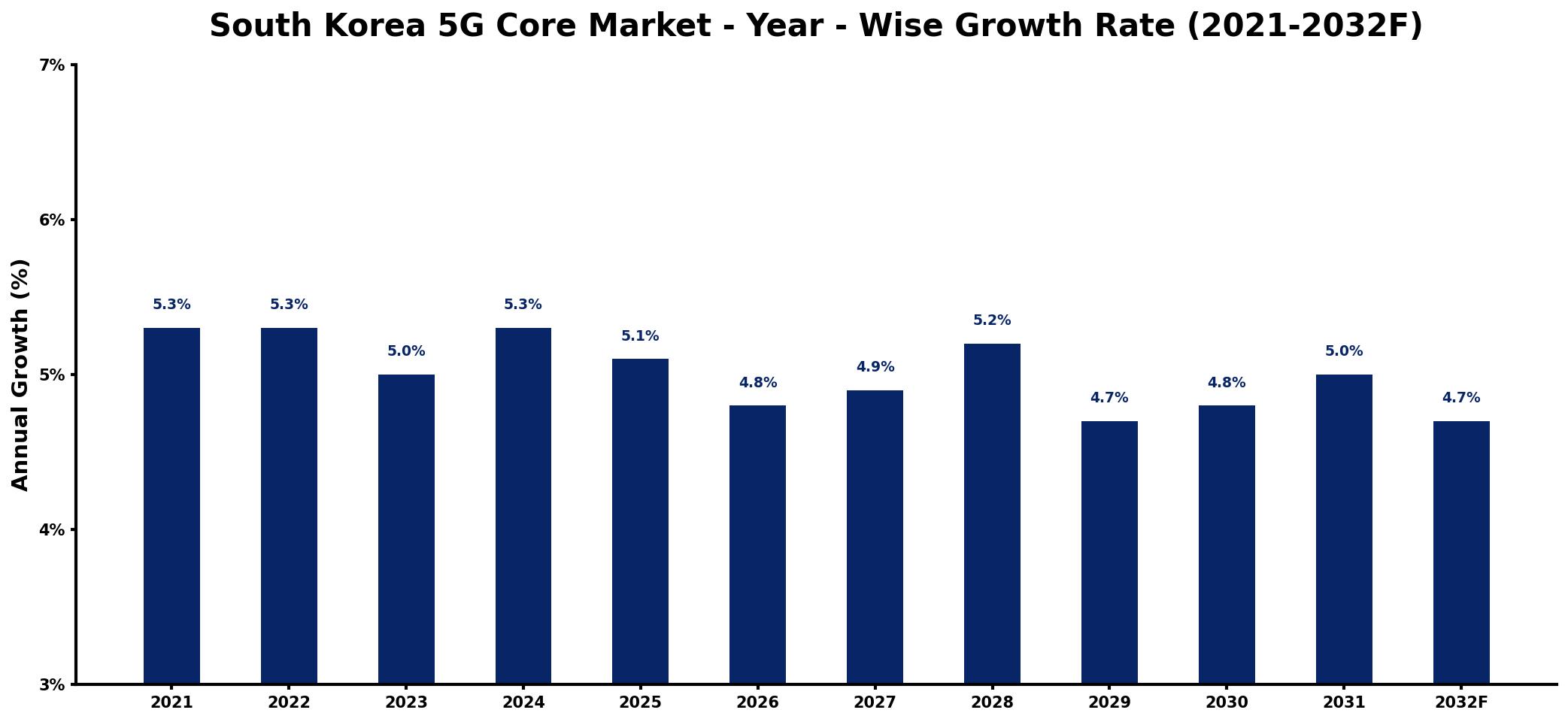
The table below presents the year‑wise growth rates along with the key drivers influencing the market
| Year | Growth Rate | Major Drivers |
| 2021 | 5.3% | Rising demand for mobile data |
| 2022 | 5.3% | Increased investments in infrastructure |
| 2023 | 5.0% | Expansion of IoT applications |
| 2024 | 5.3% | Growth in smart city initiatives |
| 2025 | 5.1% | Surge in cloud computing adoption |
| 2026 | 4.8% | Development of edge computing solutions |
| 2027 | 4.9% | Emergence of autonomous vehicles |
| 2028 | 5.2% | Advancements in virtual reality technologies |
| 2029 | 4.7% | Integration of AI in services |
| 2030 | 4.8% | Boost in remote working solutions |
| 2031 | 5.0% | increased domestic production output |
| 2032 | 4.7% | increased overall sector activity |
Note: Market size estimations and growth projections presented in this report are based on 6Wresearch's proprietary forecasting methodology, utilizing the latest available industry data, government publications, and primary research inputs.
South Korea 5G Core Market Synopsis
The South Korea 5G Core Market is characterized by an increasing adoption of cloud-native architecture, enabling telecom operators to deploy services with enhanced flexibility and scalability. This architectural shift is crucial for catering to the unique demands of various sectors, including healthcare, manufacturing, and smart city initiatives.
As the government reinforces its commitment to 5G technology, the market is witnessing a surge in innovative solutions designed to optimize network performance. This innovation is not only supporting the growing number of connected devices but also paving the way for new applications, such as augmented reality (AR) and virtual reality (VR), which are becoming integral to South Korea's digital ecosystem.
South Korea 5G Core Market Key Takeaways
- Robust government policies are accelerating 5G deployment and infrastructure investment.
- Cloud-native architecture is becoming a standard for enhanced service delivery.
- Network slicing capabilities are facilitating tailored solutions for diverse applications.
- Incorporation of AI and ML technologies is driving operational efficiency in network management.
- High smartphone penetration rates are fueling the demand for advanced connectivity solutions.
Evaluation of Restraints in South Korea 5G Core Market
Despite the promising outlook, the South Korea 5G Core Market faces significant restraints that could hinder its growth. One primary concern is the substantial capital expenditure required for network upgrades and new infrastructure development. This investment is critical to meeting the escalating demand for data but poses financial challenges for many operators. Additionally, cybersecurity threats associated with high-capacity networks present another layer of complexity, necessitating rigorous measures to ensure data privacy and network integrity. Regulatory hurdles, particularly around spectrum allocation and licensing, also continue to impede smooth transitions towards widespread 5G adoption.
South Korea 5G Core Market Trends
Several key trends are shaping the South Korea 5G Core Market. The move towards cloud-native architectures allows for the dynamic scaling of services, which is vital as network demands fluctuate. Network slicing is gaining traction, enabling service providers to create dedicated virtual networks optimized for specific applications, ensuring ultra-reliable low-latency communications. The integration of artificial intelligence and machine learning is revolutionizing network optimization, enabling proactive management and improved performance. This adaptability and efficiency are essential as South Korea navigates the complexities of an increasingly interconnected digital landscape.
South Korea 5G Core Market Opportunities
The South Korea 5G Core Market is ripe with investment opportunities driven by the country's commitment to technological advancements. As demand for advanced network solutions surges, opportunities abound for entities involved in developing infrastructure, software solutions, and associated services. Additionally, strategic partnerships with telecom operators and government-backed initiatives to foster 5G adoption present lucrative avenues for growth. The continuous rise in IoT devices and the establishment of smart cities are also critical factors driving long-term investment potential.
Government Initiatives in the South Korea 5G Core Market
The South Korean government has put in place several initiatives aimed at bolstering the 5G core market. Key policies include significant investments in telecommunications infrastructure, streamlined spectrum allocation, and regulatory frameworks that promote competition among telecom operators. Moreover, the government is incentivizing 5G network rollout through financial support and tax benefits, creating an environment conducive to innovation and competition in the market. These initiatives underscore South Koreas ambition to establish itself as a global leader in 5G technology.
Future Insights of the South Korea 5G Core Market
Looking ahead, the South Korea 5G Core Market is expected to see significant advancements from 2026 to 2032. With the projected increase in connected devices and data traffic, demand for robust 5G core solutions will only intensify. The proliferation of IoT and smart city developments, combined with the rise of high-bandwidth applications like AR and VR, will drive investment in network infrastructure. Telecom operators are likely to focus on optimizing existing networks while exploring new technologies, ensuring their offerings remain competitive in a rapidly evolving market.
South Korea 5G Core Market Latest Developments (2025 - 2026)
In recent months, the South Korea 5G Core Market has witnessed a flurry of activity aimed at enhancing network capabilities and improving service delivery. Telecom operators are actively working to upgrade their infrastructure in anticipation of growing data traffic. Concurrently, advancements in network slicing are making it feasible to cater to specific user requirements, thereby improving the quality of service. The ongoing evolution of AI and ML applications is also influencing strategies for network management and optimization, setting the stage for more dynamic and responsive networks in the near future.
South Korea 5G Core Market - Key Attractiveness of the Report
- 10 Years of Market Numbers
- Historical Data Starting from 2022 to 2025
- Base Year: 2025
- Forecast Data until 2032
- Key Performance Indicators Impacting the Market
- Major Upcoming Developments and Projects
Key Highlights of the Report:
- South Korea 5G Core Market Outlook
- Market Size of South Korea 5G Core Market, 2025
- Forecast of South Korea 5G Core Market, 2032
- Historical Data and Forecast of South Korea 5G Core Revenues & Volume for the Period 2022-2032F
- South Korea 5G Core Market Trend Evolution
- South Korea 5G Core Market Drivers and Challenges
- South Korea 5G Core Price Trends
- South Korea 5G Core Porter's Five Forces
- South Korea 5G Core Industry Life Cycle
- Historical Data and Forecast of South Korea 5G Core Market Revenues & Volume By Component for the Period 2022-2032F
- Historical Data and Forecast of South Korea 5G Core Market Revenues & Volume By Solutions for the Period 2022-2032F
- Historical Data and Forecast of South Korea 5G Core Market Revenues & Volume By Services for the Period 2022-2032F
- Historical Data and Forecast of South Korea 5G Core Market Revenues & Volume By Network Function for the Period 2022-2032F
- Historical Data and Forecast of South Korea 5G Core Market Revenues & Volume By Access for the Period 2022-2032F
- Historical Data and Forecast of South Korea 5G Core Market Revenues & Volume By Mobility Management Function for the Period 2022-2032F
- Historical Data and Forecast of South Korea 5G Core Market Revenues & Volume By Policy Control Function for the Period 2022-2032F
- Historical Data and Forecast of South Korea 5G Core Market Revenues & Volume By Unified Data Management for the Period 2022-2032F
- Historical Data and Forecast of South Korea 5G Core Market Revenues & Volume By Deployment Model for the Period 2022-2032F
- Historical Data and Forecast of South Korea 5G Core Market Revenues & Volume By Cloud for the Period 2022-2032F
- Historical Data and Forecast of South Korea 5G Core Market Revenues & Volume By On-premises for the Period 2022-2032F
- Historical Data and Forecast of South Korea 5G Core Market Revenues & Volume By End User for the Period 2022-2032F
- Historical Data and Forecast of South Korea 5G Core Market Revenues & Volume By Telecom Operators for the Period 2022-2032F
- Historical Data and Forecast of South Korea 5G Core Market Revenues & Volume By Enterprises for the Period 2022-2032F
- South Korea 5G Core Import Export Trade Statistics
- Market Opportunity Assessment By Component
- Market Opportunity Assessment By Network Function
- Market Opportunity Assessment By Deployment Model
- Market Opportunity Assessment By End User
- South Korea 5G Core Top Companies Market Share
- South Korea 5G Core Competitive Benchmarking By Technical and Operational Parameters
- South Korea 5G Core Company Profiles
- South Korea 5G Core Key Strategic Recommendations






































