South Korea 5G Internet of Things Market (2026-2032) | Competitive, Segments, Supply, Outlook, Growth, Value, Demand, Size, Opportunities, Trends, Challenges, Share, Segmentation, Competition, Strategy, Revenue, Drivers, Strategic Insights, Analysis, Companies, Restraints, Pricing Analysis, Forecast, Industry, Consumer Insights, Investment Trends
Market Forecast By IoT Application (Smart Cities, Industrial IoT, Connected Vehicles, Healthcare IoT), By Frequency Band (Sub-6 GHz, mmWave, 26-39 GHz, Above 39 GHz), By Connectivity Type (Cellular, Private 5G, V2X, Satellite IoT), By Industry (Urban Development, Manufacturing, Automotive, Telemedicine) And Competitive Landscape
| Product Code: ETC11647018 | Publication Date: Apr 2025 | Updated Date: Jun 2026 | Product Type: Market Research Report | |
| Publisher: 6Wresearch | Author: Bhawna Singh | No. of Pages: 70 | No. of Figures: 35 | No. of Tables: 5 |
South Korea 5G Internet of Things Market Growth Rate
According to 6Wresearch internal database and industry insights, the South Korea 5G Internet of Things Market is projected to grow at a compound annual growth rate (CAGR) of 13.7% during the forecast period (2026-2032).
South Korea 5G Internet of Things Market Year-wise Growth Rate and Key Drivers
This graph illustrates the annual growth rates of the South Korea 5G Internet of Things Market from 2021 to 2032, highlighting a steady upward trajectory and projected market expansion over the forecast period.
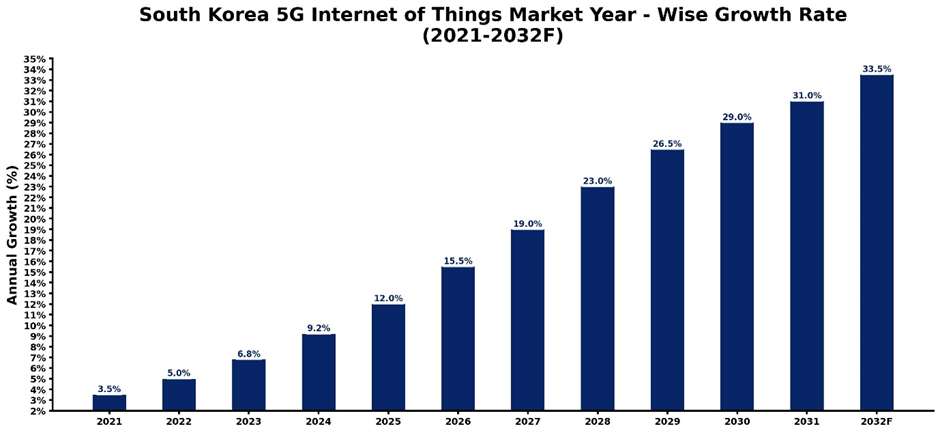
The following table summarizes the historical and forecasted growth rates of the South Korea 5G Internet of Things Market, along with the rationale behind each year’s performance.
| Year | Estimated Growth (Index Change) | Market Rationale |
| 2021 | 3.5% | Early 5G IoT adoption driven by smart city pilots and industrial automation trials |
| 2022 | 5% | Expansion of connected devices across manufacturing and logistics sectors |
| 2023 | 6.8% | Strong uptake of private 5G networks in enterprise environments |
| 2024 | 9.2% | Growth in connected mobility and V2X testing programs |
| 2025 | 12% | Scaling of IoT ecosystems across smart infrastructure and healthcare |
| 2026 | 15.5% | Transition to mature IoT deployment with AI + edge computing integration |
| 2027 | 19% | Rapid expansion of smart city platforms and autonomous systems |
| 2028 | 23% | High-density IoT networks deployed in industrial and urban ecosystems |
| 2029 | 26.5% | Increased adoption of satellite-integrated IoT and remote connectivity solutions |
| 2030 | 29% | Market stabilization with optimization of large-scale IoT infrastructure |
| 2031 | 31% | Replacement cycles and upgrades dominate IoT expansion activities |
| 2032 | 33.5% | Mature ecosystem with steady incremental IoT growth across sectors |
Topics Covered in the South Korea 5G Internet of Things Market Report
The South Korea 5G Internet of Things Market report thoroughly covers the market by IoT Application, Frequency Band, Connectivity Type and Industry. The market report provides an unbiased and detailed analysis of ongoing market trends, opportunities/high growth areas, and market drivers, which help stakeholders devise and align their market strategies according to the current and future market dynamics.
South Korea 5G Internet of Things Market Highlights
| Report Name | South Korea 5G Internet of Things Market |
| Forecast period | 2026-2032 |
| CAGR | 13.7% |
| Growing Sector | Industrial IoT and Manufacturing |
South Korea 5G Internet of Things Market Synopsis
South Korea 5G Internet of Things Market is experiencing unprecedented growth as the country aggressively makes a shift towards the implementation of fast and responsive communication environments for vital industrial and consumer uses. IoT devices, which act as an intelligent medium between the physical equipment and the digital network, are utilizing 5G technology to enable instantaneous data communication.
Moreover, requirements for 5G Standalone technology and continuous cooperation between the public and private sector is successfully creating an environment conducive to advanced automation, smart city management, and telecommunication services in the region.
Evaluation of Growth Drivers in the South Korea 5G Internet of Things Market (2026-2032)
Below mentioned are some prominent drivers and their influence on the market dynamics:
| Drivers | Primary Segments Affected | Why it Matters (Evidence) |
| Mandatory 5G SA Upgrades | Network Infrastructure | Government mandates ensure network stability and readiness for advanced AI. |
| Industrial Automation Demand | Manufacturing | Shift toward smart factories requires real-time data from 5G-linked sensors. |
| Integration of Smart Cities | Urban Development | Smart traffic and utility management using IoT is more efficient. |
| Adoption of Private 5G Networks | Enterprise | Businesses need reliable connectivity that is fast and secure. |
| Integration of AI and Data Analytics | Software & Services | Autonomous systems depend on data processed by 5G. |
South Korea 5G Internet of Things Market is expected to grow at the CAGR of 13.7% during the forecast period of 2026-2032. Growth is driven by mandatory upgrades to standalone 5G networks, the accelerating adoption of industrial automation across the manufacturing sector, and significant public investment in smart city infrastructure. Additional contributions come from strong domestic semiconductor capabilities and ongoing partnerships between telecom leaders and enterprise technology firms aimed at positioning South Korea as a global leader in AI-native connectivity and 6G readiness.
Evaluation of Restraints in the South Korea 5G Internet of Things Market
Below mentioned are some major restraints and their influence on the market dynamics:
| Restraints | Primary Segments Affected | What This Means (Evidence) |
| High Implementation Costs | Small & Medium Enterprises | Capital-intensive nature of 5G infrastructure limits entry for smaller firms. |
| Cybersecurity Vulnerabilities | Connected Devices | Increased surface area for IoT connections elevates risks of network breaches. |
| Network coverage shortcomings | Rural connectivity | Varying base station locations affect IoT connectivity. |
| Complexity of technical nature | Integration services | Legacy hardware integration challenges due to 5G protocols delay IoT. |
| Bandwidth limitations | Telecom services | Interference with other devices affects maximum performance. |
South Korea 5G Internet of Things Market Challenges
Irrespective of massive growth and development, the market faces several challenges such as the high capital expenditure required for deploying 5G infrastructure, persistent cybersecurity threats in hyper-connected ecosystems, and the complexity of integrating legacy industrial systems with new network architectures. In addition to this, the uneven distribution of 5G coverage outside major metropolitan hubs and the ongoing struggle for efficient spectrum management continue to create bottlenecks that might slightly impede the broader South Korea 5G Internet of Things Market Growth objectives for stakeholders.
South Korea 5G Internet of Things Market Trends
Strategic trends currently shaping the evolution of the South Korea 5G Internet of Things (IoT) landscape include:
- AI-Native Network Optimization: Operators are increasingly deploying AI-powered radio access networks to dynamically manage power consumption and traffic routing.
- Expansion of Private 5G Networks: Large firms are constructing their private 5G networks to protect their information and also to give them dedicated bandwidth.
- Edge Computing Usage: The computations taking place on the edge of the network have become common practice to reduce latency of autonomous systems and robotics.
- Zero Trust Security Approach: Various layer authentications are being used by companies in order to protect their IoT devices.
Investment Opportunities in the South Korea 5G Internet of Things Market
Some high-potential investment opportunities in the South Korea 5G Internet of Things marketplace include:
- Industrial Sensors: Investing in the manufacture of advanced sensors built to endure difficult industrial conditions.
- Security Solutions: Investing in advanced software that provides real-time threat monitoring and encryption.
- Smart Infrastructure Solutions: Offering technical expertise to help cities modernize their urban infrastructure with 5G enabled communication modules.
- Edge Data Center Solutions: Designing edge data centers that reduce latency in enterprise businesses using 5G.
Top 5 Leading Players in the South Korea 5G Internet of Things Market
Pivotal industry participants actively driving the South Korea 5G Internet of Things market comprise:
1. Samsung Electronics Co., Ltd.
| Company Name | Samsung Electronics Co., Ltd. |
|---|---|
| Established Year | 1969 |
| Headquarters | Suwon, South Korea |
| Official Website | Click Here |
Samsung provides high-performance 5G hardware, semiconductors, and integrated IoT platforms for global consumer and industrial smart ecosystems.
2. SK Telecom Co., Ltd.
| Company Name | SK Telecom Co., Ltd. |
|---|---|
| Established Year | 1984 |
| Headquarters | Seoul, South Korea |
| Official Website | Click Here |
SK Telecom offers leading-edge 5G connectivity services, AI-driven IoT analytics, and cloud-based network solutions for domestic infrastructure management.
3. KT Corporation
| Company Name | KT Corporation |
|---|---|
| Established Year | 1981 |
| Headquarters | Seongnam, South Korea |
| Official Website | Click Here |
KT develops smart city IoT solutions and reliable 5G network architectures to support public services and automated facility control.
4. LG Electronics Inc.
| Company Name | LG Electronics Inc. |
|---|---|
| Established Year | 1958 |
| Headquarters | Seoul, South Korea |
| Official Website | Click Here |
LG manufactures connected smart home devices and industrial IoT components that leverage 5G for seamless cross-platform device interaction.
5. Sensorview Co., Ltd.
| Company Name | Sensorview Co., Ltd. |
|---|---|
| Established Year | 2015 |
| Headquarters | Seongnam, South Korea |
| Official Website | Click Here |
Sensorview specializes in high-frequency 5G components, including mmWave antennas and cables critical for the physical 5G IoT infrastructure.
Government Initiatives Being Implemented in the South Korea 5G Internet of Things Market
According to South Korean Government Data, major initiatives that are being implemented are mentioned below:
Compulsory 5G SA Upgrade: The Ministry of Science and ICT must ensure that the 5G base stations are linked to standalone core equipment until 2026, thereby enabling network slicing and decreased latency.
- 5G Infrastructure Investments Tax Credits: Under government policies, 3% tax credits are available to those who make 5G-related infrastructure investments with additional incentives when deployment goals for indoor base stations are surpassed.
- AI-Based 6G Research Collaboration: The government is playing an active role in fostering research collaboration between telecom operators and tech companies on autonomous networks for 6G communications.
Future Insights of the South Korea 5G Internet of Things Market
The future of the South Korea 5G Internet of Things Industry remains exceptionally bright as the nation solidifies its position through the integration of AI, 6G readiness, and hyper-connected industrial standards. The transition towards 5G standalone core networks will allow developers to develop applications that have low latency and high reliability, and which are necessary for the development of the next generation fleet of autonomous vehicles, remote patient care diagnostics, and fully automated factories. Such an approach to digital transformation will certainly attract considerable investments and guarantee the market’s leadership in technology.
Market Segmentation Analysis
The report offers a comprehensive study of the subsequent market segments and their leading categories:
By IoT Application- Smart Cities Dominate Market, Healthcare IoT Set for Rapid Expansion
According to Bhawna Singh, Assistant Manager, 6Wresearch, Smart cities captured the largest share of the South Korea 5G IoT market in 2025 at 42.10%, driven by massive deployments of intelligent traffic management, smart lighting, and real-time public utility monitoring systems. Meanwhile, healthcare IoT is poised to grow at a stellar CAGR of 11.20% through 2032, fueled by the demand for remote patient monitoring devices and AI-enabled diagnostic tools that require the high bandwidth only 5G can provide.
By Industry- Manufacturing Leads Market, Telemedicine Shows Rapid Growth
The manufacturing sector dominated 48.50% of the South Korea 5G Internet of Things Market Share in 2025, anchored by the integration of 5G-enabled robotics and predictive maintenance sensors. At the same time, the market for telemedicine technology is forecast to exhibit a healthy compound annual growth rate of 9.80% until 2032 due to the increasing demand from the general population for a high-quality system of online consultations.
Note: Market size estimations and growth projections presented in this report are based on 6Wresearch’s advanced forecasting approach, validated with industry datasets as of June 2026.
Key Attractiveness of the Report
- 10 Years of Market Numbers.
- Historical Data Starting from 2022 to 2025.
- Base Year: 2025.
- Forecast Data until 2032.
- Key Performance Indicators Impacting the Market.
- Major Upcoming Developments and Projects.
Key Highlights of the Report:
- South Korea 5G Internet of Things Market Outlook
- Market Size of South Korea 5G Internet of Things Market, 2025
- Forecast of South Korea 5G Internet of Things Market, 2032
- Historical Data and Forecast of South Korea 5G Internet of Things Revenues & Volume for the Period 2022-2032
- South Korea 5G Internet of Things Market Trend Evolution
- South Korea 5G Internet of Things Market Drivers and Challenges
- South Korea 5G Internet of Things Price Trends
- South Korea 5G Internet of Things Porter's Five Forces
- South Korea 5G Internet of Things Industry Life Cycle
- Historical Data and Forecast of South Korea 5G Internet of Things Market Revenues & Volume By IoT Application for the Period 2022-2032
- Historical Data and Forecast of South Korea 5G Internet of Things Market Revenues & Volume By Smart Cities for the Period 2022-2032
- Historical Data and Forecast of South Korea 5G Internet of Things Market Revenues & Volume By Industrial IoT for the Period 2022-2032
- Historical Data and Forecast of South Korea 5G Internet of Things Market Revenues & Volume By Connected Vehicles for the Period 2022-2032
- Historical Data and Forecast of South Korea 5G Internet of Things Market Revenues & Volume By Healthcare IoT for the Period 2022-2032
- Historical Data and Forecast of South Korea 5G Internet of Things Market Revenues & Volume By Frequency Band for the Period 2022-2032
- Historical Data and Forecast of South Korea 5G Internet of Things Market Revenues & Volume By Sub-6 GHz for the Period 2022-2032
- Historical Data and Forecast of South Korea 5G Internet of Things Market Revenues & Volume By mmWave for the Period 2022-2032
- Historical Data and Forecast of South Korea 5G Internet of Things Market Revenues & Volume By 26-39 GHz for the Period 2022-2032
- Historical Data and Forecast of South Korea 5G Internet of Things Market Revenues & Volume By Above 39 GHz for the Period 2022-2032
- Historical Data and Forecast of South Korea 5G Internet of Things Market Revenues & Volume By Connectivity Type for the Period 2022-2032
- Historical Data and Forecast of South Korea 5G Internet of Things Market Revenues & Volume By Cellular for the Period 2022-2032
- Historical Data and Forecast of South Korea 5G Internet of Things Market Revenues & Volume By Private 5G for the Period 2022-2032
- Historical Data and Forecast of South Korea 5G Internet of Things Market Revenues & Volume By V2X for the Period 2022-2032
- Historical Data and Forecast of South Korea 5G Internet of Things Market Revenues & Volume By Satellite IoT for the Period 2022-2032
- Historical Data and Forecast of South Korea 5G Internet of Things Market Revenues & Volume By Industry for the Period 2022-2032
- Historical Data and Forecast of South Korea 5G Internet of Things Market Revenues & Volume By Urban Development for the Period 2022-2032
- Historical Data and Forecast of South Korea 5G Internet of Things Market Revenues & Volume By Manufacturing for the Period 2022-2032
- Historical Data and Forecast of South Korea 5G Internet of Things Market Revenues & Volume By Automotive for the Period 2022-2032
- Historical Data and Forecast of South Korea 5G Internet of Things Market Revenues & Volume By Telemedicine for the Period 2022-2032
- South Korea 5G Internet of Things Import Export Trade Statistics
- Market Opportunity Assessment By IoT Application
- Market Opportunity Assessment By Frequency Band
- Market Opportunity Assessment By Connectivity Type
- Market Opportunity Assessment By Industry
- South Korea 5G Internet of Things Top Companies Market Share
- South Korea 5G Internet of Things Competitive Benchmarking By Technical and Operational Parameters
- South Korea 5G Internet of Things Company Profiles
- South Korea 5G Internet of Things Key Strategic Recommendations
Market Covered
The report offers a comprehensive study of the subsequent market segments:
By IoT Application
- Smart Cities
- Industrial IoT
- Connected Vehicles
- Healthcare IoT
By Frequency Band
- Sub-6 GHz
- mmWave
- 26–39 GHz
- Above 39 GHz
By Connectivity Type
- Cellular
- Private 5G
- V2X
- Satellite IoT
By Industry
- Urban Development
- Manufacturing
- Automotive
- Telemedicine
Frequently Asked Questions About the Market Study (FAQs):
6Wresearch actively monitors the South Korea 5G Internet of Things Market and publishes its comprehensive annual report, highlighting emerging trends, growth drivers, revenue analysis, and forecast outlook. Our insights help businesses to make data-backed strategic decisions with ongoing market dynamics. Our analysts track relevent industries related to the South Korea 5G Internet of Things Market, allowing our clients with actionable intelligence and reliable forecasts tailored to emerging regional needs.
Yes, we provide customisation as per your requirements. To learn more, feel free to contact us on sales@6wresearch.com
| 1 Executive Summary |
| 2 Introduction |
| 2.1 Key Highlights of the Report |
| 2.2 Report Description |
| 2.3 Market Scope & Segmentation |
| 2.4 Research Methodology |
| 2.5 Assumptions |
| 3 South Korea 5G Internet of Things Market Overview |
| 3.1 South Korea Country Macro Economic Indicators |
| 3.2 South Korea 5G Internet of Things Market Revenues & Volume, 2022 & 2032F |
| 3.3 South Korea 5G Internet of Things Market - Industry Life Cycle |
| 3.4 South Korea 5G Internet of Things Market - Porter's Five Forces |
| 3.5 South Korea 5G Internet of Things Market Revenues & Volume Share, By IoT Application, 2022 & 2032F |
| 3.6 South Korea 5G Internet of Things Market Revenues & Volume Share, By Frequency Band, 2022 & 2032F |
| 3.7 South Korea 5G Internet of Things Market Revenues & Volume Share, By Connectivity Type, 2022 & 2032F |
| 3.8 South Korea 5G Internet of Things Market Revenues & Volume Share, By Industry, 2022 & 2032F |
| 4 South Korea 5G Internet of Things Market Dynamics |
| 4.1 Impact Analysis |
| 4.2 Market Drivers |
| 4.2.1 Increasing demand for high-speed internet connectivity driving the adoption of 5G technology. |
| 4.2.2 Growing investments in IoT infrastructure and smart city initiatives in South Korea. |
| 4.2.3 Technological advancements and innovations in IoT devices and applications. |
| 4.2.4 Government support and initiatives to promote the development and deployment of 5G IoT solutions. |
| 4.3 Market Restraints |
| 4.3.1 High initial costs associated with the deployment of 5G infrastructure and IoT devices. |
| 4.3.2 Security and privacy concerns related to IoT data and devices. |
| 4.3.3 Lack of skilled professionals to develop and manage 5G IoT solutions. |
| 4.3.4 Interoperability issues between different IoT devices and platforms. |
| 5 South Korea 5G Internet of Things Market Trends |
| 6 South Korea 5G Internet of Things Market, By Types |
| 6.1 South Korea 5G Internet of Things Market, By IoT Application |
| 6.1.1 Overview and Analysis |
| 6.1.2 South Korea 5G Internet of Things Market Revenues & Volume, By IoT Application, 2022-2032F |
| 6.1.3 South Korea 5G Internet of Things Market Revenues & Volume, By Smart Cities, 2022-2032F |
| 6.1.4 South Korea 5G Internet of Things Market Revenues & Volume, By Industrial IoT, 2022-2032F |
| 6.1.5 South Korea 5G Internet of Things Market Revenues & Volume, By Connected Vehicles, 2022-2032F |
| 6.1.6 South Korea 5G Internet of Things Market Revenues & Volume, By Healthcare IoT, 2022-2032F |
| 6.2 South Korea 5G Internet of Things Market, By Frequency Band |
| 6.2.1 Overview and Analysis |
| 6.2.2 South Korea 5G Internet of Things Market Revenues & Volume, By Sub-6 GHz, 2022-2032F |
| 6.2.3 South Korea 5G Internet of Things Market Revenues & Volume, By mmWave, 2022-2032F |
| 6.2.4 South Korea 5G Internet of Things Market Revenues & Volume, By 26-39 GHz, 2022-2032F |
| 6.2.5 South Korea 5G Internet of Things Market Revenues & Volume, By Above 39 GHz, 2022-2032F |
| 6.3 South Korea 5G Internet of Things Market, By Connectivity Type |
| 6.3.1 Overview and Analysis |
| 6.3.2 South Korea 5G Internet of Things Market Revenues & Volume, By Cellular, 2022-2032F |
| 6.3.3 South Korea 5G Internet of Things Market Revenues & Volume, By Private 5G, 2022-2032F |
| 6.3.4 South Korea 5G Internet of Things Market Revenues & Volume, By V2X, 2022-2032F |
| 6.3.5 South Korea 5G Internet of Things Market Revenues & Volume, By Satellite IoT, 2022-2032F |
| 6.4 South Korea 5G Internet of Things Market, By Industry |
| 6.4.1 Overview and Analysis |
| 6.4.2 South Korea 5G Internet of Things Market Revenues & Volume, By Urban Development, 2022-2032F |
| 6.4.3 South Korea 5G Internet of Things Market Revenues & Volume, By Manufacturing, 2022-2032F |
| 6.4.4 South Korea 5G Internet of Things Market Revenues & Volume, By Automotive, 2022-2032F |
| 6.4.5 South Korea 5G Internet of Things Market Revenues & Volume, By Telemedicine, 2022-2032F |
| 7 South Korea 5G Internet of Things Market Import-Export Trade Statistics |
| 7.1 South Korea 5G Internet of Things Market Export to Major Countries |
| 7.2 South Korea 5G Internet of Things Market Imports from Major Countries |
| 8 South Korea 5G Internet of Things Market Key Performance Indicators |
| 8.1 Average data speed and latency of 5G networks in South Korea. |
| 8.2 Number of IoT devices connected to 5G networks in the country. |
| 8.3 Rate of adoption of 5G IoT solutions in key industries such as healthcare, manufacturing, and transportation. |
| 8.4 Energy efficiency and sustainability measures implemented in 5G IoT deployments. |
| 8.5 Level of regulatory compliance and data protection standards in the South Korean 5G IoT market. |
| 9 South Korea 5G Internet of Things Market - Opportunity Assessment |
| 9.1 South Korea 5G Internet of Things Market Opportunity Assessment, By IoT Application, 2022 & 2032F |
| 9.2 South Korea 5G Internet of Things Market Opportunity Assessment, By Frequency Band, 2022 & 2032F |
| 9.3 South Korea 5G Internet of Things Market Opportunity Assessment, By Connectivity Type, 2022 & 2032F |
| 9.4 South Korea 5G Internet of Things Market Opportunity Assessment, By Industry, 2022 & 2032F |
| 10 South Korea 5G Internet of Things Market - Competitive Landscape |
| 10.1 South Korea 5G Internet of Things Market Revenue Share, By Companies, 2025 |
| 10.2 South Korea 5G Internet of Things Market Competitive Benchmarking, By Operating and Technical Parameters |
| 11 Company Profiles |
| 12 Recommendations |
| 13 Disclaimer |
Global Go To Market Strategy - 2030
Export potential enables firms to identify high-growth global markets with greater confidence by combining advanced trade intelligence with a structured quantitative methodology. The framework analyzes emerging demand trends and country-level import patterns while integrating macroeconomic and trade datasets such as GDP and population forecasts, bilateral import–export flows, tariff structures, elasticity differentials between developed and developing economies, geographic distance, and import demand projections. Using weighted trade values from 2020–2024 as the base period to project country-to-country export potential for 2030, these inputs are operationalized through calculated drivers such as gravity model parameters, tariff impact factors, and projected GDP per-capita growth. Through an analysis of hidden potentials, demand hotspots, and market conditions that are most favorable to success, this method enables firms to focus on target countries, maximize returns, and global expansion with data, backed by accuracy.
By factoring in the projected importer demand gap that is currently unmet and could be potential opportunity, it identifies the potential for the Exporter (Country) among 190 countries, against the general trade analysis, which identifies the biggest importer or exporter.
To discover high-growth global markets and optimize your business strategy:
Click Here
Pricing
- Single User License$ 1,995
- Department License$ 2,400
- Site License$ 3,120
- Global License$ 3,795

Leadership Perspectives from Industry Events
Search
Thought Leadership and Analyst Meet




Our Clients








6WResearch In News
- India Air Conditioner Market Set for Strong Rebound in 2026 After Weather-Led Correction and GST-Driven Recovery: 6Wresearch
- ADAS in India: How Automatic Emergency Braking, Blind Spot Detection & Driver Monitoring are Transforming Road Safety
- Doha a strategic location for EV manufacturing hub: IPA Qatar
- Demand for luxury TVs surging in the GCC, says Samsung
- Empowering Growth: The Thriving Journey of Bangladesh’s Cable Industry
- Demand for luxury TVs surging in the GCC, says Samsung
Latest Reports
- Nicaragua RPG Gaming Market (2026-2032)
- New Zealand RPG Gaming Market (2026-2032)
- Netherlands RPG Gaming Market (2026-2032)
- Nauru RPG Gaming Market (2026-2032)
- Namibia RPG Gaming Market (2026-2032)
- Mozambique RPG Gaming Market (2026-2032)
- Montenegro RPG Gaming Market (2026-2032)
- Mongolia RPG Gaming Market (2026-2032)
- Monaco RPG Gaming Market (2026-2032)
- Micronesia RPG Gaming Market (2026-2032)
Industry Events and Analyst Meet

HIMTEX 2026

India Refining Summit 2026

India EV Show 2026

EV tech India Expo 2026

Auto Tech Asia 2026
Whitepaper
- Middle East & Africa Commercial Security Market Click here to view more.
- Middle East & Africa Fire Safety Systems & Equipment Market Click here to view more.
- GCC Drone Market Click here to view more.
- Middle East Lighting Fixture Market Click here to view more.
- GCC Physical & Perimeter Security Market Click here to view more.


