South Korea AI in Education Market Size & Growth Rate (2026-2032)
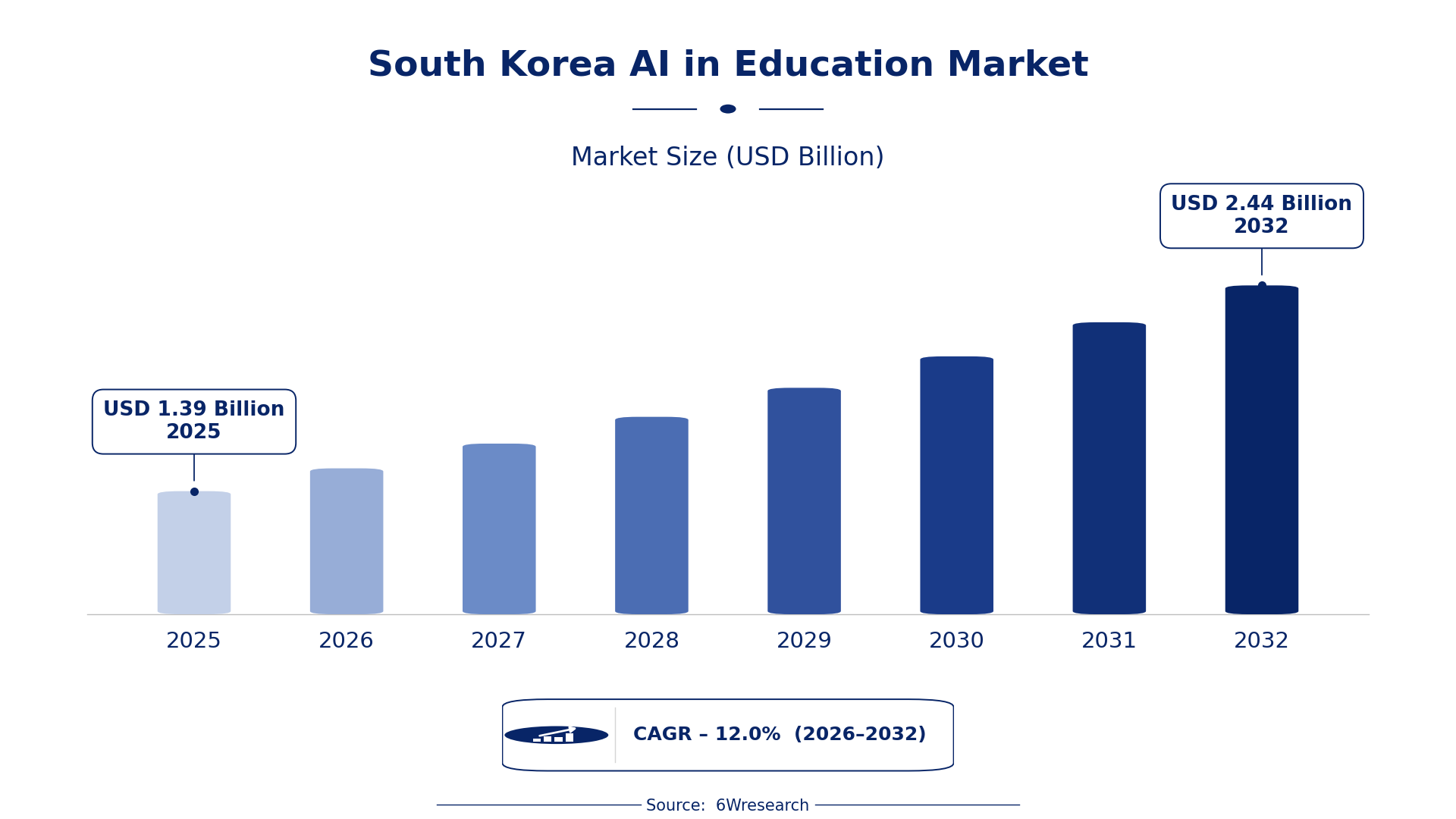
The South Korea AI in Education Market was estimated at USD 1392 Million in 2025 and is projected to reach USD 2439 Million by 2032, growing at a CAGR of 12.0% from 2026 to 2032.
South Korea AI in Education Market Synopsis
The South Korea AI in Education market is experiencing robust growth as educational institutions increasingly incorporate advanced technologies. This shift is driven by the need for personalized learning experiences and enhanced student engagement, which are proving critical in the current educational environment.
With a strong push from the government to integrate AI solutions into the curriculum, the market is set to expand further. The demand for online learning platforms, spurred by the pandemic, has accelerated the adoption of AI tools, ensuring better educational outcomes across diverse learning scenarios.
South Korea AI in Education Market Year-wise Growth Rate and Key Drivers
This graph illustrates the annual growth rates of the South Korea AI in Education Market from 2021 to 2032, highlighting a steady upward trajectory and projected expansion over the forecast period.
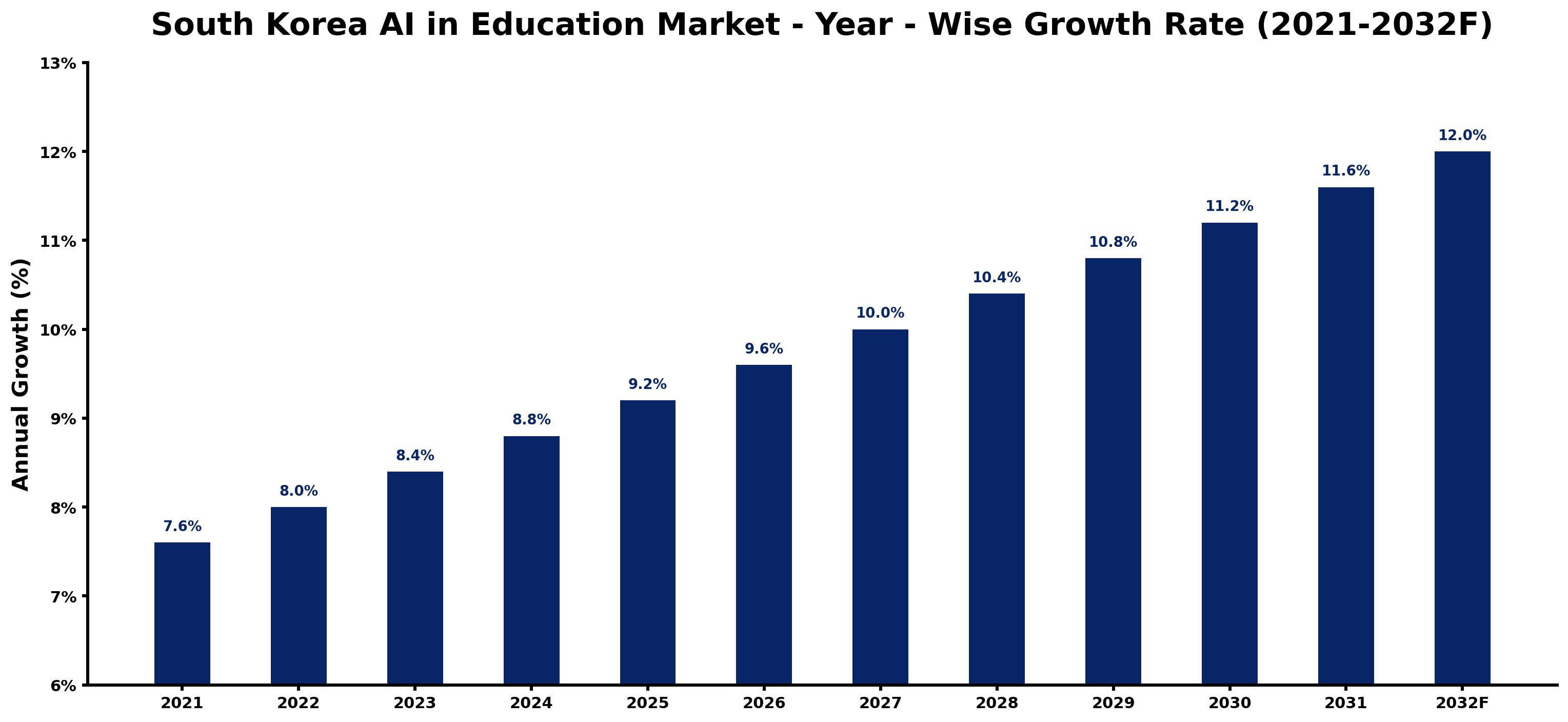
The table below presents the year‑wise growth rates along with the key drivers influencing the market
| Year | Growth Rate | Major Drivers |
| 2021 | 7.6% | Ministry of Education's AI curriculum implementation plan. |
| 2022 | 8.0% | Growing adoption of smart classrooms across South Korean schools. |
| 2023 | 8.4% | Increased private sector investment in educational AI startups. |
| 2024 | 8.8% | Launch of AI-focused teacher training programs nationwide. |
| 2025 | 9.2% | Government incentives for EdTech companies developing AI solutions. |
| 2026 | 9.6% | Research funding for AI educational tools from KERIS. |
| 2027 | 10.0% | Partnerships between schools and AI technology providers. |
| 2028 | 10.4% | Integration of AI in special education programs. |
| 2029 | 10.8% | Boost in digital literacy programs emphasizing AI education. |
| 2030 | 11.2% | Enhanced data privacy regulations encouraging responsible AI use. |
| 2031 | 11.6% | Gyeonggi Province's initiative to deploy AI tutors. |
| 2032 | 12.0% | Increased demand for AI solutions in exam preparation. |
Note: Market size estimations and growth projections presented in this report are based on 6Wresearch's proprietary forecasting methodology, utilizing the latest available industry data, government publications, and primary research inputs.
South Korea AI in Education Market Key Takeaways
Below are some of the specific key takeaways from the market, including:
- The market is characterized by a surge in the development of AI-driven personalized learning tools.
- Government initiatives are actively promoting the integration of AI technologies in educational settings.
- Ongoing investments in online learning platforms are shaping the future of education in South Korea.
- Key players are collaborating to enhance their AI solutions and address the evolving needs of learners.
- Data privacy and ethical considerations remain critical challenges as AI adoption expands.
Evaluation of Restraints in South Korea AI in Education Market
Despite the promising growth trajectory, the South Korea AI in Education market faces notable challenges. Integrating AI technologies within traditional educational frameworks has proven difficult, as many stakeholders are hesitant to embrace such changes. There are also ongoing concerns about data privacy and the ethical implications of utilizing AI in classrooms. on top of that, adequate training for educators to effectively use AI tools is essential, yet often insufficient. This lack of preparedness can hinder the potential benefits of AI in enhancing educational experiences.
South Korea AI in Education Market Trends
Several key trends are shaping the South Korea AI in Education market. The development of virtual tutors is gaining traction, allowing for a more personalized learning experience for students. on top of that, the rise of adaptive learning platforms is enabling educators to tailor their teaching methods based on individual student needs. AI-driven assessment tools are also becoming increasingly prevalent, streamlining administrative tasks and providing insights into student performance. As technology evolves, educational institutions are prioritizing partnerships to enhance AI solutions that meet the diverse demands of the education sector.
South Korea AI in Education Market Opportunities
Investment opportunities abound in the South Korea AI in Education market, particularly as demand for personalized learning solutions continues to rise. The integration of AI applications into various educational aspects, from adaptive learning platforms to intelligent content creation tools, presents lucrative avenues for investors. Collaborations with established educational institutions for implementing AI solutions can further enhance market potential. With government backing for AI technology in education, the landscape for investment is promising, attracting those keen on capitalizing at the intersection of technology and learning.
Government Initiatives in the South Korea AI in Education Market
The South Korean government is taking decisive steps to shape the AI in Education market through various initiatives. With a clear focus on enhancing the educational framework, public policy is geared towards integrating AI technologies effectively. These initiatives reflect the government's commitment to modernizing education, ensuring that students and educators have the resources necessary to thrive in a digital world.
- Recently launched the AI Smart Education Initiative, aimed at integrating AI technologies in classrooms.
- Currently ongoing funding programs to support AI education projects and research initiatives.
- Planned development of AI-powered educational content to facilitate personalized learning experiences.
- Ongoing training programs for educators to equip them with the skills needed for effective AI integration.
- Future initiatives expected to enhance digital infrastructure in schools across the nation.
Future Insights of the South Korea AI in Education Market
Looking ahead, the South Korea AI in Education market is set to experience substantial growth driven by technological advancements and increasing demand for innovative educational solutions. As educational institutions continue to prioritize personalized learning, the adoption of AI tools is likely to accelerate. The government's ongoing support and investment in AI technology will further bolster market expansion, positioning South Korea as a leader in education technology. By 2032, we can expect the market to not only grow in size but also to evolve in terms of the solutions offered, catering to an increasingly diverse range of educational needs.
South Korea AI in Education Market Latest Developments
In the past year, the South Korea AI in Education market has witnessed a flurry of activity as stakeholders accelerate their efforts to integrate AI solutions into the educational framework. Recent developments indicate a clear trend towards enhancing learning experiences through innovative technology, with various initiatives underway to support this transition.
- A major technology vendor launched a new AI-driven platform aimed at improving student engagement in early 2025.
- An initiative that began in mid-2025 to develop customized learning modules for diverse student needs remains underway.
- A partnership between educational institutions and tech startups is currently ongoing, focusing on creating virtual learning environments.
- A rollout of AI assessment tools is expected to begin in the second half of 2026, aimed at streamlining evaluation processes.
- Plans for a nationwide training program for educators to enhance their AI competency are set to be initiated by 2027.
South Korea AI in Education Market - Key Attractiveness of the Report
- 10 Years of Market Numbers
- Historical Data Starting from 2022 to 2025
- Base Year: 2025
- Forecast Data until 2032
- Key Performance Indicators Impacting the Market
- Major Upcoming Developments and Projects
Key Highlights of the Report:
- South Korea AI in Education Market Outlook
- Market Size of South Korea AI in Education Market, 2025
- Forecast of South Korea AI in Education Market, 2032
- Historical Data and Forecast of South Korea AI in Education Revenues & Volume for the Period 2022-2032F
- South Korea AI in Education Market Trend Evolution
- South Korea AI in Education Market Drivers and Challenges
- South Korea AI in Education Price Trends
- South Korea AI in Education Porter's Five Forces
- South Korea AI in Education Industry Life Cycle
- Historical Data and Forecast of South Korea AI in Education Market Revenues & Volume By Technology for the Period 2022-2032F
- Historical Data and Forecast of South Korea AI in Education Market Revenues & Volume By Deep Learning and Machine Learning for the Period 2022-2032F
- Historical Data and Forecast of South Korea AI in Education Market Revenues & Volume By Natural Language Processing (NLP) for the Period 2022-2032F
- Historical Data and Forecast of South Korea AI in Education Market Revenues & Volume By Component for the Period 2022-2032F
- Historical Data and Forecast of South Korea AI in Education Market Revenues & Volume By Solutions for the Period 2022-2032F
- Historical Data and Forecast of South Korea AI in Education Market Revenues & Volume By Services for the Period 2022-2032F
- Historical Data and Forecast of South Korea AI in Education Market Revenues & Volume By Application for the Period 2022-2032F
- Historical Data and Forecast of South Korea AI in Education Market Revenues & Volume By Virtual Facilitators and Learning Environments for the Period 2022-2032F
- Historical Data and Forecast of South Korea AI in Education Market Revenues & Volume By Intelligent Tutoring Systems (ITS) for the Period 2022-2032F
- Historical Data and Forecast of South Korea AI in Education Market Revenues & Volume By Content Delivery Systems for the Period 2022-2032F
- Historical Data and Forecast of South Korea AI in Education Market Revenues & Volume By Fraud and Risk Management for the Period 2022-2032F
- Historical Data and Forecast of South Korea AI in Education Market Revenues & Volume By Student-initiated learning for the Period 2022-2032F
- Historical Data and Forecast of South Korea AI in Education Market Revenues & Volume By Others for the Period 2022-2032F
- Historical Data and Forecast of South Korea AI in Education Market Revenues & Volume By Deployment for the Period 2022-2032F
- Historical Data and Forecast of South Korea AI in Education Market Revenues & Volume By Cloud for the Period 2022-2032F
- Historical Data and Forecast of South Korea AI in Education Market Revenues & Volume By On-premises for the Period 2022-2032F
- Historical Data and Forecast of South Korea AI in Education Market Revenues & Volume By End for the Period 2022-2032F
- Historical Data and Forecast of South Korea AI in Education Market Revenues & Volume By Educational Institutes for the Period 2022-2032F
- Historical Data and Forecast of South Korea AI in Education Market Revenues & Volume By Educational Publishers for the Period 2022-2032F
- Historical Data and Forecast of South Korea AI in Education Market Revenues & Volume By Others for the Period 2022-2032F
- South Korea AI in Education Import Export Trade Statistics
- Market Opportunity Assessment By Technology
- Market Opportunity Assessment By Component
- Market Opportunity Assessment By Application
- Market Opportunity Assessment By Deployment
- Market Opportunity Assessment By End
- South Korea AI in Education Top Companies Market Share
- South Korea AI in Education Competitive Benchmarking By Technical and Operational Parameters
- South Korea AI in Education Company Profiles
- South Korea AI in Education Key Strategic Recommendations






































