South Korea Aircraft Cabin Interior Market Size, Share & Growth Rate
The South Korea Aircraft Cabin Interior Market was estimated at USD 1398 Million in 2025 and is projected to reach USD 2643 Million by 2032, growing at a CAGR of 9.5% from 2026 to 2032. This growth trajectory is primarily fueled by the surge in air travel demand and the push for technological innovations aimed at enhancing passenger comfort. Additionally, airlines are increasingly focused on modernizing their fleets, which directly contributes to the robust demand for advanced cabin interior solutions.
South Korea Aircraft Cabin Interior Market Year-wise Growth Rate and Key Drivers
This graph highlights how the South Korea Aircraft Cabin Interior Market has steadily grown over the years, supported by major growth factors.
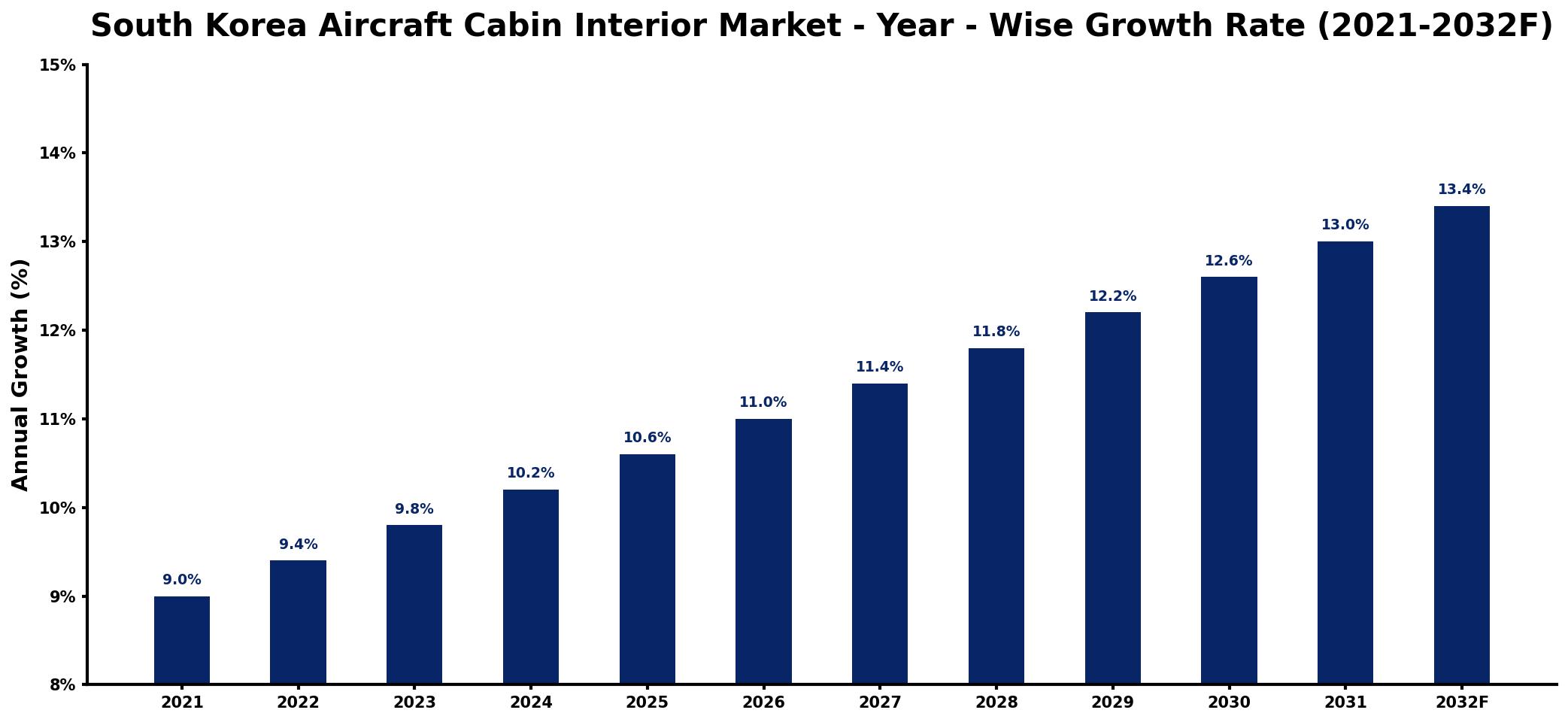
The table below presents the year‑wise growth rates along with the key drivers influencing the market
| Year | Growth Rate | Major Drivers |
| 2021 | 9.0% | Rising passenger travel demand |
| 2022 | 9.4% | Increased airline fleet modernization |
| 2023 | 9.8% | Growing focus on passenger comfort |
| 2024 | 10.2% | Expansion of low-cost carriers |
| 2025 | 10.6% | Technological advancements in materials |
| 2026 | 11.0% | Surge in eco-friendly solutions |
| 2027 | 11.4% | Investment in luxury travel experience |
| 2028 | 11.8% | Enhanced safety regulations compliance |
| 2029 | 12.2% | Growth in regional air travel |
| 2030 | 12.6% | Demand for customized solutions |
| 2031 | 13.0% | Collaborations with design innovators |
| 2032 | 13.4% | Integration of smart technologies |
Note: Market size estimations and growth projections presented in this report are based on 6Wresearch's proprietary forecasting methodology, utilizing the latest available industry data, government publications, and primary research inputs.
South Korea Aircraft Cabin Interior Market Synopsis
In recent years, the South Korea Aircraft Cabin Interior Market has gained momentum, responding to the dual forces of heightened passenger expectations and environmental concerns. However, the market is poised for an even more dynamic shift as airlines embark on comprehensive refurbishments and adopt cutting-edge technologies to stay competitive.
Looking ahead, the emphasis on lightweight materials, sustainable practices, and personalized cabin experiences is expected to redefine the market landscape. As domestic and international airlines prioritize enhancing passenger satisfaction, the sector will likely experience significant advancements in design and functionality.
South Korea Aircraft Cabin Interior Market Key Takeaways
- The market is experiencing a notable shift towards sustainable and eco-friendly cabin solutions.
- Airlines are investing heavily in refurbishing existing aircraft to improve passenger comfort and experience.
- Technological advancements are increasingly shaping the design and functionality of cabin interiors.
- There is a growing trend of personalized cabin configurations tailored to diverse passenger segments.
- Government initiatives are supporting innovation and competitiveness in the aircraft cabin interior sector.
Evaluation of Restraints in South Korea Aircraft Cabin Interior Market
Despite the promising growth outlook, several real constraints hinder market potential. Stringent regulatory requirements in aviation safety impose challenges for manufacturers, compelling them to constantly adapt their products. Intense competition from established global players adds pressure, compelling local companies to innovate continuously. Additionally, the fluctuation in raw material prices and possible supply chain disruptions can impede timely project execution, posing a challenge to maintaining profit margins in a rapidly evolving market.
South Korea Aircraft Cabin Interior Market Trends
Current trends indicate a decisive move towards lightweight materials that enhance fuel efficiency and reduce emissions. Airlines are also gravitating towards advanced technologies, such as smart seating arrangements and integrated in-flight entertainment systems, to elevate the passenger experience. Furthermore, the market is witnessing a shift towards personalized designs, allowing airlines to cater to specific passenger demographics. This trend towards customization is complemented by a growing commitment to sustainability, where manufacturers focus on eco-friendly materials and production processes.
South Korea Aircraft Cabin Interior Market Opportunities
The South Korea Aircraft Cabin Interior Market offers considerable investment opportunities, particularly in the retrofitting and upgrading of existing aircraft. As airlines seek to refresh their cabin interiors to align with modern expectations, the demand for innovative and aesthetic solutions is likely to rise. Moreover, the increasing emphasis on sustainable practices presents avenues for companies specializing in environmentally friendly materials and designs. Partnerships with local suppliers could further enhance the market potential, enabling a collaborative approach to fulfilling the evolving needs of the aviation sector.
Government Initiatives in the South Korea Aircraft Cabin Interior Market
The South Korean government has proactively implemented several initiatives to bolster the aircraft cabin interior market. These initiatives include financial incentives for research and development efforts aimed at fostering innovation within the industry. Additionally, the government encourages strategic partnerships between domestic firms and international entities to enhance technological capabilities. Regulatory frameworks are also in place to ensure quality and safety in cabin interior products, thereby strengthening the market's competitive edge on a global scale.
Future Insights of the South Korea Aircraft Cabin Interior Market
Looking forward to the period from 2026 to 2032, the South Korea Aircraft Cabin Interior Market is expected to experience robust growth driven by the anticipated rise in air travel and fleet modernization initiatives. Technological advancements will continue to transform cabin designs, making them more efficient and passenger-centric. Airlines will focus on differentiating themselves through upgraded interiors, which will further stimulate market expansion. Given South Korea's pivotal role in the global aviation industry, the aircraft cabin interior market is set to see sustained investments, creating opportunities for innovation and growth.
South Korea Aircraft Cabin Interior Market Latest Developments (2025 - 2026)
Recent developments in the South Korea Aircraft Cabin Interior Market reflect a strong shift towards the incorporation of advanced technology and sustainable materials. As airlines increasingly prioritize passenger experience, many are exploring new design paradigms that focus on comfort and functionality. Moreover, collaborations between local manufacturers and international firms are emerging, aiming to integrate innovative solutions into cabin interiors. This evolving landscape is indicative of an industry in transition, responding dynamically to the changing needs of air travel.
South Korea Aircraft Cabin Interior Market - Key Attractiveness of the Report
- 10 Years of Market Numbers
- Historical Data Starting from 2022 to 2025
- Base Year: 2025
- Forecast Data until 2032
- Key Performance Indicators Impacting the Market
- Major Upcoming Developments and Projects
Key Highlights of the Report:
- South Korea Aircraft Cabin Interior Market Outlook
- Market Size of South Korea Aircraft Cabin Interior Market, 2025
- Forecast of South Korea Aircraft Cabin Interior Market, 2032
- Historical Data and Forecast of South Korea Aircraft Cabin Interior Revenues & Volume for the Period 2022-2032F
- South Korea Aircraft Cabin Interior Market Trend Evolution
- South Korea Aircraft Cabin Interior Market Drivers and Challenges
- South Korea Aircraft Cabin Interior Price Trends
- South Korea Aircraft Cabin Interior Porter's Five Forces
- South Korea Aircraft Cabin Interior Industry Life Cycle
- Historical Data and Forecast of South Korea Aircraft Cabin Interior Market Revenues & Volume By Type for the Period 2022-2032F
- Historical Data and Forecast of South Korea Aircraft Cabin Interior Market Revenues & Volume By Seats for the Period 2022-2032F
- Historical Data and Forecast of South Korea Aircraft Cabin Interior Market Revenues & Volume By Cabin Lightening for the Period 2022-2032F
- Historical Data and Forecast of South Korea Aircraft Cabin Interior Market Revenues & Volume By Windows and Windshields for the Period 2022-2032F
- Historical Data and Forecast of South Korea Aircraft Cabin Interior Market Revenues & Volume By Galley and Lavatory for the Period 2022-2032F
- Historical Data and Forecast of South Korea Aircraft Cabin Interior Market Revenues & Volume By In-Flight Entertainment & Connectivity for the Period 2022-2032F
- Historical Data and Forecast of South Korea Aircraft Cabin Interior Market Revenues & Volume By Others for the Period 2022-2032F
- Historical Data and Forecast of South Korea Aircraft Cabin Interior Market Revenues & Volume By Class for the Period 2022-2032F
- Historical Data and Forecast of South Korea Aircraft Cabin Interior Market Revenues & Volume By First Class for the Period 2022-2032F
- Historical Data and Forecast of South Korea Aircraft Cabin Interior Market Revenues & Volume By Business Class for the Period 2022-2032F
- Historical Data and Forecast of South Korea Aircraft Cabin Interior Market Revenues & Volume By Premium Economy Class for the Period 2022-2032F
- Historical Data and Forecast of South Korea Aircraft Cabin Interior Market Revenues & Volume By Economy Class for the Period 2022-2032F
- Historical Data and Forecast of South Korea Aircraft Cabin Interior Market Revenues & Volume By Aircraft Type for the Period 2022-2032F
- Historical Data and Forecast of South Korea Aircraft Cabin Interior Market Revenues & Volume By Narrow Body Aircraft for the Period 2022-2032F
- Historical Data and Forecast of South Korea Aircraft Cabin Interior Market Revenues & Volume By Wide-Body Aircraft for the Period 2022-2032F
- Historical Data and Forecast of South Korea Aircraft Cabin Interior Market Revenues & Volume By Business Jets for the Period 2022-2032F
- Historical Data and Forecast of South Korea Aircraft Cabin Interior Market Revenues & Volume By Regional Transport Aircraft for the Period 2022-2032F
- Historical Data and Forecast of South Korea Aircraft Cabin Interior Market Revenues & Volume By End User for the Period 2022-2032F
- Historical Data and Forecast of South Korea Aircraft Cabin Interior Market Revenues & Volume By OEM for the Period 2022-2032F
- Historical Data and Forecast of South Korea Aircraft Cabin Interior Market Revenues & Volume By Aftermarket for the Period 2022-2032F
- South Korea Aircraft Cabin Interior Import Export Trade Statistics
- Market Opportunity Assessment By Type
- Market Opportunity Assessment By Class
- Market Opportunity Assessment By Aircraft Type
- Market Opportunity Assessment By End User
- South Korea Aircraft Cabin Interior Top Companies Market Share
- South Korea Aircraft Cabin Interior Competitive Benchmarking By Technical and Operational Parameters
- South Korea Aircraft Cabin Interior Company Profiles
- South Korea Aircraft Cabin Interior Key Strategic Recommendations






































