South Korea Algorithmic Trading Market Size & Growth Rate (2026-2032)
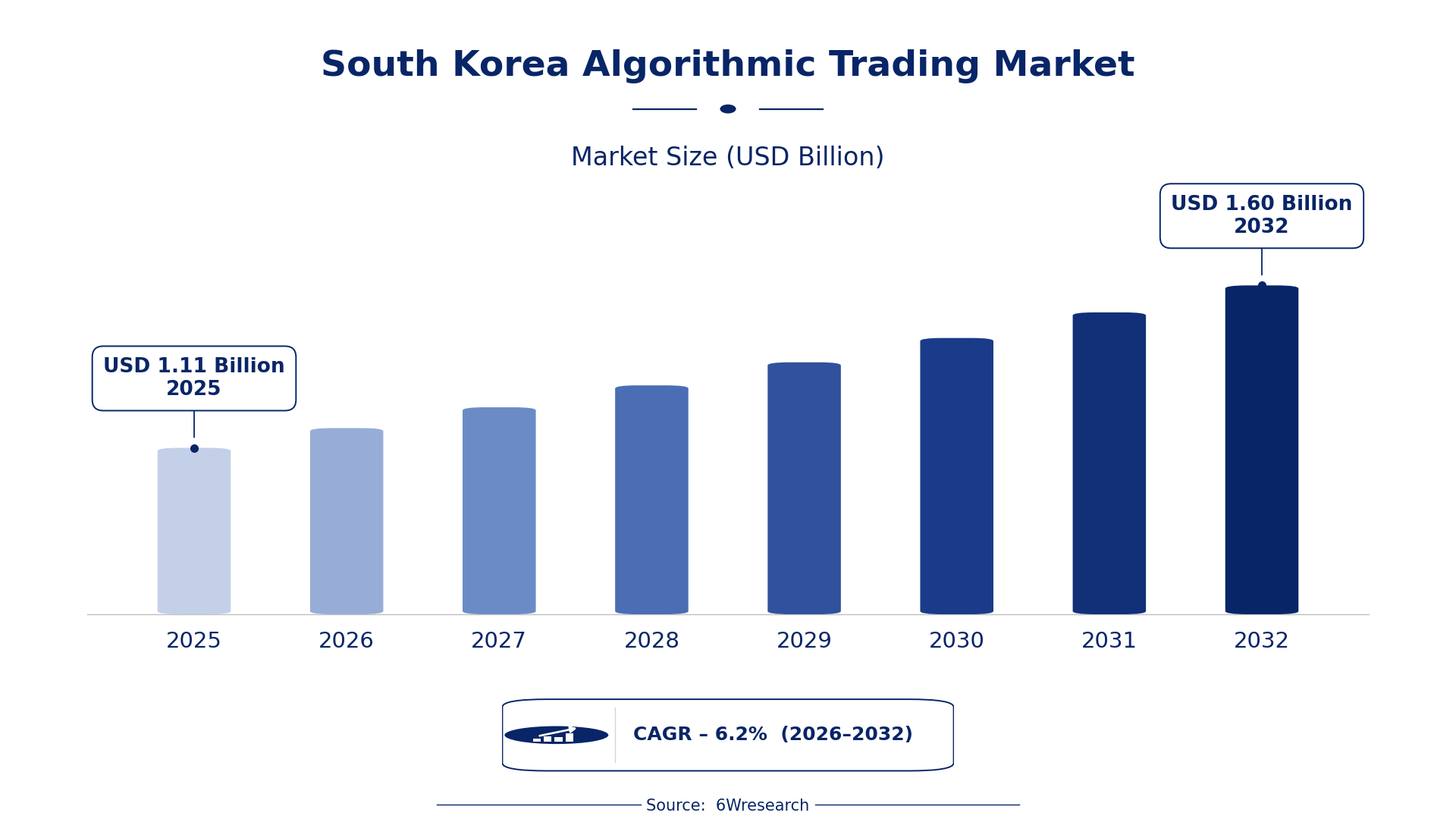
The South Korea Algorithmic Trading Market was estimated at USD 1111 Million in 2025 and is projected to reach USD 1599 Million by 2032, growing at a CAGR of 6.2% from 2026 to 2032.
South Korea Algorithmic Trading Market Synopsis
The accelerating integration of artificial intelligence and machine learning into trading strategies is the foremost force driving the South Korea Algorithmic Trading Market. This technological shift is reshaping how financial services operate, fostering a competitive edge for those who adapt quickly.
As both domestic and international firms focus on developing tailored solutions for South Korean investors, the demand for high-speed automated trading is surging. This trend is heightened by the ongoing efforts to educate retail investors about algorithmic trading, further pushing the market's growth trajectory.
South Korea Algorithmic Trading Market Year-wise Growth Rate and Key Drivers
This graph illustrates the annual growth rates of the South Korea Algorithmic Trading Market from 2021 to 2032, highlighting a steady upward trajectory and projected expansion over the forecast period.
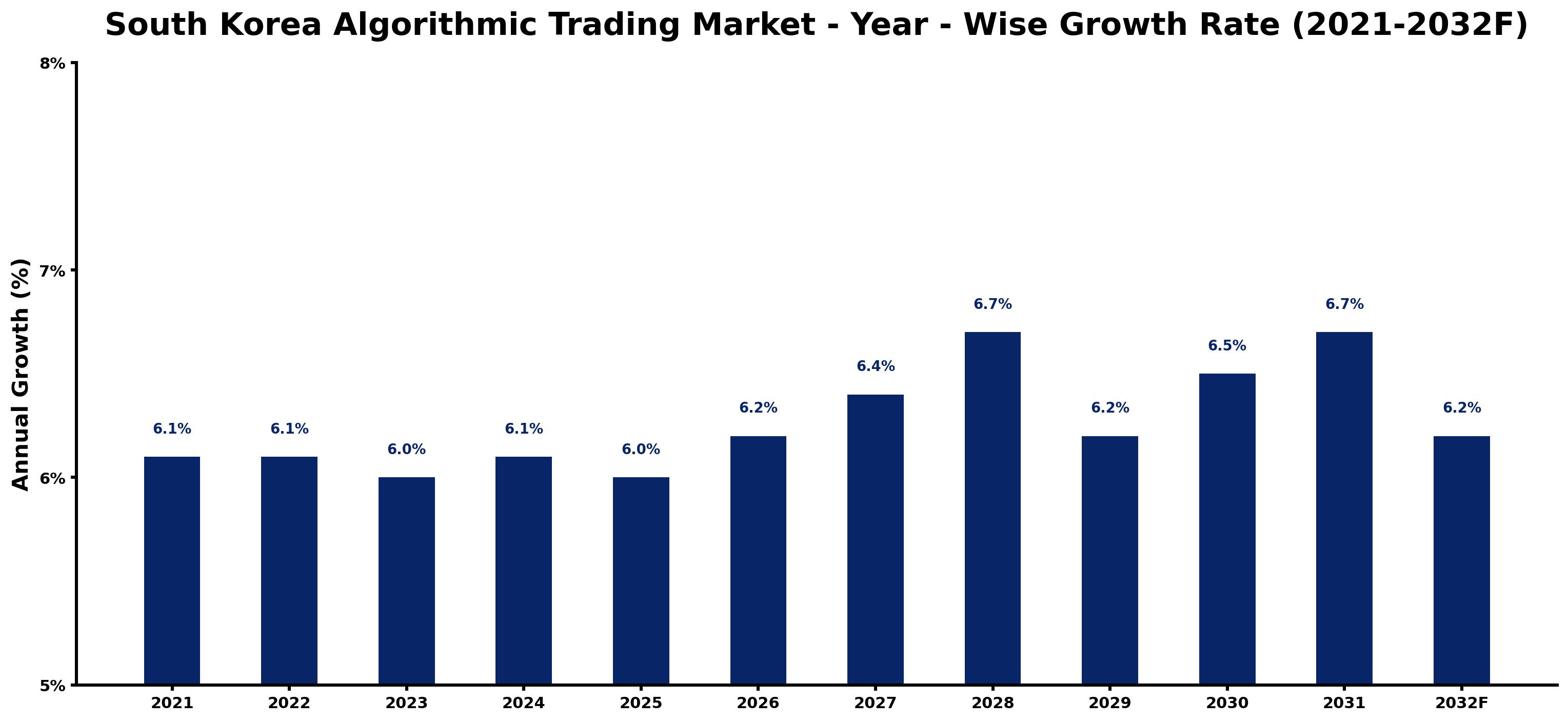
The table below presents the year‑wise growth rates along with the key drivers influencing the market
| Year | Growth Rate | Major Drivers |
| 2021 | 6.1% | Increased retail investor participation in stock trading |
| 2022 | 6.1% | Adoption of AI algorithms in local trading firms |
| 2023 | 6.0% | Regulatory support for automated trading technologies |
| 2024 | 6.1% | Growing fintech partnerships with local brokerage houses |
| 2025 | 6.0% | Higher hedge fund activity in domestic markets |
| 2026 | 6.2% | South Korea's digital asset regulation fostering innovation |
| 2027 | 6.4% | Broadbasing among millennials driving algorithmic platforms |
| 2028 | 6.7% | Launch of major AI trading competitions by exchanges |
| 2029 | 6.2% | Investments in data analytics for trading strategies |
| 2030 | 6.5% | Emergence of blockchain-based trading solutions |
| 2031 | 6.7% | Collaboration with tech giants on trading infrastructure |
| 2032 | 6.2% | Increased funding for algorithmic trading startups |
Note: Market size estimations and growth projections presented in this report are based on 6Wresearch's proprietary forecasting methodology, utilizing the latest available industry data, government publications, and primary research inputs.
South Korea Algorithmic Trading Market Key Takeaways
Below are some of the specific key takeaways from the market, including:
- Advanced technology is a key driver of growth in algorithmic trading, with significant investment from institutional players.
- High-frequency trading is on the rise, necessitating more sophisticated algorithms to keep pace.
- Regulatory reforms are aimed at enhancing market transparency and protecting investors.
- There is a growing focus on risk management and compliance among market participants.
- Big data analytics is increasingly integrated into trading strategies, optimizing performance and outcomes.
Evaluation of Restraints in South Korea Algorithmic Trading Market
The South Korea Algorithmic Trading Market faces several restraints that could impede its growth. One of the most pressing issues is the regulatory complexity that exists in the country. As the regulatory framework evolves, firms must remain vigilant to adapt their strategies accordingly, which can divert resources and attention.
In addition, competition is intensifying as new players enter the market. This saturation leads to pressure on existing firms to innovate continuously. Concerns about data quality and access are also prevalent, which can affect the reliability of trading algorithms. Addressing these challenges requires a proactive approach focused on compliance and technological advancement.
South Korea Algorithmic Trading Market Trends
Several current trends are shaping the South Korea Algorithmic Trading Market. The development of sophisticated algorithms designed specifically for local market conditions is crucial. This custom approach enables traders to optimize their strategies in response to unique market dynamics.
The integration of artificial intelligence and machine learning technologies is becoming increasingly common, allowing for enhanced predictive analytics and decision-making. on top of that, the rise of high-frequency trading is compelling firms to innovate constantly to maintain competitive advantages.
South Korea Algorithmic Trading Market Opportunities
Investment opportunities abound in the South Korea Algorithmic Trading Market. As institutional investors and brokerage firms increasingly adopt automated trading strategies, there is significant potential for software providers and algorithm developers. Firms focusing on creating innovative trading algorithms and platforms tailored to South Korea's financial institutions stand to benefit greatly.
Strategic collaborations with local financial entities and active participation in industry events can further enhance market presence. These partnerships can pave the way for valuable insights and shared technological advancements, creating a mutually beneficial ecosystem.
Government Initiatives in the South Korea Algorithmic Trading Market
The South Korean government plays a crucial role in shaping the algorithmic trading market through regulatory frameworks aimed at ensuring market integrity. The Financial Services Commission (FSC) has implemented guidelines to promote transparency and accountability, which are vital as algorithmic trading gains traction. These initiatives reflect a commitment to fostering a secure trading environment.
- A regulatory framework established in 2025 mandates that algorithmic trading firms register with the Korea Financial Investment Association (KOFIA) to enhance market oversight.
- Current initiatives include ongoing assessments by the FSC to adapt regulations that prevent market manipulation and ensure compliance with evolving trading practices.
- Planned public-private initiatives aim to bolster infrastructure and technological advancements in the trading sector by 2028.
- Recent guidelines introduced in early 2025 focus on enhancing investor protection and fostering trust in automated trading systems.
Future Insights of the South Korea Algorithmic Trading Market
Looking ahead to 2026-2032, the South Korea Algorithmic Trading Market is set for substantial growth driven by ongoing technological advancements. The increasing sophistication of trading algorithms will enable participants to capitalize on market opportunities more effectively.
As financial institutions embrace technology-driven solutions, we can expect to see enhanced trading performance and reduced operational costs. Regulatory initiatives focused on transparency will further support this growth, paving the way for innovative developments within the sector.
South Korea Algorithmic Trading Market Latest Developments
Recent activity in the South Korea Algorithmic Trading Market has been vibrant, reflecting the sector's dynamic nature. Over the past year, firms have been increasingly focused on integrating advanced technologies to enhance trading efficiency and effectiveness.
- A leading regional operator launched a new algorithmic trading platform in early 2025, designed to improve execution speed and lower transaction costs for investors.
- An initiative that began in mid-2025 aims to enhance data analytics capabilities through machine learning, which is currently underway.
- Upcoming collaborations between major brokerage firms are expected to create shared algorithmic trading solutions by late 2026.
- In Q2 2025, a technology vendor introduced innovative tools for risk management that are now gaining traction among financial institutions.
South Korea Algorithmic Trading Market - Key Attractiveness of the Report
- 10 Years of Market Numbers
- Historical Data Starting from 2022 to 2025
- Base Year: 2025
- Forecast Data until 2032
- Key Performance Indicators Impacting the Market
- Major Upcoming Developments and Projects
Key Highlights of the Report:
- South Korea Algorithmic Trading Market Outlook
- Market Size of South Korea Algorithmic Trading Market, 2025
- Forecast of South Korea Algorithmic Trading Market, 2032
- Historical Data and Forecast of South Korea Algorithmic Trading Revenues & Volume for the Period 2022-2032F
- South Korea Algorithmic Trading Market Trend Evolution
- South Korea Algorithmic Trading Market Drivers and Challenges
- South Korea Algorithmic Trading Price Trends
- South Korea Algorithmic Trading Porter's Five Forces
- South Korea Algorithmic Trading Industry Life Cycle
- Historical Data and Forecast of South Korea Algorithmic Trading Market Revenues & Volume By Trading Type for the Period 2022-2032F
- Historical Data and Forecast of South Korea Algorithmic Trading Market Revenues & Volume By Foreign Exchange (FOREX) for the Period 2022-2032F
- Historical Data and Forecast of South Korea Algorithmic Trading Market Revenues & Volume By Stock Markets for the Period 2022-2032F
- Historical Data and Forecast of South Korea Algorithmic Trading Market Revenues & Volume By Exchange-Traded Fund (ETF) for the Period 2022-2032F
- Historical Data and Forecast of South Korea Algorithmic Trading Market Revenues & Volume By Bonds for the Period 2022-2032F
- Historical Data and Forecast of South Korea Algorithmic Trading Market Revenues & Volume By Cryptocurrencies for the Period 2022-2032F
- Historical Data and Forecast of South Korea Algorithmic Trading Market Revenues & Volume By Others for the Period 2022-2032F
- Historical Data and Forecast of South Korea Algorithmic Trading Market Revenues & Volume By Deployment Mode for the Period 2022-2032F
- Historical Data and Forecast of South Korea Algorithmic Trading Market Revenues & Volume By Cloud for the Period 2022-2032F
- Historical Data and Forecast of South Korea Algorithmic Trading Market Revenues & Volume By On-premises for the Period 2022-2032F
- Historical Data and Forecast of South Korea Algorithmic Trading Market Revenues & Volume By Component for the Period 2022-2032F
- Historical Data and Forecast of South Korea Algorithmic Trading Market Revenues & Volume By Solutions for the Period 2022-2032F
- Historical Data and Forecast of South Korea Algorithmic Trading Market Revenues & Volume By Services for the Period 2022-2032F
- Historical Data and Forecast of South Korea Algorithmic Trading Market Revenues & Volume By Enterprise Size for the Period 2022-2032F
- Historical Data and Forecast of South Korea Algorithmic Trading Market Revenues & Volume By Small and Medium-sized Enterprises (SMEs) for the Period 2022-2032F
- Historical Data and Forecast of South Korea Algorithmic Trading Market Revenues & Volume By Large Enterprises for the Period 2022-2032F
- South Korea Algorithmic Trading Import Export Trade Statistics
- Market Opportunity Assessment By Trading Type
- Market Opportunity Assessment By Deployment Mode
- Market Opportunity Assessment By Component
- Market Opportunity Assessment By Enterprise Size
- South Korea Algorithmic Trading Top Companies Market Share
- South Korea Algorithmic Trading Competitive Benchmarking By Technical and Operational Parameters
- South Korea Algorithmic Trading Company Profiles
- South Korea Algorithmic Trading Key Strategic Recommendations






































