South Korea Apiculture Market Size, Share & Growth Rate
The South Korea Apiculture Market was estimated at USD 409 Million in 2025 and is projected to reach USD 578 Million by 2032, growing at a CAGR of 5.1% from 2026 to 2032. This growth trajectory is primarily driven by an increasing consumer focus on health and wellness, which has heightened demand for organic and natural honey products. Additionally, the government's support in fostering sustainable beekeeping practices plays a crucial role in enhancing production capabilities, ultimately benefiting market expansion.
South Korea Apiculture Market Year-wise Growth Rate and Key Drivers
This graph highlights how the South Korea Apiculture Market has steadily grown over the years, supported by major growth factors.
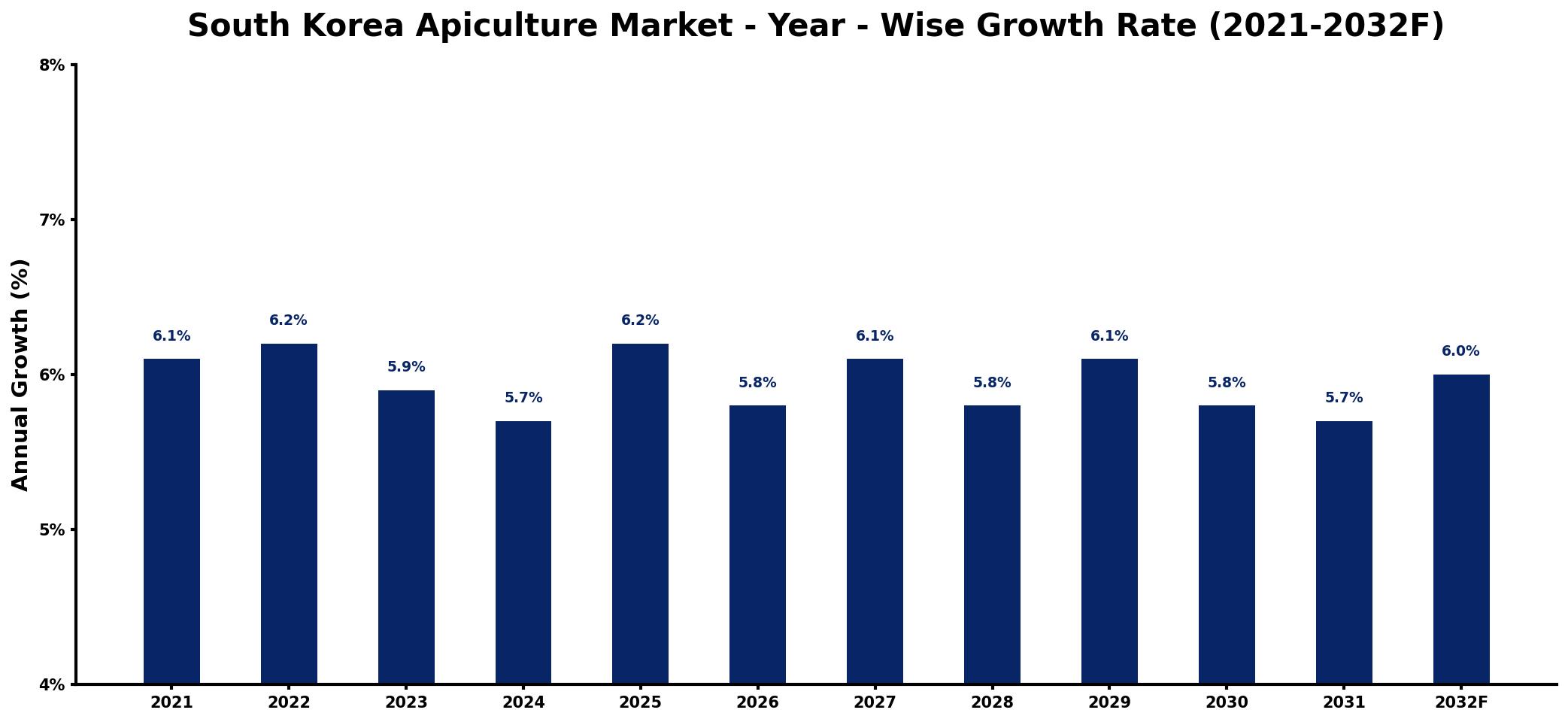
The table below presents the year‑wise growth rates along with the key drivers influencing the market
| Year | Growth Rate | Major Drivers |
| 2021 | 6.1% | Rising consumer health consciousness |
| 2022 | 6.2% | Increased organic product demand |
| 2023 | 5.9% | Growing popularity of local products |
| 2024 | 5.7% | Expansion of eco-friendly practices |
| 2025 | 6.2% | Surge in online purchasing channels |
| 2026 | 5.8% | Strengthening export market opportunities |
| 2027 | 6.1% | Enhanced agricultural technology adoption |
| 2028 | 5.8% | Supportive government policy initiatives |
| 2029 | 6.1% | Growing interest in sustainable practices |
| 2030 | 5.8% | Increased investment in research |
| 2031 | 5.7% | rising procurement volume requirements |
| 2032 | 6.0% | Rising awareness of pollinator importance |
Note: Market size estimations and growth projections presented in this report are based on 6Wresearch's proprietary forecasting methodology, utilizing the latest available industry data, government publications, and primary research inputs.
South Korea Apiculture Market Synopsis
The South Korea Apiculture Market is experiencing a surge in demand for local honey, prized for its exceptional purity and unique flavors. Consumers are increasingly seeking ethically sourced products, which aligns with broader trends toward health consciousness and sustainability.
Amidst this growing demand, beekeepers are modernizing their practices, integrating advanced techniques and equipment to enhance productivity. This evolution not only improves the quality of honey but also opens up avenues for export, reinforcing the market's position on the global stage.
South Korea Apiculture Market Key Takeaways
- The market is characterized by a shift towards high-quality, sustainably produced honey.
- Urban beekeeping is on the rise, with city residents increasingly engaging in this environmentally friendly practice.
- There is a significant focus on bee health, driven by conservation efforts and initiatives to protect pollinator habitats.
- Investment in modern technologies is vital for increasing honey production efficiency.
- Consumer preferences are moving towards natural and organic bee products, influencing market dynamics.
Evaluation of Restraints in South Korea Apiculture Market
Despite its positive trajectory, the South Korea Apiculture Market faces several challenges. Increased competition from imported honey, often lower in price due to different regulatory frameworks and production methods, poses a significant threat to local producers. Furthermore, the global decline in bee populations, exacerbated by climate change and pesticide use, raises concerns over future honey supply. These factors, along with limited suitable land for beekeeping, can stifle market expansion and put pressure on domestic beekeepers.
South Korea Apiculture Market Trends
Current trends indicate a strong consumer preference for premium, high-quality honey products. This shift is fueled by increasing awareness of the numerous health benefits associated with natural and organic options. Moreover, urban beekeeping is emerging as a popular hobby, leading to innovative practices tailored for metropolitan environments. Concurrently, a heightened emphasis on conservation and bee health is shaping the industry's practices, ensuring that sustainable beekeeping remains at the forefront.
South Korea Apiculture Market Opportunities
Investment opportunities in the South Korea Apiculture Market are abundant. As health-conscious consumers continue to drive demand for high-quality bee products, beekeepers can explore modern technologies to enhance production efficiency. Additionally, the growing trend of eco-friendly practices opens doors for sustainable investments. This environment creates a fertile ground for new players and existing businesses looking to capitalize on the ongoing shift towards organic and ethically produced goods.
Government Initiatives in the South Korea Apiculture Market
The South Korean government is proactively supporting the apiculture sector through various initiatives. These include financial assistance for beekeepers, comprehensive training programs designed to enhance beekeeping skills, and dedicated research to boost bee health and productivity. Furthermore, regulations aimed at controlling bee diseases and promoting sustainable practices are being implemented to ensure the industry's long-term viability and competitiveness.
Future Insights of the South Korea Apiculture Market
Looking ahead to 2026-2032, the South Korea Apiculture Market is expected to sustain its growth momentum. Factors such as increasing health consciousness and a shift toward natural sweeteners will bolster demand for honey and other bee products. Government initiatives to promote sustainable practices will further enhance market conditions. However, addressing the challenges posed by climate change and competition from imports will be essential for maintaining this growth trajectory.
South Korea Apiculture Market Latest Developments (2025 - 2026)
Recent developments in the South Korea Apiculture Market point towards a vibrant future. There is an increasing focus on innovation in beekeeping practices, particularly as urban beekeeping gains traction. Moreover, ongoing government support for training and sustainable practices continues to strengthen the industry, while consumer preferences lean towards natural products. These dynamics set the stage for exciting advancements and market growth in the coming years.
South Korea Apiculture Market - Key Attractiveness of the Report
- 10 Years of Market Numbers
- Historical Data Starting from 2022 to 2025
- Base Year: 2025
- Forecast Data until 2032
- Key Performance Indicators Impacting the Market
- Major Upcoming Developments and Projects
Key Highlights of the Report:
- South Korea Apiculture Market Outlook
- Market Size of South Korea Apiculture Market, 2025
- Forecast of South Korea Apiculture Market, 2032
- Historical Data and Forecast of South Korea Apiculture Revenues & Volume for the Period 2022-2032F
- South Korea Apiculture Market Trend Evolution
- South Korea Apiculture Market Drivers and Challenges
- South Korea Apiculture Price Trends
- South Korea Apiculture Porter's Five Forces
- South Korea Apiculture Industry Life Cycle
- Historical Data and Forecast of South Korea Apiculture Market Revenues & Volume By Product Type for the Period 2022-2032F
- Historical Data and Forecast of South Korea Apiculture Market Revenues & Volume By Honey for the Period 2022-2032F
- Historical Data and Forecast of South Korea Apiculture Market Revenues & Volume By Beeswax for the Period 2022-2032F
- Historical Data and Forecast of South Korea Apiculture Market Revenues & Volume By Live-bees for the Period 2022-2032F
- Historical Data and Forecast of South Korea Apiculture Market Revenues & Volume By Others for the Period 2022-2032F
- Historical Data and Forecast of South Korea Apiculture Market Revenues & Volume By Application for the Period 2022-2032F
- Historical Data and Forecast of South Korea Apiculture Market Revenues & Volume By Medical for the Period 2022-2032F
- Historical Data and Forecast of South Korea Apiculture Market Revenues & Volume By Food Beverages for the Period 2022-2032F
- Historical Data and Forecast of South Korea Apiculture Market Revenues & Volume By Cosmetics for the Period 2022-2032F
- Historical Data and Forecast of South Korea Apiculture Market Revenues & Volume By Others for the Period 2022-2032F
- South Korea Apiculture Import Export Trade Statistics
- Market Opportunity Assessment By Product Type
- Market Opportunity Assessment By Application
- South Korea Apiculture Top Companies Market Share
- South Korea Apiculture Competitive Benchmarking By Technical and Operational Parameters
- South Korea Apiculture Company Profiles
- South Korea Apiculture Key Strategic Recommendations






































