South Korea Art and Sculpture Market Size, Share & Growth Rate
The South Korea Art and Sculpture Market was estimated at USD 431 Million in 2025 and is projected to reach USD 568 Million by 2032, growing at a CAGR of 4.0% from 2026 to 2032. This anticipated growth is driven by a renewed global interest in Korean culture, the rising popularity of contemporary artistic expressions, and increased domestic investment in the arts. Additionally, major art fairs and exhibitions are fostering connections between local artists and international collectors, amplifying the market's visibility.
South Korea Art and Sculpture Market Year-wise Growth Rate and Key Drivers
This graph highlights how the South Korea Art and Sculpture Market has steadily grown over the years, supported by major growth factors.
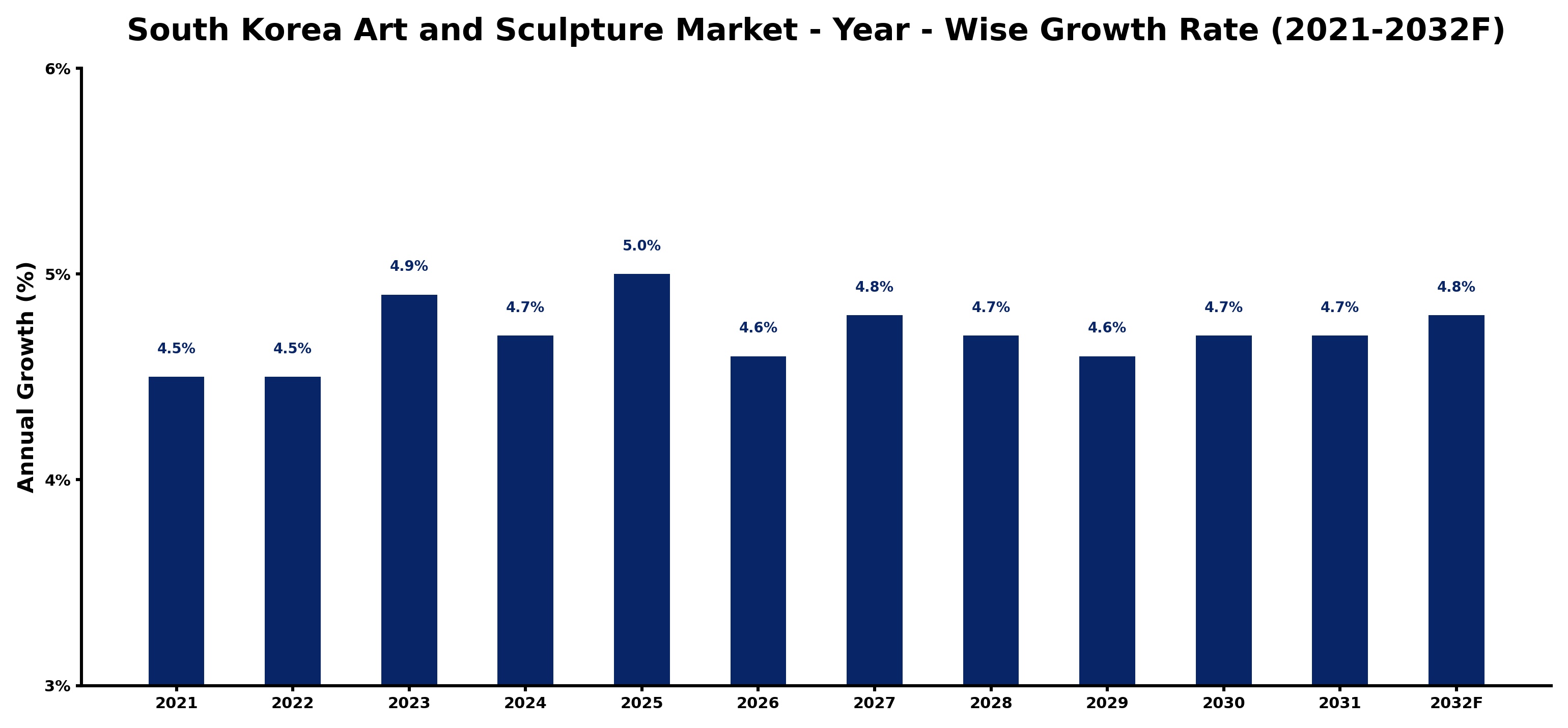
The table below presents the year‑wise growth rates along with the key drivers influencing the market
| Year | Growth Rate | Major Drivers |
| 2021 | 4.5% | Increasing industrial infrastructure investments |
| 2022 | 4.5% | Growing urbanization and commercial development |
| 2023 | 4.9% | Increasing industrial automation investments |
| 2024 | 4.7% | Government infrastructure modernization initiatives |
| 2025 | 5.0% | Increasing adoption of advanced technologies |
| 2026 | 4.6% | Increasing adoption of advanced technologies |
| 2027 | 4.8% | Increasing smart city development projects |
| 2028 | 4.7% | Expansion of commercial construction activities |
| 2029 | 4.6% | Rising electricity demand across industries |
| 2030 | 4.7% | Expansion of manufacturing activities |
| 2031 | 4.7% | Increasing industrial infrastructure investments |
| 2032 | 4.8% | Increasing industrial automation investments |
Note - Market size estimations and growth projections presented in this report are based on 6Wresearch’s advanced forecasting approach, validated with industry datasets as of June 2026.
South Korea Art and Sculpture Market Synopsis
An increasing number of galleries in South Korea's urban centers, particularly Seoul and Busan, are showcasing a mix of traditional and contemporary art forms, drawing both domestic and international buyers. This diverse representation not only elevates the status of Korean art but also highlights the unique narratives and techniques that resonate with global audiences.
Moreover, there is a burgeoning interest in sculpture as a medium that challenges conventional boundaries through innovative materials and themes. Artists are increasingly using their work to address pressing social issues, further bridging the gap between art and society, which, in turn, enriches the market landscape.
South Korea Art and Sculpture Market Key Takeaways
- The market reflects a harmonious blend of traditional Korean art forms and contemporary practices.
- Growing recognition of Korean artists on international platforms is driving demand for their works.
- Art fairs, particularly the Korea International Art Fair, are pivotal in boosting market visibility.
- Emerging artists are redefining sculpture, exploring new materials and themes that engage wider audiences.
- Government policies are increasingly supportive, providing incentives that encourage investment in the arts.
Evaluation of Restraints in South Korea Art and Sculpture Market
Despite its dynamic nature, the South Korea art and sculpture market faces notable constraints. One significant issue is the limited international recognition for many local artists, which restricts their ability to secure opportunities on the global stage. Additionally, the market grapples with a lack of robust government support compared to other cultural sectors. The rise of digital art has also posed challenges, as it shifts some focus away from traditional mediums. Moreover, with a crowded talent pool, emerging artists often struggle for visibility amid established names, making it imperative to foster new avenues for exposure.
South Korea Art and Sculpture Market Trends
Key trends shaping the South Korea art and sculpture market include a resurgence of interest in traditional art forms like pottery and calligraphy, reinterpreted through a contemporary lens. Artists are increasingly addressing themes of identity, history, and social issues, reflecting a global dialogue. Furthermore, the integration of digital platforms for art sales is gaining traction, offering artists innovative ways to reach collectors beyond physical galleries. The rise of online auctions and social media platforms is changing the dynamics of art distribution and consumption.
South Korea Art and Sculpture Market Opportunities
Investors in the South Korea art and sculpture market have ample opportunities, particularly in contemporary artworks that have begun to gain traction at international auctions. The historical artifacts market also presents lucrative options for both local and international collectors seeking to invest in traditional Korean art. Collaborating with established galleries and engaging with art fairs like KIAF offers significant potential for networking and discovering emerging talent, ultimately positioning investors favorably in this evolving market landscape.
Government Initiatives in the South Korea Art and Sculpture Market
The South Korean government actively supports the art and sculpture sector through funding and various initiatives aimed at cultural promotion. The Ministry of Culture, Sports, and Tourism plays a key role in providing resources for the development of both traditional and modern art. Tax incentives encourage donations and investments in the arts, while the Korean Cultural Heritage Administration oversees projects that preserve and promote the country's rich artistic heritage. These efforts are crucial for nurturing a vibrant and sustainable art community.
Future Insights of the South Korea Art and Sculpture Market
Looking ahead to 2026-2032, the South Korea art and sculpture market is poised for robust growth. The combined forces of increasing domestic demand and expanding global recognition of Korean artistry suggest a promising trajectory. As more international collectors seek out Korean art, there will be a greater emphasis on showcasing diverse styles and narratives. Furthermore, the integration of digital technologies in art promotion and sales will continue to enhance accessibility, allowing both established and emerging artists to broaden their reach and impact.
South Korea Art and Sculpture Market Latest Developments (May 2025 - June 2026)
Recent developments in the South Korea art and sculpture market indicate a strong focus on nurturing local talent through various initiatives and exhibitions. This has resulted in a noticeable increase in participation from young artists at prominent art fairs. Additionally, galleries are increasingly utilizing online platforms to enhance accessibility, expanding their reach beyond traditional audiences. The continued collaboration between government bodies and the art community aims to create a more supportive environment for artistic innovation and growth.
South Korea Art and Sculpture Market - Key Attractiveness of the Report
- 10 Years of Market Numbers
- Historical Data Starting from 2022 to 2025
- Base Year: 2025
- Forecast Data until 2032
- Key Performance Indicators Impacting the Market
- Major Upcoming Developments and Projects
Key Highlights of the Report:
- South Korea Art and Sculpture Market Outlook
- Market Size of South Korea Art and Sculpture Market, 2025
- Forecast of South Korea Art and Sculpture Market, 2032
- Historical Data and Forecast of South Korea Art and Sculpture Revenues & Volume for the Period 2022-2032F
- South Korea Art and Sculpture Market Trend Evolution
- South Korea Art and Sculpture Market Drivers and Challenges
- South Korea Art and Sculpture Price Trends
- South Korea Art and Sculpture Porter's Five Forces
- South Korea Art and Sculpture Industry Life Cycle
- Historical Data and Forecast of South Korea Art and Sculpture Market Revenues & Volume By Types for the Period 2022-2032F
- Historical Data and Forecast of South Korea Art and Sculpture Market Revenues & Volume By Artifacts for the Period 2022-2032F
- Historical Data and Forecast of South Korea Art and Sculpture Market Revenues & Volume By Sculpture for the Period 2022-2032F
- Historical Data and Forecast of South Korea Art and Sculpture Market Revenues & Volume By Sales Channel for the Period 2022-2032F
- Historical Data and Forecast of South Korea Art and Sculpture Market Revenues & Volume By Auction Houses for the Period 2022-2032F
- Historical Data and Forecast of South Korea Art and Sculpture Market Revenues & Volume By Dealers for the Period 2022-2032F
- Historical Data and Forecast of South Korea Art and Sculpture Market Revenues & Volume By Galleries for the Period 2022-2032F
- Historical Data and Forecast of South Korea Art and Sculpture Market Revenues & Volume By Art Fairs for the Period 2022-2032F
- Historical Data and Forecast of South Korea Art and Sculpture Market Revenues & Volume By Online Sales for the Period 2022-2032F
- Historical Data and Forecast of South Korea Art and Sculpture Market Revenues & Volume By Retail Outlets for the Period 2022-2032F
- Historical Data and Forecast of South Korea Art and Sculpture Market Revenues & Volume By Artists Studios for the Period 2022-2032F
- Historical Data and Forecast of South Korea Art and Sculpture Market Revenues & Volume By Others for the Period 2022-2032F
- Historical Data and Forecast of South Korea Art and Sculpture Market Revenues & Volume By End-user for the Period 2022-2032F
- Historical Data and Forecast of South Korea Art and Sculpture Market Revenues & Volume By Private Collectors for the Period 2022-2032F
- Historical Data and Forecast of South Korea Art and Sculpture Market Revenues & Volume By Museums for the Period 2022-2032F
- Historical Data and Forecast of South Korea Art and Sculpture Market Revenues & Volume By Real Estate Developers for the Period 2022-2032F
- Historical Data and Forecast of South Korea Art and Sculpture Market Revenues & Volume By Interior Designers for the Period 2022-2032F
- Historical Data and Forecast of South Korea Art and Sculpture Market Revenues & Volume By Residential Individual Buyers for the Period 2022-2032F
- Historical Data and Forecast of South Korea Art and Sculpture Market Revenues & Volume By Other Professionals for the Period 2022-2032F
- South Korea Art and Sculpture Import Export Trade Statistics
- Market Opportunity Assessment By Types
- Market Opportunity Assessment By Sales Channel
- Market Opportunity Assessment By End-user
- South Korea Art and Sculpture Top Companies Market Share
- South Korea Art and Sculpture Competitive Benchmarking By Technical and Operational Parameters
- South Korea Art and Sculpture Company Profiles
- South Korea Art and Sculpture Key Strategic Recommendations






































