Nigeria Art and Sculpture Market Size, Share & Growth Rate
The Nigeria Art and Sculpture Market was estimated at USD 824 Million in 2025 and is projected to reach USD 1171 Million by 2032, growing at a CAGR of 5.1% from 2026 to 2032. This growth is underpinned by a rising global appetite for African art, coupled with increased visibility for Nigerian artists on international platforms. The blend of traditional craftsmanship with contemporary themes is attracting a diverse audience, enhancing both local and international interest in the unique narratives and cultural significance embedded in Nigerian art.
Nigeria Art and Sculpture Market Year-wise Growth Rate and Key Drivers
This graph highlights how the Nigeria Art and Sculpture Market has steadily grown over the years, supported by major growth factors.
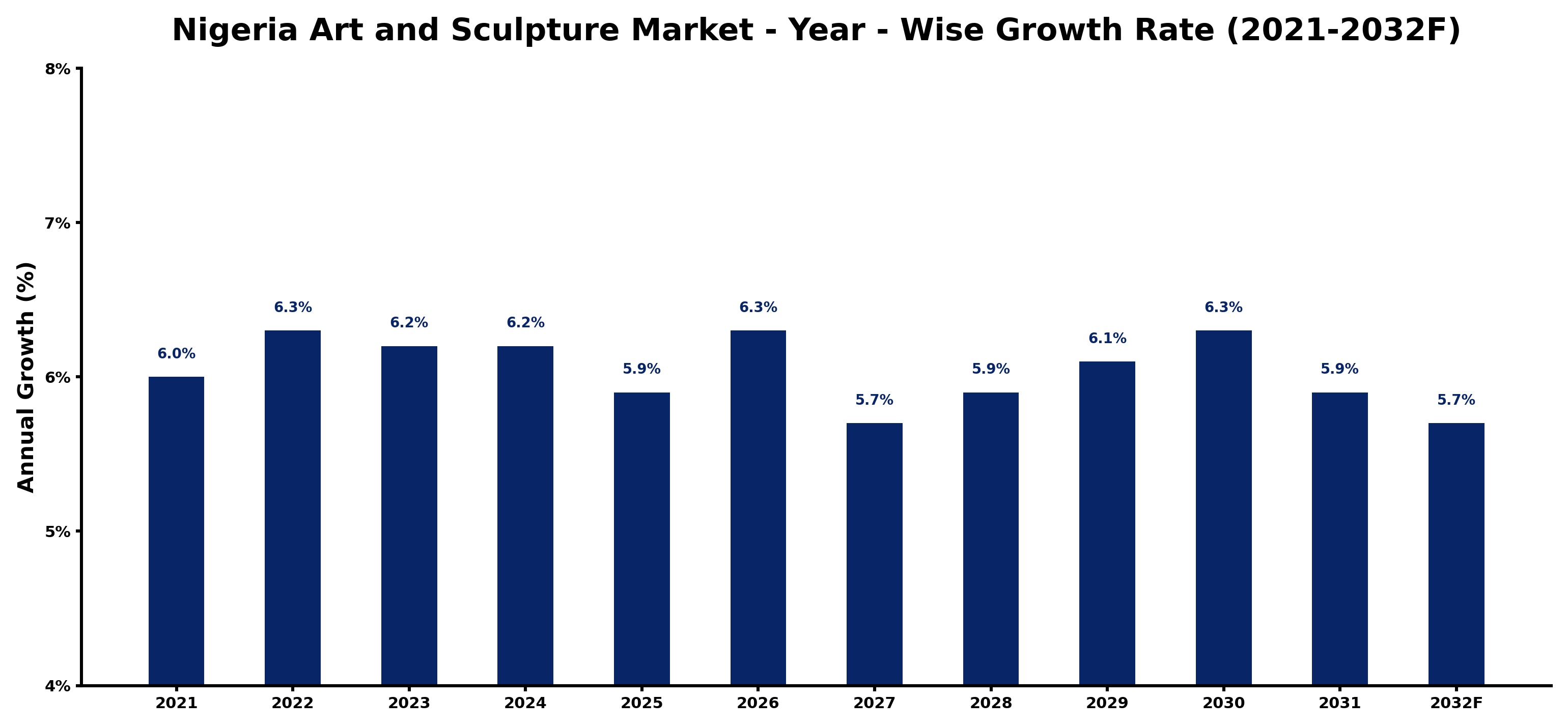
The table below presents the year‑wise growth rates along with the key drivers influencing the market
| Year | Growth Rate | Major Drivers |
| 2021 | 6.0% | Expansion of transportation and logistics networks |
| 2022 | 6.3% | Rapid growth in telecom and data center sectors |
| 2023 | 6.2% | Increasing industrial automation investments |
| 2024 | 6.2% | Rapid growth in telecom and data center sectors |
| 2025 | 5.9% | Growing renewable energy integration projects |
| 2026 | 6.3% | Rapid growth in telecom and data center sectors |
| 2027 | 5.7% | Expansion of manufacturing activities |
| 2028 | 5.9% | Government infrastructure modernization initiatives |
| 2029 | 6.1% | Growing urbanization and commercial development |
| 2030 | 6.3% | Increasing adoption of advanced technologies |
| 2031 | 5.9% | Rapid growth in telecom and data center sectors |
| 2032 | 5.7% | Increasing smart city development projects |
Note - Market size estimations and growth projections presented in this report are based on 6Wresearch's advanced forecasting approach, validated with industry datasets as of June 2026.
Nigeria Art and Sculpture Market Synopsis
Currently, Nigeria's art and sculpture market is a bustling arena, reflecting the country's deep-rooted cultural heritage. Major cities like Lagos and Abuja have become dynamic hubs for art exhibitions, fairs, and galleries, showcasing both the innovative and traditional aspects of Nigerian artistry.
Moreover, the increasing recognition of Nigerian artists on the global stage is creating new opportunities for growth. Collectors and investors alike are acknowledging the potential for significant returns, positioning Nigerian art as an attractive investment asset that marries cultural appreciation with financial viability.
Nigeria Art and Sculpture Market Key Takeaways
- The market is characterized by a fusion of traditional and contemporary art forms.
- Increased global visibility of Nigerian artists is driving international demand.
- Investors view Nigerian artworks as valuable assets with promising appreciation potential.
- Government initiatives are focused on promoting local artists and cultural heritage preservation.
- Technological advancements are enhancing accessibility for artists to showcase their work globally.
Evaluation of Restraints in Nigeria Art and Sculpture Market
Despite its vibrancy, the Nigeria art and sculpture market faces notable constraints that inhibit its full potential. Logistical and infrastructural challenges hinder artists' access to international markets, making it difficult for them to reach a broader audience. Additionally, the lack of substantial government support and funding limits the resources available for artistic development. Furthermore, the prevalence of counterfeiting undermines the market's integrity, while a gap in formal art education programs stifles the emergence of new talent. Addressing these issues will be crucial for fostering a more robust and sustainable art ecosystem in Nigeria.
Nigeria Art and Sculpture Market Trends
The Nigeria art and sculpture market is currently experiencing a noteworthy trend towards the reinterpretation of traditional art forms. Artists are creatively merging age-old techniques with contemporary aesthetics, appealing to both local and international audiences. Additionally, there is a marked shift in how art is perceived; it is increasingly viewed not just as a cultural artifact but as a viable investment. Online platforms are also playing a pivotal role, enabling artists to reach global collectors, thus broadening their market scope and potential clientele.
Nigeria Art and Sculpture Market Opportunities
Investors looking into the Nigeria art and sculpture market can find substantial opportunities in supporting emerging artists, who are poised to make significant impacts on the art scene. Participating in local art fairs and auctions can serve as a strategic avenue for diversification. Moreover, the growing appreciation for unique, culturally rich artworks positions Nigerian art as not only an aesthetic choice but also a lucrative investment. As global interest continues to rise, positioning oneself early in this market could yield significant future returns.
Government Initiatives in the Nigeria Art and Sculpture Market
The Nigerian government has initiated several policies aimed at promoting the art and sculpture market, including the National Endowment for the Arts, which supports artists and cultural organizations. Programs such as the "Buy Nigerian Art" campaign encourage local patronage, fostering an environment that nurtures local talent. Additionally, regulatory measures aim to protect cultural artifacts, ensuring that Nigeria's rich artistic legacy is preserved and promoted. These initiatives not only enhance the market's visibility but also support the overall development of the cultural landscape in Nigeria.
Future Insights of the Nigeria Art and Sculpture Market
Looking ahead to the period from 2026 to 2032, the Nigeria art and sculpture market is set to flourish, driven by an ever-growing appreciation for African art globally. As collectors increasingly seek out unique and culturally rich pieces, the market is poised for expansion. Technological advancements will continue to facilitate broader access for artists, enabling them to connect with global audiences. The rich tapestry of Nigerian culture, when coupled with innovative artistic expression, suggests a promising and dynamic future for the market.
Nigeria Art and Sculpture Market Latest Developments (May 2025 - June 2026)
Recent developments within the Nigeria art and sculpture market indicate a shift towards more collaborative projects among artists, galleries, and educational institutions. Various initiatives are emerging to promote arts education, aiming to equip upcoming artists with necessary skills. Additionally, there has been a noticeable increase in the organization of international art exhibitions featuring Nigerian artists, further enhancing their visibility on the global art stage.
Nigeria Art and Sculpture Market - Key Attractiveness of the Report
- 10 Years of Market Numbers
- Historical Data Starting from 2022 to 2025
- Base Year: 2025
- Forecast Data until 2032
- Key Performance Indicators Impacting the Market
- Major Upcoming Developments and Projects
Key Highlights of the Report:
- Nigeria Art and Sculpture Market Outlook
- Market Size of Nigeria Art and Sculpture Market, 2025
- Forecast of Nigeria Art and Sculpture Market, 2032
- Historical Data and Forecast of Nigeria Art and Sculpture Revenues & Volume for the Period 2022-2032F
- Nigeria Art and Sculpture Market Trend Evolution
- Nigeria Art and Sculpture Market Drivers and Challenges
- Nigeria Art and Sculpture Price Trends
- Nigeria Art and Sculpture Porter's Five Forces
- Nigeria Art and Sculpture Industry Life Cycle
- Historical Data and Forecast of Nigeria Art and Sculpture Market Revenues & Volume By Types for the Period 2022-2032F
- Historical Data and Forecast of Nigeria Art and Sculpture Market Revenues & Volume By Artifacts for the Period 2022-2032F
- Historical Data and Forecast of Nigeria Art and Sculpture Market Revenues & Volume By Sculpture for the Period 2022-2032F
- Historical Data and Forecast of Nigeria Art and Sculpture Market Revenues & Volume By Sales Channel for the Period 2022-2032F
- Historical Data and Forecast of Nigeria Art and Sculpture Market Revenues & Volume By Auction Houses for the Period 2022-2032F
- Historical Data and Forecast of Nigeria Art and Sculpture Market Revenues & Volume By Dealers for the Period 2022-2032F
- Historical Data and Forecast of Nigeria Art and Sculpture Market Revenues & Volume By Galleries for the Period 2022-2032F
- Historical Data and Forecast of Nigeria Art and Sculpture Market Revenues & Volume By Art Fairs for the Period 2022-2032F
- Historical Data and Forecast of Nigeria Art and Sculpture Market Revenues & Volume By Online Sales for the Period 2022-2032F
- Historical Data and Forecast of Nigeria Art and Sculpture Market Revenues & Volume By Retail Outlets for the Period 2022-2032F
- Historical Data and Forecast of Nigeria Art and Sculpture Market Revenues & Volume By Artists Studios for the Period 2022-2032F
- Historical Data and Forecast of Nigeria Art and Sculpture Market Revenues & Volume By Others for the Period 2022-2032F
- Historical Data and Forecast of Nigeria Art and Sculpture Market Revenues & Volume By End-user for the Period 2022-2032F
- Historical Data and Forecast of Nigeria Art and Sculpture Market Revenues & Volume By Private Collectors for the Period 2022-2032F
- Historical Data and Forecast of Nigeria Art and Sculpture Market Revenues & Volume By Museums for the Period 2022-2032F
- Historical Data and Forecast of Nigeria Art and Sculpture Market Revenues & Volume By Real Estate Developers for the Period 2022-2032F
- Historical Data and Forecast of Nigeria Art and Sculpture Market Revenues & Volume By Interior Designers for the Period 2022-2032F
- Historical Data and Forecast of Nigeria Art and Sculpture Market Revenues & Volume By Residential Individual Buyers for the Period 2022-2032F
- Historical Data and Forecast of Nigeria Art and Sculpture Market Revenues & Volume By Other Professionals for the Period 2022-2032F
- Nigeria Art and Sculpture Import Export Trade Statistics
- Market Opportunity Assessment By Types
- Market Opportunity Assessment By Sales Channel
- Market Opportunity Assessment By End-user
- Nigeria Art and Sculpture Top Companies Market Share
- Nigeria Art and Sculpture Competitive Benchmarking By Technical and Operational Parameters
- Nigeria Art and Sculpture Company Profiles
- Nigeria Art and Sculpture Key Strategic Recommendations






































