South Korea Bakeware Market Summary
The south korea bakeware market was estimated at USD 353 Million in 2025 and is projected to reach USD 475 Million by 2032, growing at a CAGR of 5.3% from 2026 to 2032.
South Korea Bakeware Market Year-wise Growth Rate and Key Drivers
This graph highlights how the South Korea Bakeware Market has steadily grown over the past five years, supported by major growth factors.
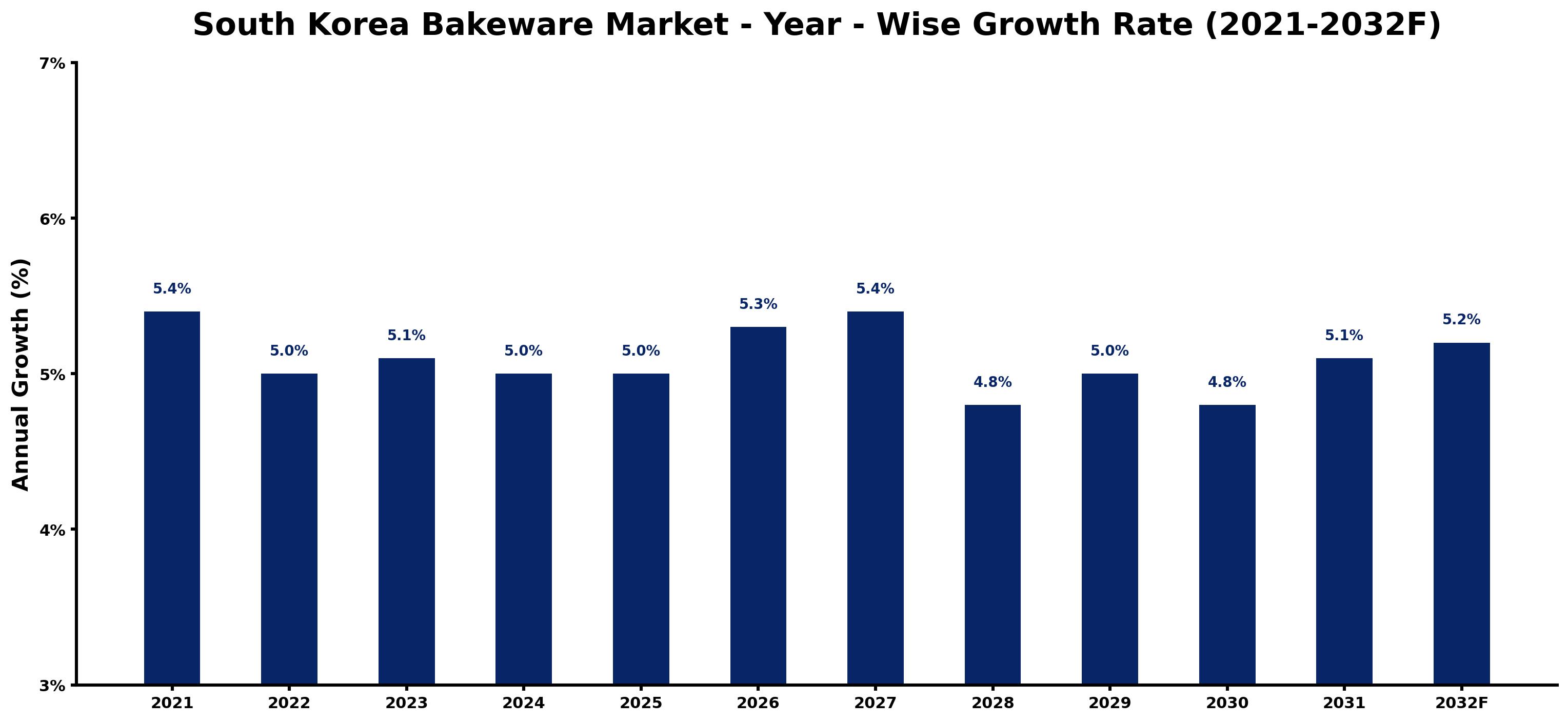
The table below presents the year wise growth rates along with the key drivers influencing the market
| Year | Growth Rate | Major Drivers |
| 2021 | 5.4% | Post-lockdown retail projects fueled interest in home baking among South Korean consumers. |
| 2022 | 5.0% | Local cooking shows showcased innovative recipes, inspiring purchases of specialized bakeware. |
| 2023 | 5.1% | Increased disposable income allowed families to invest in premium baking products. |
| 2024 | 5.0% | Emerging online platforms simplified access to diverse bakeware options for consumers. |
| 2025 | 5.0% | Health trends encouraged gluten-free and organic baking, expanding the market scope. |
| 2026 | 5.3% | Urbanization led to more compact kitchens, increasing demand for space-efficient bakeware. |
| 2027 | 5.4% | Influencer collaborations highlighted creative uses for bakeware, significantly boosting brand visibility. |
| 2028 | 4.8% | Sustainability trends prompted interest in eco-friendly bakeware materials among conscientious shoppers. |
| 2029 | 5.0% | Culinary education programs introduced baking courses, creating a new generation of enthusiasts. |
| 2030 | 4.8% | High-quality non-stick coatings gained popularity, enhancing user experience and bakery performance. |
| 2031 | 5.1% | Customizable bakeware options attracted consumers looking for personalized kitchen accessories. |
| 2032 | 5.2% | Global baking competitions inspired local bakers, driving demand for professional-grade bakeware. |
Note - Market size estimations and growth projections presented in this report are based on 6Wresearch's advanced forecasting approach, validated with industry datasets as of June 2026.
South Korea Bakeware Market Synopsis
The South Korea Bakeware Market is projected to reach 5.3% and witness significant growth during the forecast period (2026-2032). This market is currently characterized by an increasing consumer interest in home baking and cooking, consequently elevating the demand for a variety of bakeware products. Items such as baking pans, trays, molds, and various accessories are instrumental in catering to both amateur and professional bakers alike. The drive for high-quality, durable, and innovative bakeware solutions is intensifying, fueled by consumer preference for non-stick and easy-to-use items. Additionally, the market's expansion is significantly supported by the rise of e-commerce platforms, which enhance product availability and convenience for consumers seeking reliable bakeware solutions.
South Korea Bakeware Market Growth Drivers
The growth trajectory of the South Korea Bakeware Market is primarily driven by several factors:
- The rising popularity of home cooking and baking among consumers who value quality time spent on culinary activities.
- Increased disposable income, allowing a larger segment of the population to invest in high-quality bakeware products.
- The growing trend towards health-conscious baking, leading to greater demand for bakeware that supports healthier cooking practices.
- A surge in social media influence, with platforms showcasing baking trends that encourage consumers to try new recipes and invest in premium bakeware.
- The proliferation of specialty baking stores and online marketplaces which provide consumers with diverse options, enhancing accessibility to innovative bakeware products.
South Korea Bakeware Market Trends and Opportunities
Current trends indicate a shift towards multifunctional and innovative bakeware products in the South Korea Bakeware Market. Consumers increasingly prioritize:
- High-quality materials that provide durability and a non-stick experience, enhancing user convenience.
- Eco-friendly bakeware options, as environmental consciousness grows amongst consumers, prompting brands to develop sustainable products.
- Stylish design and versatility in bakeware, aiming to cater to aesthetic preferences and multi-purpose use.
- Technological advancements that improve product performance, such as enhanced heat distribution or easy-release features.
- The growing preference for online shopping, encouraging brands to improve their digital presence and marketing strategies to reach a broader audience.
South Korea Bakeware Market Challenges and Restraints
Despite the promising growth, the South Korea Bakeware Market faces several challenges:
- Intense competition between domestic and international manufacturers, leading to pricing pressures and reduced profit margins.
- The evolving consumer demand towards health-conscious baking necessitates ongoing product innovation to meet changing expectations.
- Fluctuations in raw material costs that can impact production and pricing strategies within the market.
- Increased consumer preferences for unique, visually appealing designs that require manufacturers to invest in research and development continuously.
- The need for companies to maintain product quality without significantly raising prices, which poses a significant challenge for profitability.
South Korea Bakeware Market Investment Opportunities
Investment opportunities within the South Korea Bakeware Market are expected to flourish due to several factors:
- A notable increase in the number of consumers engaging in home baking presents vast potential for new product introductions in the bakeware segment.
- Investors can leverage the growing demand for durable and aesthetically pleasing bakeware by focusing on premium product lines.
- The rise of eco-friendly products offers a niche market for sustainable bakeware options that appeal to environmentally conscious consumers.
- Collaborative ventures with local retailers and participation in baking expos can facilitate market penetration and brand recognition.
- Expanding the availability of online sales channels can help reach a wider audience and tap into new customer demographics.
South Korea Bakeware Market Government Investment and Initiatives
Government policies play a crucial role in shaping the South Korea Bakeware Market. The South Korean government has implemented measures that support food safety and quality standards, which are essential for consumer protection. Key initiatives include:
- Regulations ensuring compliance with food safety standards for materials used in bakeware, which enhances consumer trust and product integrity.
- Support for small and medium-sized enterprises (SMEs) through funding, training, and resources to bolster the local manufacturing sector.
- Incentives aimed at encouraging innovation within the industry, including grants for research and development aimed at creating advanced bakeware products.
- Public spending on initiatives that promote health and safety in food-related industries, which indirectly enhances the bakeware market.
- Efforts to streamline export processes for bakeware products, allowing domestic manufacturers to access international markets more effectively.
South Korea Bakeware Market Latest Developments (May 2025 - June 2026)
The period from May 2025 to June 2026 has witnessed significant developments in the South Korea Bakeware Market, reflecting changing consumer preferences and innovative product launches. An increasing number of companies are focusing on integrating advanced materials into their product offerings to enhance functionality and performance. Additionally, there has been a marked rise in online sales, with e-commerce platforms becoming vital channels for shoppers seeking convenience. Social media continues to drive trends, inspiring both novice and seasoned bakers to explore new recipes and techniques, thereby stimulating demand for a diverse range of bakeware products. Furthermore, a growing emphasis on sustainability has prompted manufacturers to introduce eco-friendly options, aligning with consumer expectations for environmentally responsible products.
South Korea Bakeware Market - Key Attractiveness of the Report
- 10 Years of Market Numbers
- Historical Data Starting from 2022 to 2025
- Base Year: 2025
- Forecast Data until 2032
- Key Performance Indicators Impacting the Market
- Major Upcoming Developments and Projects
Key Highlights of the Report:
- South Korea Bakeware Market Outlook
- Market Size of South Korea Bakeware Market, 2025
- Forecast of South Korea Bakeware Market, 2032F
- Historical Data and Forecast of South Korea Bakeware Revenues & Volume for the Period 2022-2032F
- South Korea Bakeware Market Trend Evolution
- South Korea Bakeware Market Drivers and Challenges
- South Korea Bakeware Price Trends
- South Korea Bakeware Porter's Five Forces
- South Korea Bakeware Industry Life Cycle
- Historical Data and Forecast of South Korea Bakeware Market Revenues & Volume By Product Type for the Period 2022-2032F
- Historical Data and Forecast of South Korea Bakeware Market Revenues & Volume By Ceramic for the Period 2022-2032F
- Historical Data and Forecast of South Korea Bakeware Market Revenues & Volume By Aluminium for the Period 2022-2032F
- Historical Data and Forecast of South Korea Bakeware Market Revenues & Volume By Cast Iron for the Period 2022-2032F
- Historical Data and Forecast of South Korea Bakeware Market Revenues & Volume By Stainless Steel for the Period 2022-2032F
- Historical Data and Forecast of South Korea Bakeware Market Revenues & Volume By Glass for the Period 2022-2032F
- Historical Data and Forecast of South Korea Bakeware Market Revenues & Volume By Others for the Period 2022-2032F
- Historical Data and Forecast of South Korea Bakeware Market Revenues & Volume By Applications for the Period 2022-2032F
- Historical Data and Forecast of South Korea Bakeware Market Revenues & Volume By Commercial for the Period 2022-2032F
- Historical Data and Forecast of South Korea Bakeware Market Revenues & Volume By Household for the Period 2022-2032F
- South Korea Bakeware Import Export Trade Statistics
- Market Opportunity Assessment By Product Type
- Market Opportunity Assessment By Applications
- South Korea Bakeware Top Companies Market Share
- South Korea Bakeware Competitive Benchmarking By Technical and Operational Parameters
- South Korea Bakeware Company Profiles
- South Korea Bakeware Key Strategic Recommendations






































