South Korea Car Air Fresheners Market Size, Share & Growth Rate
The South Korea Car Air Fresheners Market was estimated at USD 542 Million in 2025 and is projected to reach USD 924 Million by 2032, growing at a CAGR of 7.9% from 2026 to 2032. This growth trajectory is fueled by a rising standard of living and an increasing focus on personal hygiene among South Korean consumers. As more individuals seek to enhance their driving experience, the demand for innovative and long-lasting car air fresheners is expected to rise significantly.
South Korea Car Air Fresheners Market Year-wise Growth Rate and Key Drivers
This graph highlights how the South Korea Car Air Fresheners Market has steadily grown over the years, supported by major growth factors.
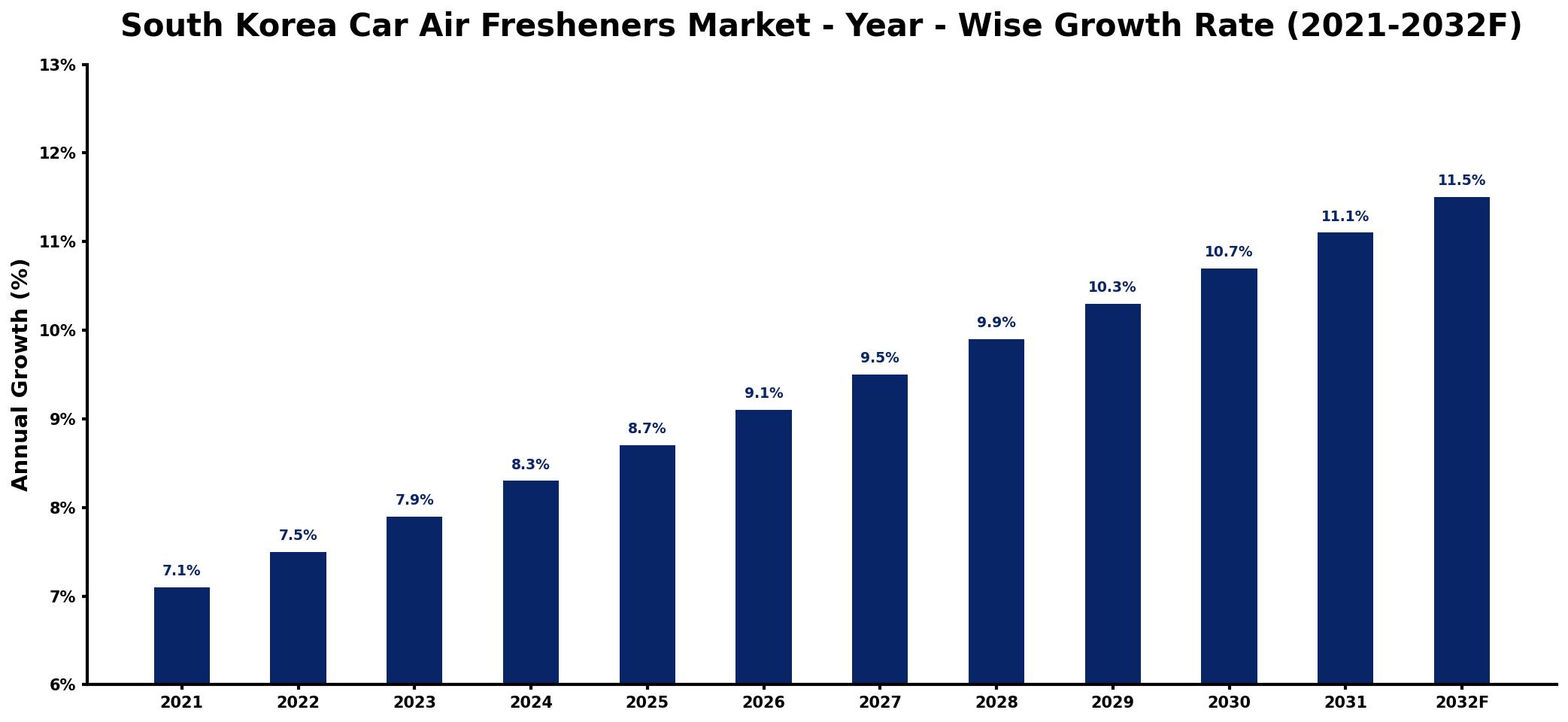
The table below presents the year‑wise growth rates along with the key drivers influencing the market
| Year | Growth Rate | Major Drivers |
| 2021 | 7.1% | Rising consumer disposable income levels |
| 2022 | 7.5% | Increased focus on interior aesthetics |
| 2023 | 7.9% | Growing demand for premium fragrances |
| 2024 | 8.3% | Expansion of retail distribution channels |
| 2025 | 8.7% | Surge in eco-friendly product offerings |
| 2026 | 9.1% | Innovations in scent technology applications |
| 2027 | 9.5% | Heightened awareness of health benefits |
| 2028 | 9.9% | Growth in online shopping platforms |
| 2029 | 10.3% | Increasing popularity of subscription services |
| 2030 | 10.7% | Rising interest in personalized experiences |
| 2031 | 11.1% | Enhanced marketing and promotional strategies |
| 2032 | 11.5% | Development of unique scent profiles |
Note: Market size estimations and growth projections presented in this report are based on 6Wresearch's proprietary forecasting methodology, utilizing the latest available industry data, government publications, and primary research inputs.
South Korea Car Air Fresheners Market Synopsis
Currently, the strongest force shaping the South Korea Car Air Fresheners Market is the shifting consumer preference towards eco-friendly and natural products. With heightened awareness regarding sustainability and health issues, consumers are increasingly opting for car air fresheners that are free from harmful chemicals and made from organic ingredients.
In addition, the trend of personalization is gaining momentum, with consumers gravitating towards unique scents and customizable options that reflect their personal style. This shift is prompting brands to innovate their offerings to meet the diverse demands of South Korean car owners.
South Korea Car Air Fresheners Market Key Takeaways
- The market is witnessing a growing preference for long-lasting and premium quality car air fresheners.
- Eco-friendly and natural product offerings are increasingly in demand due to consumer health consciousness.
- Customization options in scents and designs are becoming a major trend among consumers.
- Online retail channels are rapidly gaining popularity, providing convenience and a broader selection.
- Innovative packaging and marketing strategies are critical for attracting consumers in a competitive landscape.
Evaluation of Restraints in South Korea Car Air Fresheners Market
Despite the robust growth, the South Korea Car Air Fresheners Market faces challenges from intense competition among numerous local and international brands. This saturation makes it difficult for companies to differentiate their products. Additionally, cultural preferences significantly influence consumer choices regarding scents and designs, requiring manufacturers to continuously adapt their offerings. Moreover, increasing environmental regulations demand that companies balance efficacy with eco-friendliness, presenting a complex challenge in product development.
South Korea Car Air Fresheners Market Trends
The South Korea Car Air Fresheners Market is notably characterized by trends that emphasize eco-friendliness and personalization. Consumers are prioritizing products that feature natural ingredients and innovative scent delivery systems. There is also a marked interest in customizable air fresheners that allow consumers to express their individuality. Furthermore, marketers are increasingly focusing on memorable branding strategies that enhance the overall scent experience in vehicles.
South Korea Car Air Fresheners Market Opportunities
Investment opportunities in the South Korea Car Air Fresheners Market are abundant. Brands can tap into the growing consumer demand for premium automotive accessories by offering innovative products that cater to specific preferences. Collaborations with automotive manufacturers or retailers can create exclusive product lines, enhancing market reach. Additionally, leveraging digital marketing strategies can help connect with tech-savvy consumers, driving further engagement and sales.
Government Initiatives in the South Korea Car Air Fresheners Market
The South Korean government plays an active role in ensuring the safety and quality of car air fresheners through regulatory measures. The Ministry of Environment mandates compliance with chemical substance regulations, emphasizing consumer health and environmental protection. Manufacturers must adhere to strict labeling requirements that disclose ingredients and potential hazards. Moreover, the government encourages the development of sustainable practices in the production and disposal of air fresheners.
Future Insights of the South Korea Car Air Fresheners Market
Looking ahead to 2026-2032, the South Korea Car Air Fresheners Market is set to flourish, supported by rising vehicle ownership and a growing consumer inclination towards enhancing interior car environments. As technology advances, we can expect a broader range of eco-friendly and innovative air fresheners to emerge. The market will likely continue to evolve as consumers demand products that not only smell good but also align with their values regarding health and sustainability.
South Korea Car Air Fresheners Market Latest Developments (2025 - 2026)
Recent developments in the South Korea Car Air Fresheners Market indicate a shift toward more creative and sustainable product offerings. Brands are increasingly investing in research to develop natural and organic air fresheners that meet rising consumer expectations for eco-friendliness. In addition, marketing strategies are becoming more sophisticated, with companies utilizing social media platforms and influencer partnerships to connect with younger, environmentally conscious consumers.
South Korea Car Air Fresheners Market - Key Attractiveness of the Report
- 10 Years of Market Numbers
- Historical Data Starting from 2022 to 2025
- Base Year: 2025
- Forecast Data until 2032
- Key Performance Indicators Impacting the Market
- Major Upcoming Developments and Projects
Key Highlights of the Report:
- South Korea Car Air Fresheners Market Outlook
- Market Size of South Korea Car Air Fresheners Market, 2025
- Forecast of South Korea Car Air Fresheners Market, 2032
- Historical Data and Forecast of South Korea Car Air Fresheners Revenues & Volume for the Period 2022-2032F
- South Korea Car Air Fresheners Market Trend Evolution
- South Korea Car Air Fresheners Market Drivers and Challenges
- South Korea Car Air Fresheners Price Trends
- South Korea Car Air Fresheners Porter's Five Forces
- South Korea Car Air Fresheners Industry Life Cycle
- Historical Data and Forecast of South Korea Car Air Fresheners Market Revenues & Volume By Product for the Period 2022-2032F
- Historical Data and Forecast of South Korea Car Air Fresheners Market Revenues & Volume By Gel & Cans for the Period 2022-2032F
- Historical Data and Forecast of South Korea Car Air Fresheners Market Revenues & Volume By Spray/Aerosol for the Period 2022-2032F
- Historical Data and Forecast of South Korea Car Air Fresheners Market Revenues & Volume By Paper Car Air Fresheners for the Period 2022-2032F
- Historical Data and Forecast of South Korea Car Air Fresheners Market Revenues & Volume By Vents & Clips for the Period 2022-2032F
- Historical Data and Forecast of South Korea Car Air Fresheners Market Revenues & Volume By End-User for the Period 2022-2032F
- Historical Data and Forecast of South Korea Car Air Fresheners Market Revenues & Volume By Sports Car for the Period 2022-2032F
- Historical Data and Forecast of South Korea Car Air Fresheners Market Revenues & Volume By Mid-range Car for the Period 2022-2032F
- Historical Data and Forecast of South Korea Car Air Fresheners Market Revenues & Volume By SUV for the Period 2022-2032F
- Historical Data and Forecast of South Korea Car Air Fresheners Market Revenues & Volume By Others for the Period 2022-2032F
- Historical Data and Forecast of South Korea Car Air Fresheners Market Revenues & Volume By Fragrance for the Period 2022-2032F
- Historical Data and Forecast of South Korea Car Air Fresheners Market Revenues & Volume By Scented for the Period 2022-2032F
- Historical Data and Forecast of South Korea Car Air Fresheners Market Revenues & Volume By UnScented for the Period 2022-2032F
- South Korea Car Air Fresheners Import Export Trade Statistics
- Market Opportunity Assessment By Product
- Market Opportunity Assessment By End-User
- Market Opportunity Assessment By Fragrance
- South Korea Car Air Fresheners Top Companies Market Share
- South Korea Car Air Fresheners Competitive Benchmarking By Technical and Operational Parameters
- South Korea Car Air Fresheners Company Profiles
- South Korea Car Air Fresheners Key Strategic Recommendations






































