South Korea Chlorine Dioxide Market Size, Share & Growth Rate
The South Korea Chlorine Dioxide Market was estimated at USD 308 Million in 2025 and is projected to reach USD 425 Million by 2032, growing at a CAGR of 4.7% from 2026 to 2032. This growth trajectory is primarily driven by the increasing applications of chlorine dioxide across vital sectors such as water treatment and healthcare. The demand for effective disinfection solutions, paired with governmental push for environmental compliance, underpins this positive market outlook.
South Korea Chlorine Dioxide Market Year-wise Growth Rate and Key Drivers
This graph highlights how the South Korea Chlorine Dioxide Market has steadily grown over the years, supported by major growth factors.
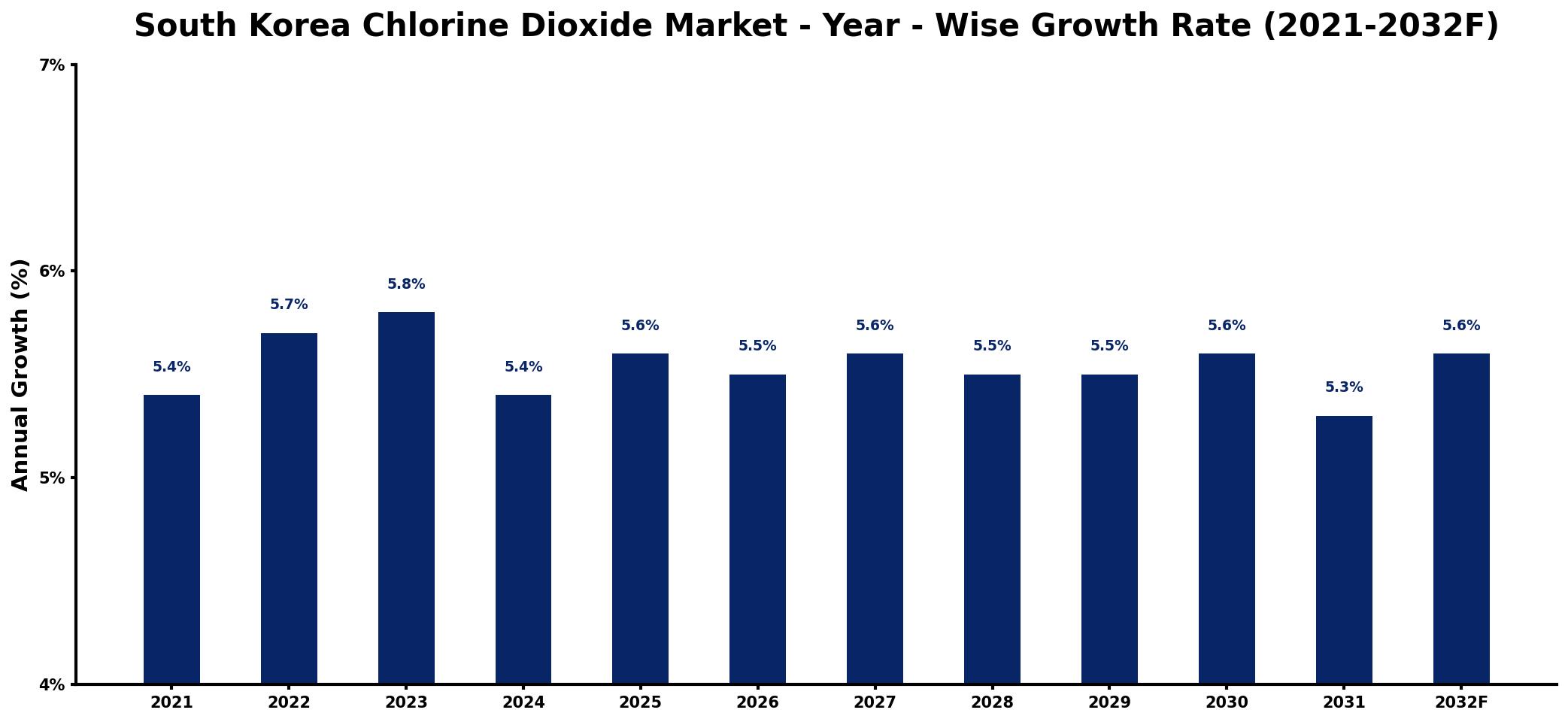
The table below presents the year‑wise growth rates along with the key drivers influencing the market
| Year | Growth Rate | Major Drivers |
| 2021 | 5.4% | Increased demand from healthcare sector |
| 2022 | 5.7% | Expansion in water treatment facilities |
| 2023 | 5.8% | Growing interest in environmental safety |
| 2024 | 5.4% | Rise in industrial applications utilization |
| 2025 | 5.6% | Surge in regulatory compliance requirements |
| 2026 | 5.5% | Investment in research and development |
| 2027 | 5.6% | Higher adoption in food processing |
| 2028 | 5.5% | increased pharmaceutical industry usage |
| 2029 | 5.5% | Strengthened supply chain networks established |
| 2030 | 5.6% | Broader acceptance in agricultural practices |
| 2031 | 5.3% | Wider recognition of sanitization benefits |
| 2032 | 5.6% | Increased collaboration among industry players |
Note: Market size estimations and growth projections presented in this report are based on 6Wresearch's proprietary forecasting methodology, utilizing the latest available industry data, government publications, and primary research inputs.
South Korea Chlorine Dioxide Market Synopsis
Currently, the South Korea Chlorine Dioxide Market is witnessing robust expansion, underscored by its critical role in water treatment and sanitation. The rising public awareness regarding the health implications of water quality has spurred industries to adopt chlorine dioxide as a preferred disinfection agent.
Moreover, the ongoing evolution of the pulp and paper industry and the need for stringent hygiene practices in healthcare settings are significant factors propelling the market. As businesses and institutions increasingly prioritize environmental sustainability, chlorine dioxide's eco-friendliness compared to traditional chlorine disinfectants enhances its appeal.
South Korea Chlorine Dioxide Market Key Takeaways
- Steady market growth driven by rising demand in water treatment, healthcare, and food processing industries.
- Increasing emphasis on environmentally sustainable disinfection practices is enhancing the market appeal.
- Government regulations promoting effective disinfection methods are favoring chlorine dioxide adoption.
- Heightened awareness of public health and water quality is boosting market expansion.
- Opportunities for innovation and investment are emerging in sectors like healthcare and municipal services.
Evaluation of Restraints in South Korea Chlorine Dioxide Market
Despite the favorable growth prospects, the South Korea Chlorine Dioxide Market faces several hurdles. One primary challenge stems from the complex regulatory landscape that necessitates strict compliance with safety and efficacy standards. As companies grapple with these regulations, they must also contend with fierce competition from alternative disinfection technologies, such as ozone and UV treatment. Concerns regarding the environmental impact of chlorine dioxide, particularly its byproducts, further complicate its market position. Addressing these challenges requires strategic innovation and a commitment to demonstrating chlorine dioxide's efficacy and safety across diverse applications.
South Korea Chlorine Dioxide Market Trends
The market is increasingly gravitating towards sustainable disinfection solutions. Chlorine dioxide is becoming the preferred choice due to its high effectiveness against various pathogens while posing lower environmental risks. Additionally, the post-pandemic landscape has intensified the focus on sanitation and disinfection protocols, with chlorine dioxide emerging as a reliable solution in many sectors. Technological advancements in chlorine dioxide production methods, aimed at enhancing efficacy and reducing environmental impact, are also on the rise, further shaping the market's evolution.
South Korea Chlorine Dioxide Market Opportunities
The South Korea Chlorine Dioxide Market presents ample investment opportunities, particularly within the water treatment sector, as municipal and industrial facilities seek efficient disinfection methods. The healthcare industry is also ripe for innovation, as the need for effective sterilization solutions continues to grow. Furthermore, companies specializing in consulting services related to chlorine dioxide applications can carve out a niche in this evolving market. Overall, aligning investments with the increasing focus on public health and environmental sustainability can yield substantial returns in this burgeoning market.
Government Initiatives in the South Korea Chlorine Dioxide Market
The South Korean government actively enforces stringent regulations to uphold the safety and quality of chlorine dioxide products. Oversight is primarily managed by the Ministry of Food and Drug Safety (MFDS), which ensures compliance through rigorous approval processes and regular inspections. These initiatives aim to maintain consumer confidence while promoting transparency in marketing and labeling practices. By fostering a regulated environment, the government is helping to safeguard public health and encourage responsible market practices.
Future Insights of the South Korea Chlorine Dioxide Market
Looking ahead to 2026-2032, the South Korea Chlorine Dioxide Market is expected to maintain its upward trajectory. The continuing demand for effective water treatment solutions, coupled with rigorous governmental regulations, will compel industries to adopt chlorine dioxide more widely. The growing public awareness of water quality and sanitation benefits will further support this trend. Moreover, advancements in production techniques aimed at enhancing both efficacy and sustainability will play a crucial role in propelling market growth in the coming years.
South Korea Chlorine Dioxide Market Latest Developments (2025 - 2026)
Recent developments in the South Korea Chlorine Dioxide Market have centered around innovation and regulatory compliance. Companies are increasingly focusing on developing advanced chlorine dioxide formulations to meet the stringent standards set forth by the government. The trend of adopting chlorine dioxide for diverse applications, particularly in sanitation and disinfection, has seen a notable uptick, reflecting its growing acceptance in both public and private sectors. Additionally, increased collaboration among industry stakeholders is fostering innovation and enhancing product offerings.
South Korea Chlorine Dioxide Market - Key Attractiveness of the Report
- 10 Years of Market Numbers
- Historical Data Starting from 2022 to 2025
- Base Year: 2025
- Forecast Data until 2032
- Key Performance Indicators Impacting the Market
- Major Upcoming Developments and Projects
Key Highlights of the Report:
- South Korea Chlorine Dioxide Market Outlook
- Market Size of South Korea Chlorine Dioxide Market, 2025
- Forecast of South Korea Chlorine Dioxide Market, 2032
- Historical Data and Forecast of South Korea Chlorine Dioxide Revenues & Volume for the Period 2022-2032F
- South Korea Chlorine Dioxide Market Trend Evolution
- South Korea Chlorine Dioxide Market Drivers and Challenges
- South Korea Chlorine Dioxide Price Trends
- South Korea Chlorine Dioxide Porter's Five Forces
- South Korea Chlorine Dioxide Industry Life Cycle
- Historical Data and Forecast of South Korea Chlorine Dioxide Market Revenues & Volume By Application for the Period 2022-2032F
- Historical Data and Forecast of South Korea Chlorine Dioxide Market Revenues & Volume By Industrial Water Treatment for the Period 2022-2032F
- Historical Data and Forecast of South Korea Chlorine Dioxide Market Revenues & Volume By Pulp & Paper Processing for the Period 2022-2032F
- Historical Data and Forecast of South Korea Chlorine Dioxide Market Revenues & Volume By Oil & Gas for the Period 2022-2032F
- Historical Data and Forecast of South Korea Chlorine Dioxide Market Revenues & Volume By Medical for the Period 2022-2032F
- Historical Data and Forecast of South Korea Chlorine Dioxide Market Revenues & Volume By Food & Beverages for the Period 2022-2032F
- Historical Data and Forecast of South Korea Chlorine Dioxide Market Revenues & Volume By Others for the Period 2022-2032F
- South Korea Chlorine Dioxide Import Export Trade Statistics
- Market Opportunity Assessment By Application
- South Korea Chlorine Dioxide Top Companies Market Share
- South Korea Chlorine Dioxide Competitive Benchmarking By Technical and Operational Parameters
- South Korea Chlorine Dioxide Company Profiles
- South Korea Chlorine Dioxide Key Strategic Recommendations






































