South Korea Cloud Compliance Market Size & Growth Rate (2026-2032)
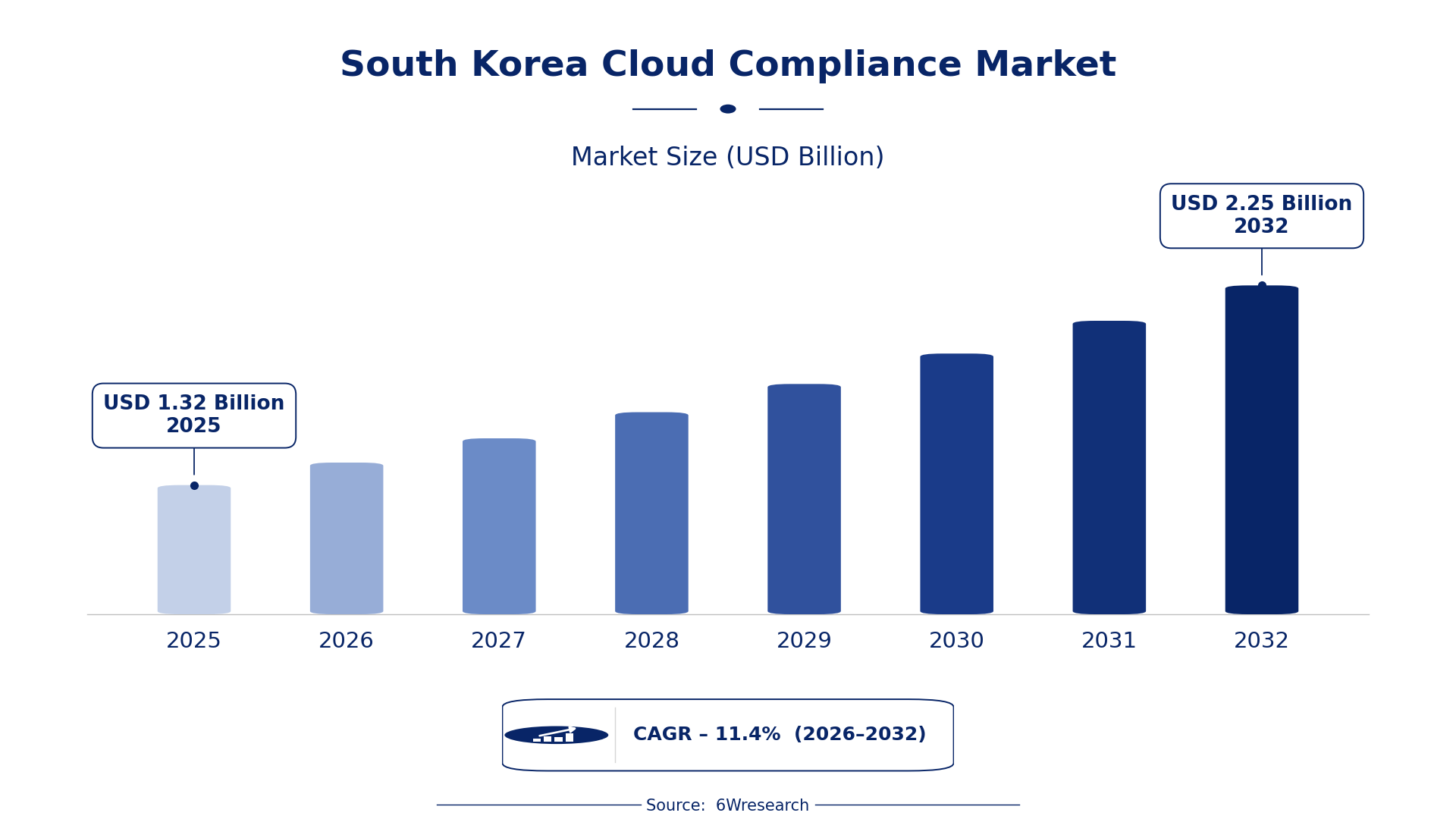
The South Korea Cloud Compliance Market was estimated at USD 1324 Million in 2025 and is projected to reach USD 2245 Million by 2032, growing at a CAGR of 11.4% from 2026 to 2032.
South Korea Cloud Compliance Market Synopsis
The increasing adoption of cloud services is the primary driver influencing the South Korea Cloud Compliance Market today. As organizations recognize the necessity of adhering to stringent data protection laws, they are investing heavily in compliance solutions that ensure both security and regulatory alignment.
Current trends indicate that businesses are prioritizing cloud compliance not just as a regulatory requirement but as a strategic advantage. The heightened focus on data privacy, particularly under laws such as the Personal Information Protection Act (PIPA) and the General Data Protection Regulation (GDPR), is compelling organizations to adopt advanced compliance solutions.
South Korea Cloud Compliance Market Year-wise Growth Rate and Key Drivers
This graph illustrates the annual growth rates of the South Korea Cloud Compliance Market from 2021 to 2032, highlighting a steady upward trajectory and projected expansion over the forecast period.
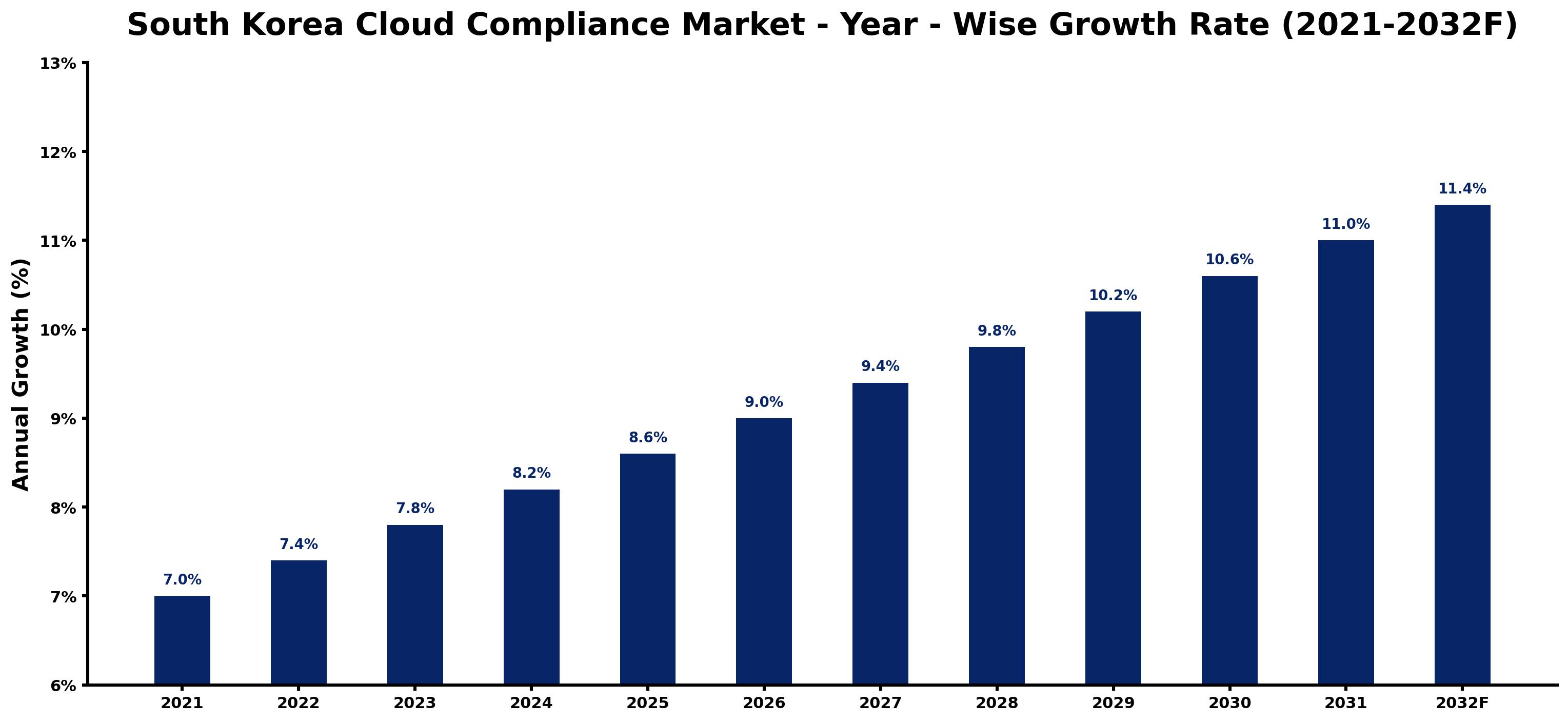
The table below presents the year‑wise growth rates along with the key drivers influencing the market
| Year | Growth Rate | Major Drivers |
| 2021 | 7.0% | KISA data protection regulations boost cloud compliance needs. |
| 2022 | 7.4% | Increased remote work drives demand for compliant cloud solutions. |
| 2023 | 7.8% | Legislative focus on personal data protection enhances compliance requirements. |
| 2024 | 8.2% | Government digital transformation strategies boost cloud adoption. |
| 2025 | 8.6% | Rise in fintech firms demands stringent cloud compliance standards. |
| 2026 | 9.0% | Local startups leveraging cloud for GDPR compliance spurs growth. |
| 2027 | 9.4% | Cybersecurity incidents increase urgency for comprehensive cloud compliance. |
| 2028 | 9.8% | Growing interest in blockchain solutions requires enhanced compliance frameworks. |
| 2029 | 10.2% | E-commerce expansion necessitates robust cloud compliance infrastructures. |
| 2030 | 10.6% | Increased AI adoption drives complex compliance challenges in cloud. |
| 2031 | 11.0% | Government mandates for digital identity verification uplift compliance measures. |
| 2032 | 11.4% | Corporate ESG initiatives heighten demand for compliant cloud services. |
Note: Market size estimations and growth projections presented in this report are based on 6Wresearch's proprietary forecasting methodology, utilizing the latest available industry data, government publications, and primary research inputs.
South Korea Cloud Compliance Market Key Takeaways
Below are some of the specific key takeaways from the market, including:
- The market is projected to expand significantly, driven by regulatory compliance needs.
- Data encryption, access control, and monitoring services are in high demand.
- Complex regulatory frameworks present challenges that companies must navigate.
- Investment in innovative compliance solutions is crucial for market participants.
- Government initiatives are actively promoting cloud compliance and data protection.
Evaluation of Restraints in South Korea Cloud Compliance Market
Navigating the intricate regulatory environment remains a substantial challenge for organizations in the South Korea Cloud Compliance Market. With strict laws governing data protection, businesses must ensure compliance with varying requirements, including data sovereignty and industry-specific standards. This complexity often necessitates significant investment in compliance strategies, which can be a barrier for smaller firms. Additionally, the lack of unified compliance frameworks across different sectors complicates the compliance landscape further, making it imperative for companies to seek specialized expertise in cloud compliance.
South Korea Cloud Compliance Market Trends
The South Korea Cloud Compliance Market is currently witnessing a strong emphasis on advanced data protection mechanisms. Organizations are increasingly adopting solutions that include robust data encryption and comprehensive monitoring tools to safeguard sensitive information. on top of that, there is a marked shift towards compliance solutions that not only fulfill regulatory mandates but also enhance operational efficiency.
Another emerging trend is the integration of artificial intelligence and machine learning in compliance solutions. These technologies are being leveraged to streamline compliance processes and improve risk management, allowing organizations to respond more effectively to evolving regulatory demands.
South Korea Cloud Compliance Market Opportunities
The landscape presents lucrative opportunities for investment, particularly in sectors that are heavily regulated, such as finance and healthcare. As organizations continue to transition to cloud platforms, the demand for tailored compliance solutions is expected to surge. Companies that can offer innovative, scalable compliance tools that align with South Korea’s regulatory frameworks stand to gain significant market share. Additionally, partnerships between cloud service providers and compliance specialists could foster new service offerings and enhance market penetration.
Government Initiatives in the South Korea Cloud Compliance Market
The South Korean government has taken a proactive stance in shaping the Cloud Compliance Market through various initiatives aimed at reinforcing data protection and cloud service adoption. Policies are designed to ensure that businesses adhere to stringent compliance standards while leveraging cloud technologies. This regulatory environment is crucial for fostering trust and security in the digital economy.
- A recently completed initiative involved the introduction of the Cloud First Strategy, which encourages government agencies to adopt cloud services for efficiency.
- Currently, the Ministry of Science and ICT is implementing the Cloud Computing Conformity Assessment Scheme to align with international compliance standards.
- A planned public-private partnership is expected to enhance compliance frameworks and support the development of new cloud technologies by 2028.
- The ongoing enhancement of the Personal Information Protection Act (PIPA) is being monitored to ensure it adapts to emerging technologies and business needs.
Future Insights of the South Korea Cloud Compliance Market
Looking ahead, the South Korea Cloud Compliance Market is set to experience significant growth as organizations continue to prioritize data security and compliance. The convergence of stricter regulatory frameworks and the ongoing digital transformation across industries will drive demand for advanced compliance solutions. As businesses increasingly recognize the importance of safeguarding sensitive information, those offering comprehensive compliance strategies will be well-positioned to thrive in this evolving market landscape.
South Korea Cloud Compliance Market Latest Developments
In the last 12-14 months, the South Korea Cloud Compliance Market has seen a flurry of activity as companies strive to enhance their compliance capabilities. The focus has been on integrating cutting-edge technologies and adapting to regulatory changes, ensuring that cloud solutions are both secure and compliant.
- A major technology vendor launched a new compliance solution in early 2025, featuring enhanced data encryption and monitoring capabilities.
- An initiative that began in mid-2025 aims to educate businesses on navigating complex compliance requirements, with workshops and resources being developed.
- A rollout expected to begin in the second half of 2026 focuses on expanding the Cloud Computing Conformity Assessment Scheme to cover more industries.
- Currently, a collaboration is underway between industry stakeholders to develop a standardized compliance framework that could simplify adherence across sectors.
South Korea Cloud Compliance Market - Key Attractiveness of the Report
- 10 Years of Market Numbers
- Historical Data Starting from 2022 to 2025
- Base Year: 2025
- Forecast Data until 2032
- Key Performance Indicators Impacting the Market
- Major Upcoming Developments and Projects
Key Highlights of the Report:
- South Korea Cloud Compliance Market Outlook
- Market Size of South Korea Cloud Compliance Market, 2025
- Forecast of South Korea Cloud Compliance Market, 2032
- Historical Data and Forecast of South Korea Cloud Compliance Revenues & Volume for the Period 2022-2032F
- South Korea Cloud Compliance Market Trend Evolution
- South Korea Cloud Compliance Market Drivers and Challenges
- South Korea Cloud Compliance Price Trends
- South Korea Cloud Compliance Porter's Five Forces
- South Korea Cloud Compliance Industry Life Cycle
- Historical Data and Forecast of South Korea Cloud Compliance Market Revenues & Volume By Component for the Period 2022-2032F
- Historical Data and Forecast of South Korea Cloud Compliance Market Revenues & Volume By Software for the Period 2022-2032F
- Historical Data and Forecast of South Korea Cloud Compliance Market Revenues & Volume By Services for the Period 2022-2032F
- Historical Data and Forecast of South Korea Cloud Compliance Market Revenues & Volume By Cloud Model for the Period 2022-2032F
- Historical Data and Forecast of South Korea Cloud Compliance Market Revenues & Volume By Infrastructure-as-a-Service (IaaS) for the Period 2022-2032F
- Historical Data and Forecast of South Korea Cloud Compliance Market Revenues & Volume By Platform-as-a-Service (PaaS) for the Period 2022-2032F
- Historical Data and Forecast of South Korea Cloud Compliance Market Revenues & Volume By Software-as-a-Service (SaaS) for the Period 2022-2032F
- Historical Data and Forecast of South Korea Cloud Compliance Market Revenues & Volume By Application for the Period 2022-2032F
- Historical Data and Forecast of South Korea Cloud Compliance Market Revenues & Volume By Audit and Compliance Management for the Period 2022-2032F
- Historical Data and Forecast of South Korea Cloud Compliance Market Revenues & Volume By Threat Detection and Remediation for the Period 2022-2032F
- Historical Data and Forecast of South Korea Cloud Compliance Market Revenues & Volume By Activity Monitoring and Analytics for the Period 2022-2032F
- Historical Data and Forecast of South Korea Cloud Compliance Market Revenues & Volume By Visibility and Risk Assessment for the Period 2022-2032F
- Historical Data and Forecast of South Korea Cloud Compliance Market Revenues & Volume By Other Applications for the Period 2022-2032F
- Historical Data and Forecast of South Korea Cloud Compliance Market Revenues & Volume By Organization Size for the Period 2022-2032F
- Historical Data and Forecast of South Korea Cloud Compliance Market Revenues & Volume By Large Enterprises for the Period 2022-2032F
- Historical Data and Forecast of South Korea Cloud Compliance Market Revenues & Volume By Small and Medium-sized Enterprises (SMEs) for the Period 2022-2032F
- Historical Data and Forecast of South Korea Cloud Compliance Market Revenues & Volume By Vertical for the Period 2022-2032F
- Historical Data and Forecast of South Korea Cloud Compliance Market Revenues & Volume By Banking, Financial Services, and Insurance (BFSI) for the Period 2022-2032F
- Historical Data and Forecast of South Korea Cloud Compliance Market Revenues & Volume By Government for the Period 2022-2032F
- Historical Data and Forecast of South Korea Cloud Compliance Market Revenues & Volume By Healthcare for the Period 2022-2032F
- Historical Data and Forecast of South Korea Cloud Compliance Market Revenues & Volume By IT and ITeS for the Period 2022-2032F
- Historical Data and Forecast of South Korea Cloud Compliance Market Revenues & Volume By Retail and eCommerce for the Period 2022-2032F
- Historical Data and Forecast of South Korea Cloud Compliance Market Revenues & Volume By Manufacturing for the Period 2022-2032F
- South Korea Cloud Compliance Import Export Trade Statistics
- Market Opportunity Assessment By Component
- Market Opportunity Assessment By Cloud Model
- Market Opportunity Assessment By Application
- Market Opportunity Assessment By Organization Size
- Market Opportunity Assessment By Vertical
- South Korea Cloud Compliance Top Companies Market Share
- South Korea Cloud Compliance Competitive Benchmarking By Technical and Operational Parameters
- South Korea Cloud Compliance Company Profiles
- South Korea Cloud Compliance Key Strategic Recommendations






































