South Korea Connected Mining Market Size & Growth Rate (2026-2032)
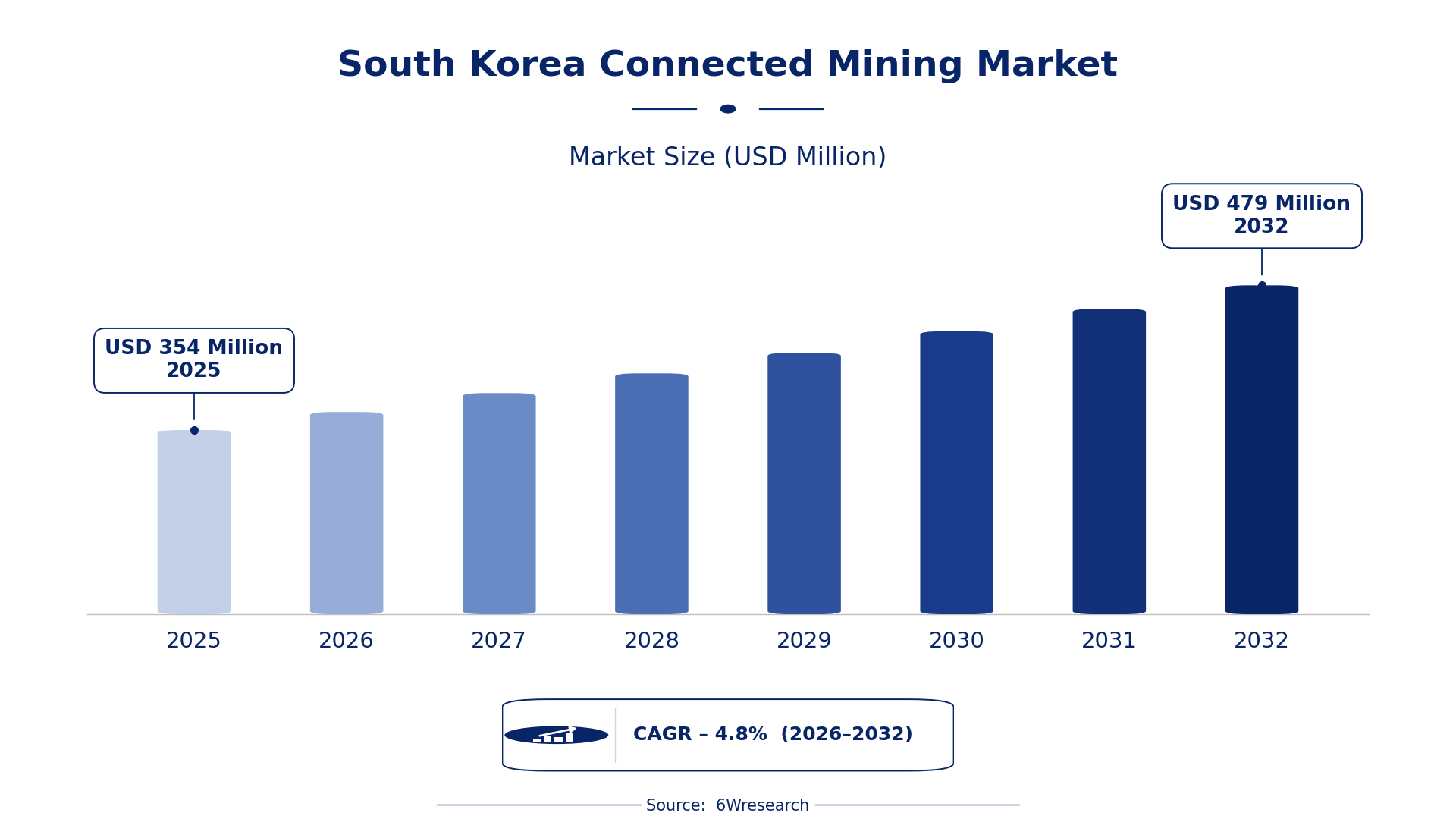
The South Korea Connected Mining Market was estimated at USD 354 Million in 2025 and is projected to reach USD 479 Million by 2032, growing at a CAGR of 4.8% from 2026 to 2032.
South Korea Connected Mining Market Synopsis
The demand for connected mining solutions in South Korea is gaining traction as mining companies seek ways to increase efficiency and enhance safety protocols. With the integration of advanced technologies such as IoT and AI, operations are becoming more streamlined, allowing for real-time data monitoring and decision-making.
As major mining firms invest in innovative technologies, the market is also seeing a shift towards sustainable practices. These changes are not just about improving productivity but also about meeting increasing regulatory pressures for environmental responsibility.
South Korea Connected Mining Market Year-wise Growth Rate and Key Drivers
This graph illustrates the annual growth rates of the South Korea Connected Mining Market from 2021 to 2032, highlighting a steady upward trajectory and projected expansion over the forecast period.
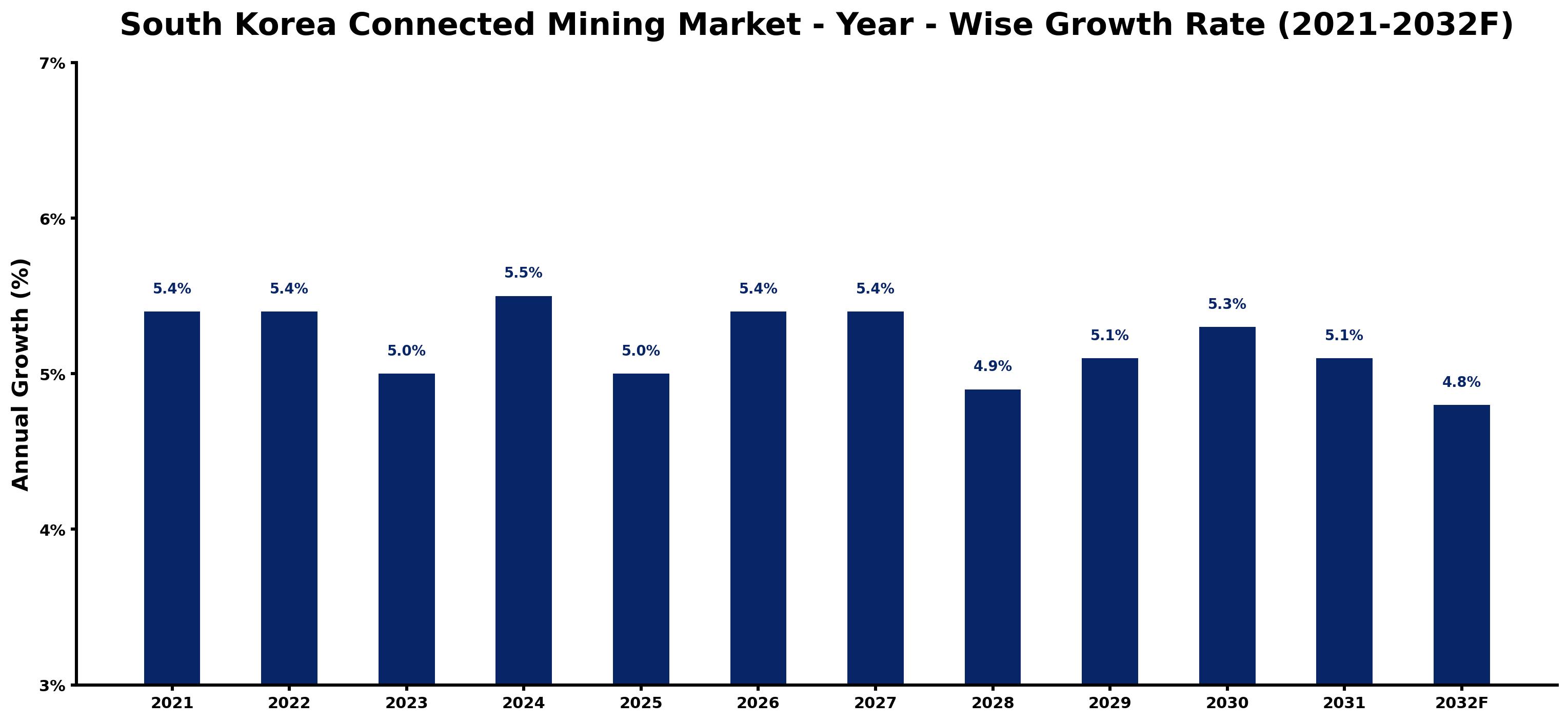
The table below presents the year‑wise growth rates along with the key drivers influencing the market
| Year | Growth Rate | Major Drivers |
| 2021 | 5.4% | Increased investment in smart mining technologies. |
| 2022 | 5.4% | KOSHA safety regulations stimulate technology upgrades. |
| 2023 | 5.0% | Government incentives for eco-friendly mining practices. |
| 2024 | 5.5% | Rising adoption of IoT devices in mining operations. |
| 2025 | 5.0% | Focus on automation to enhance resource extraction efficiency. |
| 2026 | 5.4% | National policies promoting digital transformation in mining. |
| 2027 | 5.4% | Local demand for advanced analytics in mining processes. |
| 2028 | 4.9% | Initiatives supporting sustainable practices in mining industry. |
| 2029 | 5.1% | Investment in AI solutions for operational improvements. |
| 2030 | 5.3% | Collaboration with tech firms for innovative mining solutions. |
| 2031 | 5.1% | Increased emphasis on data security and cyber resilience. |
| 2032 | 4.8% | Emergence of 5G technology enhancing connectivity in mines. |
Note: Market size estimations and growth projections presented in this report are based on 6Wresearch's proprietary forecasting methodology, utilizing the latest available industry data, government publications, and primary research inputs.
South Korea Connected Mining Market Key Takeaways
Below are some of the specific key takeaways from the market, including:
- Growing adoption of IoT and AI is reshaping operational efficiencies in mining.
- Real-time data analytics is becoming standard practice for equipment monitoring.
- Investment in 5G connectivity infrastructure is critical for enhancing operational capabilities.
- Government policies are actively promoting digital transformation within the mining sector.
- Sustainability initiatives are influencing technology investments and operational strategies.
Evaluation of Restraints in South Korea Connected Mining Market
The South Korea Connected Mining Market faces several obstacles that could hinder its growth trajectory. A primary concern is the integration of new technologies with existing traditional mining practices, which can lead to operational disruptions. on top of that, data security remains a pressing issue, as the increasing reliance on digital tools exposes companies to potential cyber threats. The workforce also presents a challenge; there is a growing skills gap that must be addressed to fully utilize advanced technologies. Resistance to change from established practices adds to these complexities, necessitating a collaborative approach among stakeholders to drive innovation effectively.
South Korea Connected Mining Market Trends
The market is experiencing a pronounced shift towards digitalization, with companies increasingly adopting IoT, AI, and data analytics. These technologies enhance safety measures and improve operational efficiencies by providing real-time insights into equipment performance. The focus on sustainability is also becoming a trend; firms are implementing innovative energy management and waste reduction solutions to align with global standards.
South Korea Connected Mining Market Opportunities
The market presents numerous investment opportunities, particularly in areas like IoT and automation. Companies can enhance their operational efficiency and safety standards through these technologies. on top of that, the establishment of advanced connectivity infrastructure, such as 5G networks, will facilitate real-time monitoring and control of mining processes. As South Korea continues to be a leader in technology, this environment is ripe for innovative solutions that can transform the mining sector.
Government Initiatives in the South Korea Connected Mining Market
The South Korean government plays a crucial role in shaping the Connected Mining Market through various initiatives aimed at promoting digital transformation. These policies focus on enhancing efficiency and productivity while ensuring compliance with environmental regulations. The commitment to technological advancement is clear, as the government seeks to support the mining sector's transition into a more connected and sustainable industry.
- A recent initiative by the Ministry of Trade, Industry, and Energy aims to promote IoT adoption in mining operations, launched in early 2025.
- Current efforts are underway to enhance data security protocols within mining companies to protect against cyber threats.
- A planned public-private partnership is expected to expand the use of AI technologies in mining by 2028.
- Financial incentives are currently offered to mining firms investing in digital transformation projects.
- Ongoing regulatory adjustments are being made to streamline compliance for companies adopting advanced technologies.
Future Insights of the South Korea Connected Mining Market
Looking ahead to 2026-2032, the South Korea Connected Mining Market is set for substantial growth. The increasing adoption of IoT, AI, and automation will be central to enhancing operational efficiencies and worker safety. The government's commitment to digitalization, along with significant investments from major companies, will further drive market expansion. Additionally, a surge in global demand for minerals and metals will provide further impetus for innovation and investment in connected mining solutions.
South Korea Connected Mining Market Latest Developments
In the past year, the South Korea Connected Mining Market has seen a flurry of activity, with companies accelerating their digital transformation efforts. This trend reflects a broader recognition of the need for innovation in mining practices. As firms adopt more advanced technologies, the market is witnessing significant developments aimed at improving productivity and sustainability.
- A leading technology vendor launched a new predictive maintenance tool in Q1 2025, aimed at enhancing equipment reliability.
- An ongoing initiative started in early 2025 focuses on upgrading data analytics capabilities among regional mining companies.
- A major regional operator is currently piloting a fleet of autonomous vehicles, expected to expand by late 2026.
- A planned rollout of 5G connectivity for mining sites is set to begin in mid-2026, enhancing real-time data transmission.
- A collaborative project between academia and industry was recently completed, producing new energy management technologies for mining operations.
South Korea Connected Mining Market - Key Attractiveness of the Report
- 10 Years of Market Numbers
- Historical Data Starting from 2022 to 2025
- Base Year: 2025
- Forecast Data until 2032
- Key Performance Indicators Impacting the Market
- Major Upcoming Developments and Projects
Key Highlights of the Report:
- South Korea Connected Mining Market Outlook
- Market Size of South Korea Connected Mining Market, 2025
- Forecast of South Korea Connected Mining Market, 2032
- Historical Data and Forecast of South Korea Connected Mining Revenues & Volume for the Period 2022-2032F
- South Korea Connected Mining Market Trend Evolution
- South Korea Connected Mining Market Drivers and Challenges
- South Korea Connected Mining Price Trends
- South Korea Connected Mining Porter's Five Forces
- South Korea Connected Mining Industry Life Cycle
- Historical Data and Forecast of South Korea Connected Mining Market Revenues & Volume By Component for the Period 2022-2032F
- Historical Data and Forecast of South Korea Connected Mining Market Revenues & Volume By Solutions for the Period 2022-2032F
- Historical Data and Forecast of South Korea Connected Mining Market Revenues & Volume By Services for the Period 2022-2032F
- Historical Data and Forecast of South Korea Connected Mining Market Revenues & Volume By Service for the Period 2022-2032F
- Historical Data and Forecast of South Korea Connected Mining Market Revenues & Volume By Professional for the Period 2022-2032F
- Historical Data and Forecast of South Korea Connected Mining Market Revenues & Volume By Managed for the Period 2022-2032F
- Historical Data and Forecast of South Korea Connected Mining Market Revenues & Volume By Solution for the Period 2022-2032F
- Historical Data and Forecast of South Korea Connected Mining Market Revenues & Volume By Asset Tracking and Optimization for the Period 2022-2032F
- Historical Data and Forecast of South Korea Connected Mining Market Revenues & Volume By Fleet Management for the Period 2022-2032F
- Historical Data and Forecast of South Korea Connected Mining Market Revenues & Volume By Industrial Safety and Security for the Period 2022-2032F
- Historical Data and Forecast of South Korea Connected Mining Market Revenues & Volume By Workforce Management for the Period 2022-2032F
- Historical Data and Forecast of South Korea Connected Mining Market Revenues & Volume By Analytics and Reporting for the Period 2022-2032F
- Historical Data and Forecast of South Korea Connected Mining Market Revenues & Volume By Process Control for the Period 2022-2032F
- Historical Data and Forecast of South Korea Connected Mining Market Revenues & Volume By Others for the Period 2022-2032F
- Historical Data and Forecast of South Korea Connected Mining Market Revenues & Volume By Application for the Period 2022-2032F
- Historical Data and Forecast of South Korea Connected Mining Market Revenues & Volume By Exploration for the Period 2022-2032F
- Historical Data and Forecast of South Korea Connected Mining Market Revenues & Volume By Processing and Refining for the Period 2022-2032F
- Historical Data and Forecast of South Korea Connected Mining Market Revenues & Volume By Transportation for the Period 2022-2032F
- Historical Data and Forecast of South Korea Connected Mining Market Revenues & Volume By Deployment Mode for the Period 2022-2032F
- Historical Data and Forecast of South Korea Connected Mining Market Revenues & Volume By On-premises for the Period 2022-2032F
- Historical Data and Forecast of South Korea Connected Mining Market Revenues & Volume By Cloud for the Period 2022-2032F
- Historical Data and Forecast of South Korea Connected Mining Market Revenues & Volume By Mining Type for the Period 2022-2032F
- Historical Data and Forecast of South Korea Connected Mining Market Revenues & Volume By Surface for the Period 2022-2032F
- Historical Data and Forecast of South Korea Connected Mining Market Revenues & Volume By Underground for the Period 2022-2032F
- South Korea Connected Mining Import Export Trade Statistics
- Market Opportunity Assessment By Component
- Market Opportunity Assessment By Service
- Market Opportunity Assessment By Solution
- Market Opportunity Assessment By Application
- Market Opportunity Assessment By Deployment Mode
- Market Opportunity Assessment By Mining Type
- South Korea Connected Mining Top Companies Market Share
- South Korea Connected Mining Competitive Benchmarking By Technical and Operational Parameters
- South Korea Connected Mining Company Profiles
- South Korea Connected Mining Key Strategic Recommendations






































