South Korea Construction Plastics Market Size, Share & Growth Rate
The South Korea Construction Plastics Market was estimated at USD 493 Million in 2025 and is projected to reach USD 686 Million by 2032, growing at a CAGR of 4.8% from 2026 to 2032. This upward trajectory is primarily driven by the increasing demand for lightweight and durable construction materials that enhance building efficiency and sustainability. Moreover, ongoing innovations in plastic formulations are expanding their applications across various sectors, solidifying the market's growth prospects.
South Korea Construction Plastics Market Year-wise Growth Rate and Key Drivers
This graph highlights how the South Korea Construction Plastics Market has steadily grown over the years, supported by major growth factors.
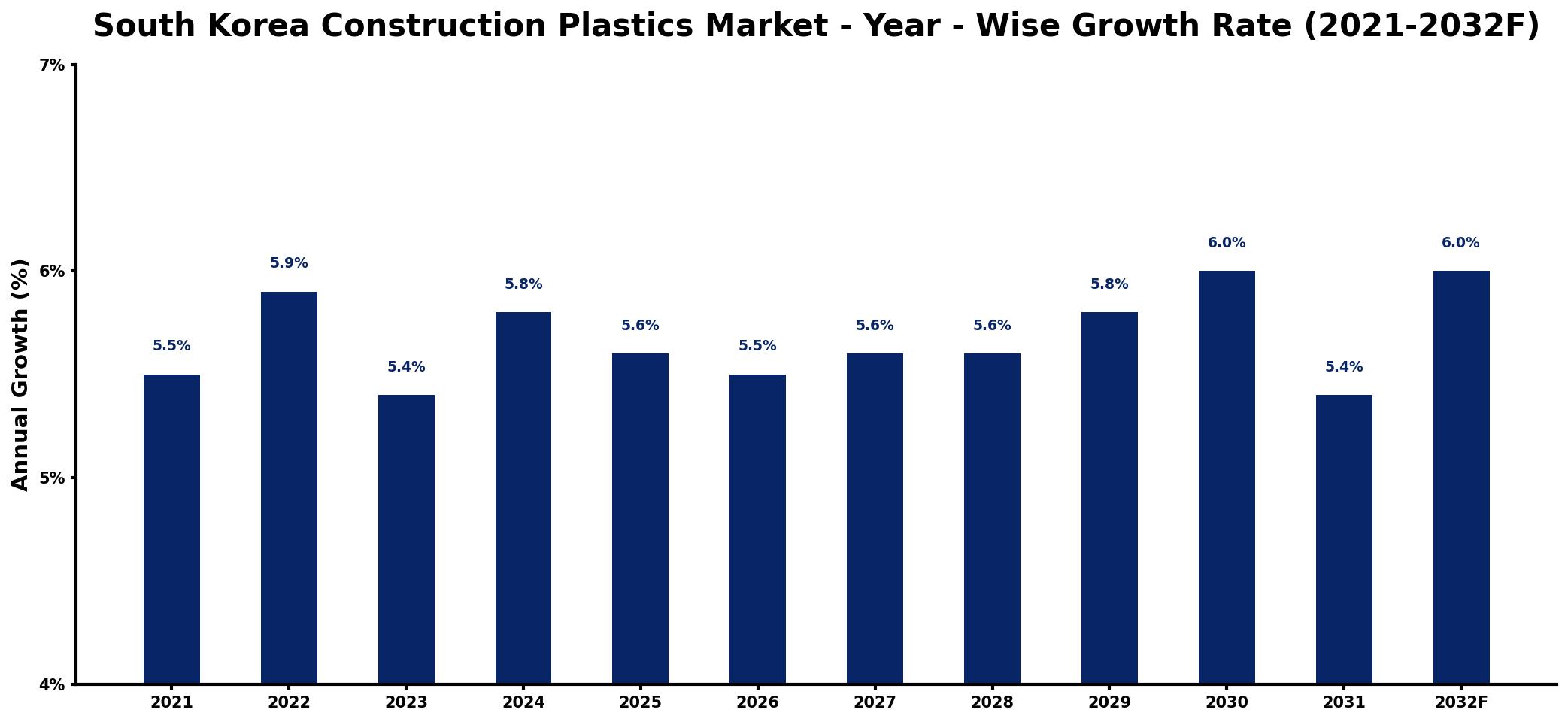
The table below presents the year‑wise growth rates along with the key drivers influencing the market
| Year | Growth Rate | Major Drivers |
| 2021 | 5.5% | Rising infrastructure development projects |
| 2022 | 5.9% | Increased demand from housing sector |
| 2023 | 5.4% | Growth in renewable energy initiatives |
| 2024 | 5.8% | Expansion of urban development plans |
| 2025 | 5.6% | Investment in sustainable building materials |
| 2026 | 5.5% | Technological advancements in manufacturing |
| 2027 | 5.6% | Higher consumer preference for durability |
| 2028 | 5.6% | Government incentives for green initiatives |
| 2029 | 5.8% | increased capital investment inflows |
| 2030 | 6.0% | Innovations in efficient production processes |
| 2031 | 5.4% | Strengthened supply chain partnerships |
| 2032 | 6.0% | Emerging markets seeking modern solutions |
Note: Market size estimations and growth projections presented in this report are based on 6Wresearch's proprietary forecasting methodology, utilizing the latest available industry data, government publications, and primary research inputs.
South Korea Construction Plastics Market Synopsis
In recent years, the South Korea Construction Plastics Market has gained considerable momentum, largely propelled by urbanization and infrastructural development. However, as the sector evolves, the focus is shifting toward sustainable practices and environmentally friendly materials, with a growing emphasis on lifecycle assessment and recycling.
The market is entering a transformative phase, with significant opportunities arising from advancements in material science and government policies promoting sustainability. As manufacturers innovate in polymer technology, the emphasis on achieving regulatory compliance and material compatibility remains crucial for future growth.
South Korea Construction Plastics Market Key Takeaways
- Strong demand for lightweight and durable materials is driving market growth.
- Innovations in plastic formulations are enhancing applications in construction.
- Government policies emphasize recycling and sustainability in construction practices.
- Challenges in developing flame-retardant and environmentally compliant materials persist.
- Strategic collaboration with architects and developers is essential for market expansion.
Evaluation of Restraints in South Korea Construction Plastics Market
Despite the growth opportunities, several key restraints are impacting the South Korea Construction Plastics Market. Manufacturers are challenged by the need to develop sustainable, flame-retardant plastics that meet stringent safety standards. Furthermore, the complexities associated with material compatibility and the necessity for rigorous regulatory compliance create hurdles that can delay product development and market entry. Addressing lifecycle assessments and recycling challenges remains a crucial focus to ensure the sustainability of plastic solutions.
South Korea Construction Plastics Market Trends
The market is witnessing significant trends that are reshaping demand and technology. Notably, there is a growing inclination towards incorporating recycled plastics into construction applications, aligning with the broader sustainability goals of the industry. Additionally, advancements in polymer additives and composite materials are facilitating the development of more efficient and durable building components.
Furthermore, the integration of digital technologies into the construction process is enhancing design capabilities and improving project efficiency. The collaboration between technology developers and construction firms is paving the way for innovative plastic applications that address modern construction challenges.
South Korea Construction Plastics Market Opportunities
Genuine growth opportunities are arising in areas such as biodegradable plastics and innovative composite materials tailored for specific construction needs. The increasing focus on sustainability is prompting investments in research and development to create eco-friendly construction materials that comply with regulatory standards. This presents an avenue for manufacturers to differentiate their offerings and capture market share.
Government Initiatives in the South Korea Construction Plastics Market
The South Korean government is actively promoting policies aimed at enhancing the sustainability of construction practices. This includes initiatives that focus on material recycling, waste reduction, and the development of eco-friendly construction products. Incentives are in place to support research in biodegradable materials and to foster collaboration between industry and academic institutions for innovative solutions.
Future Insights of the South Korea Construction Plastics Market
Looking ahead to 2026-2032, the South Korea Construction Plastics Market is poised for significant expansion. As the industry adapts to the dual pressures of sustainability and innovation, demand for advanced plastic solutions will likely increase. Manufacturers that prioritize eco-friendly practices and collaborate with stakeholders will be well-positioned to capitalize on emerging opportunities and navigate the evolving regulatory landscape.
South Korea Construction Plastics Market Latest Developments (2025 - 2026)
In the last year, the South Korea Construction Plastics Market has seen a shift towards more sustainable practices, with many manufacturers exploring new material formulations that emphasize environmental responsibility. The development of recycling infrastructure has gained traction, supported by government initiatives aimed at enhancing waste management within the construction sector. Additionally, there is an observable trend of companies investing in R&D to develop innovative, flame-retardant materials that meet stringent building safety standards.
South Korea Construction Plastics Market - Key Attractiveness of the Report
- 10 Years of Market Numbers
- Historical Data Starting from 2022 to 2025
- Base Year: 2025
- Forecast Data until 2032
- Key Performance Indicators Impacting the Market
- Major Upcoming Developments and Projects
Key Highlights of the Report:
- South Korea Construction Plastics Market Outlook
- Market Size of South Korea Construction Plastics Market, 2025
- Forecast of South Korea Construction Plastics Market, 2032
- Historical Data and Forecast of South Korea Construction Plastics Revenues & Volume for the Period 2022-2032F
- South Korea Construction Plastics Market Trend Evolution
- South Korea Construction Plastics Market Drivers and Challenges
- South Korea Construction Plastics Price Trends
- South Korea Construction Plastics Porter's Five Forces
- South Korea Construction Plastics Industry Life Cycle
- Historical Data and Forecast of South Korea Construction Plastics Market Revenues & Volume By Type for the Period 2022-2032F
- Historical Data and Forecast of South Korea Construction Plastics Market Revenues & Volume By Pvc for the Period 2022-2032F
- Historical Data and Forecast of South Korea Construction Plastics Market Revenues & Volume By Polyurethane for the Period 2022-2032F
- Historical Data and Forecast of South Korea Construction Plastics Market Revenues & Volume By Polypropylene for the Period 2022-2032F
- Historical Data and Forecast of South Korea Construction Plastics Market Revenues & Volume By Polyethylene for the Period 2022-2032F
- Historical Data and Forecast of South Korea Construction Plastics Market Revenues & Volume By Application for the Period 2022-2032F
- Historical Data and Forecast of South Korea Construction Plastics Market Revenues & Volume By Window for the Period 2022-2032F
- Historical Data and Forecast of South Korea Construction Plastics Market Revenues & Volume By Roofing for the Period 2022-2032F
- Historical Data and Forecast of South Korea Construction Plastics Market Revenues & Volume By Flooring for the Period 2022-2032F
- Historical Data and Forecast of South Korea Construction Plastics Market Revenues & Volume By Insulation for the Period 2022-2032F
- Historical Data and Forecast of South Korea Construction Plastics Market Revenues & Volume By Piping for the Period 2022-2032F
- South Korea Construction Plastics Import Export Trade Statistics
- Market Opportunity Assessment By Type
- Market Opportunity Assessment By Application
- South Korea Construction Plastics Top Companies Market Share
- South Korea Construction Plastics Competitive Benchmarking By Technical and Operational Parameters
- South Korea Construction Plastics Company Profiles
- South Korea Construction Plastics Key Strategic Recommendations






































