South Korea Decorative Rugs Market Size, Share & Growth Rate
The South Korea Decorative Rugs Market was estimated at USD 1064 Million in 2025 and is projected to reach USD 1510 Million by 2032, growing at a CAGR of 5.1% from 2026 to 2032. This robust growth is driven by increasing urbanization and rising disposable incomes, which are encouraging consumers to invest in home décor. Additionally, the market is buoyed by a growing interest in unique and stylish rugs that reflect personal tastes and complement contemporary living spaces.
South Korea Decorative Rugs Market Year-wise Growth Rate and Key Drivers
This graph highlights how the South Korea Decorative Rugs Market has steadily grown over the years, supported by major growth factors.
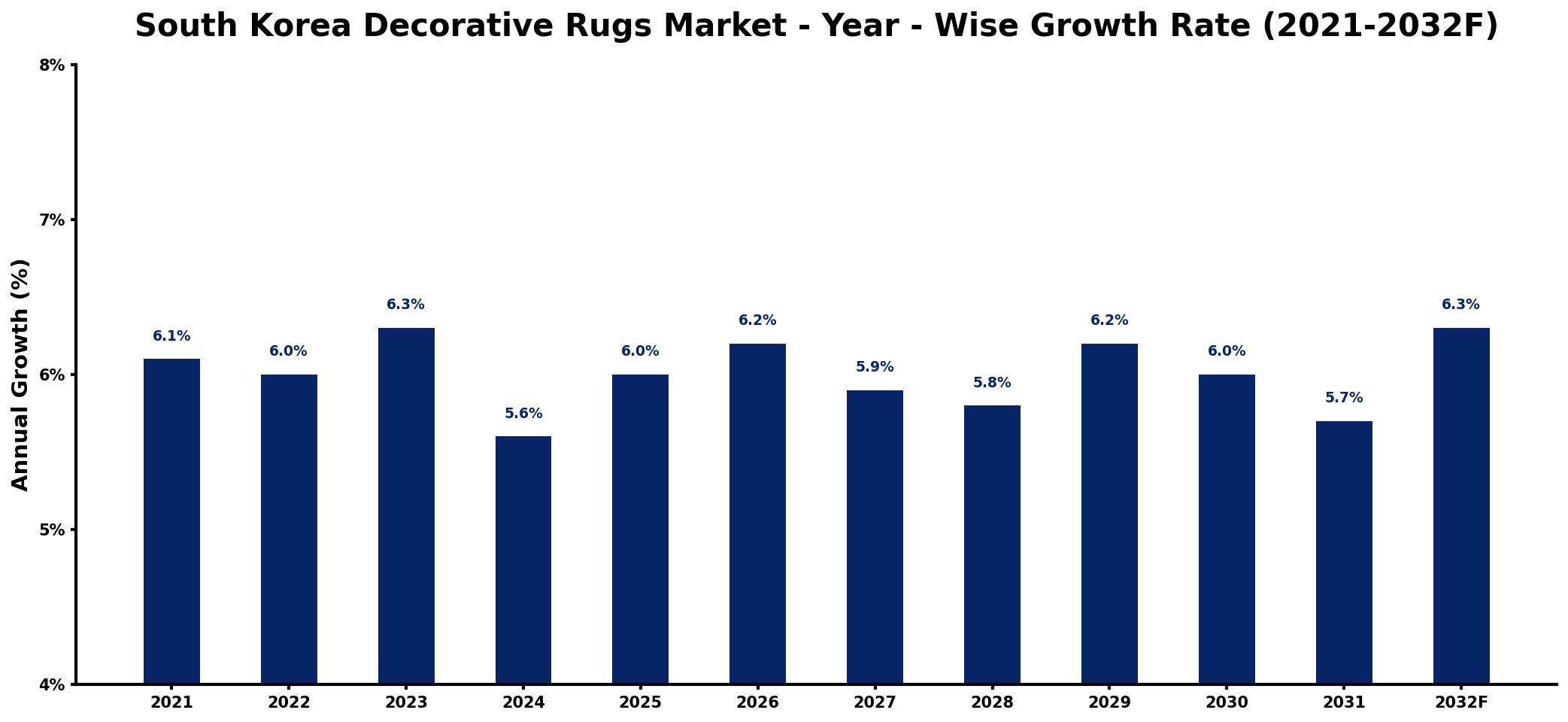
The table below presents the year‑wise growth rates along with the key drivers influencing the market
| Year | Growth Rate | Major Drivers |
| 2021 | 6.1% | Rising interior design trends |
| 2022 | 6.0% | Increased home renovation projects |
| 2023 | 6.3% | Growth in online shopping platforms |
| 2024 | 5.6% | Shift towards sustainable materials |
| 2025 | 6.0% | Expansion of e-commerce channels |
| 2026 | 6.2% | Surge in luxury home decor |
| 2027 | 5.9% | Increased demand for customization |
| 2028 | 5.8% | strengthening international trade flows |
| 2029 | 6.2% | Rising disposable income levels |
| 2030 | 6.0% | Focus on home comfort aesthetics |
| 2031 | 5.7% | Emergence of new design styles |
| 2032 | 6.3% | Increase in consumer lifestyle spending |
Note: Market size estimations and growth projections presented in this report are based on 6Wresearch's proprietary forecasting methodology, utilizing the latest available industry data, government publications, and primary research inputs.
South Korea Decorative Rugs Market Synopsis
Recently, the South Korea decorative rugs market has been on an upward trajectory, fueled by a desire for aesthetic enhancement in homes. However, as consumers increasingly prioritize eco-friendly and sustainable products, the market is shifting towards options that align with these values, positioning itself for further growth.
Looking ahead, the demand for decorative rugs is set to evolve, with emerging trends in minimalist and modern designs gaining traction. This shift suggests that the market may diversify even further, catering to an audience keen on both style and sustainability.
South Korea Decorative Rugs Market Key Takeaways
- The market is projected to grow steadily, reaching USD 1510 Million by 2032.
- Consumer preferences are increasingly leaning towards eco-friendly materials and sustainable production methods.
- Traditional Korean designs are witnessing a renaissance, appealing to consumers' sense of cultural heritage.
- Innovative online retail channels are enhancing accessibility and variety for consumers.
- Customization options are becoming crucial in meeting diverse consumer demands.
Evaluation of Restraints in South Korea Decorative Rugs Market
Despite its growth potential, the South Korea decorative rugs market faces several restraints. The intense competition from both domestic and international brands often leads to pricing pressures, affecting profit margins for companies. Additionally, the growing preference for alternative flooring solutions, such as hardwood and laminate, poses a challenge for rug manufacturers. To navigate these constraints, companies must focus on differentiation through unique offerings and strategic marketing.
South Korea Decorative Rugs Market Trends
Current trends within the South Korea decorative rugs market show a pronounced shift towards sustainability. Consumers are increasingly favoring rugs made from natural fibers, such as wool and jute. Additionally, the integration of modern design aesthetics that complement minimalist interiors is on the rise. E-commerce platforms are playing a pivotal role in reshaping consumer shopping habits, providing a broader selection and competitive pricing that traditional retail can seldom match.
South Korea Decorative Rugs Market Opportunities
The market presents numerous opportunities for growth and investment. Companies can capitalize on the rising demand for innovative and sustainable designs. There is significant potential in collaborating with local designers who understand the cultural nuances of South Korean consumers. Furthermore, the growing trend of home improvement projects offers fertile ground for the introduction of decorative rugs as a means to elevate interior spaces.
Government Initiatives in the South Korea Decorative Rugs Market
The South Korean government is actively supporting the decorative rugs market through various initiatives. Policies such as the Korea-EU Free Trade Agreement have reduced tariffs on imported rugs, increasing affordability for consumers. Additionally, strict regulations regarding quality and safety are enforced to protect consumer interests. Incentives and subsidies for local manufacturers are also in place, fostering an environment of competitiveness and innovation within the industry.
Future Insights of the South Korea Decorative Rugs Market
As we look toward 2026-2032, the South Korea decorative rugs market is expected to continue its upward momentum. The integration of social media influences and awareness of interior design trends will likely shape consumer purchasing behavior. The demand for aesthetically pleasing and high-quality rugs will remain strong, providing ample opportunities for both local and international manufacturers to thrive in this vibrant market.
South Korea Decorative Rugs Market Latest Developments (2025 - 2026)
In recent months, the South Korea decorative rugs market has seen a surge in interest toward bespoke and customizable products. Retailers are increasingly adopting technology to facilitate personalized designs, aligning with consumer trends that favor individuality. Additionally, there has been a noticeable uptick in collaborations between interior designers and rug manufacturers, enhancing the market's innovative design landscape.
South Korea Decorative Rugs Market - Key Attractiveness of the Report
- 10 Years of Market Numbers
- Historical Data Starting from 2022 to 2025
- Base Year: 2025
- Forecast Data until 2032
- Key Performance Indicators Impacting the Market
- Major Upcoming Developments and Projects
Key Highlights of the Report:
- South Korea Decorative Rugs Market Outlook
- Market Size of South Korea Decorative Rugs Market, 2025
- Forecast of South Korea Decorative Rugs Market, 2032
- Historical Data and Forecast of South Korea Decorative Rugs Revenues & Volume for the Period 2022-2032F
- South Korea Decorative Rugs Market Trend Evolution
- South Korea Decorative Rugs Market Drivers and Challenges
- South Korea Decorative Rugs Price Trends
- South Korea Decorative Rugs Porter's Five Forces
- South Korea Decorative Rugs Industry Life Cycle
- Historical Data and Forecast of South Korea Decorative Rugs Market Revenues & Volume By Product for the Period 2022-2032F
- Historical Data and Forecast of South Korea Decorative Rugs Market Revenues & Volume By Hand-knotted Rugs for the Period 2022-2032F
- Historical Data and Forecast of South Korea Decorative Rugs Market Revenues & Volume By Hand-tufted Rugs for the Period 2022-2032F
- Historical Data and Forecast of South Korea Decorative Rugs Market Revenues & Volume By Machine-made Rugs for the Period 2022-2032F
- Historical Data and Forecast of South Korea Decorative Rugs Market Revenues & Volume By Flatweave Rugs for the Period 2022-2032F
- Historical Data and Forecast of South Korea Decorative Rugs Market Revenues & Volume By Others for the Period 2022-2032F
- Historical Data and Forecast of South Korea Decorative Rugs Market Revenues & Volume By Material for the Period 2022-2032F
- Historical Data and Forecast of South Korea Decorative Rugs Market Revenues & Volume By Wool for the Period 2022-2032F
- Historical Data and Forecast of South Korea Decorative Rugs Market Revenues & Volume By Nylon for the Period 2022-2032F
- Historical Data and Forecast of South Korea Decorative Rugs Market Revenues & Volume By Cotton for the Period 2022-2032F
- Historical Data and Forecast of South Korea Decorative Rugs Market Revenues & Volume By Polyester for the Period 2022-2032F
- Historical Data and Forecast of South Korea Decorative Rugs Market Revenues & Volume By Jute for the Period 2022-2032F
- Historical Data and Forecast of South Korea Decorative Rugs Market Revenues & Volume By Others for the Period 2022-2032F
- Historical Data and Forecast of South Korea Decorative Rugs Market Revenues & Volume By Distribution Channel for the Period 2022-2032F
- Historical Data and Forecast of South Korea Decorative Rugs Market Revenues & Volume By Wholesalers/Distributors for the Period 2022-2032F
- Historical Data and Forecast of South Korea Decorative Rugs Market Revenues & Volume By Hypermarkets/Supermarkets for the Period 2022-2032F
- Historical Data and Forecast of South Korea Decorative Rugs Market Revenues & Volume By Specialty Stores for the Period 2022-2032F
- Historical Data and Forecast of South Korea Decorative Rugs Market Revenues & Volume By Online Retailers for the Period 2022-2032F
- Historical Data and Forecast of South Korea Decorative Rugs Market Revenues & Volume By Others for the Period 2022-2032F
- Historical Data and Forecast of South Korea Decorative Rugs Market Revenues & Volume By End-use for the Period 2022-2032F
- Historical Data and Forecast of South Korea Decorative Rugs Market Revenues & Volume By Residential for the Period 2022-2032F
- Historical Data and Forecast of South Korea Decorative Rugs Market Revenues & Volume By Commercial for the Period 2022-2032F
- South Korea Decorative Rugs Import Export Trade Statistics
- Market Opportunity Assessment By Product
- Market Opportunity Assessment By Material
- Market Opportunity Assessment By Distribution Channel
- Market Opportunity Assessment By End-use
- South Korea Decorative Rugs Top Companies Market Share
- South Korea Decorative Rugs Competitive Benchmarking By Technical and Operational Parameters
- South Korea Decorative Rugs Company Profiles
- South Korea Decorative Rugs Key Strategic Recommendations






































