South Korea DevSecOps Market Size & Growth Rate (2026-2032)
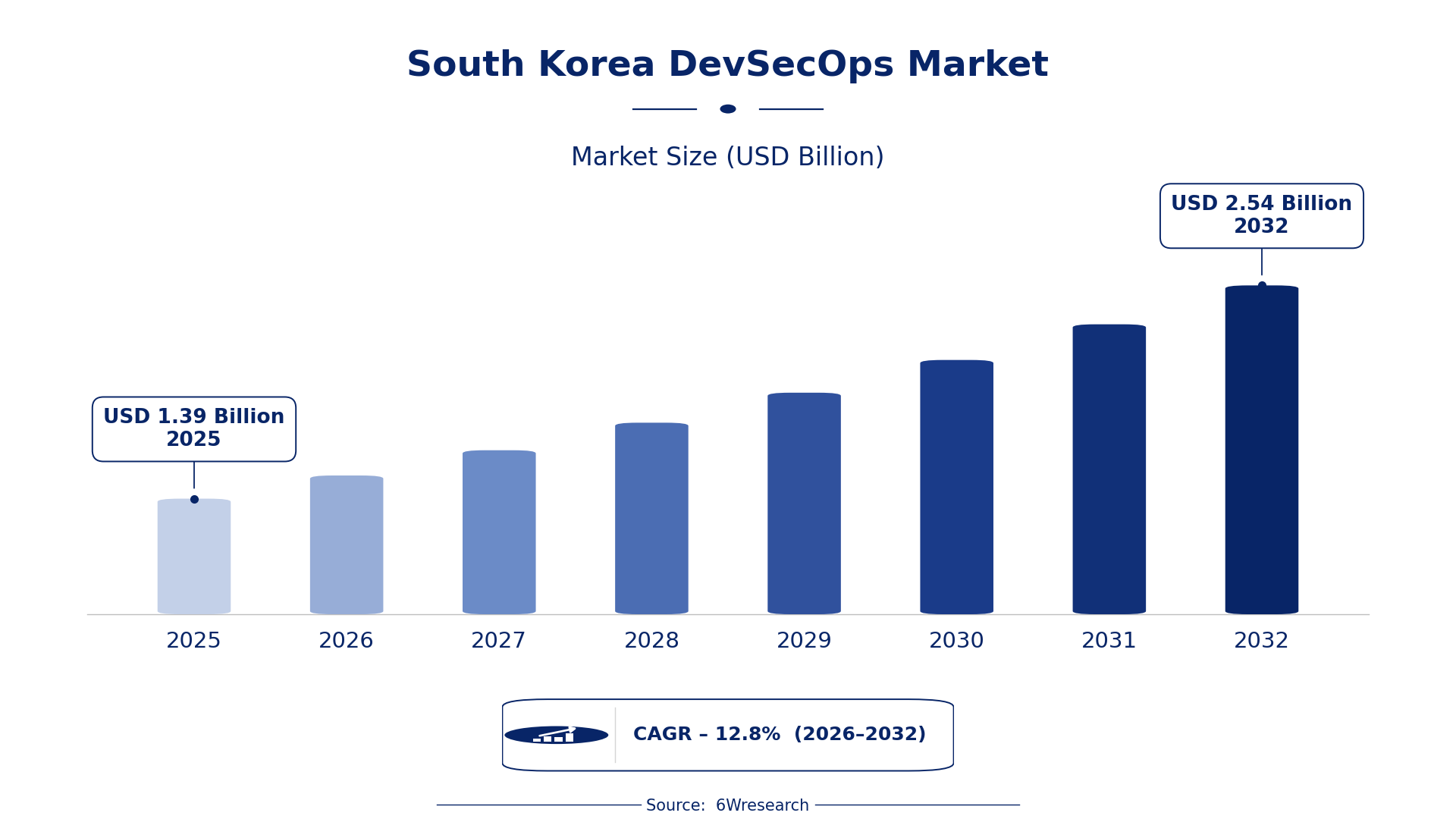
The South Korea DevSecOps Market was estimated at USD 1390 Million in 2025 and is projected to reach USD 2544 Million by 2032, growing at a CAGR of 12.8% from 2026 to 2032.
South Korea DevSecOps Market Synopsis
In South Korea, the integration of security within the DevOps pipeline is not just a trend; it’s becoming a business necessity. As organizations increasingly rely on digital solutions, the demand for secure software applications has surged, driving the DevSecOps market into a growth phase that reflects the critical importance of cybersecurity.
The commitment to agile development practices further propels this market forward. Companies are adopting DevSecOps to enhance collaboration among development, security, and operations teams, effectively automating security measures and ensuring compliance throughout the software lifecycle. This proactive approach helps mitigate risks while allowing for rapid deployment of new applications.
South Korea DevSecOps Market Year-wise Growth Rate and Key Drivers
This graph illustrates the annual growth rates of the South Korea DevSecOps Market from 2021 to 2032, highlighting a steady upward trajectory and projected expansion over the forecast period.
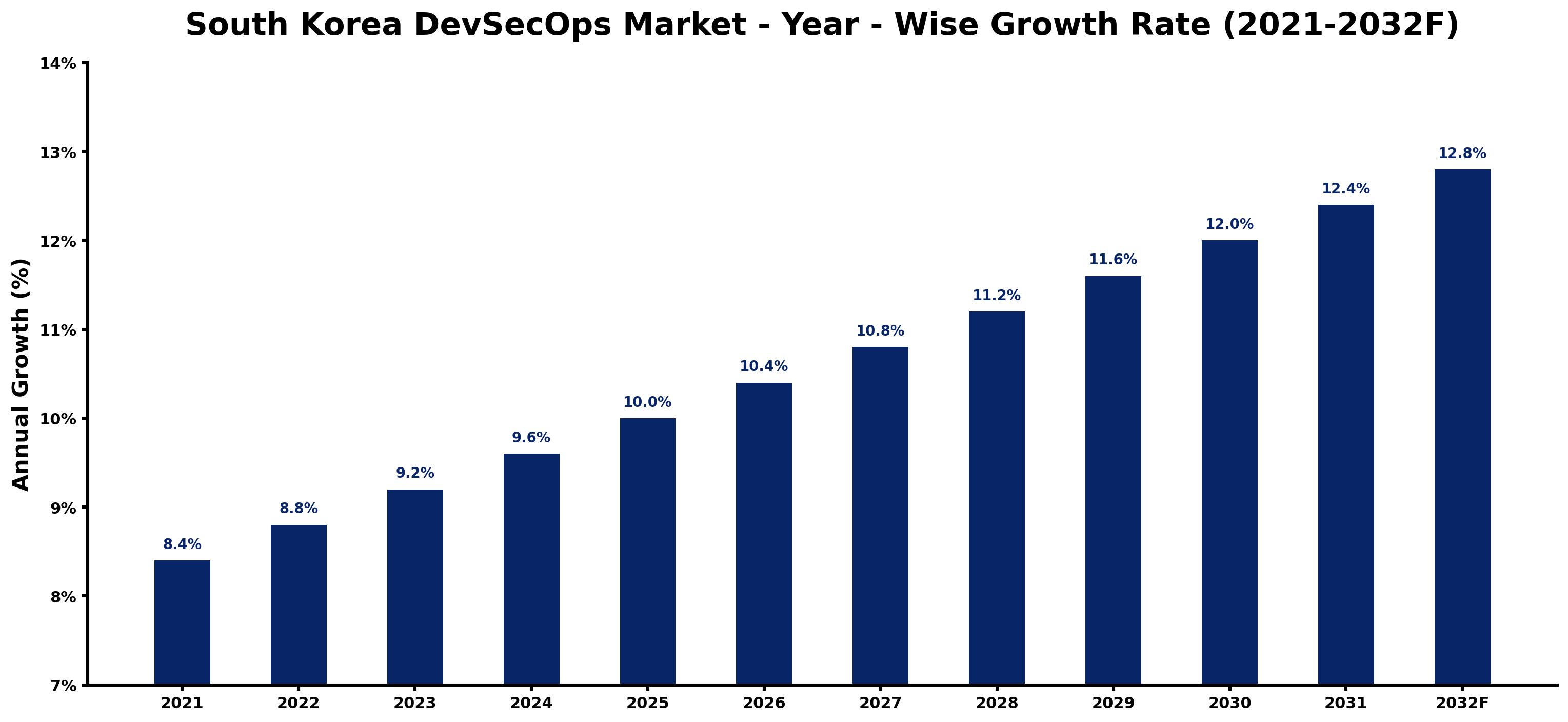
The table below presents the year‑wise growth rates along with the key drivers influencing the market
| Year | Growth Rate | Major Drivers |
| 2021 | 8.4% | Government investment in cloud-native security initiatives. |
| 2022 | 8.8% | Increased attacks prompting enhanced DevSecOps solutions demand. |
| 2023 | 9.2% | Growing adoption of AI in software development processes. |
| 2024 | 9.6% | Surge in digital transformation spurring DevSecOps initiatives. |
| 2025 | 10.0% | Local startups prioritizing security in software delivery cycles. |
| 2026 | 10.4% | Regulatory push for compliance driving secure coding practices. |
| 2027 | 10.8% | Enhanced workforce training programs on DevSecOps practices. |
| 2028 | 11.2% | Korean firms increasing investments in continuous security monitoring. |
| 2029 | 11.6% | Collaboration between tech giants fostering DevSecOps innovation. |
| 2030 | 12.0% | Focus on secure cloud infrastructure fueling market growth. |
| 2031 | 12.4% | Rising consumer awareness of data privacy influencing development. |
| 2032 | 12.8% | Integration of blockchain technology enhancing secure software delivery. |
Note: Market size estimations and growth projections presented in this report are based on 6Wresearch's proprietary forecasting methodology, utilizing the latest available industry data, government publications, and primary research inputs.
South Korea DevSecOps Market Key Takeaways
Below are some of the specific key takeaways from the market, including:
- The market is witnessing a notable shift towards automated security testing and vulnerability management.
- Regulatory compliance is becoming a driving force for organizations to adopt DevSecOps practices.
- Collaboration between development and security teams is essential for resilient software deployment.
- Organizations are increasingly prioritizing secure coding practices to minimize security flaws early in the development process.
- The rise in cybersecurity threats is pushing businesses to invest in comprehensive security measures.
Evaluation of Restraints in South Korea DevSecOps Market
Cultural resistance within organizations remains a significant barrier to the widespread adoption of DevSecOps practices in South Korea. Traditional silos between development, security, and IT operations hinder collaboration, making it challenging to implement a unified approach to security in software development. Additionally, the need for training and upskilling IT teams to integrate DevSecOps with existing agile methodologies complicates the transition. These factors collectively slow down the pace of DevSecOps implementation, despite its clear advantages.
South Korea DevSecOps Market Trends
A marked trend in the South Korean DevSecOps market is the increasing emphasis on automation. Organizations are investing in tools that streamline security testing and compliance checks, minimizing human error and accelerating deployment timelines. on top of that, the alignment of DevSecOps with cloud-native applications is gaining traction as businesses seek to enhance scalability and flexibility. The integration of Artificial Intelligence and Machine Learning for predictive analytics in vulnerability management is also on the rise, reshaping how security is approached in software development.
South Korea DevSecOps Market Opportunities
With digital transformation initiatives in full swing, significant opportunities exist for organizations to capitalize on the DevSecOps movement. Companies that prioritize security in their development pipelines can differentiate themselves in a competitive market. Investment in cybersecurity education and upskilling programs offers another avenue for growth, as the demand for knowledgeable professionals in this area continues to rise. Additionally, collaboration between the public and private sectors can spur innovative solutions and support the adoption of robust security measures.
Government Initiatives in the South Korea DevSecOps Market
The South Korean government is actively promoting the adoption of DevSecOps practices through a variety of initiatives aimed at enhancing cybersecurity in software development. These initiatives focus on integrating security into the software lifecycle, emphasizing the importance of regulatory compliance and industry collaboration. Such policies are crucial for fostering a secure digital environment in the rapidly changing technological landscape.
- A recently completed initiative to enhance cybersecurity education in universities has laid the groundwork for future professionals skilled in DevSecOps.
- An ongoing regulatory framework is being implemented to mandate security best practices in software development across various industries.
- A planned public-private partnership aims to establish a cybersecurity resource center by 2027, designed to support organizations in adopting DevSecOps methodologies.
- The government is currently facilitating workshops and training programs to encourage collaboration between development and security teams.
- Upcoming legislation expected in 2026 will introduce stricter compliance standards for software applications, further pushing the need for integrated security practices.
Future Insights of the South Korea DevSecOps Market
Looking ahead to 2026-2032, the South Korea DevSecOps market is set to experience substantial growth driven by the increasing complexity of cybersecurity threats and the need for agile software development processes. As organizations continue to prioritize speed and security, the adoption of DevSecOps will likely become standard practice. Innovations in automation and AI will redefine how security is integrated into the development lifecycle, making it imperative for companies to stay ahead of the curve to maintain competitiveness.
South Korea DevSecOps Market Latest Developments
In the last 12-14 months, the South Korea DevSecOps market has seen a flurry of activity, with organizations ramping up their investments in security automation tools and practices. This momentum reflects a growing recognition of the critical role that security plays in the development process. Companies are not only adopting new technologies but also refining their strategies to align with evolving regulatory requirements.
- A major technology vendor launched a new automated security testing tool in Q3 2025, aimed at streamlining the vulnerability management process.
- An initiative focused on integrating AI into existing DevSecOps frameworks began in early 2025 and is currently underway, with promising early results.
- A public sector program aimed at enhancing cybersecurity in small and medium-sized enterprises was initiated in late 2025 and continues to gain traction.
- A forthcoming collaboration between leading tech firms to develop a standardized DevSecOps framework is planned to kick off in mid-2026.
- A pilot program for automated compliance checks within DevSecOps processes was successfully completed in early 2025, with plans for broader implementation in 2026.
South Korea DevSecOps Market - Key Attractiveness of the Report
- 10 Years of Market Numbers
- Historical Data Starting from 2022 to 2025
- Base Year: 2025
- Forecast Data until 2032
- Key Performance Indicators Impacting the Market
- Major Upcoming Developments and Projects
Key Highlights of the Report:
- South Korea DevSecOps Market Outlook
- Market Size of South Korea DevSecOps Market, 2025
- Forecast of South Korea DevSecOps Market, 2032
- Historical Data and Forecast of South Korea DevSecOps Revenues & Volume for the Period 2022-2032F
- South Korea DevSecOps Market Trend Evolution
- South Korea DevSecOps Market Drivers and Challenges
- South Korea DevSecOps Price Trends
- South Korea DevSecOps Porter's Five Forces
- South Korea DevSecOps Industry Life Cycle
- Historical Data and Forecast of South Korea DevSecOps Market Revenues & Volume By Component for the Period 2022-2032F
- Historical Data and Forecast of South Korea DevSecOps Market Revenues & Volume By Solution for the Period 2022-2032F
- Historical Data and Forecast of South Korea DevSecOps Market Revenues & Volume By Services for the Period 2022-2032F
- Historical Data and Forecast of South Korea DevSecOps Market Revenues & Volume By Vertical for the Period 2022-2032F
- Historical Data and Forecast of South Korea DevSecOps Market Revenues & Volume By BFSI for the Period 2022-2032F
- Historical Data and Forecast of South Korea DevSecOps Market Revenues & Volume By IT for the Period 2022-2032F
- Historical Data and Forecast of South Korea DevSecOps Market Revenues & Volume By Telecommunications for the Period 2022-2032F
- Historical Data and Forecast of South Korea DevSecOps Market Revenues & Volume By Manufacturing for the Period 2022-2032F
- Historical Data and Forecast of South Korea DevSecOps Market Revenues & Volume By Government for the Period 2022-2032F
- Historical Data and Forecast of South Korea DevSecOps Market Revenues & Volume By Public Sector for the Period 2022-2032F
- Historical Data and Forecast of South Korea DevSecOps Market Revenues & Volume By Deployment Type for the Period 2022-2032F
- Historical Data and Forecast of South Korea DevSecOps Market Revenues & Volume By On-premises for the Period 2022-2032F
- Historical Data and Forecast of South Korea DevSecOps Market Revenues & Volume By Cloud for the Period 2022-2032F
- Historical Data and Forecast of South Korea DevSecOps Market Revenues & Volume By Organization Size for the Period 2022-2032F
- Historical Data and Forecast of South Korea DevSecOps Market Revenues & Volume By SMEs for the Period 2022-2032F
- Historical Data and Forecast of South Korea DevSecOps Market Revenues & Volume By Large Enterprises for the Period 2022-2032F
- South Korea DevSecOps Import Export Trade Statistics
- Market Opportunity Assessment By Component
- Market Opportunity Assessment By Vertical
- Market Opportunity Assessment By Deployment Type
- Market Opportunity Assessment By Organization Size
- South Korea DevSecOps Top Companies Market Share
- South Korea DevSecOps Competitive Benchmarking By Technical and Operational Parameters
- South Korea DevSecOps Company Profiles
- South Korea DevSecOps Key Strategic Recommendations






































