South Korea Donkey Milk Market Size, Share & Growth Rate
The South Korea Donkey Milk Market was estimated at USD 285 Million in 2025 and is projected to reach USD 392 Million by 2032, growing at a CAGR of 4.7% from 2026 to 2032. This growth trajectory is fueled by a marked increase in consumer interest in the health benefits of donkey milk, particularly in skincare applications. As awareness of the moisturizing and anti-aging properties of donkey milk rises, the market is seeing an uptick in both product development and consumer demand.
South Korea Donkey Milk Market Year-wise Growth Rate and Key Drivers
This graph highlights how the South Korea Donkey Milk Market has steadily grown over the years, supported by major growth factors.
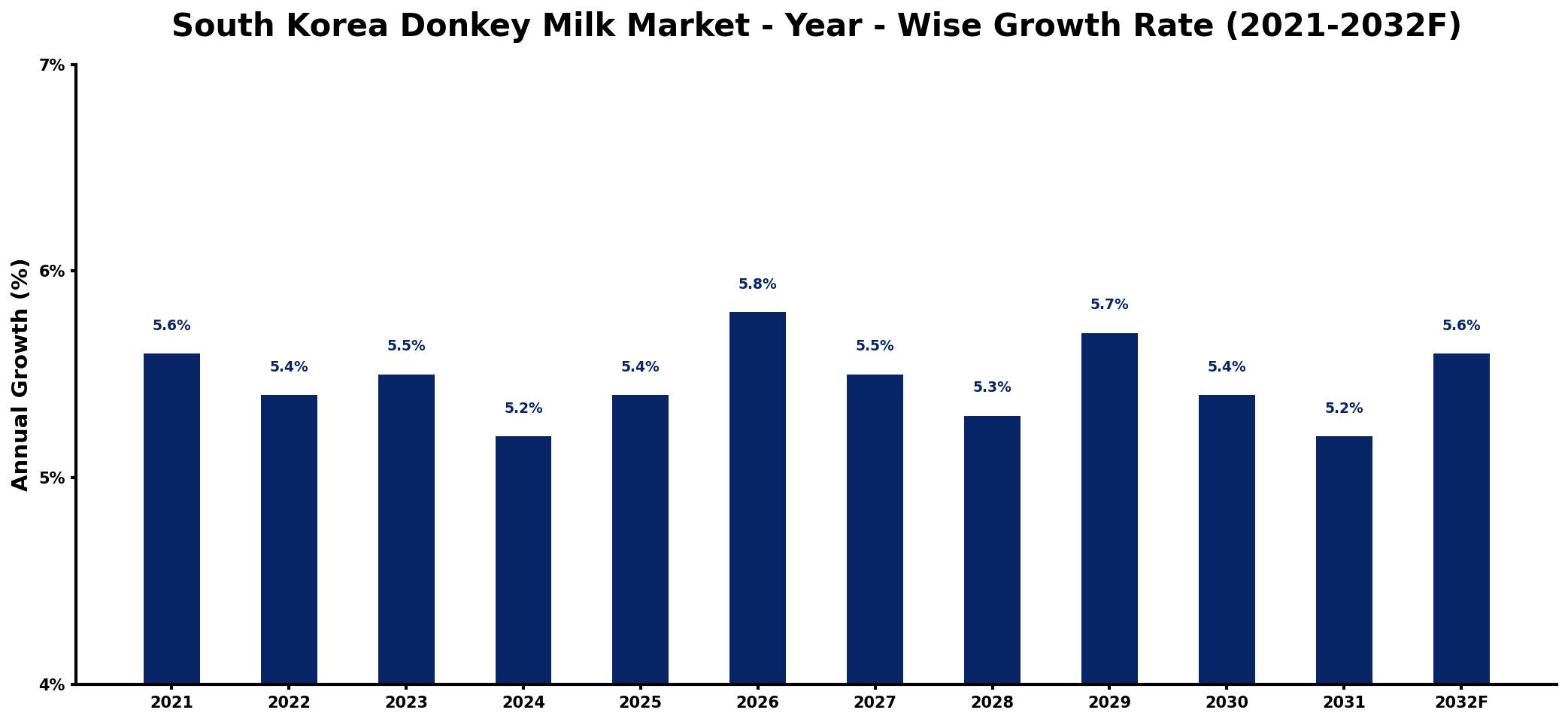
The table below presents the year‑wise growth rates along with the key drivers influencing the market
| Year | Growth Rate | Major Drivers |
| 2021 | 5.6% | Rising consumer health awareness |
| 2022 | 5.4% | Increased interest in alternatives |
| 2023 | 5.5% | Expansion of wellness trends |
| 2024 | 5.2% | Growth in premium segments |
| 2025 | 5.4% | Emerging market investment opportunities |
| 2026 | 5.8% | Enhanced distribution channels development |
| 2027 | 5.5% | Surge in online retail platforms |
| 2028 | 5.3% | Growing popularity of natural products |
| 2029 | 5.7% | Higher demand for functional foods |
| 2030 | 5.4% | Increased research and innovation |
| 2031 | 5.2% | Strengthened partnerships with retailers |
| 2032 | 5.6% | Broadened consumer education initiatives |
Note: Market size estimations and growth projections presented in this report are based on 6Wresearch's proprietary forecasting methodology, utilizing the latest available industry data, government publications, and primary research inputs.
South Korea Donkey Milk Market Synopsis
The South Korea donkey milk market is characterized by a burgeoning interest in natural beauty products. With donkey milk recognized for its rich content of vitamins and minerals, it has become a favored ingredient in various skincare formulations, including creams and soaps. This aligns with the broader consumer trend towards organic and natural cosmetic solutions.
The rising demand for donkey milk-based products is being met with innovation from companies looking to enhance their offerings. As consumers continue to prioritize non-irritating and effective skincare options, the adoption of donkey milk in beauty products is expected to accelerate, opening new avenues for market expansion.
South Korea Donkey Milk Market Key Takeaways
- Steady growth driven by increased consumer awareness of donkey milk's health benefits.
- Demand for natural and organic skincare products is propelling market expansion.
- Ongoing product innovation is enriching the market with diverse donkey milk offerings.
- Investors are increasingly interested in opportunities within donkey milk farming and product development.
- Government initiatives are supporting sustainable practices in the donkey milk industry.
Evaluation of Restraints in South Korea Donkey Milk Market
Despite the promising growth trajectory of the South Korea donkey milk market, several constraints persist. A significant challenge is the relatively low awareness of donkey milk compared to more established dairy products, which can limit consumer adoption. Additionally, sourcing donkey milk can be complicated due to its lower production volumes. Consistency in quality and supply chain management are essential but can be difficult to navigate. Regulatory complexities further add to the challenges, as the market must comply with strict health and safety standards while facing competition from alternative dairy products.
South Korea Donkey Milk Market Trends
The market is currently experiencing significant trends that reflect consumer preferences. Notably, there is a rising inclination towards clean and natural beauty, which positions donkey milk as an attractive ingredient due to its reputation for being gentle and effective. Additionally, the increasing popularity of donkey milk-based cosmetics signifies a broader acceptance of niche dairy products within the beauty industry. Companies are capitalizing on this trend by launching a variety of innovative donkey milk-infused products, enhancing consumer choice and market penetration.
South Korea Donkey Milk Market Opportunities
Investment opportunities in the South Korea donkey milk market are abundant, particularly as consumers gravitate towards premium skincare solutions. Entrepreneurs can explore ventures in donkey milk farming, processing, and product development tailored to the cosmetic industry. Collaborations with local farmers and beauty brands can lead to new product lines and greater market reach. Furthermore, leveraging digital marketing strategies can enhance visibility and drive sales, as online shopping becomes more prevalent among South Korean consumers.
Government Initiatives in the South Korea Donkey Milk Market
The South Korean government is actively fostering the donkey milk market through various initiatives aimed at quality assurance and consumer protection. Regulations regarding labeling and advertising ensure that consumers receive accurate information about donkey milk products. Additionally, subsidies for farmers contribute to the sustainability of donkey milk production, encouraging ethical practices. The government is also investing in research to further understand the health benefits of donkey milk, reinforcing its place within the cosmetic and health industries.
Future Insights of the South Korea Donkey Milk Market
Looking ahead to 2026-2032, the South Korea donkey milk market is set to experience considerable growth. Increased awareness of the nutritional and skincare benefits of donkey milk will likely drive demand further. As consumers continue to prioritize clean and sustainable beauty options, donkey milks role in this segment will become more pronounced. The expansion of e-commerce platforms will also facilitate access to donkey milk products, making them more widely available to interested consumers.
South Korea Donkey Milk Market Latest Developments (2025 - 2026)
In recent months, the South Korea donkey milk market has seen a surge in product launches, particularly in the skincare category. Companies are introducing innovative formulations that combine donkey milk with other natural ingredients to appeal to health-conscious consumers. The rise of social media marketing has also amplified consumer engagement, as influencers highlight the benefits of donkey milk products, creating a buzz around this niche segment.
South Korea Donkey Milk Market - Key Attractiveness of the Report
- 10 Years of Market Numbers
- Historical Data Starting from 2022 to 2025
- Base Year: 2025
- Forecast Data until 2032
- Key Performance Indicators Impacting the Market
- Major Upcoming Developments and Projects
Key Highlights of the Report:
- South Korea Donkey Milk Market Outlook
- Market Size of South Korea Donkey Milk Market, 2025
- Forecast of South Korea Donkey Milk Market, 2032
- Historical Data and Forecast of South Korea Donkey Milk Revenues & Volume for the Period 2022-2032F
- South Korea Donkey Milk Market Trend Evolution
- South Korea Donkey Milk Market Drivers and Challenges
- South Korea Donkey Milk Price Trends
- South Korea Donkey Milk Porter's Five Forces
- South Korea Donkey Milk Industry Life Cycle
- Historical Data and Forecast of South Korea Donkey Milk Market Revenues & Volume By Application for the Period 2022-2032F
- Historical Data and Forecast of South Korea Donkey Milk Market Revenues & Volume By Cosmetics and Personal Care for the Period 2022-2032F
- Historical Data and Forecast of South Korea Donkey Milk Market Revenues & Volume By Food & Beverages for the Period 2022-2032F
- Historical Data and Forecast of South Korea Donkey Milk Market Revenues & Volume By Form for the Period 2022-2032F
- Historical Data and Forecast of South Korea Donkey Milk Market Revenues & Volume By Liquid for the Period 2022-2032F
- Historical Data and Forecast of South Korea Donkey Milk Market Revenues & Volume By Powder for the Period 2022-2032F
- South Korea Donkey Milk Import Export Trade Statistics
- Market Opportunity Assessment By Application
- Market Opportunity Assessment By Form
- South Korea Donkey Milk Top Companies Market Share
- South Korea Donkey Milk Competitive Benchmarking By Technical and Operational Parameters
- South Korea Donkey Milk Company Profiles
- South Korea Donkey Milk Key Strategic Recommendations






































