South Korea Electrical Steel Market Size, Share & Growth Rate
The South Korea Electrical Steel Market was estimated at USD 247 Million in 2025 and is projected to reach USD 329 Million by 2032, growing at a CAGR of 4.2% from 2026 to 2032. This growth trajectory is driven by the country's rapidly expanding automotive industry, particularly the shift towards electric vehicles, alongside a surge in demand for renewable energy solutions. Additionally, advancements in manufacturing technologies and heightened energy efficiency requirements are propelling the market forward.
South Korea Electrical Steel Market Year-wise Growth Rate and Key Drivers
This graph highlights how the South Korea Electrical Steel Market has steadily grown over the years, supported by major growth factors.
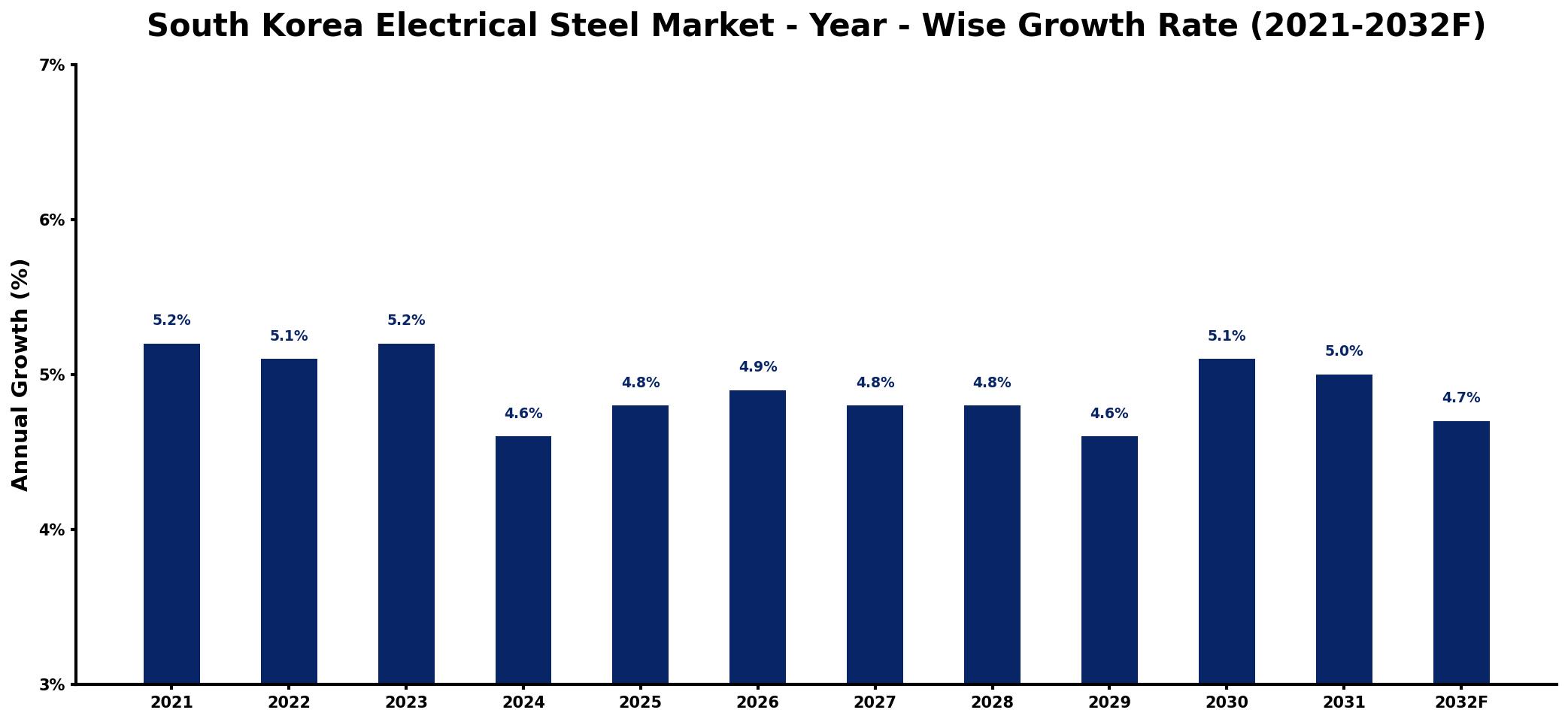
The table below presents the year‑wise growth rates along with the key drivers influencing the market
| Year | Growth Rate | Major Drivers |
| 2021 | 5.2% | Rising demand for renewable energy |
| 2022 | 5.1% | Expansion of automotive manufacturing sector |
| 2023 | 5.2% | Growth in industrial automation projects |
| 2024 | 4.6% | Shift towards energy efficient solutions |
| 2025 | 4.8% | Investment in electric vehicle infrastructure |
| 2026 | 4.9% | Increase in wind turbine installations |
| 2027 | 4.8% | Technological advancements in manufacturing |
| 2028 | 4.8% | Emergence of smart grid technologies |
| 2029 | 4.6% | Growing focus on sustainability initiatives |
| 2030 | 5.1% | increased capital investment inflows |
| 2031 | 5.0% | rising end-use demand growth |
| 2032 | 4.7% | Increased government infrastructure spending |
Note: Market size estimations and growth projections presented in this report are based on 6Wresearch's proprietary forecasting methodology, utilizing the latest available industry data, government publications, and primary research inputs.
South Korea Electrical Steel Market Synopsis
The South Korea Electrical Steel Market has been experiencing steady growth, largely propelled by the nations robust industrial base and the increased need for high-performance electrical components. With a strong focus on innovation, the market is evolving to meet the stringent energy efficiency standards expected from modern electrical systems.
Furthermore, the growing emphasis on sustainability and renewable energy has prompted manufacturers to invest in advanced materials, enhancing the quality of electrical steel. As a result, South Korea has positioned itself as a leader in the production of electrical steel that caters to critical sectors like automotive and energy.
South Korea Electrical Steel Market Key Takeaways
- The market is expected to witness a steady compound annual growth rate due to rising demand for energy-efficient solutions.
- Innovations in magnetic properties and materials are being prioritized to enhance product performance.
- Government policies are driving the growth of local manufacturers through financial support and collaboration initiatives.
- Demand from electric vehicle manufacturers is significantly influencing production strategies in the electrical steel sector.
- Sustainability trends are prompting a shift towards eco-friendly electrical steel products.
Evaluation of Restraints in South Korea Electrical Steel Market
The South Korea Electrical Steel Market grapples with several constraints that could limit its growth potential. Chief among these is the intense competition that compels manufacturers to innovate continually. Fluctuating raw material costs, particularly for iron ore and scrap metal, pose another significant challenge, as these variations can affect production expenses. Additionally, navigating stringent regulatory frameworks around environmental standards requires ongoing investment in compliant technologies, which can be burdensome for some companies. Furthermore, global economic trends and trade policies may introduce uncertainties that affect market dynamics and pricing stability.
South Korea Electrical Steel Market Trends
Emerging trends in the South Korea Electrical Steel Market indicate a robust demand for high-efficiency electrical steel products, spurred by the adoption of electric vehicles and renewable energy technologies. Manufacturers are investing heavily in R&D to develop advanced electrical steel materials that offer superior magnetic properties to satisfy the evolving needs of the automotive and energy sectors. Moreover, there is a discernible shift towards sustainability, with companies increasingly prioritizing eco-friendly production processes and materials. Collaborative efforts among industry players further aim to enhance technological capabilities and expand market reach.
South Korea Electrical Steel Market Opportunities
The South Korea Electrical Steel Market presents significant investment opportunities as the demand for electrical steel continues to soar, driven by the expansion of industries such as automotive, energy, and household appliances. With a clear shift towards renewable energy sources and energy-efficient technologies, investors can capitalize on companies producing high-quality electrical steel products essential for applications like transformers and electric motors. The ongoing technological advancements and the increasing focus on innovation within the market further enhance the potential for profitable growth.
Government Initiatives in the South Korea Electrical Steel Market
The South Korean government plays a pivotal role in fostering the growth of the electrical steel market through various initiatives aimed at bolstering domestic production capabilities and minimizing dependency on imports. Policies such as financial incentives and subsidies encourage companies to invest in R&D for advanced electrical steel technologies. Moreover, initiatives promoting collaboration between the industry and research institutions are designed to spur innovation and ensure that the domestic sector remains competitive. Regulatory frameworks focusing on sustainability and energy efficiency further underscore the governments commitment to enhancing the electrical steel market.
Future Insights of the South Korea Electrical Steel Market
Looking ahead to the period between 2026 and 2032, the South Korea Electrical Steel Market is poised for consistent growth. The increasing demand for energy-efficient electrical equipment and appliances will likely remain a driving force. Additionally, the government's continued support for renewable energy initiatives is expected to further accelerate market demand for electrical steel, particularly in applications related to transformers and electric motors. The burgeoning electric vehicle sector will also contribute to this positive outlook, as manufacturers focus on producing advanced electrical steel capable of meeting the unique demands of next-generation automotive technologies.
South Korea Electrical Steel Market Latest Developments (2025 - 2026)
In recent months, the South Korea Electrical Steel Market has seen a notable shift towards integrating advanced manufacturing technologies, particularly in response to the growing demand for electric vehicles. Manufacturers are increasingly exploring innovative alloys and production methods to enhance the performance characteristics of electrical steel. Collaboration efforts among key stakeholders have intensified, focusing on shared R&D projects aimed at improving magnetic performance and reducing production costs. These developments signal a proactive approach to meeting the evolving needs of a rapidly changing industry landscape.
South Korea Electrical Steel Market - Key Attractiveness of the Report
- 10 Years of Market Numbers
- Historical Data Starting from 2022 to 2025
- Base Year: 2025
- Forecast Data until 2032
- Key Performance Indicators Impacting the Market
- Major Upcoming Developments and Projects
Key Highlights of the Report:
- South Korea Electrical Steel Market Outlook
- Market Size of South Korea Electrical Steel Market, 2025
- Forecast of South Korea Electrical Steel Market, 2032
- Historical Data and Forecast of South Korea Electrical Steel Revenues & Volume for the Period 2022-2032F
- South Korea Electrical Steel Market Trend Evolution
- South Korea Electrical Steel Market Drivers and Challenges
- South Korea Electrical Steel Price Trends
- South Korea Electrical Steel Porter's Five Forces
- South Korea Electrical Steel Industry Life Cycle
- Historical Data and Forecast of South Korea Electrical Steel Market Revenues & Volume By Type for the Period 2022-2032F
- Historical Data and Forecast of South Korea Electrical Steel Market Revenues & Volume By Grain-oriented for the Period 2022-2032F
- Historical Data and Forecast of South Korea Electrical Steel Market Revenues & Volume By Non-grain-oriented for the Period 2022-2032F
- Historical Data and Forecast of South Korea Electrical Steel Market Revenues & Volume By End Use for the Period 2022-2032F
- Historical Data and Forecast of South Korea Electrical Steel Market Revenues & Volume By Energy for the Period 2022-2032F
- Historical Data and Forecast of South Korea Electrical Steel Market Revenues & Volume By Automotive for the Period 2022-2032F
- Historical Data and Forecast of South Korea Electrical Steel Market Revenues & Volume By Household Appliances for the Period 2022-2032F
- Historical Data and Forecast of South Korea Electrical Steel Market Revenues & Volume By Manufacturing for the Period 2022-2032F
- Historical Data and Forecast of South Korea Electrical Steel Market Revenues & Volume By Others for the Period 2022-2032F
- Historical Data and Forecast of South Korea Electrical Steel Market Revenues & Volume By Application for the Period 2022-2032F
- Historical Data and Forecast of South Korea Electrical Steel Market Revenues & Volume By Transformers for the Period 2022-2032F
- Historical Data and Forecast of South Korea Electrical Steel Market Revenues & Volume By Motors for the Period 2022-2032F
- Historical Data and Forecast of South Korea Electrical Steel Market Revenues & Volume By Inductors for the Period 2022-2032F
- Historical Data and Forecast of South Korea Electrical Steel Market Revenues & Volume By Others for the Period 2022-2032F
- South Korea Electrical Steel Import Export Trade Statistics
- Market Opportunity Assessment By Type
- Market Opportunity Assessment By End Use
- Market Opportunity Assessment By Application
- South Korea Electrical Steel Top Companies Market Share
- South Korea Electrical Steel Competitive Benchmarking By Technical and Operational Parameters
- South Korea Electrical Steel Company Profiles
- South Korea Electrical Steel Key Strategic Recommendations






































