South Korea Fruit Pulp Market Size, Share & Growth Rate
The South Korea Fruit Pulp Market was estimated at USD 761 Million in 2025 and is projected to reach USD 1086 Million by 2032, growing at a CAGR of 5.2% from 2026 to 2032. This promising growth trajectory is fueled by an increasing consumer preference for natural and minimally processed food options, which aligns with the global trend toward healthier eating habits. Moreover, innovations in processing technology are enhancing the flavor retention and nutritional value of fruit pulps, making them more appealing to food and beverage manufacturers.
South Korea Fruit Pulp Market Year-wise Growth Rate and Key Drivers
This graph highlights how the South Korea Fruit Pulp Market has steadily grown over the years, supported by major growth factors.
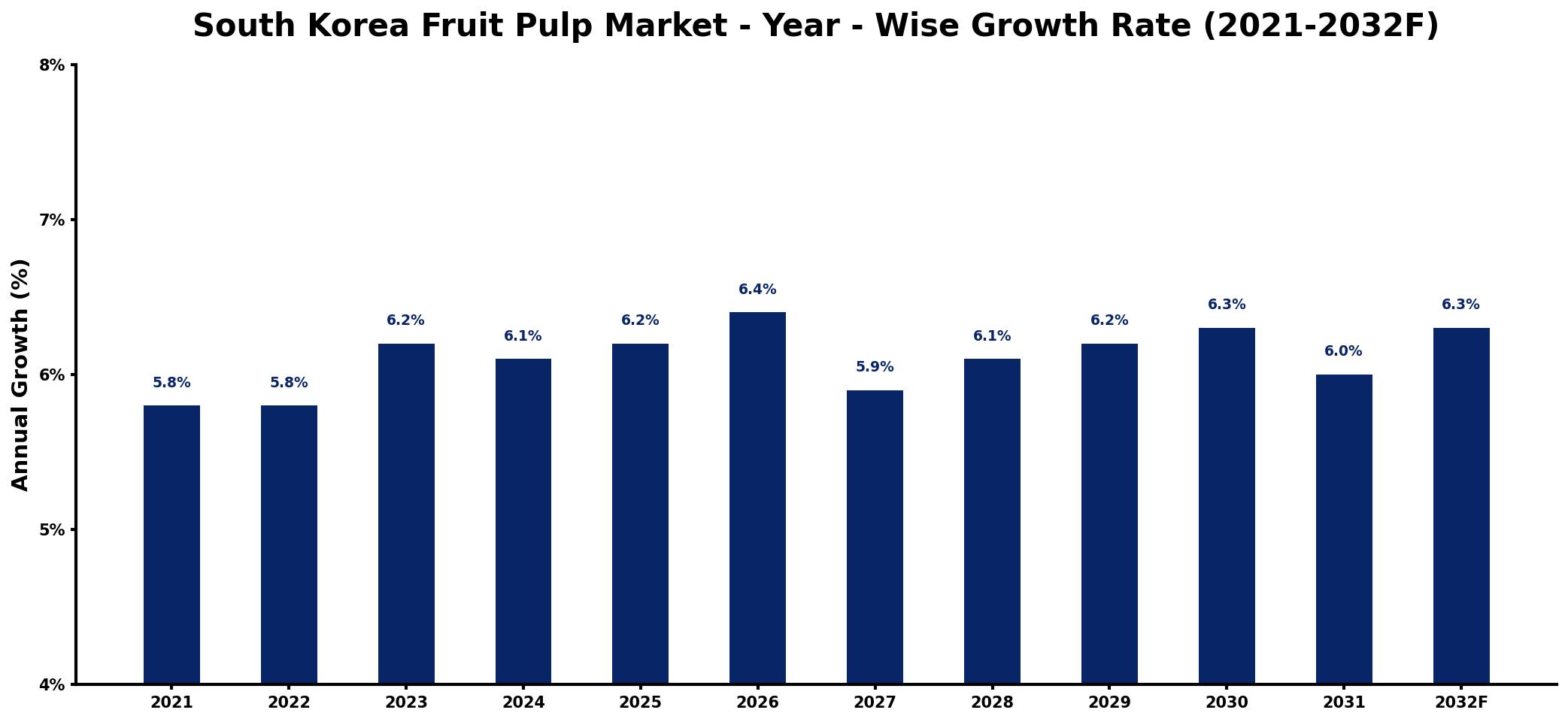
The table below presents the year‑wise growth rates along with the key drivers influencing the market
| Year | Growth Rate | Major Drivers |
| 2021 | 5.8% | Rising health-conscious consumer trends |
| 2022 | 5.8% | Increased demand for natural ingredients |
| 2023 | 6.2% | Expansion of beverage industry applications |
| 2024 | 6.1% | Growth in organic product popularity |
| 2025 | 6.2% | increased production capacity utilization |
| 2026 | 6.4% | Innovations in product formulations |
| 2027 | 5.9% | Strengthening distribution network capabilities |
| 2028 | 6.1% | Emerging markets attracting investments |
| 2029 | 6.2% | Rising popularity of functional foods |
| 2030 | 6.3% | Increased focus on sustainability initiatives |
| 2031 | 6.0% | Enhanced consumer awareness campaigns |
| 2032 | 6.3% | improved raw material availability |
Note: Market size estimations and growth projections presented in this report are based on 6Wresearch's proprietary forecasting methodology, utilizing the latest available industry data, government publications, and primary research inputs.
South Korea Fruit Pulp Market Synopsis
The strongest force shaping the South Korea Fruit Pulp Market right now is the rising demand for clean label products. Consumers are increasingly scrutinizing ingredients in their food, favoring those that are natural and free from artificial additives. This shift towards transparency is prompting manufacturers to prioritize fruit pulp as a core ingredient in various applications, from juices to dairy products.
In addition to changing consumer preferences, advancements in fruit processing technologies are playing a crucial role in market dynamics. These technologies are not only improving the efficiency of extraction processes but also enhancing the preservation of sensory attributes, such as flavor and texture, making fruit pulp more desirable in the food industry.
South Korea Fruit Pulp Market Key Takeaways
- Natural fruit ingredients are increasingly favored in beverages and food products.
- Technological innovations are enhancing the extraction and preservation processes.
- Regulatory frameworks ensure high quality and safety standards in production.
- Sustainable sourcing practices are gaining traction among consumers and producers alike.
- Market growth is driven by changing consumer preferences for health and nutrition.
Evaluation of Restraints in South Korea Fruit Pulp Market
Despite its growth, the South Korea Fruit Pulp Market faces several notable constraints. Seasonal fluctuations in fruit production can lead to supply chain disruptions, impacting both availability and pricing of fruit pulp. Additionally, the increasing consumer demand for preservative-free products complicates manufacturing processes, requiring companies to invest in advanced processing and packaging solutions while maintaining the highest standards of product quality and safety.
South Korea Fruit Pulp Market Trends
Current trends indicate a robust shift toward functional foods that offer both nutritional benefits and taste enhancement. This trend is manifested in the growing incorporation of fruit pulps into health-focused beverages and snack products. Moreover, sustainability is becoming a central theme, with more brands adopting eco-friendly practices in sourcing and processing fruit, responding to a socially-conscious consumer base. Innovations in product formulation, such as blends of various fruit pulps, are also emerging, catering to diverse palate preferences.
South Korea Fruit Pulp Market Opportunities
Significant growth opportunities exist within the South Korea Fruit Pulp Market, particularly in the functional beverage segment. As health-conscious consumers seek products that offer added benefits, there is a strong potential for fruit pulps enriched with vitamins and antioxidants. Additionally, the expansion of e-commerce channels presents an avenue for reaching broader audiences, allowing producers to introduce innovative fruit-based products directly to consumers, thus enhancing market penetration.
Government Initiatives in the South Korea Fruit Pulp Market
The South Korean government plays a pivotal role in regulating the fruit pulp market through various initiatives aimed at ensuring food safety and quality. Policies focus on establishing sourcing standards for raw materials, enforcing stringent hygiene regulations during processing, and implementing clear labeling requirements for consumers. These frameworks not only bolster the quality assurance of fruit pulps but also support sustainable agricultural practices, aligning with the growing demand for nutritious fruit-based products.
Future Insights of the South Korea Fruit Pulp Market
Looking ahead to 2026-2032, the South Korea Fruit Pulp Market is positioned for sustained growth driven by evolving consumer behavior and ongoing technological advancements. The increasing integration of fruit pulps in diverse applications will likely expand as manufacturers innovate to meet health trends and dietary preferences. Additionally, the emphasis on sustainability will continue to influence market dynamics, as both consumers and industry stakeholders prioritize environmentally conscious sourcing and production methods.
South Korea Fruit Pulp Market Latest Developments (2025 - 2026)
Recent developments in the South Korea Fruit Pulp Market show a notable increase in collaborative efforts between food producers and technology firms aimed at enhancing processing techniques. Various initiatives are underway to develop more efficient extraction methods that retain the quality and nutritional integrity of fruit pulps. Moreover, several manufacturers are exploring new fruit combinations to cater to an increasingly diverse consumer base, reflecting the market's adaptability to changing preferences and demands.
South Korea Fruit Pulp Market - Key Attractiveness of the Report
- 10 Years of Market Numbers
- Historical Data Starting from 2022 to 2025
- Base Year: 2025
- Forecast Data until 2032
- Key Performance Indicators Impacting the Market
- Major Upcoming Developments and Projects
Key Highlights of the Report:
- South Korea Fruit Pulp Market Outlook
- Market Size of South Korea Fruit Pulp Market, 2025
- Forecast of South Korea Fruit Pulp Market, 2032
- Historical Data and Forecast of South Korea Fruit Pulp Revenues & Volume for the Period 2022-2032F
- South Korea Fruit Pulp Market Trend Evolution
- South Korea Fruit Pulp Market Drivers and Challenges
- South Korea Fruit Pulp Price Trends
- South Korea Fruit Pulp Porter's Five Forces
- South Korea Fruit Pulp Industry Life Cycle
- Historical Data and Forecast of South Korea Fruit Pulp Market Revenues & Volume By Fruit Type for the Period 2022-2032F
- Historical Data and Forecast of South Korea Fruit Pulp Market Revenues & Volume By Mango for the Period 2022-2032F
- Historical Data and Forecast of South Korea Fruit Pulp Market Revenues & Volume By Strawberry for the Period 2022-2032F
- Historical Data and Forecast of South Korea Fruit Pulp Market Revenues & Volume By Apple for the Period 2022-2032F
- Historical Data and Forecast of South Korea Fruit Pulp Market Revenues & Volume By Guava for the Period 2022-2032F
- Historical Data and Forecast of South Korea Fruit Pulp Market Revenues & Volume By Berries for the Period 2022-2032F
- Historical Data and Forecast of South Korea Fruit Pulp Market Revenues & Volume By Citrus Fruits for the Period 2022-2032F
- Historical Data and Forecast of South Korea Fruit Pulp Market Revenues & Volume By Others for the Period 2022-2032F
- Historical Data and Forecast of South Korea Fruit Pulp Market Revenues & Volume By Form for the Period 2022-2032F
- Historical Data and Forecast of South Korea Fruit Pulp Market Revenues & Volume By Liquid for the Period 2022-2032F
- Historical Data and Forecast of South Korea Fruit Pulp Market Revenues & Volume By Powder for the Period 2022-2032F
- Historical Data and Forecast of South Korea Fruit Pulp Market Revenues & Volume By Application for the Period 2022-2032F
- Historical Data and Forecast of South Korea Fruit Pulp Market Revenues & Volume By Food and Beverages for the Period 2022-2032F
- Historical Data and Forecast of South Korea Fruit Pulp Market Revenues & Volume By Distribution for the Period 2022-2032F
- Historical Data and Forecast of South Korea Fruit Pulp Market Revenues & Volume By E-Commerce for the Period 2022-2032F
- Historical Data and Forecast of South Korea Fruit Pulp Market Revenues & Volume By Convenience Stores for the Period 2022-2032F
- Historical Data and Forecast of South Korea Fruit Pulp Market Revenues & Volume By Supermarkets/Hypermarkets for the Period 2022-2032F
- Historical Data and Forecast of South Korea Fruit Pulp Market Revenues & Volume By Specialty Stores for the Period 2022-2032F
- Historical Data and Forecast of South Korea Fruit Pulp Market Revenues & Volume By Others for the Period 2022-2032F
- South Korea Fruit Pulp Import Export Trade Statistics
- Market Opportunity Assessment By Fruit Type
- Market Opportunity Assessment By Form
- Market Opportunity Assessment By Application
- Market Opportunity Assessment By Distribution
- South Korea Fruit Pulp Top Companies Market Share
- South Korea Fruit Pulp Competitive Benchmarking By Technical and Operational Parameters
- South Korea Fruit Pulp Company Profiles
- South Korea Fruit Pulp Key Strategic Recommendations






































