South Korea Functional Apparel Market Size, Share & Growth Rate
The South Korea Functional Apparel Market was estimated at USD 1050 Million in 2025 and is projected to reach USD 1499 Million by 2032, growing at a CAGR of 5.2% from 2026 to 2032. This promising trajectory is underpinned by the increasing enthusiasm for outdoor activities and sports, alongside a growing consciousness around health and wellness. As consumers seek clothing that not only performs well but also aligns with their active lifestyles, innovations in textile technology are enabling brands to deliver advanced materials with exceptional functionality and comfort.
South Korea Functional Apparel Market Year-wise Growth Rate and Key Drivers
This graph highlights how the South Korea Functional Apparel Market has steadily grown over the years, supported by major growth factors.
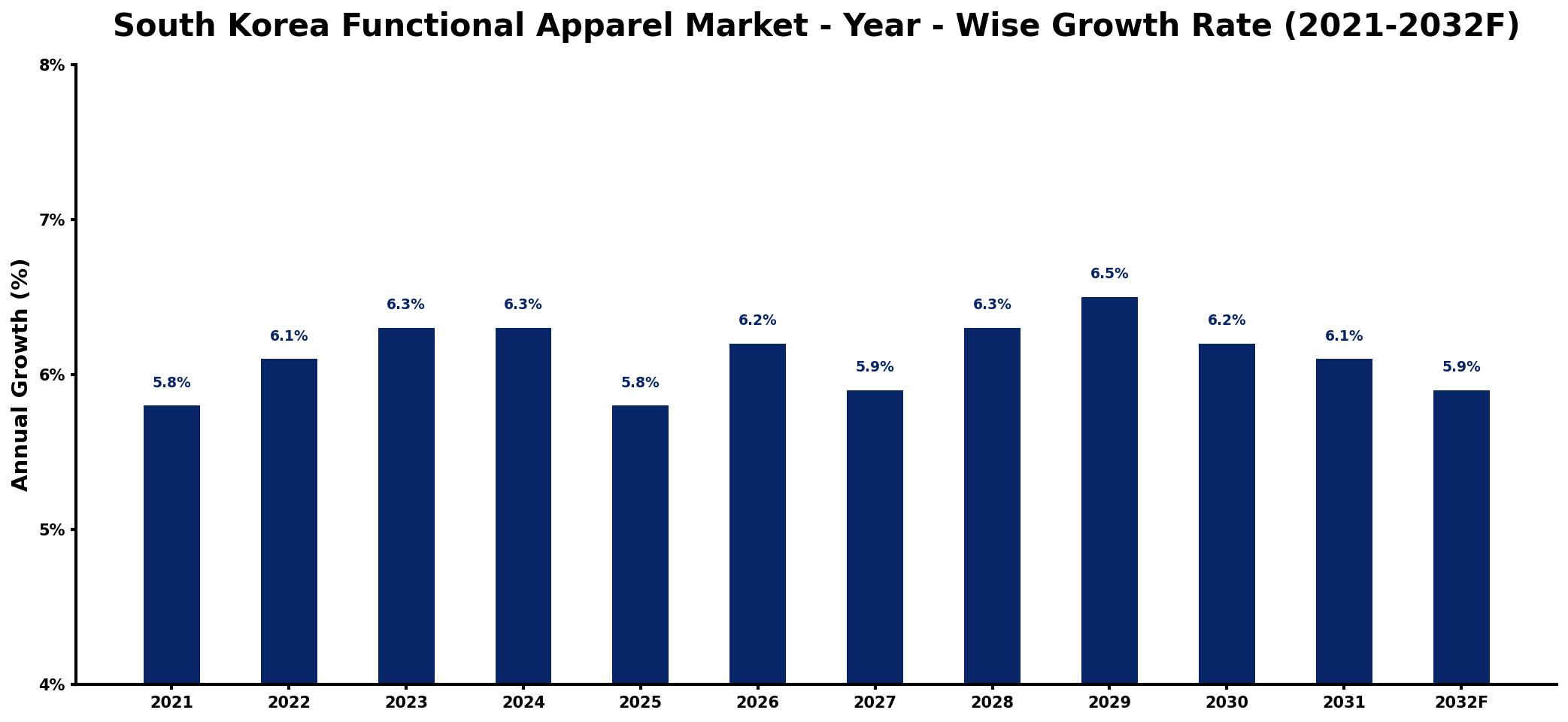
The table below presents the year‑wise growth rates along with the key drivers influencing the market
| Year | Growth Rate | Major Drivers |
| 2021 | 5.8% | Rise in active lifestyle trends |
| 2022 | 6.1% | Increased consumer health awareness |
| 2023 | 6.3% | Growing demand for sustainability |
| 2024 | 6.3% | Expansion of online retail channels |
| 2025 | 5.8% | Higher disposable income levels |
| 2026 | 6.2% | Technological advancements in materials |
| 2027 | 5.9% | Increased participation in fitness activities |
| 2028 | 6.3% | increased domestic production output |
| 2029 | 6.5% | Growing interest in outdoor activities |
| 2030 | 6.2% | increased production capacity utilization |
| 2031 | 6.1% | Increasing collaboration with influencers |
| 2032 | 5.9% | Growing popularity of athleisure trends |
Note: Market size estimations and growth projections presented in this report are based on 6Wresearch's proprietary forecasting methodology, utilizing the latest available industry data, government publications, and primary research inputs.
South Korea Functional Apparel Market Synopsis
In recent years, the South Korea Functional Apparel Market has seen robust growth driven by a surge in outdoor pursuits and fitness activities. However, as the market evolves, there is a clear shift towards multifunctional apparel that meets diverse consumer demands—blending style, comfort, and advanced performance features. As we look ahead, the integration of sustainable practices alongside innovative technologies is anticipated to redefine this segment.
Market momentum is building as brands navigate the balance between high-performance textiles and consumer preferences for fashionable yet functional attire. The industry is expected to adapt by offering apparel that not only caters to athletes but also attracts fashion-conscious consumers, thus broadening the market's appeal.
South Korea Functional Apparel Market Key Takeaways
- The market reflects a growing consumer preference for performance-driven apparel that emphasizes durability and comfort.
- Innovations in textile engineering are pivotal, enabling products with moisture-wicking, UV protection, and thermal insulation features.
- Health and wellness trends continue to fuel demand for activewear and athleisure, contributing to market expansion.
- Government regulations promote safety and sustainability, guiding product development in the functional apparel sector.
- Sustainable practices are gaining traction, responding to consumer demand for eco-friendly apparel solutions.
Evaluation of Restraints in South Korea Functional Apparel Market
Despite the favorable growth trajectory, the South Korea Functional Apparel Market faces notable restraints. Chief among them is the challenge of continuously innovating fabrics that deliver multifunctionality while remaining fashionable. The demand for high-performance characteristics—such as moisture-wicking and antibacterial properties—can be difficult to reconcile with consumer expectations for comfort and style. Additionally, fluctuating raw material prices and the need for eco-conscious manufacturing practices complicate production processes, compelling brands to adopt agile strategies to align with market trends.
South Korea Functional Apparel Market Trends
The South Korea Functional Apparel Market is increasingly influenced by trends emphasizing sustainability and health. Eco-friendly materials are becoming essential as consumers gravitate toward brands that demonstrate a commitment to environmentally responsible practices. Moreover, the rise of smart textiles—integrating technology into fabric—offers exciting prospects, with features like temperature regulation and fitness tracking embedded into clothing. Athleisure continues to gain popularity, merging comfort and style while catering to a lifestyle that blends work and play.
South Korea Functional Apparel Market Opportunities
Opportunities abound in the South Korea Functional Apparel Market as the consumer base diversifies. Companies that can harness innovative materials and align with sustainability trends will likely thrive. The increasing popularity of outdoor recreational activities presents significant potential for growth in specialized apparel segments. Additionally, tapping into the burgeoning interest in health and fitness among younger demographics can lead to the development of new product lines that resonate with evolving consumer values.
Government Initiatives in the South Korea Functional Apparel Market
The South Korean government has instituted various regulations designed to ensure product safety, environmental protection, and consumer rights within the functional apparel market. These regulations encompass material standards and labeling requirements, fostering transparency in the textile sector. Initiatives to promote eco-friendly manufacturing practices support innovation in textile engineering, creating a conducive environment for sustainable product development while ensuring compliance with safety standards.
Future Insights of the South Korea Functional Apparel Market
Looking ahead to 2026-2032, the South Korea Functional Apparel Market is poised for significant growth as consumer lifestyles evolve. An increasing focus on health, wellness, and outdoor activities will drive demand for high-performance apparel. Furthermore, advancements in sustainable materials and innovative production techniques are expected to reshape the market landscape. As brands adapt to consumer expectations for multifunctional, stylish, and eco-friendly options, the competitive dynamics will foster a vibrant ecosystem ripe for growth and investment.
South Korea Functional Apparel Market Latest Developments (2025 - 2026)
In the recent months, the South Korea Functional Apparel Market has experienced notable shifts as brands adapt to changing consumer preferences. The introduction of new fabric technologies has been a key focus, with innovations that enhance comfort and performance becoming prevalent. Additionally, sustainable practices are increasingly emphasized, with several companies announcing initiatives aimed at reducing their environmental footprint. The market is also witnessing a rise in collaborations between brands and tech companies, aiming to integrate smart technologies into functional apparel.
South Korea Functional Apparel Market - Key Attractiveness of the Report
- 10 Years of Market Numbers
- Historical Data Starting from 2022 to 2025
- Base Year: 2025
- Forecast Data until 2032
- Key Performance Indicators Impacting the Market
- Major Upcoming Developments and Projects
Key Highlights of the Report:
- South Korea Functional Apparel Market Outlook
- Market Size of South Korea Functional Apparel Market, 2025
- Forecast of South Korea Functional Apparel Market, 2032
- Historical Data and Forecast of South Korea Functional Apparel Revenues & Volume for the Period 2022-2032F
- South Korea Functional Apparel Market Trend Evolution
- South Korea Functional Apparel Market Drivers and Challenges
- South Korea Functional Apparel Price Trends
- South Korea Functional Apparel Porter's Five Forces
- South Korea Functional Apparel Industry Life Cycle
- Historical Data and Forecast of South Korea Functional Apparel Market Revenues & Volume By Product Type for the Period 2022-2032F
- Historical Data and Forecast of South Korea Functional Apparel Market Revenues & Volume By Sportswear for the Period 2022-2032F
- Historical Data and Forecast of South Korea Functional Apparel Market Revenues & Volume By Activewear for the Period 2022-2032F
- Historical Data and Forecast of South Korea Functional Apparel Market Revenues & Volume By Protective Clothing for the Period 2022-2032F
- Historical Data and Forecast of South Korea Functional Apparel Market Revenues & Volume By Others for the Period 2022-2032F
- Historical Data and Forecast of South Korea Functional Apparel Market Revenues & Volume By Application for the Period 2022-2032F
- Historical Data and Forecast of South Korea Functional Apparel Market Revenues & Volume By Sports Industry for the Period 2022-2032F
- Historical Data and Forecast of South Korea Functional Apparel Market Revenues & Volume By Outdoor Clothing for the Period 2022-2032F
- Historical Data and Forecast of South Korea Functional Apparel Market Revenues & Volume By Healthcare sector for the Period 2022-2032F
- Historical Data and Forecast of South Korea Functional Apparel Market Revenues & Volume By Distribution Channel for the Period 2022-2032F
- Historical Data and Forecast of South Korea Functional Apparel Market Revenues & Volume By Offline Store for the Period 2022-2032F
- Historical Data and Forecast of South Korea Functional Apparel Market Revenues & Volume By Online Store for the Period 2022-2032F
- South Korea Functional Apparel Import Export Trade Statistics
- Market Opportunity Assessment By Product Type
- Market Opportunity Assessment By Application
- Market Opportunity Assessment By Distribution Channel
- South Korea Functional Apparel Top Companies Market Share
- South Korea Functional Apparel Competitive Benchmarking By Technical and Operational Parameters
- South Korea Functional Apparel Company Profiles
- South Korea Functional Apparel Key Strategic Recommendations






































