South Korea Groceries Market Summary
The south korea groceries market was estimated at USD 634 Million in 2025 and is projected to reach USD 927 Million by 2032, growing at a CAGR of 6.6% from 2026 to 2032.
South Korea Groceries Market Year-wise Growth Rate and Key Drivers
This graph highlights how the South Korea Groceries Market has steadily grown over the past five years, supported by major growth factors.
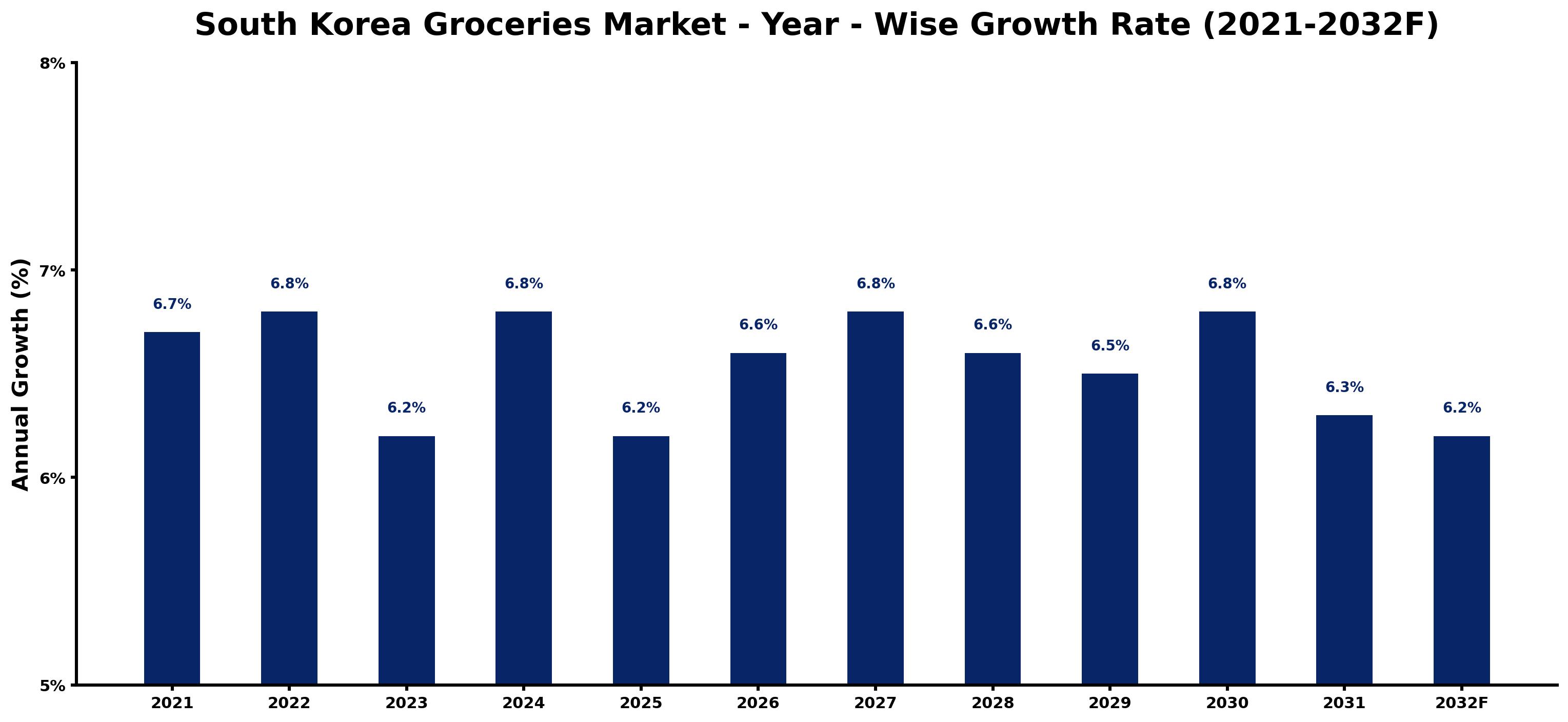
The table below presents the year wise growth rates along with the key drivers influencing the market
| Year | Growth Rate | Major Drivers |
| 2021 | 6.7% | Post-lockdown retail projects triggered a swift pivot towards online grocery platforms. |
| 2022 | 6.8% | Consumer interest in plant-based foods expanded, reshaping grocery product offerings. |
| 2023 | 6.2% | Tech investments in supply chain optimization enhanced delivery speed and customer satisfaction. |
| 2024 | 6.8% | Health-conscious trends encouraged supermarkets to stock more organic and wholesome products. |
| 2025 | 6.2% | Innovations in eco-friendly packaging gained traction, appealing to environmentally aware shoppers. |
| 2026 | 6.6% | Convenience stores began integrating advanced technologies, improving customer experience and efficiency. |
| 2027 | 6.8% | Local sourcing initiatives flourished, supporting regional farmers and enhancing product freshness. |
| 2028 | 6.6% | Demographic shifts saw younger consumers driving demand for diverse international cuisines. |
| 2029 | 6.5% | Smart kitchen devices gained popularity, creating synergies with grocery delivery services. |
| 2030 | 6.8% | Increased urbanization led to the emergence of micro-fulfillment centers near consumer hotspots. |
| 2031 | 6.3% | Collaborations between traditional grocers and tech companies spurred innovative retail solutions. |
| 2032 | 6.2% | Consumer loyalty programs evolved, leveraging data analytics to personalize shopping experiences. |
Note - Market size estimations and growth projections presented in this report are based on 6Wresearch's advanced forecasting approach, validated with industry datasets as of June 2026.
South Korea Groceries Market Synopsis
The South Korea Groceries Market is projected to reach 6.6% and witness significant growth during the forecast period (2026-2032). This market's expansion is being driven by several key factors, particularly the increasing health consciousness among South Korean consumers. As more individuals prioritize their health, there is a noticeable shift towards healthier food options, including organic products and fresh produce. Additionally, rising disposable incomes have empowered consumers to invest in higher quality and often more expensive grocery items for their households. This trend is further augmented by the proliferation of convenience stores, which are now offering a variety of ready-to-eat meals that cater to the busy lifestyles of consumers.
South Korea Groceries Market Growth Drivers
The growth trajectory of the South Korea Groceries Market can be attributed to several interrelated drivers:
- The increasing awareness of health and wellness is prompting consumers to seek out nutritious food options, significantly impacting purchasing behavior towards healthy groceries.
- With the rise in disposable income, consumers are increasingly willing to invest in premium grocery products that promise better quality and health benefits.
- The expanding network of convenience stores has made it easier for consumers to access a variety of food options, including ready-to-eat meals, which improve the convenience factor for busy lifestyles.
- Changes in consumer preferences are pushing large hypermarkets and supermarkets to innovate by developing new product lines with enhanced ingredients and attractive packaging, thereby drawing customers away from traditional small markets.
- Government initiatives aimed at promoting local produce and healthy eating habits are also contributing to the market's growth by encouraging consumers to support local farmers and businesses.
South Korea Groceries Market Trends and Opportunities
Several notable trends are currently shaping the South Korea Groceries Market, creating new opportunities for stakeholders:
- There is a significant surge in demand for organic and locally sourced products, as consumers exhibit a preference for food items that are perceived as healthier and environmentally friendly.
- The digital transformation of the grocery sector is evident, with e-commerce platforms gaining popularity, allowing consumers to shop online for their grocery needs conveniently.
- Subscription services for grocery delivery have become increasingly popular, providing consumers with curated selections of fresh produce and pantry staples delivered directly to their homes.
- Health-oriented innovations, such as ready-to-eat meals that cater to dietary preferences like vegan, gluten-free, and low-carb options, are gaining traction among health-conscious consumers.
- The emphasis on sustainability is influencing packaging trends, with more brands adopting environmentally friendly materials to appeal to eco-conscious consumers.
South Korea Groceries Market Challenges and Restraints
Despite the positive outlook, the South Korea Groceries Market faces several challenges that could hinder growth:
- High competition from both traditional retailers and online grocery platforms poses a significant challenge, as consumers are increasingly seeking value for money.
- Fluctuations in food prices due to external factors such as global supply chain disruptions can impact consumer spending and overall market stability.
- The need for constant innovation requires significant investment from grocery retailers, which can be a barrier for smaller market players.
- Regulatory and compliance requirements in terms of food safety, labeling, and environmental standards can complicate operations for grocery suppliers.
- Shifts in consumer behavior, driven by economic uncertainties and changing lifestyles, can create unpredictability in demand, making it challenging for retailers to manage inventory effectively.
South Korea Groceries Market Government Investment and Initiatives
The South Korean government has implemented a variety of initiatives aimed at bolstering the groceries sector, enhancing both market dynamics and consumer experience:
- Government policies supporting the agricultural sector encourage the use of local produce in grocery stores, promoting food security and sustainability.
- Public health campaigns focused on nutrition are being funded to raise awareness about healthy eating habits among South Korean consumers.
- Investments in infrastructure improvement are being made to facilitate better supply chain management, ensuring efficient distribution of groceries across urban and rural areas.
- Incentives for retailers to adopt technology in their operations aim to modernize grocery shopping experiences in response to the digital shift.
- Collaborative programs between the government and local producers are fostering an environment that supports the availability and promotion of organic and fresh food items in the market.
South Korea Groceries Market Latest Developments (May 2025 - June 2026)
Recent developments in the South Korea Groceries Market have showcased a dynamic shift towards innovation and consumer-centric strategies:
- Retailers have been actively expanding their product ranges to include more organic and health-oriented options, reflecting the growing consumer trend towards healthy living.
- Technological advancements have supported a rise in online grocery ordering and delivery, facilitating a seamless shopping experience for consumers.
- Promotional campaigns focused on local produce have been launched, encouraging consumers to make healthier choices and support local agriculture.
- The market has witnessed an uptick in sustainability initiatives, with retailers adopting eco-friendly packaging solutions and reducing food waste.
- Collaborative efforts between manufacturers and distribution channels are being enhanced to ensure product availability and prompt delivery in response to consumer demand.
South Korea Groceries Market - Key Attractiveness of the Report
- 10 Years of Market Numbers
- Historical Data Starting from 2022 to 2025
- Base Year: 2025
- Forecast Data until 2032
- Key Performance Indicators Impacting the Market
- Major Upcoming Developments and Projects
Key Highlights of the Report:
- South Korea Groceries Market Outlook
- Market Size of South Korea Groceries Market, 2025
- Forecast of South Korea Groceries Market, 2032F
- Historical Data and Forecast of South Korea Groceries Revenues & Volume for the Period 2022-2032F
- South Korea Groceries Market Trend Evolution
- South Korea Groceries Market Drivers and Challenges
- South Korea Groceries Price Trends
- South Korea Groceries Porter's Five Forces
- South Korea Groceries Industry Life Cycle
- Historical Data and Forecast of South Korea Groceries Market Revenues & Volume By Product Types for the Period 2022-2032F
- Historical Data and Forecast of South Korea Groceries Market Revenues & Volume By Packaged Food for the Period 2022-2032F
- Historical Data and Forecast of South Korea Groceries Market Revenues & Volume By Unpackaged Food for the Period 2022-2032F
- Historical Data and Forecast of South Korea Groceries Market Revenues & Volume By Drinks for the Period 2022-2032F
- Historical Data and Forecast of South Korea Groceries Market Revenues & Volume By Tobacco for the Period 2022-2032F
- Historical Data and Forecast of South Korea Groceries Market Revenues & Volume By Household Products for the Period 2022-2032F
- Historical Data and Forecast of South Korea Groceries Market Revenues & Volume By Others for the Period 2022-2032F
- Historical Data and Forecast of South Korea Groceries Market Revenues & Volume By Distribution Channel for the Period 2022-2032F
- Historical Data and Forecast of South Korea Groceries Market Revenues & Volume By Supermarkets & Hypermarkets for the Period 2022-2032F
- Historical Data and Forecast of South Korea Groceries Market Revenues & Volume By Convenience Store for the Period 2022-2032F
- Historical Data and Forecast of South Korea Groceries Market Revenues & Volume By Online for the Period 2022-2032F
- South Korea Groceries Import Export Trade Statistics
- Market Opportunity Assessment By Product Types
- Market Opportunity Assessment By Distribution Channel
- South Korea Groceries Top Companies Market Share
- South Korea Groceries Competitive Benchmarking By Technical and Operational Parameters
- South Korea Groceries Company Profiles
- South Korea Groceries Key Strategic Recommendations






































