South Korea Helicopter Market Size, Share & Growth Rate
The South Korea Helicopter Market was estimated at USD 702 Million in 2025 and is projected to reach USD 997 Million by 2032, growing at a CAGR of 5.1% from 2026 to 2032. This growth trajectory is primarily driven by an increasing focus on national defense initiatives, rising demand for emergency medical services, and the expanding tourism sector. The unique geographical features of South Korea, coupled with a pressing need for advanced aerial capabilities, will further fuel the market's development.
South Korea Helicopter Market Year-wise Growth Rate and Key Drivers
This graph highlights how the South Korea Helicopter Market has steadily grown over the years, supported by major growth factors.
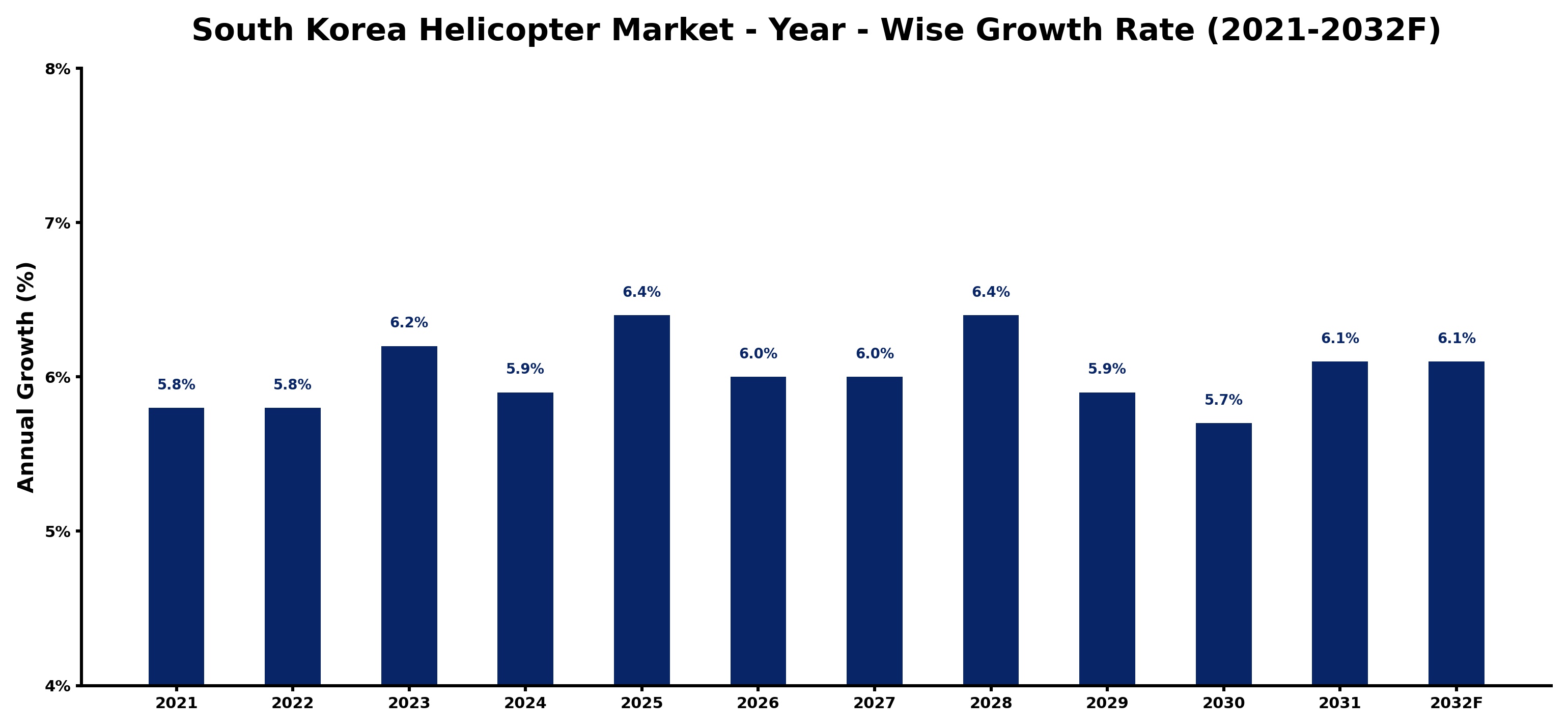
The table below presents the year‑wise growth rates along with the key drivers influencing the market
| Year | Growth Rate | Major Drivers |
| 2021 | 5.8% | Defense contracts boost helicopter component manufacturing technology integration |
| 2022 | 5.8% | Increased assembly line automation enhanced rotorcraft production capabilities |
| 2023 | 6.2% | Defense contracts drive local helicopter component manufacturing investments |
| 2024 | 5.9% | New helicopter assembly facilities boost domestic manufacturing capacity growth |
| 2025 | 6.4% | New helicopter assembly lines enhance domestic production capabilities significantly |
| 2026 | 6.0% | Defense contracts boosted helicopter component manufacturing and assembly demand |
| 2027 | 6.0% | Higher helicopter component demand fueled precision machining capabilities expansion |
| 2028 | 6.4% | Government defense contracts spurred domestic helicopter manufacturing investment |
| 2029 | 5.9% | Technology integration boosts helicopter manufacturing efficiency and export competitiveness |
| 2030 | 5.7% | Increased military contracts spurred helicopter manufacturing investment growth |
| 2031 | 6.1% | Defense contracts spurred local manufacturers to boost helicopter production capacity |
| 2032 | 6.1% | Local helicopter manufacturers boost supply chains through export contracts |
Note - Market size estimations and growth projections presented in this report are based on 6Wresearch's advanced forecasting approach, validated with industry datasets as of June 2026.
South Korea Helicopter Market Synopsis
The South Korea helicopter market has witnessed steady momentum, with significant investments in military and civilian applications over recent years. However, as the landscape evolves, various sectors are poised to experience accelerated growth, particularly in emergency services and tourism. This shift highlights the increasing reliance on helicopters for not only defense but also civic enhancement and recreational activities.
Looking ahead, advancements in technology and innovation are expected to reshape the market. As the government continues to modernize its military fleet, opportunities arise for helicopter manufacturers to introduce cutting-edge designs that are both environmentally sustainable and operationally efficient. This dynamic environment ensures that stakeholders remain keenly interested in the evolving capabilities of helicopter systems.
South Korea Helicopter Market Key Takeaways
- The market is benefiting from increasing government spending on defense and public safety initiatives.
- Rugged terrain and geographical diversity drive demand for helicopters in emergency and transportation services.
- Tourism-related helicopter services are gaining popularity, further expanding market reach.
- Innovations in design and technology are transforming helicopter capabilities, focusing on efficiency and sustainability.
- Investment opportunities abound for companies engaged in helicopter manufacturing and support services.
Evaluation of Restraints in South Korea Helicopter Market
Despite its promising outlook, the South Korea helicopter market faces significant constraints that may impede growth. A limited defense budget can restrict procurement opportunities, particularly for military helicopters. Furthermore, established global manufacturers pose strong competition, creating challenges for domestic players attempting to innovate and capture market share. Regulations regarding military equipment imports can complicate the operational landscape, necessitating close compliance with stringent governmental requirements. These factors contribute to a complex market environment that requires adept navigation by all stakeholders involved.
South Korea Helicopter Market Trends
Several current trends are shaping the South Korea helicopter market. The increasing demand for advanced surveillance and search and rescue capabilities has spurred growth in law enforcement and emergency medical sectors. Additionally, there is a notable shift towards environmentally friendly helicopter designs, as manufacturers aim to meet growing regulatory pressures for sustainability. The rising popularity of helicopter tours among domestic and international tourists underscores a strong demand for civilian applications, which is likely to expand further in the near future.
South Korea Helicopter Market Opportunities
The South Korea helicopter market offers several promising avenues for growth and investment. The government's ongoing commitment to enhancing national defense capabilities suggests a potential increase in procurement contracts for military helicopters. Moreover, the growing need for transportation services across the nation's diverse terrain creates opportunities for commercial helicopter services. Companies that can leverage South Korea's robust technological infrastructure and skilled workforce stand to benefit significantly from partnerships focused on innovative helicopter technologies and applications.
Government Initiatives in the South Korea Helicopter Market
In recent years, the South Korean government has implemented various initiatives aimed at bolstering the helicopter market. These initiatives include promoting research and development in the aerospace sector, providing tax incentives for investments in helicopter technology, and reforming regulations to streamline certification processes for new models. Additionally, the government is investing in infrastructure projects, such as constructing heliports, to enhance operational efficiency and accessibility for helicopter services. These supportive measures are designed to foster a more competitive and innovative domestic helicopter industry.
Future Insights of the South Korea Helicopter Market
The future of the South Korea helicopter market appears robust, driven by various demand factors across defense, tourism, and public safety sectors. As the government continues to modernize its military assets, substantial investments in helicopter procurement are anticipated. Furthermore, the evolving popularity of helicopter services in urban environments and the tourism industry will likely enhance operational demand. With technological advancements paving the way for more versatile and fuel-efficient helicopters, stakeholders can expect sustained growth and increased market opportunities from 2026 to 2032.
South Korea Helicopter Market Latest Developments (May 2025 - June 2026)
Recent developments in the South Korea helicopter market indicate a trend toward greater collaboration between domestic manufacturers and international partners. This collaboration is focused on technology transfer and co-development of next-generation helicopters designed to meet specific operational needs. Additionally, there is a growing emphasis on enhancing the safety and efficiency of existing helicopter models, reflecting the market's commitment to maintaining high operational standards while adapting to new requirements.
South Korea Helicopter Market - Key Attractiveness of the Report
- 10 Years of Market Numbers
- Historical Data Starting from 2022 to 2025
- Base Year: 2025
- Forecast Data until 2032
- Key Performance Indicators Impacting the Market
- Major Upcoming Developments and Projects
Key Highlights of the Report:
- South Korea Helicopter Market Outlook
- Market Size of South Korea Helicopter Market, 2025
- Forecast of South Korea Helicopter Market, 2032
- Historical Data and Forecast of South Korea Helicopter Revenues & Volume for the Period 2022-2032F
- South Korea Helicopter Market Trend Evolution
- South Korea Helicopter Market Drivers and Challenges
- South Korea Helicopter Price Trends
- South Korea Helicopter Porter's Five Forces
- South Korea Helicopter Industry Life Cycle
- Historical Data and Forecast of South Korea Helicopter Market Revenues & Volume By End-users for the Period 2022-2032F
- Historical Data and Forecast of South Korea Helicopter Market Revenues & Volume By Commercial for the Period 2022-2032F
- Historical Data and Forecast of South Korea Helicopter Market Revenues & Volume By Military for the Period 2022-2032F
- Historical Data and Forecast of South Korea Helicopter Market Revenues & Volume By Component for the Period 2022-2032F
- Historical Data and Forecast of South Korea Helicopter Market Revenues & Volume By Aerostructures/Airframes for the Period 2022-2032F
- Historical Data and Forecast of South Korea Helicopter Market Revenues & Volume By Rotary System for the Period 2022-2032F
- Historical Data and Forecast of South Korea Helicopter Market Revenues & Volume By Engine for the Period 2022-2032F
- Historical Data and Forecast of South Korea Helicopter Market Revenues & Volume By Undercarriage for the Period 2022-2032F
- Historical Data and Forecast of South Korea Helicopter Market Revenues & Volume By Avionics for the Period 2022-2032F
- Historical Data and Forecast of South Korea Helicopter Market Revenues & Volume By Cabin Interiors for the Period 2022-2032F
- Historical Data and Forecast of South Korea Helicopter Market Revenues & Volume By Environmental Control System for the Period 2022-2032F
- Historical Data and Forecast of South Korea Helicopter Market Revenues & Volume By Sales Channels for the Period 2022-2032F
- Historical Data and Forecast of South Korea Helicopter Market Revenues & Volume By OEM for the Period 2022-2032F
- Historical Data and Forecast of South Korea Helicopter Market Revenues & Volume By Maintenance for the Period 2022-2032F
- Historical Data and Forecast of South Korea Helicopter Market Revenues & Volume By Repair for the Period 2022-2032F
- Historical Data and Forecast of South Korea Helicopter Market Revenues & Volume By Overhaul for the Period 2022-2032F
- South Korea Helicopter Import Export Trade Statistics
- Market Opportunity Assessment By End-users
- Market Opportunity Assessment By Component
- Market Opportunity Assessment By Sales Channels
- South Korea Helicopter Top Companies Market Share
- South Korea Helicopter Competitive Benchmarking By Technical and Operational Parameters
- South Korea Helicopter Company Profiles
- South Korea Helicopter Key Strategic Recommendations






































