South Korea Hepatitis Vaccine Market Size, Share & Growth Rate
The South Korea Hepatitis Vaccine Market was estimated at USD 395 Million in 2025 and is projected to reach USD 535 Million by 2032, growing at a CAGR of 4.4% from 2026 to 2032. This growth trajectory is propelled by heightened public awareness around vaccination and government policies aimed at enhancing vaccination rates. The rising incidence of hepatitis infections alongside advancements in vaccine development underscores the potential for sustained market expansion.
South Korea Hepatitis Vaccine Market Year-wise Growth Rate and Key Drivers
This graph highlights how the South Korea Hepatitis Vaccine Market has steadily grown over the years, supported by major growth factors.
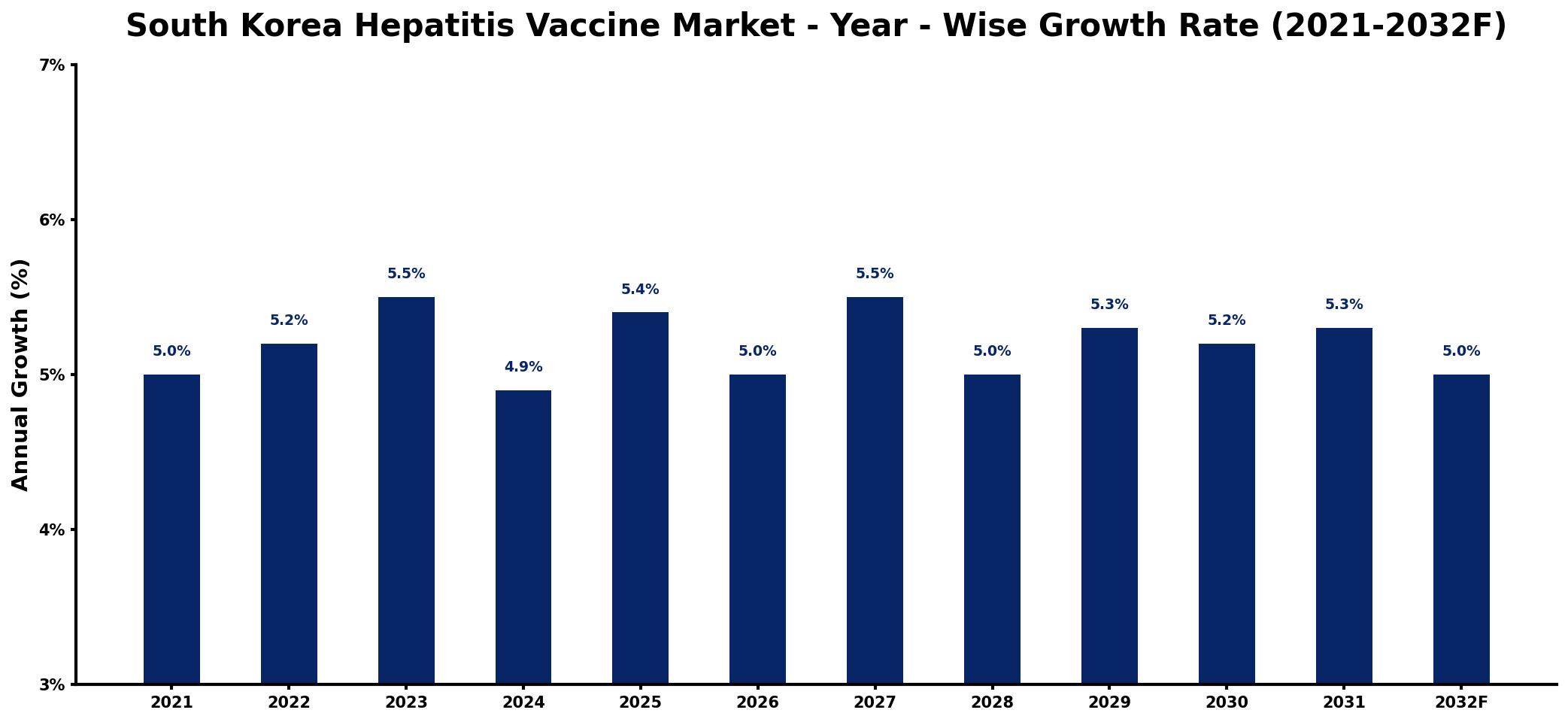
The table below presents the year‑wise growth rates along with the key drivers influencing the market
| Year | Growth Rate | Major Drivers |
| 2021 | 5.0% | Increased public health awareness |
| 2022 | 5.2% | Government funding for immunization programs |
| 2023 | 5.5% | Rising healthcare expenditure growth |
| 2024 | 4.9% | Emergence of new healthcare initiatives |
| 2025 | 5.4% | Strengthened disease prevention policies |
| 2026 | 5.0% | Expansion of healthcare infrastructure |
| 2027 | 5.5% | Growing demand for preventive care |
| 2028 | 5.0% | Investment in biotechnology advancements |
| 2029 | 5.3% | Enhanced education on disease prevention |
| 2030 | 5.2% | Supportive regulatory frameworks established |
| 2031 | 5.3% | Collaborations with international organizations |
| 2032 | 5.0% | Increased focus on community health |
Note: Market size estimations and growth projections presented in this report are based on 6Wresearch's proprietary forecasting methodology, utilizing the latest available industry data, government publications, and primary research inputs.
South Korea Hepatitis Vaccine Market Synopsis
The South Korea Hepatitis Vaccine Market has recently gained momentum, driven by government initiatives and increasing awareness regarding hepatitis prevention. However, despite this positive outlook, challenges such as competition from generic vaccines and limited public knowledge persist, potentially impacting future growth.
Looking ahead, the market is poised for further development as ongoing research and development efforts focus on the introduction of more effective vaccines. The healthcare landscape in South Korea, characterized by robust infrastructure and a commitment to preventive healthcare, offers a conducive environment for the hepatitis vaccine market to thrive.
South Korea Hepatitis Vaccine Market Key Takeaways
- The market is driven by increased governmental support and public health campaigns aimed at boosting vaccination rates.
- Rising prevalence of hepatitis infections highlights the urgent need for preventive healthcare measures.
- Innovations in vaccine formulations are expected to enhance efficacy and safety profiles.
- Partnerships between pharmaceutical companies and research institutions are fostering advancements in vaccine technology.
- Investment opportunities lie in expanding distribution networks and collaborating with local manufacturers.
Evaluation of Restraints in South Korea Hepatitis Vaccine Market
The South Korea Hepatitis Vaccine Market faces a variety of restraints that impede its growth. The increasing prevalence of generic vaccines poses a significant competitive challenge, particularly for established brands. Additionally, the high cost of innovative vaccines raises concerns among healthcare providers and patients alike, as budget constraints can limit access. Furthermore, public awareness regarding the benefits of vaccination remains insufficient, and regulatory hurdles often delay the approval of new formulations, complicating market entry for potential innovations. Addressing these issues will be essential for unlocking the full potential of the market.
South Korea Hepatitis Vaccine Market Trends
Current trends within the South Korea Hepatitis Vaccine Market emphasize a growing demand for combination vaccines that offer protection against multiple strains of hepatitis. This shift is indicative of consumers' preference for convenience and cost-effectiveness. Moreover, increased collaboration between pharmaceutical firms and academic institutions is leading to the development of next-generation vaccines that promise enhanced safety and efficacy. Overall, the focus on preventive healthcare is gaining traction, influencing vaccination practices across the region.
South Korea Hepatitis Vaccine Market Opportunities
The South Korea Hepatitis Vaccine Market presents substantial investment opportunities fueled by rising public consciousness about hepatitis prevention and government-backed vaccination programs. The increasing burden of hepatitis infections underscores a growing demand for vaccines. Investors may explore avenues in enhancing vaccine distribution channels and engaging in strategic partnerships with local manufacturers to leverage the rising need for hepatitis vaccines. Additionally, participation in public health initiatives could create avenues for market penetration and expansion.
Government Initiatives in the South Korea Hepatitis Vaccine Market
The South Korean government has taken significant steps to foster the Hepatitis vaccine market through various policy initiatives. Since the inclusion of the Hepatitis B vaccine in the National Immunization Program in 2017, there has been a concerted effort to promote vaccination among infants and high-risk populations. Subsidies for Hepatitis B vaccination, particularly targeting healthcare workers and individuals with chronic liver diseases, demonstrate a commitment to enhancing public health outcomes. Furthermore, the establishment of comprehensive guidelines for the management and prevention of hepatitis emphasizes the governments proactive stance on tackling hepatitis infections.
Future Insights of the South Korea Hepatitis Vaccine Market
Looking towards 2026-2032, the South Korea Hepatitis Vaccine Market is expected to experience a steady upward trajectory driven by a combination of increased public awareness and ongoing government initiatives aimed at controlling hepatitis prevalence. The growing elderly population, more susceptible to hepatitis infections, will further escalate vaccine demand. Continuous investments in R&D by market participants to enhance vaccine formulations will undoubtedly contribute to improved efficacy and market growth. Overall, the landscape appears promising, indicating robust opportunities for stakeholders within the healthcare sector.
South Korea Hepatitis Vaccine Market Latest Developments (2025 - 2026)
In the last year, the South Korea Hepatitis Vaccine Market has seen a range of developments focusing on vaccine accessibility and efficacy. Ongoing clinical trials are being conducted to assess new formulations that may offer improved protection against diverse strains of hepatitis. Partnerships aimed at enhancing distribution networks are also emerging, allowing for better accessibility of vaccines across the country. As public health initiatives continue to evolve, the emphasis on preventive care remains a focal point in combating hepatitis infections.
South Korea Hepatitis Vaccine Market - Key Attractiveness of the Report
- 10 Years of Market Numbers
- Historical Data Starting from 2022 to 2025
- Base Year: 2025
- Forecast Data until 2032
- Key Performance Indicators Impacting the Market
- Major Upcoming Developments and Projects
Key Highlights of the Report:
- South Korea Hepatitis Vaccine Market Outlook
- Market Size of South Korea Hepatitis Vaccine Market, 2025
- Forecast of South Korea Hepatitis Vaccine Market, 2032
- Historical Data and Forecast of South Korea Hepatitis Vaccine Revenues & Volume for the Period 2022-2032F
- South Korea Hepatitis Vaccine Market Trend Evolution
- South Korea Hepatitis Vaccine Market Drivers and Challenges
- South Korea Hepatitis Vaccine Price Trends
- South Korea Hepatitis Vaccine Porter's Five Forces
- South Korea Hepatitis Vaccine Industry Life Cycle
- Historical Data and Forecast of South Korea Hepatitis Vaccine Market Revenues & Volume By Indication for the Period 2022-2032F
- Historical Data and Forecast of South Korea Hepatitis Vaccine Market Revenues & Volume By Hepatitis A for the Period 2022-2032F
- Historical Data and Forecast of South Korea Hepatitis Vaccine Market Revenues & Volume By Hepatitis B for the Period 2022-2032F
- Historical Data and Forecast of South Korea Hepatitis Vaccine Market Revenues & Volume By Vaccine Type for the Period 2022-2032F
- Historical Data and Forecast of South Korea Hepatitis Vaccine Market Revenues & Volume By Recombinant Vaccine for the Period 2022-2032F
- Historical Data and Forecast of South Korea Hepatitis Vaccine Market Revenues & Volume By Inactivated Vaccine for the Period 2022-2032F
- Historical Data and Forecast of South Korea Hepatitis Vaccine Market Revenues & Volume By Distribution Channel for the Period 2022-2032F
- Historical Data and Forecast of South Korea Hepatitis Vaccine Market Revenues & Volume By Hospitals for the Period 2022-2032F
- Historical Data and Forecast of South Korea Hepatitis Vaccine Market Revenues & Volume By Retail Pharmacy for the Period 2022-2032F
- Historical Data and Forecast of South Korea Hepatitis Vaccine Market Revenues & Volume By Online Pharmacy for the Period 2022-2032F
- South Korea Hepatitis Vaccine Import Export Trade Statistics
- Market Opportunity Assessment By Indication
- Market Opportunity Assessment By Vaccine Type
- Market Opportunity Assessment By Distribution Channel
- South Korea Hepatitis Vaccine Top Companies Market Share
- South Korea Hepatitis Vaccine Competitive Benchmarking By Technical and Operational Parameters
- South Korea Hepatitis Vaccine Company Profiles
- South Korea Hepatitis Vaccine Key Strategic Recommendations






































