South Korea Hiking Gear & Equipment Market Size, Share & Growth Rate
The South Korea Hiking Gear & Equipment Market was estimated at USD 457 Million in 2025 and is projected to reach USD 637 Million by 2032, growing at a CAGR of 4.9% from 2026 to 2032. This growth trajectory is primarily fueled by an increasing appreciation for outdoor activities among the South Korean population, coupled with a heightened focus on personal health and fitness. Consumers are increasingly investing in high-quality, durable gear as they seek more engaging ways to connect with nature and improve their physical well-being.
South Korea Hiking Gear & Equipment Market Year-wise Growth Rate and Key Drivers
This graph highlights how the South Korea Hiking Gear & Equipment Market has steadily grown over the years, supported by major growth factors.
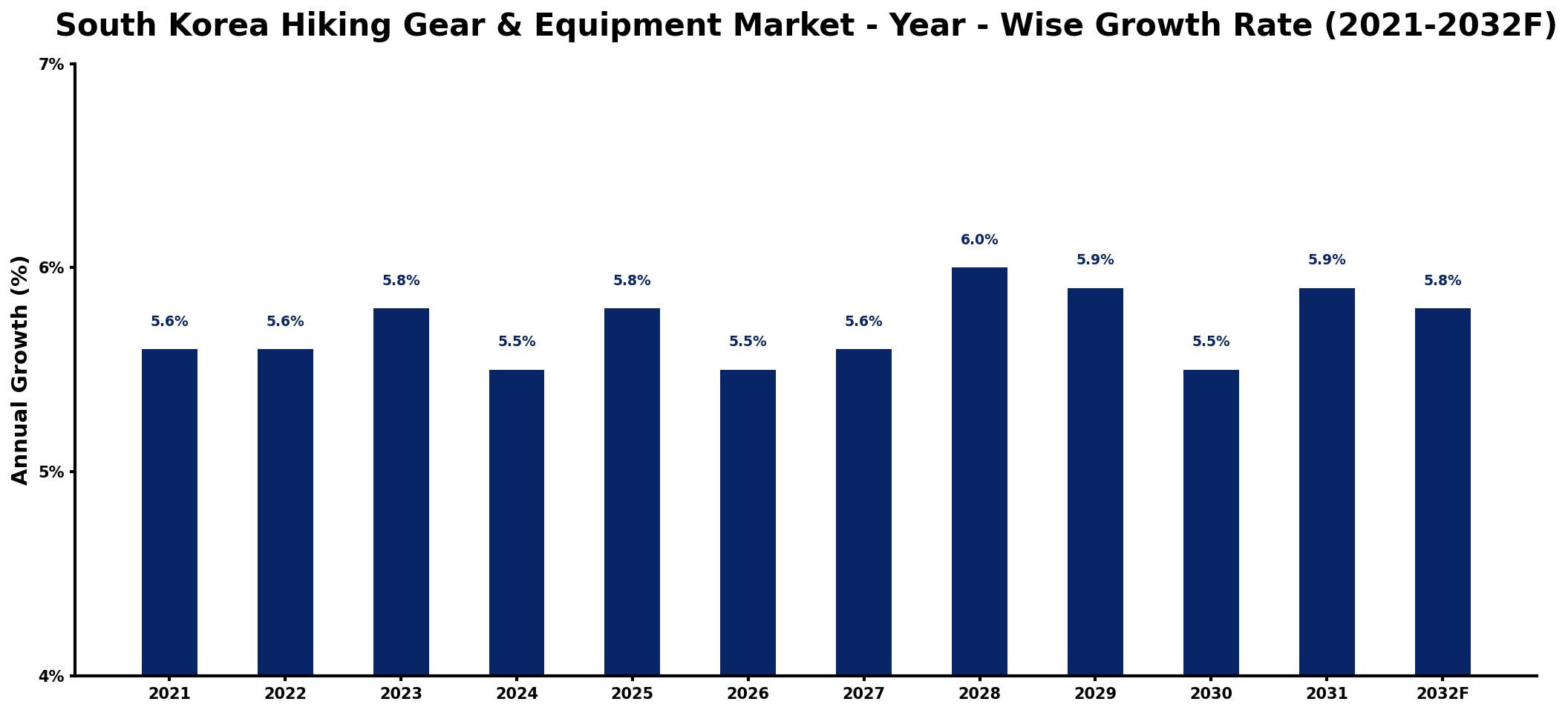
The table below presents the year‑wise growth rates along with the key drivers influencing the market
| Year | Growth Rate | Major Drivers |
| 2021 | 5.6% | Rise in outdoor recreational activities |
| 2022 | 5.6% | Increased consumer disposable income |
| 2023 | 5.8% | Expansion of eco-tourism initiatives |
| 2024 | 5.5% | Growth in health consciousness trends |
| 2025 | 5.8% | Surge in adventure travel popularity |
| 2026 | 5.5% | Development of new nature trails |
| 2027 | 5.6% | Increase in family outdoor trips |
| 2028 | 6.0% | Emergence of influencer marketing campaigns |
| 2029 | 5.9% | Enhancement of digital shopping platforms |
| 2030 | 5.5% | Boost in local tourism promotions |
| 2031 | 5.9% | Rising interest in fitness lifestyles |
| 2032 | 5.8% | Strengthening community outdoor events |
Note: Market size estimations and growth projections presented in this report are based on 6Wresearch's proprietary forecasting methodology, utilizing the latest available industry data, government publications, and primary research inputs.
South Korea Hiking Gear & Equipment Market Synopsis
The market for hiking gear in South Korea reflects a unique blend of tradition and modernity, where both local craftsmanship and international quality standards converge. The rise in eco-conscious consumerism has led to a growing preference for sustainable products, prompting manufacturers to innovate with eco-friendly materials.
As the demand for outdoor activities surges, so does the variety of hiking gear, from high-performance apparel to advanced trekking gadgets. In particular, multifunctional and lightweight options are becoming essential for hikers who seek both comfort and versatility on the trails.
- The market is evolving rapidly with the increasing health consciousness among South Koreans.
- Innovative, lightweight materials are gaining traction for hiking gear, enhancing convenience.
- Local brands are emerging strongly, appealing to consumer preferences for quality and design.
- Technological advancements are integrating into hiking gear, adding features like GPS and fitness tracking.
- Sustainability trends are reshaping the product offerings in the hiking gear segment.
Despite the promising growth, the South Korea Hiking Gear & Equipment Market faces several restraints. Intense competition, both from domestic and international brands, contributes to pricing pressures, complicating profitability for many companies. Regulatory requirements regarding product safety and quality can present challenges for compliance, particularly for new entrants. Additionally, consumer preferences are shifting rapidly, making it essential for brands to remain agile and responsive to market trends. Seasonal fluctuations in hiking activities and unpredictable weather further complicate inventory management, necessitating precise forecasting and strategic planning.
The demand for lightweight and multifunctional hiking gear is becoming a central trend, as hikers prioritize convenience without sacrificing performance. Innovations in materials science, such as the use of recycled and sustainable fabrics, are gaining favor among eco-conscious consumers. Furthermore, technology-driven enhancements in hiking equipment—like integrated GPS systems and fitness trackers—are increasingly in demand, catering to tech-savvy outdoor enthusiasts. Local brands are also capitalizing on this trend by focusing on design aesthetics and functionality, which resonate well with today's consumers.
The South Korea Hiking Gear & Equipment Market presents numerous investment opportunities, particularly in the area of sustainable and innovative products. Companies that focus on developing lightweight, eco-friendly gear will likely see significant demand as health and environmental awareness continues to grow. Moreover, the expansion of e-commerce platforms dedicated to outdoor gear is set to unlock new customer segments and enhance accessibility. Collaborations with local hiking organizations and clubs can also create brand loyalty and facilitate community engagement, further driving market penetration.
The South Korean government actively supports the hiking gear and equipment market through various initiatives aimed at promoting outdoor activities. By investing in the development of designated hiking trails and national parks, the government encourages public engagement with nature. Strict regulations ensure that hiking gear meets safety and quality standards, fostering consumer confidence in the market. Additionally, environmental conservation efforts are being bolstered through policies that advocate for eco-friendly manufacturing practices, further aligning the industry with sustainable development goals.
Looking ahead to 2026-2032, the South Korea Hiking Gear & Equipment Market is poised for continued growth, propelled by ongoing consumer interest in health and the great outdoors. As technological advancements enable the creation of smarter hiking equipment, consumers will likely enjoy enhanced experiences on their outdoor adventures. Furthermore, government initiatives that support recreation and conservation will likely create a conducive environment for sustained market expansion. The convergence of innovation and sustainability will also play a crucial role in shaping the landscape of this evolving market.
In recent months, the South Korea Hiking Gear & Equipment Market has seen a notable increase in the launch of new, sustainable product lines as companies respond to consumer demand for eco-friendly options. Collaborations between outdoor brands and technology firms are becoming more common, resulting in innovative products that incorporate smart technology features. Moreover, promotional campaigns emphasizing the health benefits of hiking have gained traction, helping to further boost participation in outdoor activities across the country.
- 10 Years of Market Numbers
- Historical Data Starting from 2022 to 2025
- Base Year: 2025
- Forecast Data until 2032
- Key Performance Indicators Impacting the Market
- Major Upcoming Developments and Projects
Key Highlights of the Report:
- South Korea Hiking Gear & Equipment Market Outlook
- Market Size of South Korea Hiking Gear & Equipment Market, 2025
- Forecast of South Korea Hiking Gear & Equipment Market, 2032
- Historical Data and Forecast of South Korea Hiking Gear & Equipment Revenues & Volume for the Period 2022-2032F
- South Korea Hiking Gear & Equipment Market Trend Evolution
- South Korea Hiking Gear & Equipment Market Drivers and Challenges
- South Korea Hiking Gear & Equipment Price Trends
- South Korea Hiking Gear & Equipment Porter's Five Forces
- South Korea Hiking Gear & Equipment Industry Life Cycle
- Historical Data and Forecast of South Korea Hiking Gear & Equipment Market Revenues & Volume By Product for the Period 2022-2032F
- Historical Data and Forecast of South Korea Hiking Gear & Equipment Market Revenues & Volume By Clothes for the Period 2022-2032F
- Historical Data and Forecast of South Korea Hiking Gear & Equipment Market Revenues & Volume By Footwear for the Period 2022-2032F
- Historical Data and Forecast of South Korea Hiking Gear & Equipment Market Revenues & Volume By Backpack for the Period 2022-2032F
- Historical Data and Forecast of South Korea Hiking Gear & Equipment Market Revenues & Volume By Equipment for the Period 2022-2032F
- Historical Data and Forecast of South Korea Hiking Gear & Equipment Market Revenues & Volume By Others for the Period 2022-2032F
- Historical Data and Forecast of South Korea Hiking Gear & Equipment Market Revenues & Volume By Distribution Channel for the Period 2022-2032F
- Historical Data and Forecast of South Korea Hiking Gear & Equipment Market Revenues & Volume By Specialty stores for the Period 2022-2032F
- Historical Data and Forecast of South Korea Hiking Gear & Equipment Market Revenues & Volume By Retail stores for the Period 2022-2032F
- Historical Data and Forecast of South Korea Hiking Gear & Equipment Market Revenues & Volume By Online for the Period 2022-2032F
- South Korea Hiking Gear & Equipment Import Export Trade Statistics
- Market Opportunity Assessment By Product
- Market Opportunity Assessment By Distribution Channel
- South Korea Hiking Gear & Equipment Top Companies Market Share
- South Korea Hiking Gear & Equipment Competitive Benchmarking By Technical and Operational Parameters
- South Korea Hiking Gear & Equipment Company Profiles
- South Korea Hiking Gear & Equipment Key Strategic Recommendations






































