South Korea LED Professional Lighting Market Summary
The south korea led professional lighting market was estimated at USD 372 Million in 2025 and is projected to reach USD 494 Million by 2032, growing at a CAGR of 4.9% from 2026 to 2032.
South Korea LED Professional Lighting Market Year-wise Growth Rate and Key Drivers
This graph highlights how the South Korea LED Professional Lighting Market has steadily grown over the past five years, supported by major growth factors.
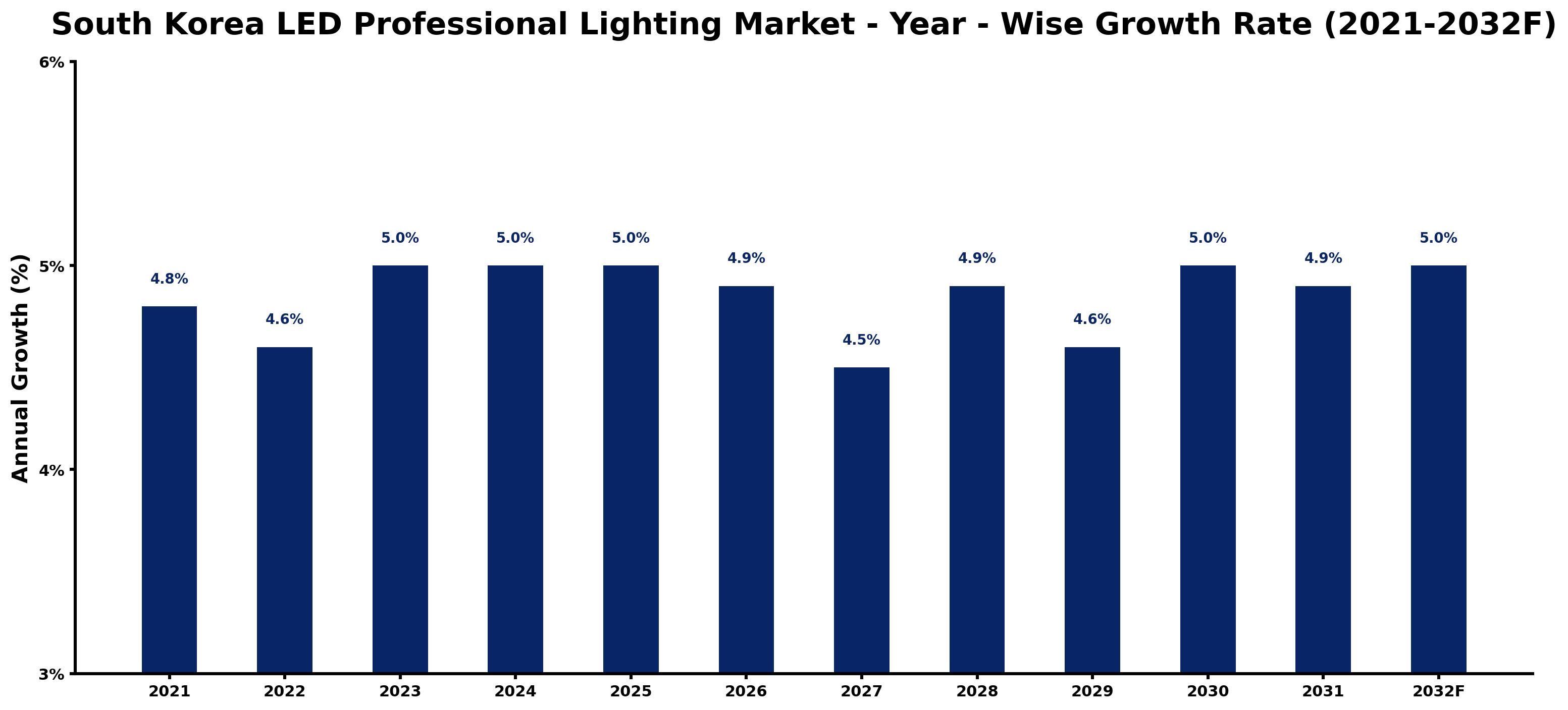
The table below presents the year wise growth rates along with the key drivers influencing the market
| Year | Growth Rate | Major Drivers |
| 2021 | 4.8% | Post-lockdown retail projects emphasize energy efficiency and modern lighting solutions. |
| 2022 | 4.6% | Urban development continues, increasing demand for aesthetically pleasing LED installations. |
| 2023 | 5.0% | Corporate sustainability efforts focus on reducing carbon footprints through LED technology. |
| 2024 | 5.0% | Smart city initiatives in South Korea enhance the need for innovative lighting solutions. |
| 2025 | 5.0% | Local manufacturers invest in advanced LED production technologies for competitive advantage. |
| 2026 | 4.9% | Rising construction activities create significant opportunities for commercial lighting upgrades. |
| 2027 | 4.5% | Technological advancements allow for enhanced smart lighting systems in urban spaces. |
| 2028 | 4.9% | Public awareness about energy conservation boosts consumer interest in LED products. |
| 2029 | 4.6% | Integration of IoT in lighting solutions transforms traditional systems into smart networks. |
| 2030 | 5.0% | Corporate budgets increasingly favor LED upgrades for long-term cost savings. |
| 2031 | 4.9% | Regenerative design principles elevate the demand for sustainable lighting solutions. |
| 2032 | 5.0% | Evolving consumer preferences push for unique and customizable lighting experiences. |
Note - Market size estimations and growth projections presented in this report are based on 6Wresearch's advanced forecasting approach, validated with industry datasets as of June 2026.
South Korea LED Professional Lighting Market Synopsis
The South Korea LED Professional Lighting Market is projected to reach 4.9% and witness significant growth during the forecast period (2026-2032). The market is characterized by a moderate compound annual growth rate (CAGR) of 5%, driven by various factors including the increasing emphasis on energy efficiency across industrial and commercial sectors. This trend not only aligns with global sustainability goals but also caters to the specific demands of the South Korean market. The rising adoption of LED lighting products, bolstered by government initiatives aimed at promoting green building practices, represents a significant catalyst for market growth.
South Korea LED Professional Lighting Market Growth Drivers
Several key drivers are contributing to the expansion of the South Korea LED Professional Lighting Market. These include:
- The increasing demand for energy-efficient lighting solutions is compelling various sectors, particularly industry and commerce, to transition to LED technologies.
- Government incentives and programs to support the development of green buildings foster a favorable environment for LED installations in both new and retrofitted structures.
- Modern architectural trends that emphasize innovative lighting designs are encouraging builders to adopt advanced LED systems that offer flexibility and aesthetics.
- Technological advancements, such as intelligent lighting and IoT integration, are transforming traditional lighting into smart lighting ecosystems that enhance user experience and functionality.
- Growing use cases across diverse applications—ranging from retail spaces to sports venues—are significantly boosting demand for high-quality professional lighting solutions.
South Korea LED Professional Lighting Market Trends and Opportunities
The South Korea LED Professional Lighting Market is witnessing several trends that indicate a promising future. Increasingly, industry players are focusing on sustainable practices and the development of energy-efficient products. The following trends are notable:
- A surge in smart city initiatives is driving demand for LED lighting solutions that can be integrated into urban infrastructure, improving connectivity and energy management.
- The hospitality and entertainment sectors are increasingly adopting advanced lighting systems that enhance ambiance and customer experience.
- There is a notable trend toward customization in lighting solutions, with architects and designers seeking unique designs tailored to specific projects.
- The advent of human-centric lighting is gaining traction, focusing on the psychological and physical well-being of users by mimicking natural light patterns.
- The expansion of e-commerce platforms is providing new sales channels for LED products, enabling greater market penetration and competition.
South Korea LED Professional Lighting Market Government Investment and Initiatives
The South Korean government is actively investing in initiatives that support the growth of the LED professional lighting sector. Policies aimed at energy conservation and sustainability are central to this strategy. The government's commitment to reducing carbon emissions has resulted in various public spending programs. These policies encourage the adoption of LED technologies in both new constructions and existing infrastructures. Key initiatives include:
- Subsidies and grants for energy-efficient building upgrades that incorporate LED lighting.
- Legislation mandating energy-efficiency standards that favor the use of LED products in public infrastructure.
- Public awareness campaigns aimed at informing businesses and consumers about the benefits of LED lighting.
- Investment in research and development focused on innovative lighting technologies that align with sustainability goals.
- Collaboration with industry stakeholders to promote the use of smart lighting solutions that enhance energy efficiency.
South Korea LED Professional Lighting Market Latest Developments (May 2025 - June 2026)
The South Korea LED Professional Lighting Market is undergoing significant transformations as it adapts to emerging trends and technologies. Recent developments from May 2025 to June 2026 indicate a clear shift toward smarter, more integrated lighting solutions. Key industry advancements during this period include:
- The introduction of more intelligent lighting systems that leverage artificial intelligence for enhanced energy management.
- Collaborative projects between technology firms and lighting manufacturers aimed at developing IoT-enabled lighting solutions.
- An increased focus on sustainability, with many companies committing to reduce their environmental footprint through eco-friendly products.
- Enhancements in LED technology that allow for greater brightness and energy efficiency, catering to a wider range of applications.
- Participation in international exhibitions and conferences demonstrating South Korea's leadership in lighting innovation.
South Korea LED Professional Lighting Market - Key Attractiveness of the Report
- 10 Years of Market Numbers
- Historical Data Starting from 2022 to 2025
- Base Year: 2025
- Forecast Data until 2032
- Key Performance Indicators Impacting the Market
- Major Upcoming Developments and Projects
Key Highlights of the Report:
- South Korea LED Professional Lighting Market Outlook
- Market Size of South Korea LED Professional Lighting Market, 2025
- Forecast of South Korea LED Professional Lighting Market, 2032
- Historical Data and Forecast of South Korea LED Professional Lighting Revenues & Volume for the Period 2022-2032
- South Korea LED Professional Lighting Market Trend Evolution
- South Korea LED Professional Lighting Market Drivers and Challenges
- South Korea LED Professional Lighting Price Trends
- South Korea LED Professional Lighting Porter's Five Forces
- South Korea LED Professional Lighting Industry Life Cycle
- Historical Data and Forecast of South Korea LED Professional Lighting Market Revenues & Volume By Product Type for the Period 2022-2032
- Historical Data and Forecast of South Korea LED Professional Lighting Market Revenues & Volume By LED Bulbs for the Period 2022-2032
- Historical Data and Forecast of South Korea LED Professional Lighting Market Revenues & Volume By LED Fixtures for the Period 2022-2032
- Historical Data and Forecast of South Korea LED Professional Lighting Market Revenues & Volume By Bare LED Tubes for the Period 2022-2032
- Historical Data and Forecast of South Korea LED Professional Lighting Market Revenues & Volume By LED Down lights for the Period 2022-2032
- Historical Data and Forecast of South Korea LED Professional Lighting Market Revenues & Volume By Applications for the Period 2022-2032
- Historical Data and Forecast of South Korea LED Professional Lighting Market Revenues & Volume By Indoor for the Period 2022-2032
- Historical Data and Forecast of South Korea LED Professional Lighting Market Revenues & Volume By Outdoor for the Period 2022-2032
- Historical Data and Forecast of South Korea LED Professional Lighting Market Revenues & Volume By Automotive for the Period 2022-2032
- Historical Data and Forecast of South Korea LED Professional Lighting Market Revenues & Volume By Backlighting for the Period 2022-2032
- South Korea LED Professional Lighting Import Export Trade Statistics
- Market Opportunity Assessment By Product Type
- Market Opportunity Assessment By Applications
- South Korea LED Professional Lighting Top Companies Market Share
- South Korea LED Professional Lighting Competitive Benchmarking By Technical and Operational Parameters
- South Korea LED Professional Lighting Company Profiles
- South Korea LED Professional Lighting Key Strategic Recommendations
Market Covered
This report offers a comprehensive study of the subsequent market segments:
By Product Type
- LED Bulbs
- LED Fixtures
- Bare LED Tubes
- LED Down lights
By Applications
- Indoor, Outdoor
- Automotive
- Backlighting






































