South Korea Mass Spectrometry Market Size, Share & Growth Rate
The South Korea Mass Spectrometry Market was estimated at USD 1273 Million in 2025 and is projected to reach USD 1828 Million by 2032, growing at a CAGR of 5.3% from 2026 to 2032. This growth trajectory is primarily fueled by the surging investments in research and development across pharmaceutical and biotechnology sectors, where mass spectrometry plays a crucial role in drug discovery and biomarker research. Additionally, the growing emphasis on environmental testing and clinical diagnostics is further propelling demand for advanced mass spectrometry technologies.
South Korea Mass Spectrometry Market Year-wise Growth Rate and Key Drivers
This graph highlights how the South Korea Mass Spectrometry Market has steadily grown over the years, supported by major growth factors.
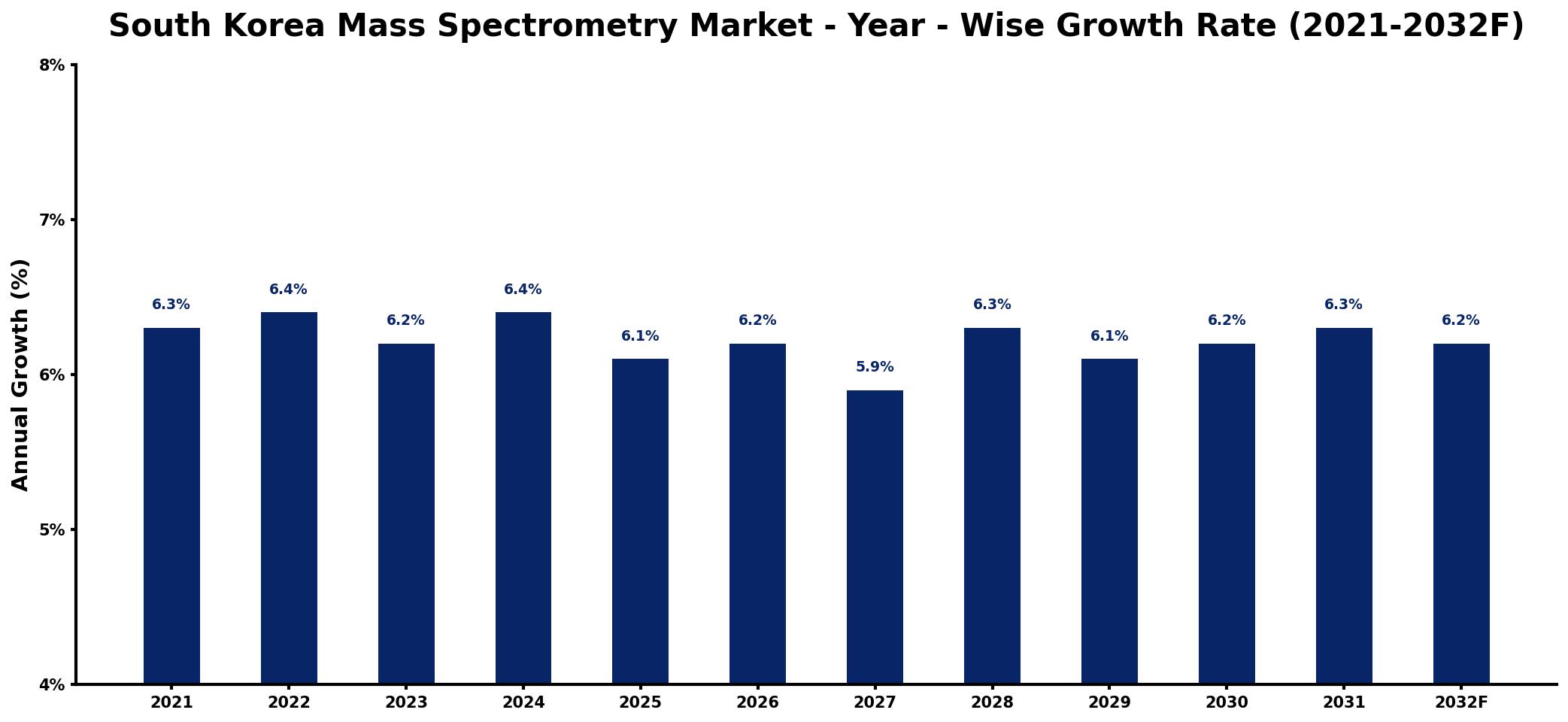
The table below presents the year‑wise growth rates along with the key drivers influencing the market
| Year | Growth Rate | Major Drivers |
| 2021 | 6.3% | Rising demand in pharmaceuticals |
| 2022 | 6.4% | Increased investments in research |
| 2023 | 6.2% | Growing biotechnology applications adoption |
| 2024 | 6.4% | Expansion of environmental testing services |
| 2025 | 6.1% | Surge in food safety regulations |
| 2026 | 6.2% | Enhanced industrial applications growth |
| 2027 | 5.9% | Development of personalized medicine initiatives |
| 2028 | 6.3% | Advancements in analytical technology |
| 2029 | 6.1% | Broader academic research funding availability |
| 2030 | 6.2% | Strengthened regulatory compliance requirements |
| 2031 | 6.3% | Emergence of new market players |
| 2032 | 6.2% | Rising importance of quality control |
Note: Market size estimations and growth projections presented in this report are based on 6Wresearch's proprietary forecasting methodology, utilizing the latest available industry data, government publications, and primary research inputs.
South Korea Mass Spectrometry Market Synopsis
The South Korean market for mass spectrometry is witnessing an uptick in adoption, especially among firms engaged in pharmaceutical development and environmental monitoring. This trend reflects a broader commitment to quality and accuracy in analytical processes, driven by evolving regulatory demands.
Furthermore, the integration of mass spectrometry in various applications such as proteomics and metabolomics is creating new pathways for innovation. The concerted efforts by industry leaders to enhance product offerings and form strategic alliances are also contributing to a competitive landscape that fosters growth.
South Korea Mass Spectrometry Market Key Takeaways
- Steady growth driven by increased R&D spending in pharmaceuticals and biotechnology.
- Rising demand for high-resolution mass spectrometry systems for precise analyses.
- Emergence of miniaturized, portable mass spectrometers for on-site applications.
- Government policies fostering innovation and collaboration in the mass spectrometry sector.
- Focus on advanced mass spectrometry technologies for personalized medicine applications.
Evaluation of Restraints in South Korea Mass Spectrometry Market
Despite the optimistic growth outlook, the South Korea Mass Spectrometry Market faces several challenges that could hinder its expansion. The competition among existing players is fierce, often leading to price wars that can affect profitability. Moreover, the rapid pace of technological advancement necessitates constant innovation, which can strain resources, especially for smaller firms. Regulatory requirements can also present hurdles, as they demand compliance with strict guidelines that may delay product launches. Finally, the current shortage of skilled professionals in mass spectrometry represents a significant barrier to growth, as companies struggle to find talent capable of leveraging complex technologies effectively.
South Korea Mass Spectrometry Market Trends
Current trends in the South Korea Mass Spectrometry Market reveal a shift towards high-resolution systems and tandem mass spectrometry for greater accuracy in compound quantification. The market is also witnessing advancements in miniaturization, enabling portable instruments that facilitate on-site testing for various applications. Another emerging trend is the focus on personalized medicine, where mass spectrometry is increasingly utilized for biomarker discovery, paving the way for tailored therapeutic solutions. Furthermore, as industries strive for enhanced analytical capabilities, there is a pronounced movement towards integrating mass spectrometry with other analytical technologies for holistic data analysis.
South Korea Mass Spectrometry Market Opportunities
Investment opportunities within the South Korea Mass Spectrometry Market are particularly promising, given the growing acceptance of mass spectrometry technologies across multiple industries. The continued expansion of pharmaceutical and biotechnology sectors presents lucrative avenues for the development of sophisticated mass spectrometry systems that provide rapid results with enhanced precision. Additionally, the South Korean governments commitment to supporting R&D initiatives creates an inviting landscape for investors interested in companies specializing in analytical instrumentation. The anticipated rise in demand for accurate and sensitive analytical techniques further positions the market as a compelling investment destination.
Government Initiatives in the South Korea Mass Spectrometry Market
The South Korean government has implemented several supportive initiatives aimed at bolstering the Mass Spectrometry Market. Notably, the Bio-Venture Support Project provides critical funding and resources to small and medium-sized enterprises within the biotechnology sector, including those focusing on mass spectrometry development. Programs like the Bio-Cluster Development Program promote collaboration and innovation among industry players, fostering an environment conducive to technological advancements. These efforts underscore the government's recognition of the importance of analytical instrumentation in driving scientific progress and economic growth.
Future Insights of the South Korea Mass Spectrometry Market
Looking ahead, the South Korea Mass Spectrometry Market is set for sustained growth driven by robust investment in R&D across sectors such as pharmaceuticals, biotechnology, and environmental testing. The emphasis on advanced analytical techniques will continue to influence the development of mass spectrometry instruments, characterized by improved sensitivity and accuracy. Additionally, the increasing integration of mass spectrometry in clinical diagnostics and personalized medicine is likely to present significant expansion opportunities. With favorable government policies and a dynamic market environment, the outlook for the South Korea Mass Spectrometry Market remains very promising for the next several years.
South Korea Mass Spectrometry Market Latest Developments (2025 - 2026)
In recent months, the South Korea Mass Spectrometry Market has seen several noteworthy developments. Advances in high-resolution technologies have emerged as key focal points, allowing for even greater analytical capabilities. Companies are increasingly launching innovative mass spectrometry platforms, aimed at enhancing user experience and expanding application ranges. Collaborative efforts between industry and academic institutions are on the rise, fostering a rich environment for research and development. Furthermore, there is growing interest in regulatory compliance solutions that support the adoption of mass spectrometry technologies across different sectors.
South Korea Mass Spectrometry Market - Key Attractiveness of the Report
- 10 Years of Market Numbers
- Historical Data Starting from 2022 to 2025
- Base Year: 2025
- Forecast Data until 2032
- Key Performance Indicators Impacting the Market
- Major Upcoming Developments and Projects
Key Highlights of the Report:
- South Korea Mass Spectrometry Market Outlook
- Market Size of South Korea Mass Spectrometry Market, 2025
- Forecast of South Korea Mass Spectrometry Market, 2032
- Historical Data and Forecast of South Korea Mass Spectrometry Revenues & Volume for the Period 2022-2032F
- South Korea Mass Spectrometry Market Trend Evolution
- South Korea Mass Spectrometry Market Drivers and Challenges
- South Korea Mass Spectrometry Price Trends
- South Korea Mass Spectrometry Porter's Five Forces
- South Korea Mass Spectrometry Industry Life Cycle
- Historical Data and Forecast of South Korea Mass Spectrometry Market Revenues & Volume By Technology for the Period 2022-2032F
- Historical Data and Forecast of South Korea Mass Spectrometry Market Revenues & Volume By Hybrid Mass Spectrometry for the Period 2022-2032F
- Historical Data and Forecast of South Korea Mass Spectrometry Market Revenues & Volume By Single Mass Spectrometry for the Period 2022-2032F
- Historical Data and Forecast of South Korea Mass Spectrometry Market Revenues & Volume By Application for the Period 2022-2032F
- Historical Data and Forecast of South Korea Mass Spectrometry Market Revenues & Volume By Pharmaceutical for the Period 2022-2032F
- Historical Data and Forecast of South Korea Mass Spectrometry Market Revenues & Volume By Biotechnology for the Period 2022-2032F
- Historical Data and Forecast of South Korea Mass Spectrometry Market Revenues & Volume By Security for the Period 2022-2032F
- Historical Data and Forecast of South Korea Mass Spectrometry Market Revenues & Volume By Industrial chemistry for the Period 2022-2032F
- Historical Data and Forecast of South Korea Mass Spectrometry Market Revenues & Volume By Environmental testing for the Period 2022-2032F
- Historical Data and Forecast of South Korea Mass Spectrometry Market Revenues & Volume By Food & beverage testing for the Period 2022-2032F
- Historical Data and Forecast of South Korea Mass Spectrometry Market Revenues & Volume By Forensic for the Period 2022-2032F
- Historical Data and Forecast of South Korea Mass Spectrometry Market Revenues & Volume By Clinical for the Period 2022-2032F
- South Korea Mass Spectrometry Import Export Trade Statistics
- Market Opportunity Assessment By Technology
- Market Opportunity Assessment By Application
- South Korea Mass Spectrometry Top Companies Market Share
- South Korea Mass Spectrometry Competitive Benchmarking By Technical and Operational Parameters
- South Korea Mass Spectrometry Company Profiles
- South Korea Mass Spectrometry Key Strategic Recommendations






































