South Korea Men Personal Care Market Summary
The south korea men personal care market was estimated at USD 331 Million in 2025 and is projected to reach USD 447 Million by 2032, growing at a CAGR of 5.1% from 2026 to 2032.
South Korea Men Personal Care Market Year-wise Growth Rate and Key Drivers
This graph highlights how the South Korea Men Personal Care Market has steadily grown over the past five years, supported by major growth factors.
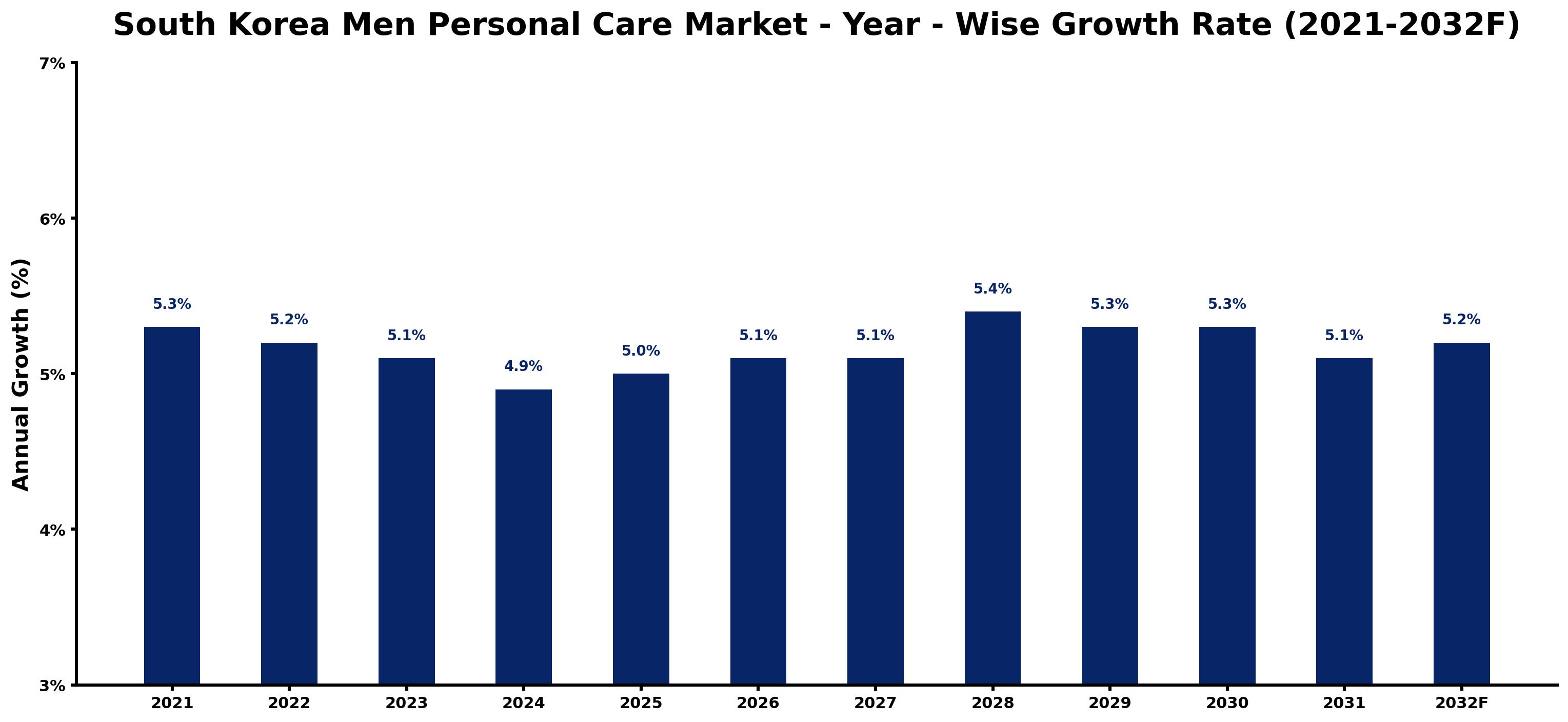
The table below presents the year wise growth rates along with the key drivers influencing the market
| Year | Growth Rate | Major Drivers |
| 2021 | 5.3% | Increased focus on skincare routines has reignited interest in men's personal care products. |
| 2022 | 5.2% | Social media influencers play a significant role in shaping men's grooming trends this year. |
| 2023 | 5.1% | Brand collaborations with popular K-Pop artists enhance visibility within the personal care sector. |
| 2024 | 4.9% | Innovations in product formulations cater to diverse skin types and specific concerns. |
| 2025 | 5.0% | Sustainable packaging initiatives resonate with environmentally conscious consumers seeking eco-friendly options. |
| 2026 | 5.1% | E-commerce platforms expand product availability and convenience for male consumers in South Korea. |
| 2027 | 5.1% | Personalization trends see more brands offering customized grooming solutions tailored to individual needs. |
| 2028 | 5.4% | Emergence of premium product lines attracts affluent consumers willing to invest in high-quality items. |
| 2029 | 5.3% | Increased awareness of skincare benefits fosters a culture of self-care and grooming among men. |
| 2030 | 5.3% | Technological advancements enable virtual try-ons, enhancing the online shopping experience significantly. |
| 2031 | 5.1% | Collaborations with dermatologists build trust and credibility in product efficacy and safety. |
| 2032 | 5.2% | Focus on mental wellness links personal grooming to overall well-being and self-esteem improvements. |
Note - Market size estimations and growth projections presented in this report are based on 6Wresearch's advanced forecasting approach, validated with industry datasets as of June 2026.
South Korea Men Personal Care Market Synopsis
The South Korea Men Personal Care Market is projected to reach 5.1% and witness significant growth during the forecast period (2026-2032). This market is experiencing a robust expansion at a compound annual growth rate (CAGR) of 8.9%, fueled by transforming consumer behaviors, increasing disposable incomes, and heightened awareness around personal grooming and hygiene. As men increasingly prioritize their appearance, there is a noticeable shift in spending patterns towards premium grooming products, which significantly influence market dynamics.
South Korea Men Personal Care Market Growth Drivers
There are several key drivers contributing to the expansion of the South Korea men personal care market:
- There is a growing demand for extensive grooming regimes among males, driven in part by societal expectations and a culture that increasingly emphasizes personal appearance.
- Awareness surrounding personal hygiene is on the rise, leading to increased purchases of products such as deodorants, shaving creams, and body washes.
- The shift in consumer preferences towards premium products is evident, with males willing to invest more in high-quality skincare and haircare solutions.
- Young male consumers are now more educated about grooming trends through media channels, significantly influencing their spending behaviors.
- An increase in disposable income levels in South Korea provides further impetus for growth, enabling consumers to spend on luxury personal care items.
South Korea Men Personal Care Market Trends and Opportunities
The South Korea men personal care market is currently witnessing several noteworthy trends that present abundant opportunities:
- There is a noticeable trend towards natural and organic products, as consumers become more conscious of the ingredients in their personal care items.
- The emergence of eCommerce platforms has transformed how men shop for personal care products, providing them with convenience and a wider selection of brands.
- Innovative product development, including targeted solutions such as anti-aging creams and hair loss treatments, caters specifically to demographic needs.
- Sustainability is gaining traction, leading companies to focus on eco-friendly packaging and sourcing practices that resonate with environmentally conscious consumers.
- Marketing campaigns increasingly emphasize lifestyle and personal enhancement narratives, further driving engagement and product purchases.
South Korea Men Personal Care Market Challenges and Restraints
While the South Korea men personal care market shows promising growth, there are inherent challenges that must be navigated:
- The saturation of the personal care market serves as a challenge, with a multitude of brands competing for a limited share, particularly in major urban areas.
- The economic climate can greatly influence consumer spending habits, with economic downturns potentially leading to reduced expenditures on non-essential items.
- Adapting to the rapidly changing market preferences and trends can pose difficulties for companies that may be slow to innovate.
- Compliance with stringent regulations regarding product safety and efficacy can add an additional layer of complexity for market entrants.
- Consumer education remains critical; misconceptions about personal care products can hinder market growth if not adequately addressed.
South Korea Men Personal Care Market Government Investment and Initiatives
The South Korean government has increasingly recognized the importance of the personal care sector, implementing various policies aimed at fostering growth and innovation:
- Investment in research and development initiatives is being encouraged through grants and subsidies, aimed at promoting innovation within the personal care industry.
- Regulatory frameworks are being streamlined to facilitate easier market entry for new personal care products, reducing barriers for small and medium-sized enterprises.
- Public awareness campaigns are underway to promote hygiene and grooming practices, further driving consumer engagement in the men personal care segment.
- Collaborations between public and private sectors are being encouraged to bolster the local manufacturing capabilities of personal care products.
- The government is also investing in "smart" technologies that integrate with personal care routines, promoting a tech-savvy approach among consumers.
South Korea Men Personal Care Market Latest Developments (May 2025 - June 2026)
Recent developments in the South Korea men personal care market indicate a dynamic shift towards more customized solutions to meet evolving consumer needs:
- Innovative product launches have become more frequent, with a focus on ethnic and cultural grooming needs reflecting South Korea's diverse population.
- Digital platforms are increasingly being utilized for marketing campaigns, leveraging social media influencers to drive brand engagement and awareness.
- The integration of AI and data analytics in product development processes is becoming a common practice, enabling companies to better understand consumer preferences.
- Sustainability trends are being adopted, with many brands committing to environmentally friendly practices in their production processes and supply chains.
- Increased collaborations between grooming brands and lifestyle companies are emerging, blending personal care with broader health and wellness initiatives.
South Korea Men Personal Care Market - Key Attractiveness of the Report
- 10 Years of Market Numbers
- Historical Data Starting from 2022 to 2025
- Base Year: 2025
- Forecast Data until 2032
- Key Performance Indicators Impacting the Market
- Major Upcoming Developments and Projects
Key Highlights of the Report:
- South Korea Men Personal Care Market Outlook
- Market Size of South Korea Men Personal Care Market, 2025
- Forecast of South Korea Men Personal Care Market, 2032F
- Historical Data and Forecast of South Korea Men Personal Care Revenues & Volume for the Period 2022-2032F
- South Korea Men Personal Care Market Trend Evolution
- South Korea Men Personal Care Market Drivers and Challenges
- South Korea Men Personal Care Price Trends
- South Korea Men Personal Care Porter's Five Forces
- South Korea Men Personal Care Industry Life Cycle
- Historical Data and Forecast of South Korea Men Personal Care Market Revenues & Volume By Types for the Period 2022-2032F
- Historical Data and Forecast of South Korea Men Personal Care Market Revenues & Volume By Hair Care for the Period 2022-2032F
- Historical Data and Forecast of South Korea Men Personal Care Market Revenues & Volume By Shaving for the Period 2022-2032F
- Historical Data and Forecast of South Korea Men Personal Care Market Revenues & Volume By Oral Care for the Period 2022-2032F
- Historical Data and Forecast of South Korea Men Personal Care Market Revenues & Volume By Personal Cleanliness for the Period 2022-2032F
- Historical Data and Forecast of South Korea Men Personal Care Market Revenues & Volume By Skin Care for the Period 2022-2032F
- Historical Data and Forecast of South Korea Men Personal Care Market Revenues & Volume By Others for the Period 2022-2032F
- Historical Data and Forecast of South Korea Men Personal Care Market Revenues & Volume By Distribution Channel for the Period 2022-2032F
- Historical Data and Forecast of South Korea Men Personal Care Market Revenues & Volume By Online for the Period 2022-2032F
- Historical Data and Forecast of South Korea Men Personal Care Market Revenues & Volume By Offline for the Period 2022-2032F
- South Korea Men Personal Care Import Export Trade Statistics
- Market Opportunity Assessment By Types
- Market Opportunity Assessment By Distribution Channel
- South Korea Men Personal Care Top Companies Market Share
- South Korea Men Personal Care Competitive Benchmarking By Technical and Operational Parameters
- South Korea Men Personal Care Company Profiles
- South Korea Men Personal Care Key Strategic Recommendations






































