South Korea Musical Instruments Market Size Growth Rate
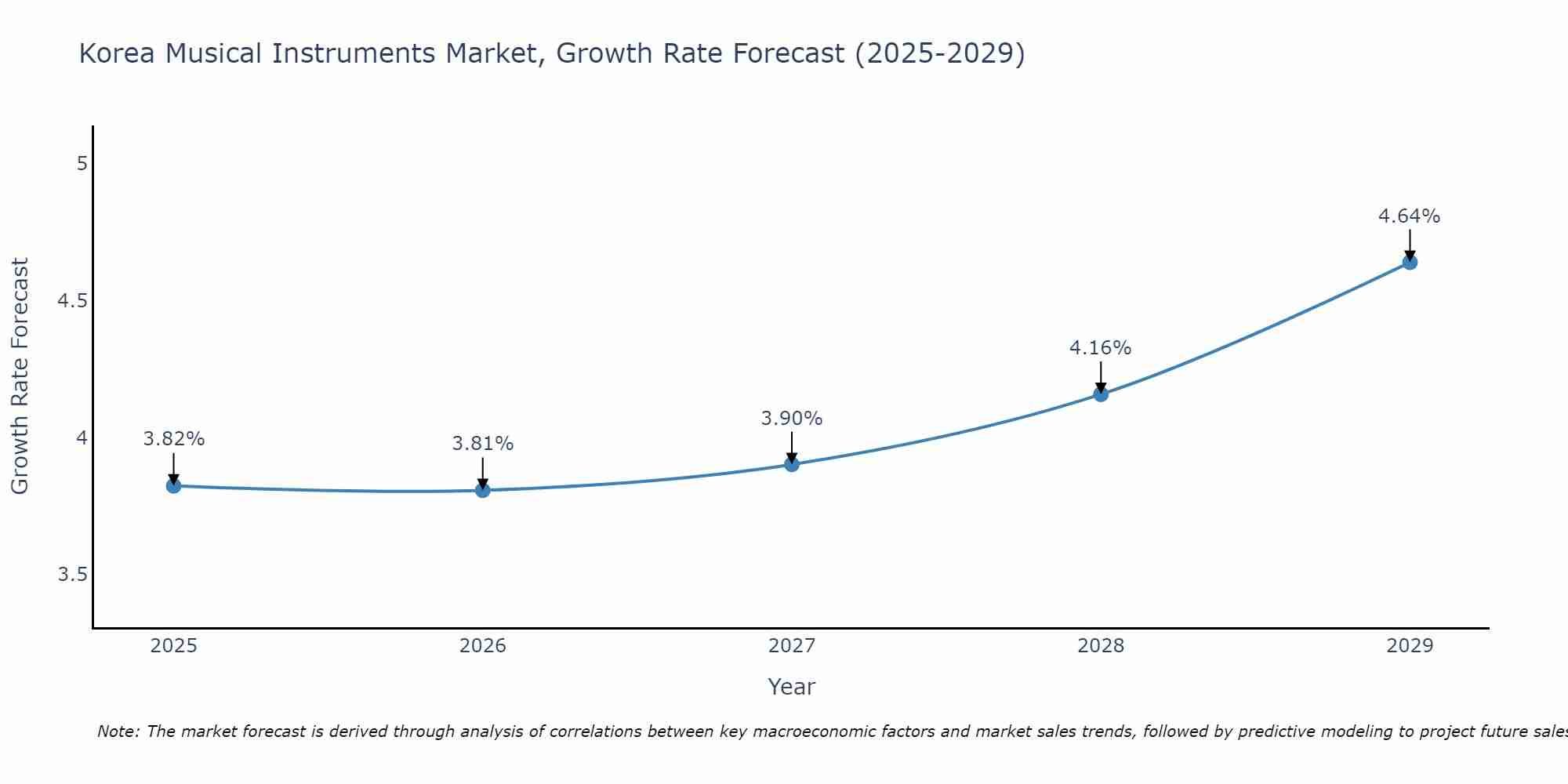
The South Korea Musical Instruments Market is projected to witness mixed growth rate patterns during 2025 to 2029. Commencing at 3.82% in 2025, growth builds up to 4.64% by 2029.
South Korea Musical Instruments Market Synopsis
South Korea musical instrument market is expected to grow at a CAGR of 5.6% during the forecast period 2020-2026. The increasing popularity of musical instruments among millennials and Gen Z, rising disposable incomes, growing demand for concerts & festivals, and the emergence of new music schools are some factors projected to drive the market growth in South Korea.
The most popular types of musical instruments in South Korea include keyboards and pianos, electric guitars, acoustic drumsets, violins & cellos, wind instruments such as flutes and clarinets; stringed instruments such as banjos, ukuleles & mandolins; brasswinds like trumpets & trombones; percussion/ethnic instruments such as djembes & cajons; harmonicas; electronic drum pads; digital audio workstations (DAWs); amplifiers/speakers/mixers etc.; pro-audio systems comprising microphones etc.; mixer consoles for recording purposes.
\H3 Players Major players on the South Korean Musical Instruments Market include YAMAHA Corporation., Roland Corporation., KORG Inc., Casio Computer Co., Ltd., Focusrite Audio Engineering Limited ULTIMATE SOUND Bank Corp (USB), EBS Sweden AB Gator Cases Inc., Gibson Brands LLC., Peavey Electronics Corporation SAMSON TECHNOLOGIES CORPORATION et al. Companies have been focusing on product innovation with advanced technologies to offer their customers better quality products at competitive prices thereby driving market growth in this region
Key Highlights of the Report:
- South Korea Musical Instruments Market Outlook
- Market Size of South Korea Musical Instruments Market, 2019
- Forecast of South Korea Musical Instruments Market, 2026
- Historical Data and Forecast of South Korea Musical Instruments Revenues & Volume for the Period 2016 - 2026
- South Korea Musical Instruments Market Trend Evolution
- South Korea Musical Instruments Market Drivers and Challenges
- South Korea Musical Instruments Price Trends
- South Korea Musical Instruments Porter's Five Forces
- South Korea Musical Instruments Industry Life Cycle
- Historical Data and Forecast of South Korea Musical Instruments Market Revenues & Volume By Type for the Period 2016 - 2026
- Historical Data and Forecast of South Korea Musical Instruments Market Revenues & Volume By Percussion Instruments for the Period 2016 - 2026
- Historical Data and Forecast of South Korea Musical Instruments Market Revenues & Volume By String Instruments for the Period 2016 - 2026
- Historical Data and Forecast of South Korea Musical Instruments Market Revenues & Volume By Piano & Key Instruments for the Period 2016 - 2026
- Historical Data and Forecast of South Korea Musical Instruments Market Revenues & Volume By Organs & Air Blown Instruments for the Period 2016 - 2026
- Historical Data and Forecast of South Korea Musical Instruments Market Revenues & Volume By Others for the Period 2016 - 2026
- Historical Data and Forecast of South Korea Musical Instruments Market Revenues & Volume By End-users for the Period 2016 - 2026
- Historical Data and Forecast of South Korea Musical Instruments Market Revenues & Volume By Commercial Events for the Period 2016 - 2026
- Historical Data and Forecast of South Korea Musical Instruments Market Revenues & Volume By Personal Use for the Period 2016 - 2026
- Historical Data and Forecast of South Korea Musical Instruments Market Revenues & Volume By Music Production/ Direction for the Period 2016 - 2026
- Historical Data and Forecast of South Korea Musical Instruments Market Revenues & Volume By Others for the Period 2016 - 2026
- South Korea Musical Instruments Import Export Trade Statistics
- Market Opportunity Assessment By Type
- Market Opportunity Assessment By End-users
- South Korea Musical Instruments Top Companies Market Share
- South Korea Musical Instruments Competitive Benchmarking By Technical and Operational Parameters
- South Korea Musical Instruments Company Profiles
- South Korea Musical Instruments Key Strategic Recommendations






































