South Korea Natural Extracts Market Size, Share & Growth Rate
The South Korea Natural Extracts Market was estimated at USD 249 Million in 2025 and is projected to reach USD 330 Million by 2032, growing at a CAGR of 4.1% from 2026 to 2032. This growth trajectory is primarily fueled by a burgeoning consumer preference for natural and organic products, particularly in the beauty, food, and beverage sectors. Increasing health awareness and a trend toward clean label offerings further amplify the demand, as consumers lean towards transparent and sustainable product options.
South Korea Natural Extracts Market Year-wise Growth Rate and Key Drivers
This graph highlights how the South Korea Natural Extracts Market has steadily grown over the years, supported by major growth factors.
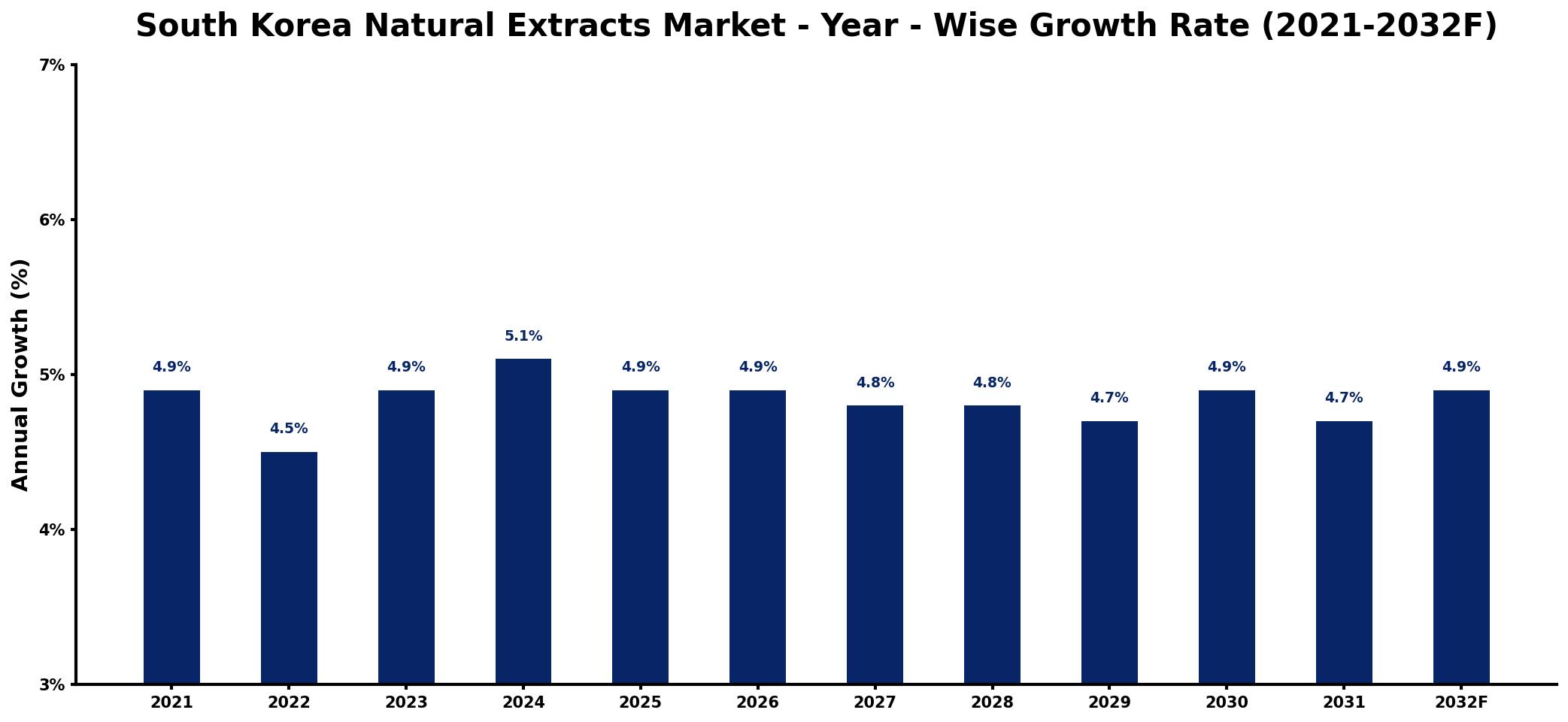
The table below presents the year‑wise growth rates along with the key drivers influencing the market
| Year | Growth Rate | Major Drivers |
| 2021 | 4.9% | Rising consumer health awareness |
| 2022 | 4.5% | Growing demand for organic products |
| 2023 | 4.9% | Increased investment in R&D |
| 2024 | 5.1% | Expansion of e-commerce platforms |
| 2025 | 4.9% | Surge in dietary supplement popularity |
| 2026 | 4.9% | Diversification of product offerings |
| 2027 | 4.8% | Heightened focus on sustainability |
| 2028 | 4.8% | Emerging trends in wellness |
| 2029 | 4.7% | Increased collaborations with manufacturers |
| 2030 | 4.9% | Growing use in food industry |
| 2031 | 4.7% | Expansion into international markets |
| 2032 | 4.9% | Rising interest in functional foods |
Note: Market size estimations and growth projections presented in this report are based on 6Wresearch's proprietary forecasting methodology, utilizing the latest available industry data, government publications, and primary research inputs.
South Korea Natural Extracts Market Synopsis
The South Korea Natural Extracts Market is currently witnessing a transformative phase, characterized by a surge in consumer interest in natural ingredients. As health-conscious consumers increasingly turn to products that boast natural origins, the market is adapting to meet this demand across multiple sectors, including cosmetics and food.
Moreover, traditional Korean herbal ingredients, such as ginseng and green tea, are gaining popularity not just domestically, but globally, for their health benefits and functional properties. As sustainable sourcing practices become more critical, consumers are also prioritizing products that support ethical production and local economies.
South Korea Natural Extracts Market Key Takeaways
- The market is rapidly growing due to increasing consumer demand for natural and organic products.
- Traditional Korean ingredients are becoming central to product innovation across various industries.
- Sustainability and ethical sourcing are significant considerations for consumers.
- The beauty and personal care sectors are pivotal in driving the adoption of natural extracts.
- Continuous innovation and strategic partnerships are essential for market players to remain competitive.
Evaluation of Restraints in South Korea Natural Extracts Market
Despite the robust growth outlook, several restraints are hindering the South Korea Natural Extracts Market. Increasing competition from both local and international entities presents a challenge for existing players. Additionally, fluctuating raw material prices can impact profit margins, while stringent regulations imposed by the government necessitate compliance investments. Companies must also navigate complex supply chain issues, which can create inconsistencies in product availability and quality.
South Korea Natural Extracts Market Trends
Current trends indicate a significant shift towards the inclusion of botanical extracts in skincare and cosmetic products, driven by their antioxidant and anti-inflammatory properties. Furthermore, consumers are increasingly discerning about the origins of their products, leading to a preference for sustainably sourced natural extracts. The popularity of clean label products continues to rise, supporting the growing trend of transparency in ingredient sourcing and processing.
South Korea Natural Extracts Market Opportunities
The South Korea natural extracts market offers substantial investment opportunities, particularly in the skincare and beauty segment. As consumers increasingly seek products enriched with natural extracts, manufacturers can capitalize on this demand by investing in innovative extraction techniques and premium raw materials. Additionally, the food and beverage sectors stand to benefit from the rising interest in natural flavors and ingredients, paving the way for new product development.
Government Initiatives in the South Korea Natural Extracts Market
The South Korean government has implemented various regulations to ensure the safety and quality of natural extracts. These regulations oversee the production and labeling of products, with the Ministry of Food and Drug Safety (MFDS) playing a critical role. Moreover, government incentives for research and development are promoting innovation within the natural extracts sector, further encouraging sustainable practices and responsible sourcing of raw materials.
Future Insights of the South Korea Natural Extracts Market
Looking ahead to 2026-2032, the South Korea Natural Extracts Market is expected to continue its upward trajectory, driven by evolving consumer preferences and an emphasis on health and wellness. The beauty and personal care sectors will likely remain dominant, as natural extracts find their way into a broader array of products. Furthermore, with advancements in extraction technology and a focus on unique ingredient formulations, this market is set to thrive in the coming years.
South Korea Natural Extracts Market Latest Developments (2025 - 2026)
Recent developments in the South Korea Natural Extracts Market highlight a growing emphasis on innovation and sustainable practices. Companies are increasingly investing in the development of new extraction technologies that enhance product purity and efficacy. Additionally, partnerships between local suppliers and manufacturers are being forged to strengthen supply chains and promote ethically sourced raw materials, responding to the rising consumer demand for transparency and sustainability.
South Korea Natural Extracts Market - Key Attractiveness of the Report
- 10 Years of Market Numbers
- Historical Data Starting from 2022 to 2025
- Base Year: 2025
- Forecast Data until 2032
- Key Performance Indicators Impacting the Market
- Major Upcoming Developments and Projects
Key Highlights of the Report:
- South Korea Natural Extracts Market Outlook
- Market Size of South Korea Natural Extracts Market, 2025
- Forecast of South Korea Natural Extracts Market, 2032
- Historical Data and Forecast of South Korea Natural Extracts Revenues & Volume for the Period 2022-2032F
- South Korea Natural Extracts Market Trend Evolution
- South Korea Natural Extracts Market Drivers and Challenges
- South Korea Natural Extracts Price Trends
- South Korea Natural Extracts Porter's Five Forces
- South Korea Natural Extracts Industry Life Cycle
- Historical Data and Forecast of South Korea Natural Extracts Market Revenues & Volume By Product for the Period 2022-2032F
- Historical Data and Forecast of South Korea Natural Extracts Market Revenues & Volume By Essential Oils for the Period 2022-2032F
- Historical Data and Forecast of South Korea Natural Extracts Market Revenues & Volume By Oleoresins for the Period 2022-2032F
- Historical Data and Forecast of South Korea Natural Extracts Market Revenues & Volume By Herbal Extracts for the Period 2022-2032F
- Historical Data and Forecast of South Korea Natural Extracts Market Revenues & Volume By Natural Colors for the Period 2022-2032F
- Historical Data and Forecast of South Korea Natural Extracts Market Revenues & Volume By Dried Crops for the Period 2022-2032F
- Historical Data and Forecast of South Korea Natural Extracts Market Revenues & Volume By Application for the Period 2022-2032F
- Historical Data and Forecast of South Korea Natural Extracts Market Revenues & Volume By Personal Care & Cosmetics for the Period 2022-2032F
- Historical Data and Forecast of South Korea Natural Extracts Market Revenues & Volume By Food & Beverage for the Period 2022-2032F
- Historical Data and Forecast of South Korea Natural Extracts Market Revenues & Volume By Animal Feed for the Period 2022-2032F
- Historical Data and Forecast of South Korea Natural Extracts Market Revenues & Volume By Pharmaceuticals for the Period 2022-2032F
- Historical Data and Forecast of South Korea Natural Extracts Market Revenues & Volume By Nutraceuticals for the Period 2022-2032F
- Historical Data and Forecast of South Korea Natural Extracts Market Revenues & Volume By Others for the Period 2022-2032F
- South Korea Natural Extracts Import Export Trade Statistics
- Market Opportunity Assessment By Product
- Market Opportunity Assessment By Application
- South Korea Natural Extracts Top Companies Market Share
- South Korea Natural Extracts Competitive Benchmarking By Technical and Operational Parameters
- South Korea Natural Extracts Company Profiles
- South Korea Natural Extracts Key Strategic Recommendations






































