Kenya Natural Extracts Market Size, Share & Growth Rate
The Kenya Natural Extracts Market was estimated at USD 494 Million in 2025 and is projected to reach USD 704 Million by 2032, growing at a CAGR of 5.2% from 2026 to 2032. This robust growth trajectory is fueled by an increasing consumer inclination towards organic ingredients across multiple sectors. The nation's unique biodiversity, featuring a plethora of botanical resources, positions it well to meet the rising demand for natural extracts in food, cosmetics, and pharmaceuticals.
Kenya Natural Extracts Market Year-wise Growth Rate and Key Drivers
This graph highlights how the Kenya Natural Extracts Market has steadily grown over the years, supported by major growth factors.
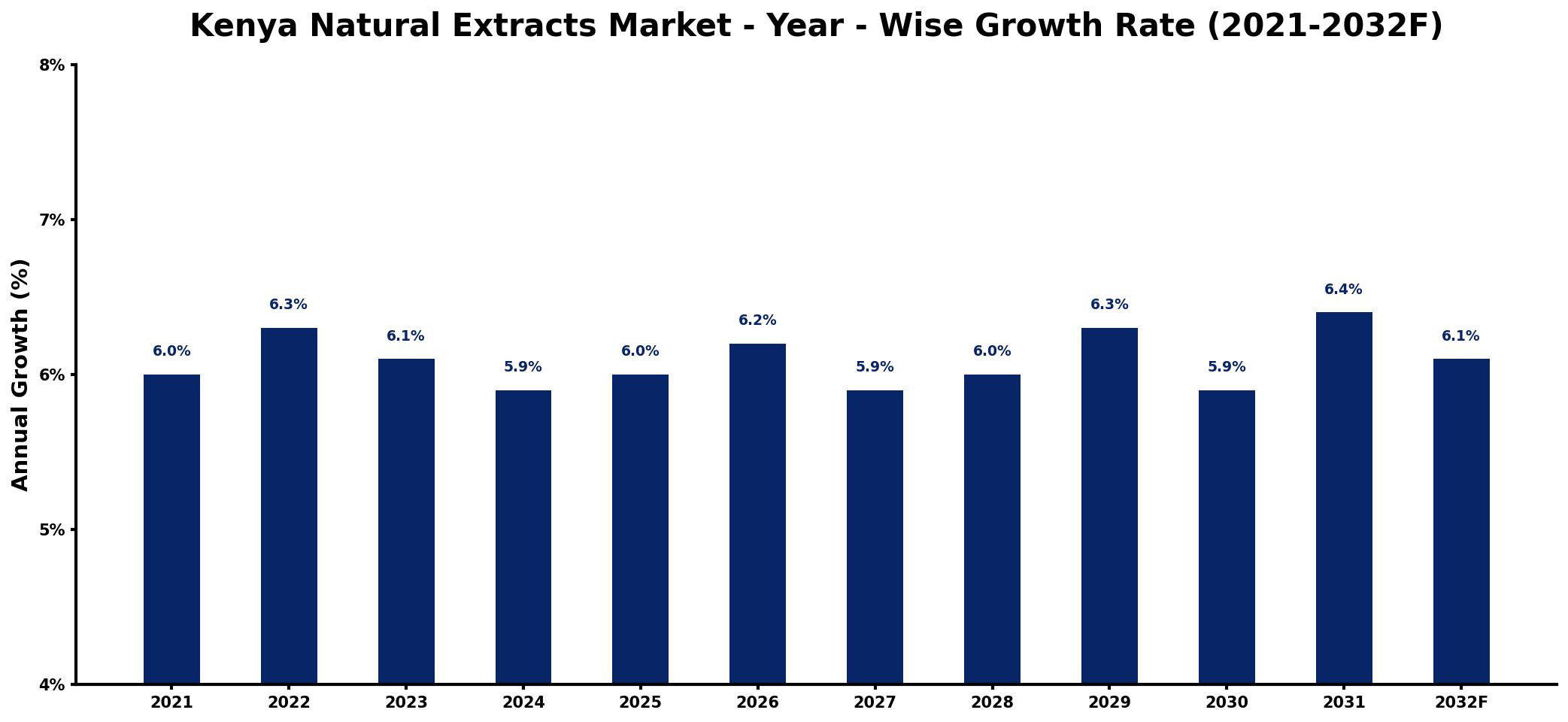
The table below presents the year‑wise growth rates along with the key drivers influencing the market
| Year | Growth Rate | Major Drivers |
| 2021 | 6.0% | Rising consumer health consciousness |
| 2022 | 6.3% | Increased investment in agriculture |
| 2023 | 6.1% | Growing demand for organic products |
| 2024 | 5.9% | Expansion of export markets |
| 2025 | 6.0% | Emergence of new product innovations |
| 2026 | 6.2% | Strengthening of supply chain networks |
| 2027 | 5.9% | Heightened focus on sustainability practices |
| 2028 | 6.0% | Boost in local production capabilities |
| 2029 | 6.3% | Growing interest in wellness trends |
| 2030 | 5.9% | Increased regulatory support initiatives |
| 2031 | 6.4% | Expansion into international markets |
| 2032 | 6.1% | Rising popularity of herbal alternatives |
Note: Market size estimations and growth projections presented in this report are based on 6Wresearch's proprietary forecasting methodology, utilizing the latest available industry data, government publications, and primary research inputs.
Kenya Natural Extracts Market Synopsis
Currently, the Kenya Natural Extracts Market is experiencing an upsurge due to heightened awareness regarding the benefits of natural ingredients. This trend is evident as consumers are shifting their preferences towards products that are not only organic but also sustainable. The local market thrives on a rich tapestry of flora, providing essential raw materials for various applications, from health supplements to skincare.
In particular, extracts like tea tree oil and baobab are gaining traction in both domestic and international markets. With the government's proactive stance on supporting natural product development, and the increased focus on ethical sourcing practices, the Kenya Natural Extracts Market is set to expand significantly in the coming years.
Kenya Natural Extracts Market Key Takeaways
- The market is set for steady growth driven by rising demand for organic and sustainable products.
- Kenya's diverse ecosystems provide a rich source of natural extracts appealing to various industries.
- Government initiatives are fostering a supportive environment for the natural extracts sector.
- Consumer health consciousness is propelling interest in the functional benefits of natural ingredients.
- Investment opportunities exist in essential oils, herbal supplements, and natural cosmetics.
Evaluation of Restraints in Kenya Natural Extracts Market
Despite its growth prospects, the Kenya Natural Extracts Market faces certain challenges that could inhibit its potential. One significant restraint is the inconsistent quality and supply of raw materials, which can lead to fluctuations in production efficiency. Additionally, inadequate infrastructure for processing and storage has been an impediment for many producers, complicating scaling efforts. The absence of standardized regulations further complicates market dynamics, potentially undermining consumer trust. Lastly, local producers must contend with competition from imported natural extracts, which may be perceived as superior in quality or pricing.
Kenya Natural Extracts Market Trends
The market is currently witnessing pivotal trends influencing both demand and technology. A rising preference for local botanicals and traditional herbal remedies is shaping product offerings across various industries. Skincare and beauty segments are increasingly incorporating natural extracts, addressing consumer concerns over synthetic additives. Furthermore, sustainability is at the forefront, with companies adopting ethical sourcing and production practices to meet consumer expectations for environmentally responsible products. The health benefits associated with natural extracts, such as antioxidants, are also gaining traction, thereby enhancing consumer interest.
Kenya Natural Extracts Market Opportunities
Investors are presented with significant opportunities within the Kenya Natural Extracts Market, particularly in sectors such as essential oils and herbal supplements. The global demand for organic products positions Kenyas vast biodiversity as an attractive resource for sustainably sourced raw materials. With an emphasis on ethical practices and eco-friendly processing, there is immense potential for profit. Furthermore, the integration of innovative technologies in production can enhance efficiency and product quality, opening new avenues for market players.
Government Initiatives in the Kenya Natural Extracts Market
The Kenyan government is actively facilitating growth in the natural extracts market through a range of supportive policies. The Forest Conservation and Management Act emphasizes sustainable practices in resource extraction, while the Wildlife Conservation and Management Act aims to protect endangered plant species. These regulations encourage responsible harvesting and environmental conservation. Additionally, initiatives promoting community-based organizations empower local producers, ensuring that their practices align with sustainability goals while fostering economic development.
Future Insights of the Kenya Natural Extracts Market
Looking ahead to the period between 2026 and 2032, the Kenya Natural Extracts Market is poised for notable expansion. With growing consumer awareness regarding the health benefits of natural products, demand is set to increase across multiple sectors, including food and beverages, cosmetics, and pharmaceuticals. Kenyas favorable climate and commitment to biodiversity conservation will further enhance cultivation prospects. However, addressing challenges such as regulatory hurdles and the competition from synthetic alternatives will be critical to sustaining this growth trajectory.
Kenya Natural Extracts Market Latest Developments (2025 - 2026)
Recent developments indicate a shift towards greater innovation within the Kenya Natural Extracts Market. Companies are increasingly focusing on enhancing their product lines with high-quality natural extracts to cater to evolving consumer demands. Moreover, collaborations between local producers and international distributors are becoming more prevalent, indicating a positive trend towards global market integration. Initiatives aimed at strengthening supply chain efficiency and improving product traceability are also gaining momentum, reflecting a commitment to quality and transparency in the industry.
Kenya Natural Extracts Market - Key Attractiveness of the Report
- 10 Years of Market Numbers
- Historical Data Starting from 2022 to 2025
- Base Year: 2025
- Forecast Data until 2032
- Key Performance Indicators Impacting the Market
- Major Upcoming Developments and Projects
Key Highlights of the Report:
- Kenya Natural Extracts Market Outlook
- Market Size of Kenya Natural Extracts Market, 2025
- Forecast of Kenya Natural Extracts Market, 2032
- Historical Data and Forecast of Kenya Natural Extracts Revenues & Volume for the Period 2022-2032F
- Kenya Natural Extracts Market Trend Evolution
- Kenya Natural Extracts Market Drivers and Challenges
- Kenya Natural Extracts Price Trends
- Kenya Natural Extracts Porter's Five Forces
- Kenya Natural Extracts Industry Life Cycle
- Historical Data and Forecast of Kenya Natural Extracts Market Revenues & Volume By Product for the Period 2022-2032F
- Historical Data and Forecast of Kenya Natural Extracts Market Revenues & Volume By Essential Oils for the Period 2022-2032F
- Historical Data and Forecast of Kenya Natural Extracts Market Revenues & Volume By Oleoresins for the Period 2022-2032F
- Historical Data and Forecast of Kenya Natural Extracts Market Revenues & Volume By Herbal Extracts for the Period 2022-2032F
- Historical Data and Forecast of Kenya Natural Extracts Market Revenues & Volume By Natural Colors for the Period 2022-2032F
- Historical Data and Forecast of Kenya Natural Extracts Market Revenues & Volume By Dried Crops for the Period 2022-2032F
- Historical Data and Forecast of Kenya Natural Extracts Market Revenues & Volume By Application for the Period 2022-2032F
- Historical Data and Forecast of Kenya Natural Extracts Market Revenues & Volume By Personal Care & Cosmetics for the Period 2022-2032F
- Historical Data and Forecast of Kenya Natural Extracts Market Revenues & Volume By Food & Beverage for the Period 2022-2032F
- Historical Data and Forecast of Kenya Natural Extracts Market Revenues & Volume By Animal Feed for the Period 2022-2032F
- Historical Data and Forecast of Kenya Natural Extracts Market Revenues & Volume By Pharmaceuticals for the Period 2022-2032F
- Historical Data and Forecast of Kenya Natural Extracts Market Revenues & Volume By Nutraceuticals for the Period 2022-2032F
- Historical Data and Forecast of Kenya Natural Extracts Market Revenues & Volume By Others for the Period 2022-2032F
- Kenya Natural Extracts Import Export Trade Statistics
- Market Opportunity Assessment By Product
- Market Opportunity Assessment By Application
- Kenya Natural Extracts Top Companies Market Share
- Kenya Natural Extracts Competitive Benchmarking By Technical and Operational Parameters
- Kenya Natural Extracts Company Profiles
- Kenya Natural Extracts Key Strategic Recommendations






































