Morocco Natural Extracts Market Size, Share & Growth Rate
The Morocco Natural Extracts Market was estimated at USD 338 Million in 2025 and is projected to reach USD 447 Million by 2032, growing at a CAGR of 4.1% from 2026 to 2032. This growth trajectory is primarily fueled by the increasing global demand for natural and organic ingredients across various sectors, particularly in food and cosmetics. As consumers become more health-conscious and environmentally aware, the appeal of Moroccos unique natural resources, such as argan oil and saffron, continues to drive market expansion.
Morocco Natural Extracts Market Year-wise Growth Rate and Key Drivers
This graph highlights how the Morocco Natural Extracts Market has steadily grown over the years, supported by major growth factors.
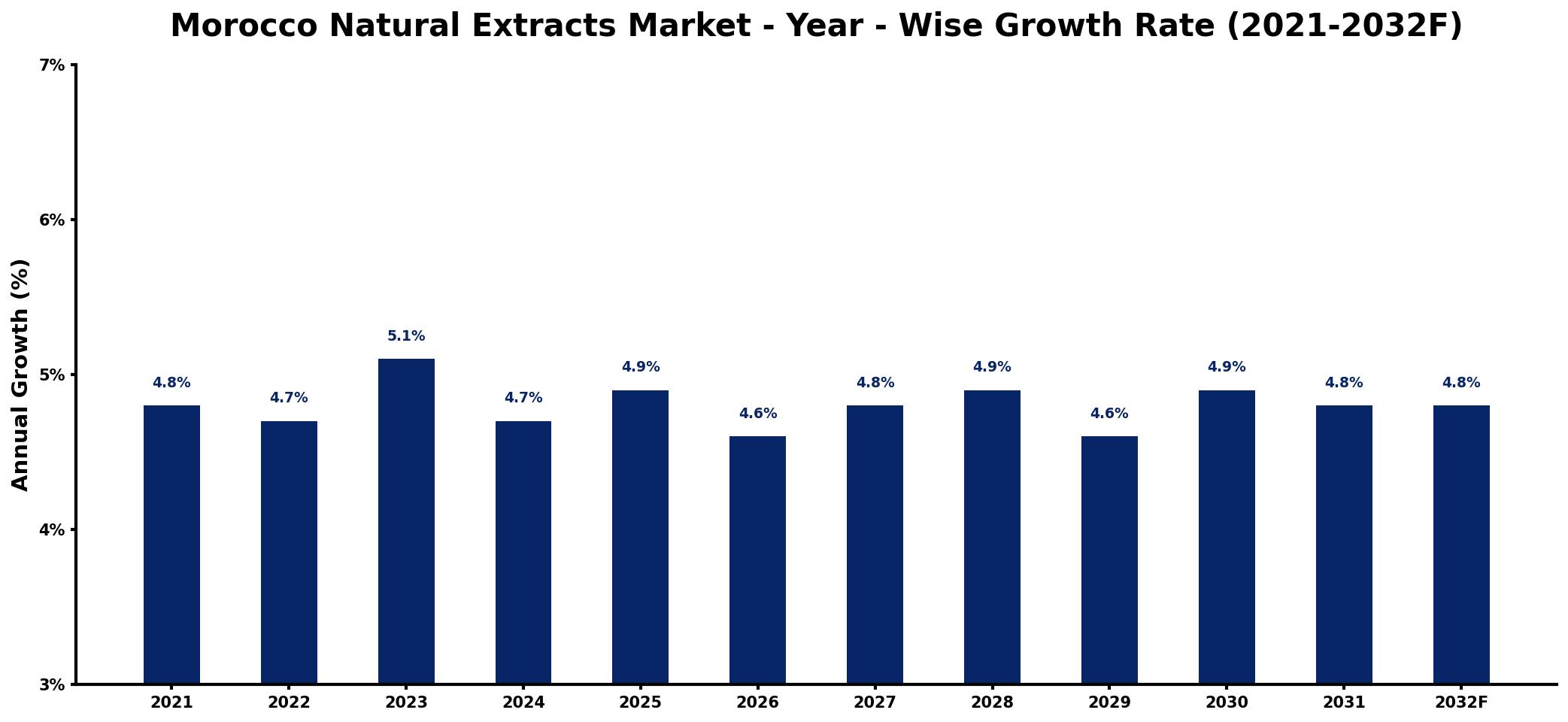
The table below presents the year‑wise growth rates along with the key drivers influencing the market
| Year | Growth Rate | Major Drivers |
| 2021 | 4.8% | Increased consumer health awareness |
| 2022 | 4.7% | Rising demand for organic products |
| 2023 | 5.1% | Growing popularity of wellness trends |
| 2024 | 4.7% | Expansion of e-commerce platforms |
| 2025 | 4.9% | Increased investment in sustainability |
| 2026 | 4.6% | Emergence of new market players |
| 2027 | 4.8% | Higher consumer spending on premium |
| 2028 | 4.9% | Broader applications in food industry |
| 2029 | 4.6% | Strengthened export opportunities abroad |
| 2030 | 4.9% | Innovations in processing technologies |
| 2031 | 4.8% | Enhanced marketing strategies adopted |
| 2032 | 4.8% | Strengthened partnerships with retailers |
Note: Market size estimations and growth projections presented in this report are based on 6Wresearch's proprietary forecasting methodology, utilizing the latest available industry data, government publications, and primary research inputs.
Morocco Natural Extracts Market Synopsis
Moroccos rich biodiversity plays a pivotal role in shaping its natural extracts market. The country is renowned for its unique offerings, notably argan oil, which has gained international acclaim for its anti-aging properties and extensive use in cosmetic formulations. This distinctive quality gives Morocco a competitive edge in the global market, attracting attention from manufacturers and consumers alike.
The countrys commitment to sustainability and ethical sourcing practices further enhances its reputation. Government initiatives aimed at supporting local producers and preserving natural habitats are paving the way for a thriving industry, ensuring that natural extracts not only meet global standards but also contribute to local economic development.
Morocco Natural Extracts Market Key Takeaways
- The Morocco Natural Extracts Market is set to grow significantly, driven by increasing consumer preference for organic products.
- Argan oil remains a cornerstone of the market, renowned for its diverse health and beauty benefits.
- Government policies are supporting sustainable practices and promoting local community welfare.
- Investors are showing heightened interest in high-value segments like saffron, further catalyzing market growth.
- Traditional Moroccan ingredients are seeing a resurgence as consumers seek authentic, clean-label products.
Evaluation of Restraints in Morocco Natural Extracts Market
Despite its promising outlook, the Morocco Natural Extracts Market faces several limitations. Inconsistent quality, often attributed to climatic variations and differing agricultural practices, poses a significant challenge to maintaining product integrity. Furthermore, limited access to modern extraction technologies can hinder production efficiency, creating hurdles in scaling operations. Coupled with fierce competition from global suppliers, these factors can affect profitability and market penetration for local businesses, necessitating strategic investments in technology and quality assurance.
Morocco Natural Extracts Market Trends
A noteworthy trend in the Morocco Natural Extracts Market is the growing consumer inclination towards clean beauty and wellness products. As awareness of the benefits of natural ingredients rises, traditional Moroccan extracts like prickly pear seed oil and rose water are experiencing increased demand. This trend is further accentuated by the global movement towards transparency in product sourcing, with consumers actively seeking brands that prioritize environmental sustainability and ethical practices. Additionally, the incorporation of natural extracts into food and beverage products is gaining traction as health-conscious consumers opt for cleaner labels.
Morocco Natural Extracts Market Opportunities
The Morocco Natural Extracts Market presents significant investment opportunities, particularly in the argan oil and saffron sectors. The high market value of saffron, combined with its expanding applications in both culinary and cosmetic industries, offers attractive prospects for growth. Moreover, the increasing trend towards organic products creates further potential for innovation, allowing investors to capitalize on Morocco's unique biodiversity and traditional knowledge to create new, high-demand products tailored to global markets.
Government Initiatives in the Morocco Natural Extracts Market
Government initiatives in Morocco are focused on promoting sustainable harvesting practices and enhancing the livelihoods of local communities involved in the production of natural extracts. Policies aimed at regulating the extraction and processing of resources such as argan oil are being implemented to ensure environmental conservation while supporting economic development. Training programs and financial assistance are also being provided to local farmers, equipping them with the skills and resources necessary to meet international standards and foster a competitive market.
Future Insights of the Morocco Natural Extracts Market
Looking ahead to 2026-2032, the Morocco Natural Extracts Market is poised for continued growth, driven by robust consumer demand for organic products and the global shift towards sustainability. The integration of innovative practices in extraction and production will likely enhance the quality and appeal of Moroccan natural extracts. Furthermore, as the government continues to support local producers and prioritize environmentally friendly practices, Morocco is set to strengthen its position as a leading supplier of premium natural extracts in the global market.
Morocco Natural Extracts Market Latest Developments (2025 - 2026)
Recent developments in the Morocco Natural Extracts Market indicate a growing collaboration between local farmers and international brands aiming to promote sustainable sourcing practices. There's an increasing focus on enhancing extraction techniques to improve yield and product quality. Furthermore, the rise of e-commerce platforms is facilitating better market access for local producers, allowing them to reach a broader audience and expand their market share. This is complemented by a push towards certification programs aimed at ensuring the authenticity and purity of Moroccan natural extracts.
Morocco Natural Extracts Market - Key Attractiveness of the Report
- 10 Years of Market Numbers
- Historical Data Starting from 2022 to 2025
- Base Year: 2025
- Forecast Data until 2032
- Key Performance Indicators Impacting the Market
- Major Upcoming Developments and Projects
Key Highlights of the Report:
- Morocco Natural Extracts Market Outlook
- Market Size of Morocco Natural Extracts Market, 2025
- Forecast of Morocco Natural Extracts Market, 2032
- Historical Data and Forecast of Morocco Natural Extracts Revenues & Volume for the Period 2022-2032F
- Morocco Natural Extracts Market Trend Evolution
- Morocco Natural Extracts Market Drivers and Challenges
- Morocco Natural Extracts Price Trends
- Morocco Natural Extracts Porter's Five Forces
- Morocco Natural Extracts Industry Life Cycle
- Historical Data and Forecast of Morocco Natural Extracts Market Revenues & Volume By Product for the Period 2022-2032F
- Historical Data and Forecast of Morocco Natural Extracts Market Revenues & Volume By Essential Oils for the Period 2022-2032F
- Historical Data and Forecast of Morocco Natural Extracts Market Revenues & Volume By Oleoresins for the Period 2022-2032F
- Historical Data and Forecast of Morocco Natural Extracts Market Revenues & Volume By Herbal Extracts for the Period 2022-2032F
- Historical Data and Forecast of Morocco Natural Extracts Market Revenues & Volume By Natural Colors for the Period 2022-2032F
- Historical Data and Forecast of Morocco Natural Extracts Market Revenues & Volume By Dried Crops for the Period 2022-2032F
- Historical Data and Forecast of Morocco Natural Extracts Market Revenues & Volume By Application for the Period 2022-2032F
- Historical Data and Forecast of Morocco Natural Extracts Market Revenues & Volume By Personal Care & Cosmetics for the Period 2022-2032F
- Historical Data and Forecast of Morocco Natural Extracts Market Revenues & Volume By Food & Beverage for the Period 2022-2032F
- Historical Data and Forecast of Morocco Natural Extracts Market Revenues & Volume By Animal Feed for the Period 2022-2032F
- Historical Data and Forecast of Morocco Natural Extracts Market Revenues & Volume By Pharmaceuticals for the Period 2022-2032F
- Historical Data and Forecast of Morocco Natural Extracts Market Revenues & Volume By Nutraceuticals for the Period 2022-2032F
- Historical Data and Forecast of Morocco Natural Extracts Market Revenues & Volume By Others for the Period 2022-2032F
- Morocco Natural Extracts Import Export Trade Statistics
- Market Opportunity Assessment By Product
- Market Opportunity Assessment By Application
- Morocco Natural Extracts Top Companies Market Share
- Morocco Natural Extracts Competitive Benchmarking By Technical and Operational Parameters
- Morocco Natural Extracts Company Profiles
- Morocco Natural Extracts Key Strategic Recommendations






































