South Korea Photo Printing And Merchandise Market Size, Share & Growth Rate
The South Korea Photo Printing And Merchandise Market was estimated at USD 489 Million in 2025 and is projected to reach USD 687 Million by 2032, growing at a CAGR of 5.0% from 2026 to 2032. This robust growth trajectory is propelled by the surging demand for personalized items, with consumers increasingly inclined to invest in unique photo products that serve as cherished keepsakes. The intersection of rising social media engagement and enhanced digital photography capabilities is enabling more individuals to explore creative avenues for sharing and displaying their memories, further bolstering market expansion.
South Korea Photo Printing And Merchandise Market Year-wise Growth Rate and Key Drivers
This graph highlights how the South Korea Photo Printing And Merchandise Market has steadily grown over the years, supported by major growth factors.
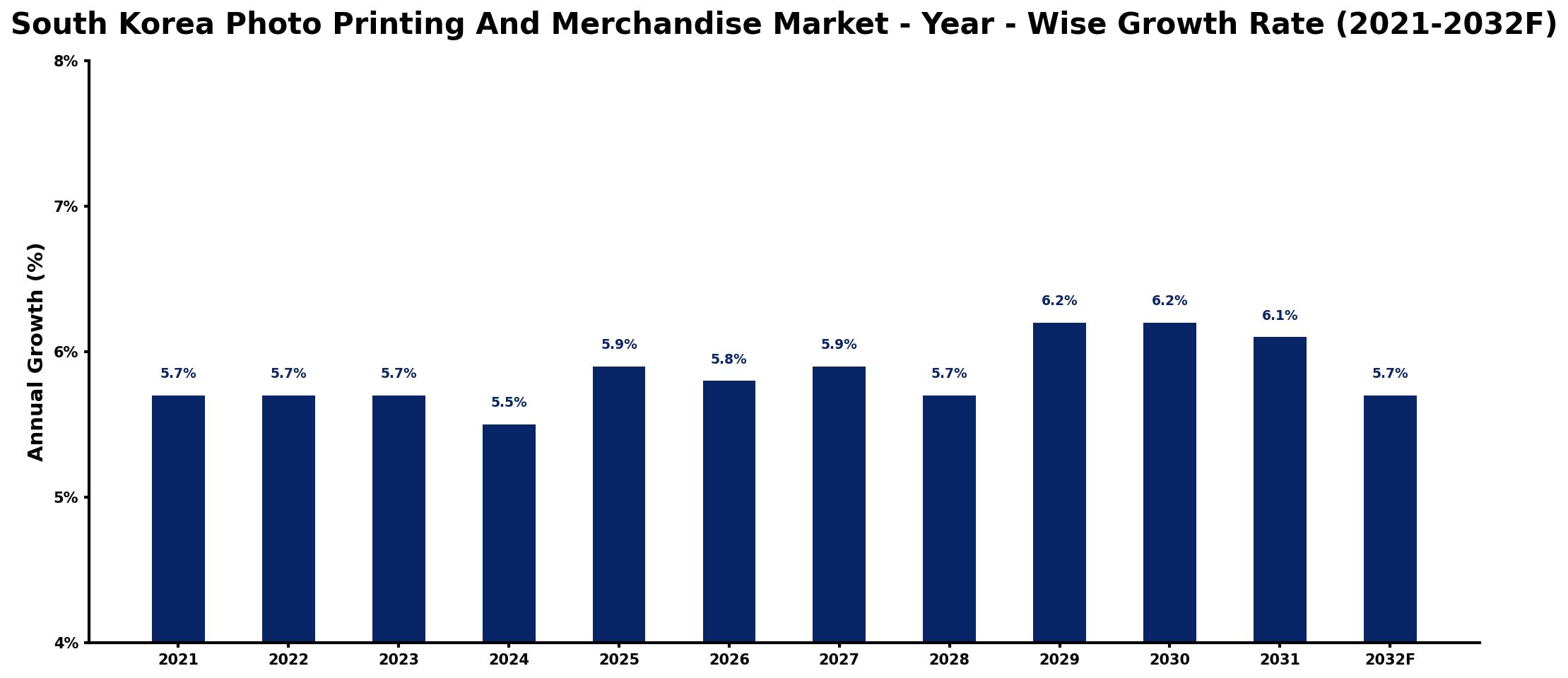
The table below presents the year‑wise growth rates along with the key drivers influencing the market
| Year | Growth Rate | Major Drivers |
| 2021 | 5.7% | Rising consumer demand for personalization |
| 2022 | 5.7% | Increased online shopping trends |
| 2023 | 5.7% | Growth in social media sharing |
| 2024 | 5.5% | Expansion of e-commerce platforms |
| 2025 | 5.9% | Emergence of new creative tools |
| 2026 | 5.8% | Higher disposable income levels |
| 2027 | 5.9% | Innovations in digital technology |
| 2028 | 5.7% | Increase in gifting culture |
| 2029 | 6.2% | Enhanced mobile application usage |
| 2030 | 6.2% | improved processing technologies adoption |
| 2031 | 6.1% | Development of sustainable practices |
| 2032 | 5.7% | Diversification of consumer preferences |
Note: Market size estimations and growth projections presented in this report are based on 6Wresearch's proprietary forecasting methodology, utilizing the latest available industry data, government publications, and primary research inputs.
South Korea Photo Printing And Merchandise Market Synopsis
The South Korea Photo Printing and Merchandise Market has seen significant momentum in recent years, largely attributed to the growing consumer appetite for customized gifts and personalized products. As digital photography becomes ubiquitous, the market is poised for transformative growth driven by the need for tangible expressions of memories.
Looking ahead, the market is expected to evolve, embracing a more diverse range of offerings that reflect changing consumer preferences. Enhanced technological solutions are being integrated to meet the growing expectations for quality and creativity, ensuring that consumers have access to innovative and appealing photo merchandise options.
South Korea Photo Printing And Merchandise Market Key Takeaways
- The market is driven by increasing consumer demand for personalized and unique photo products.
- Technological advancements are reshaping the landscape, enabling high-quality printing on various materials.
- Online platforms and mobile applications are becoming essential for providing convenient photo printing services.
- Social media trends continue to influence consumer preferences towards physical photo products.
- There is a growing focus on sustainability and ethical practices within the industry.
Evaluation of Restraints in South Korea Photo Printing And Merchandise Market
Despite the promising growth prospects, the South Korea Photo Printing and Merchandise Market faces notable restraints that could limit its full potential. The intensity of competition among established entities poses a challenge for newcomers trying to carve out a niche. Furthermore, rapid technological advancements compel businesses to consistently innovate, which can strain resources. There is also a noticeable shift in consumer preferences toward digital formats, which threatens traditional physical printing services. Companies must adapt swiftly to these changes to maintain relevance in an ever-evolving landscape.
South Korea Photo Printing And Merchandise Market Trends
The current landscape of the South Korea Photo Printing and Merchandise Market is marked by several key trends. A strong inclination toward customization has emerged, with consumers favoring unique offerings such as personalized photo books and calendars. Additionally, the integration of advanced printing technologies allows for superior quality and diverse product options, catering to evolving consumer tastes. Social media is driving a notable increase in physical photo printing, as users desire tangible reminders of their digital experiences. Moreover, sustainability initiatives are gaining traction, with companies striving to adopt eco-friendly practices to appeal to environmentally-conscious consumers.
South Korea Photo Printing And Merchandise Market Opportunities
Opportunities abound in the South Korea Photo Printing and Merchandise Market, particularly for businesses willing to innovate and diversify. The growing demand for custom photo products suggests a fertile ground for investment in online platforms that offer seamless ordering and customization features. Furthermore, advances in printing technology present avenues for producing high-quality, unique merchandise. Niche markets such as corporate gifting and event-specific products like wedding favors also hold substantial promise for new entrants and established players alike. By harnessing creativity and leveraging technology, stakeholders can differentiate themselves and tap into the expanding market.
Government Initiatives in the South Korea Photo Printing And Merchandise Market
The South Korean government plays an integral role in regulating the Photo Printing and Merchandise Market, primarily focusing on consumer protection and safeguarding intellectual property rights. The Fair Trade Commission actively monitors market competition to prevent anti-competitive practices, ensuring a fair and balanced playing field for all businesses. Additionally, copyright laws are enforced rigorously to protect the rights of photographers and artists, deterring unauthorized reproduction of their works. These initiatives contribute to a transparent market environment that fosters trust between consumers and businesses.
Future Insights of the South Korea Photo Printing And Merchandise Market
The future outlook for the South Korea Photo Printing and Merchandise Market is optimistic, with expected steady growth driven by a continued preference for personalized gifts. As social media and smartphone usage persist in rising, the demand for physical prints will likely increase, creating opportunities for innovative products that resonate with consumers. Additionally, advancements in printing technology and improvements in online service offerings will enhance accessibility, making it easier than ever for consumers to create customized merchandise. Overall, the market is set to flourish as it embraces the confluence of creativity and technology.
South Korea Photo Printing And Merchandise Market Latest Developments (2025 - 2026)
Recent developments within the South Korea Photo Printing and Merchandise Market indicate a shift towards even more user-centric offerings. Companies are increasingly investing in enhancing their online platforms, with improvements in user interface and customization features that streamline the ordering process. Innovations in printing materials and techniques have emerged, allowing businesses to expand their product ranges significantly. This period has also seen collaborative efforts among industry stakeholders to promote sustainability, with many companies adopting eco-friendly practices in production and packaging.
South Korea Photo Printing And Merchandise Market - Key Attractiveness of the Report
- 10 Years of Market Numbers
- Historical Data Starting from 2022 to 2025
- Base Year: 2025
- Forecast Data until 2032
- Key Performance Indicators Impacting the Market
- Major Upcoming Developments and Projects
Key Highlights of the Report:
- South Korea Photo Printing And Merchandise Market Outlook
- Market Size of South Korea Photo Printing And Merchandise Market, 2025
- Forecast of South Korea Photo Printing And Merchandise Market, 2032
- Historical Data and Forecast of South Korea Photo Printing And Merchandise Revenues & Volume for the Period 2022-2032F
- South Korea Photo Printing And Merchandise Market Trend Evolution
- South Korea Photo Printing And Merchandise Market Drivers and Challenges
- South Korea Photo Printing And Merchandise Price Trends
- South Korea Photo Printing And Merchandise Porter's Five Forces
- South Korea Photo Printing And Merchandise Industry Life Cycle
- Historical Data and Forecast of South Korea Photo Printing And Merchandise Market Revenues & Volume By Distribution Channel for the Period 2022-2032F
- Historical Data and Forecast of South Korea Photo Printing And Merchandise Market Revenues & Volume By Instant kiosks for the Period 2022-2032F
- Historical Data and Forecast of South Korea Photo Printing And Merchandise Market Revenues & Volume By Online stores for the Period 2022-2032F
- Historical Data and Forecast of South Korea Photo Printing And Merchandise Market Revenues & Volume By Retail stores for the Period 2022-2032F
- Historical Data and Forecast of South Korea Photo Printing And Merchandise Market Revenues & Volume By Other categories for the Period 2022-2032F
- South Korea Photo Printing And Merchandise Import Export Trade Statistics
- Market Opportunity Assessment By Distribution Channel
- South Korea Photo Printing And Merchandise Top Companies Market Share
- South Korea Photo Printing And Merchandise Competitive Benchmarking By Technical and Operational Parameters
- South Korea Photo Printing And Merchandise Company Profiles
- South Korea Photo Printing And Merchandise Key Strategic Recommendations






































