South Korea Pneumatic Tools Market Size, Share & Growth Rate
The South Korea Pneumatic Tools Market was estimated at USD 172 Million in 2025 and is projected to reach USD 243 Million by 2032, growing at a CAGR of 5.1% from 2026 to 2032. This robust growth trajectory is primarily fueled by the booming automotive and aerospace sectors, where precision and efficiency are paramount. Additionally, the increasing trend toward automation across various industries ensures a heightened demand for advanced pneumatic tools, enhancing operational productivity and performance.
South Korea Pneumatic Tools Market Year-wise Growth Rate and Key Drivers
This graph highlights how the South Korea Pneumatic Tools Market has steadily grown over the years, supported by major growth factors.
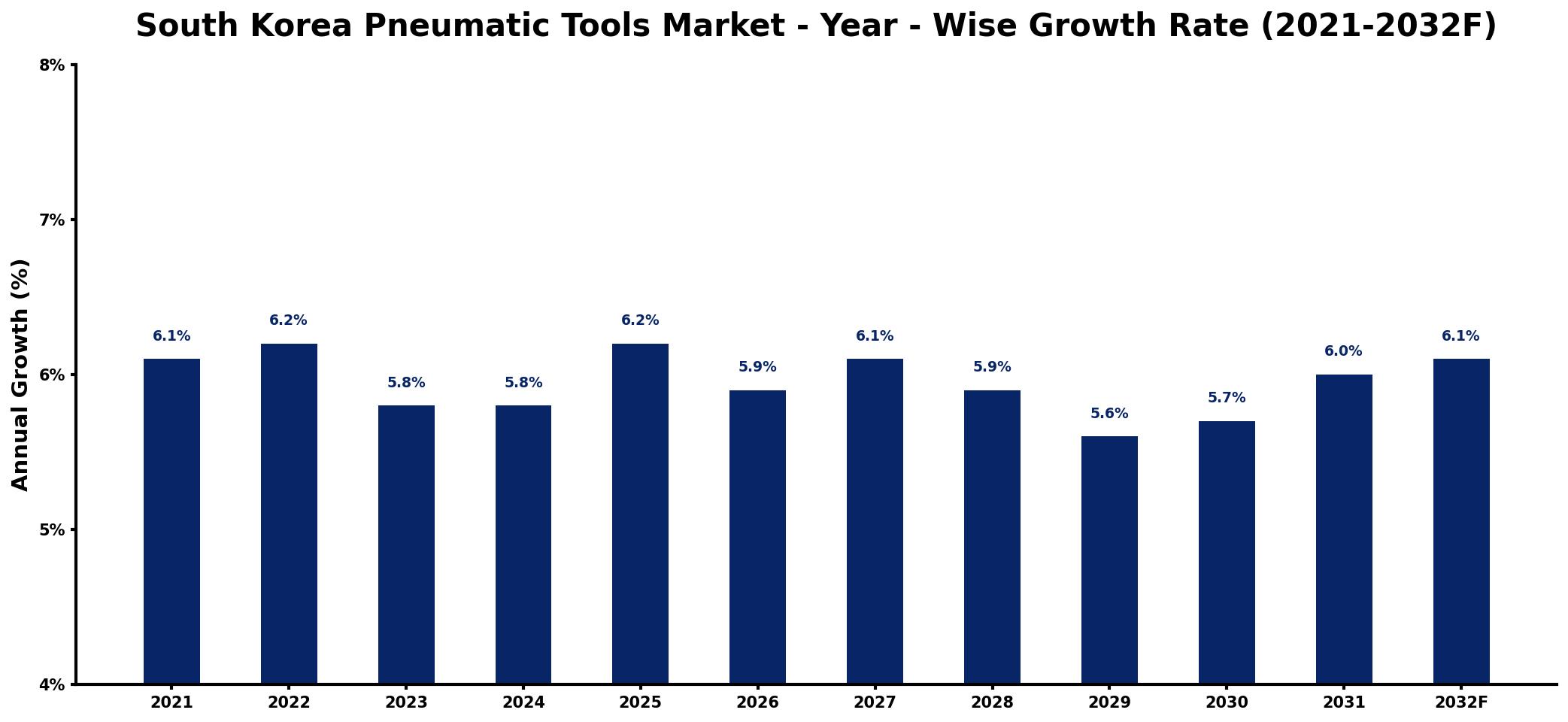
The table below presents the year‑wise growth rates along with the key drivers influencing the market
| Year | Growth Rate | Major Drivers |
| 2021 | 6.1% | Increased industrial automation investments |
| 2022 | 6.2% | Growing demand from construction sector |
| 2023 | 5.8% | Expansion of manufacturing capabilities |
| 2024 | 5.8% | Rising interest in energy efficiency |
| 2025 | 6.2% | Surge in automotive production rates |
| 2026 | 5.9% | Growth in aerospace industry projects |
| 2027 | 6.1% | Higher demand for maintenance services |
| 2028 | 5.9% | Advancements in technology integration |
| 2029 | 5.6% | Increased focus on safety standards |
| 2030 | 5.7% | rising export shipment volumes |
| 2031 | 6.0% | Rising popularity of DIY projects |
| 2032 | 6.1% | rising end-use demand growth |
Note: Market size estimations and growth projections presented in this report are based on 6Wresearch's proprietary forecasting methodology, utilizing the latest available industry data, government publications, and primary research inputs.
South Korea Pneumatic Tools Market Synopsis
In recent years, the South Korea Pneumatic Tools Market has observed a notable uptick in demand, attributable to the nation's rapid industrialization and technological advancements in manufacturing. Industries are increasingly recognizing the benefits of pneumatic tools, particularly in enhancing efficiency and precision across applications ranging from assembly to metalworking.
Key drivers such as the automotive and aerospace sectors are pushing the market towards innovation, as manufacturers seek to adopt lighter, more ergonomic designs that improve user comfort. The integration of IoT and AI technologies further enhances tool performance, driving the evolution of the pneumatic tools landscape in South Korea.
South Korea Pneumatic Tools Market Key Takeaways
- The market is influenced significantly by the growing automotive and aerospace industries.
- Increasing automation trends are leading to heightened demand for pneumatic tools.
- Manufacturers are focusing on innovation and ergonomic designs to meet consumer needs.
- Environmental sustainability is a key consideration in product development.
- Strategic partnerships are vital for companies to stay competitive in this dynamic market.
Evaluation of Restraints in South Korea Pneumatic Tools Market
Despite promising growth, the South Korea Pneumatic Tools Market faces challenges that could impede expansion. The intense competition among both domestic and international manufacturers necessitates continuous innovation and high-quality offerings to maintain market share. Additionally, fluctuating raw material prices can affect production costs, creating pricing pressures. Regulatory compliance with safety standards and environmental laws adds another layer of complexity for manufacturers, necessitating strategic agility to navigate these challenges effectively.
South Korea Pneumatic Tools Market Trends
Current trends in the South Korea Pneumatic Tools Market reveal a strong shift towards lightweight and ergonomic product designs, enhancing user experience and efficiency. Moreover, there is a growing emphasis on the integration of advanced technologies like IoT and AI, which are crucial for improving tool performance and enabling real-time monitoring. Alongside this, the demand for environmentally friendly pneumatic tools that minimize energy consumption and emissions is shaping new product developments, aligning with global sustainability initiatives.
South Korea Pneumatic Tools Market Opportunities
The South Korea Pneumatic Tools Market presents numerous investment opportunities, particularly within the expanding manufacturing sector. As industries adopt pneumatic tools for their reliability and efficiency, the potential for manufacturing and distributing high-quality tools is significant. Furthermore, offering maintenance and repair services can provide a competitive advantage. Investing in R&D to develop tools tailored to industry-specific needs will also position companies favorably within the market. Forming strategic alliances with local manufacturers could enhance market penetration and drive success in this evolving landscape.
Government Initiatives in the South Korea Pneumatic Tools Market
The South Korean government plays a pivotal role in shaping the Pneumatic Tools Market through various regulations and support initiatives aimed at ensuring product safety and environmental protection. The Ministry of Trade, Industry, and Energy (MOTIE) oversees regulations concerning product certification and testing, reinforcing consumer confidence. Furthermore, the government promotes innovation through subsidies and incentives for research and development, fostering competitiveness in the industry while prioritizing sustainability and compliance with environmental standards.
Future Insights of the South Korea Pneumatic Tools Market
Looking ahead to 2026-2032, the South Korea Pneumatic Tools Market is set for continued growth driven by ongoing industrialization and technological advancements. The increasing reliance on pneumatic tools within the automotive and construction sectors is expected to bolster demand significantly. Companies are likely to focus on innovations that enhance cost-effectiveness and energy efficiency, aligning with the broader trends of automation and sustainability. As competition intensifies, strategic product development and expansion of distribution networks will be critical for capturing market opportunities.
South Korea Pneumatic Tools Market Latest Developments (2025 - 2026)
In the recent months, the South Korea Pneumatic Tools Market has been characterized by a flurry of innovations aimed at enhancing tool performance and efficiency. The integration of smart technologies into pneumatic tools has gained traction, allowing for improved monitoring and maintenance capabilities. Moreover, there have been increased collaborations among manufacturers and technology firms to develop eco-friendly solutions that comply with stringent environmental regulations. These developments underscore the industry's commitment to addressing both performance and sustainability challenges.
South Korea Pneumatic Tools Market - Key Attractiveness of the Report
- 10 Years of Market Numbers
- Historical Data Starting from 2022 to 2025
- Base Year: 2025
- Forecast Data until 2032
- Key Performance Indicators Impacting the Market
- Major Upcoming Developments and Projects
Key Highlights of the Report:
- South Korea Pneumatic Tools Market Outlook
- Market Size of South Korea Pneumatic Tools Market, 2025
- Forecast of South Korea Pneumatic Tools Market, 2032
- Historical Data and Forecast of South Korea Pneumatic Tools Revenues & Volume for the Period 2022-2032F
- South Korea Pneumatic Tools Market Trend Evolution
- South Korea Pneumatic Tools Market Drivers and Challenges
- South Korea Pneumatic Tools Price Trends
- South Korea Pneumatic Tools Porter's Five Forces
- South Korea Pneumatic Tools Industry Life Cycle
- Historical Data and Forecast of South Korea Pneumatic Tools Market Revenues & Volume By Types for the Period 2022-2032F
- Historical Data and Forecast of South Korea Pneumatic Tools Market Revenues & Volume By Pneumatic Wrenches for the Period 2022-2032F
- Historical Data and Forecast of South Korea Pneumatic Tools Market Revenues & Volume By Pneumatic Sanders for the Period 2022-2032F
- Historical Data and Forecast of South Korea Pneumatic Tools Market Revenues & Volume By Pneumatic Hammers for the Period 2022-2032F
- Historical Data and Forecast of South Korea Pneumatic Tools Market Revenues & Volume By Pneumatic Drills for the Period 2022-2032F
- Historical Data and Forecast of South Korea Pneumatic Tools Market Revenues & Volume By Pneumatic Polishers for the Period 2022-2032F
- Historical Data and Forecast of South Korea Pneumatic Tools Market Revenues & Volume By Pneumatic Grinders for the Period 2022-2032F
- Historical Data and Forecast of South Korea Pneumatic Tools Market Revenues & Volume By Other Pneumatic Tools for the Period 2022-2032F
- Historical Data and Forecast of South Korea Pneumatic Tools Market Revenues & Volume By Application for the Period 2022-2032F
- Historical Data and Forecast of South Korea Pneumatic Tools Market Revenues & Volume By Industrial for the Period 2022-2032F
- Historical Data and Forecast of South Korea Pneumatic Tools Market Revenues & Volume By Residential or Household for the Period 2022-2032F
- Historical Data and Forecast of South Korea Pneumatic Tools Market Revenues & Volume By Others for the Period 2022-2032F
- Historical Data and Forecast of South Korea Pneumatic Tools Market Revenues & Volume By End-use for the Period 2022-2032F
- Historical Data and Forecast of South Korea Pneumatic Tools Market Revenues & Volume By Automobile for the Period 2022-2032F
- Historical Data and Forecast of South Korea Pneumatic Tools Market Revenues & Volume By Textile for the Period 2022-2032F
- Historical Data and Forecast of South Korea Pneumatic Tools Market Revenues & Volume By Defense for the Period 2022-2032F
- Historical Data and Forecast of South Korea Pneumatic Tools Market Revenues & Volume By Mining for the Period 2022-2032F
- Historical Data and Forecast of South Korea Pneumatic Tools Market Revenues & Volume By Chemicals for the Period 2022-2032F
- Historical Data and Forecast of South Korea Pneumatic Tools Market Revenues & Volume By Manufacturing for the Period 2022-2032F
- Historical Data and Forecast of South Korea Pneumatic Tools Market Revenues & Volume By Mining for the Period 2022-2032F
- South Korea Pneumatic Tools Import Export Trade Statistics
- Market Opportunity Assessment By Types
- Market Opportunity Assessment By Application
- Market Opportunity Assessment By End-use
- South Korea Pneumatic Tools Top Companies Market Share
- South Korea Pneumatic Tools Competitive Benchmarking By Technical and Operational Parameters
- South Korea Pneumatic Tools Company Profiles
- South Korea Pneumatic Tools Key Strategic Recommendations






































