South Korea Polyester Fabric Market Summary
The south korea polyester fabric market was estimated at USD 826 Million in 2025 and is projected to reach USD 1201 Million by 2032, growing at a CAGR of 6.7% from 2026 to 2032.
South Korea Polyester Fabric Market Year-wise Growth Rate and Key Drivers
This graph highlights how the South Korea Polyester Fabric Market has steadily grown over the past five years, supported by major growth factors.
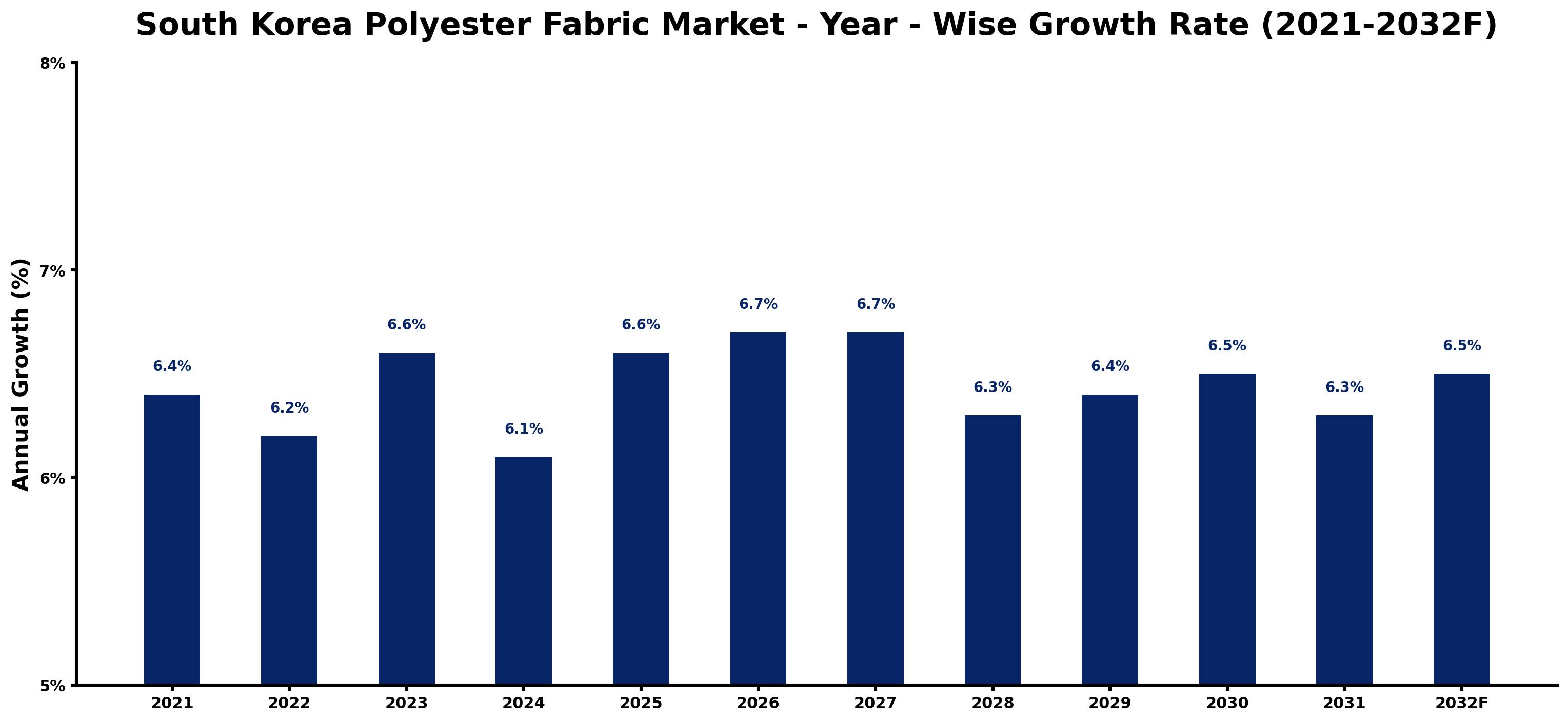
The table below presents the year wise growth rates along with the key drivers influencing the market
| Year | Growth Rate | Major Drivers |
| 2021 | 6.4% | Post-pandemic recovery sparked renewed interest in sustainable textile production methods. |
| 2022 | 6.2% | Increased consumer preference for eco-friendly fabrics prompted innovations in polyester recycling technologies. |
| 2023 | 6.6% | Local fashion brands emphasize unique styles, driving demand for high-quality polyester textiles. |
| 2024 | 6.1% | Emerging designers focus on lightweight and durable fabrics, expanding polyester market applications. |
| 2025 | 6.6% | Technological advancements in fabric manufacturing enhance polyester's appeal in outdoor apparel markets. |
| 2026 | 6.7% | Competitive pricing strategies among manufacturers create opportunities for increased market penetration. |
| 2027 | 6.7% | Retailers prioritize sustainable sourcing, influencing polyester production practices significantly. |
| 2028 | 6.3% | Regional collaborations facilitate the development of advanced polyester fabric manufacturing technologies. |
| 2029 | 6.4% | Consumer education on polyester's recyclability strengthens its market position against alternatives. |
| 2030 | 6.5% | Innovations in dyeing processes reduce environmental impacts, further attracting eco-conscious consumers. |
| 2031 | 6.3% | Global fashion trends increasingly favor versatility and durability, aligning with polyester attributes. |
| 2032 | 6.5% | Partnerships between brands and manufacturers result in customized polyester fabric solutions. |
Note - Market size estimations and growth projections presented in this report are based on 6Wresearch's advanced forecasting approach, validated with industry datasets as of June 2026.
South Korea Polyester Fabric Market Synopsis
The South Korea Polyester Fabric Market is projected to reach 6.7% and witness significant growth during the forecast period (2026-2032). As one of the largest markets for polyester fabric in Asia, South Korea is poised to benefit from multiple growth drivers, including increasing demand from both the apparel and home furnishing industries. Additionally, factors such as rising disposable income, a growing population, and a heightened consumer preference for branded clothing are anticipated to further propel market expansion in the coming years.
South Korea Polyester Fabric Market Growth Drivers
The growth of the South Korea Polyester Fabric Market can be attributed to several key factors:
- The apparel sector is seeing a strong demand for polyester fabrics due to their versatility and affordability, contributing to market growth.
- Increased consumer spending power, driven by rising disposable income, has led to higher expenditure on clothing and home textiles.
- Advancements in fabric technology, including the development of lightweight, durable, and highly elastic fabrics, are attracting manufacturers and consumers alike.
- A growing emphasis on sustainability has led to increased interest in bio-based polyester fabrics, creating new opportunities within the market.
- The robust growth of e-commerce platforms is facilitating easier access to a variety of polyester fabric options for consumers, thus stimulating market demand.
South Korea Polyester Fabric Market Trends and Opportunities
The South Korea Polyester Fabric Market is witnessing notable trends that are likely to shape its future:
- There is a marked shift towards eco-friendly and sustainable fabrics, which is expected to drive innovations in product development.
- Technological advancements, including smart textiles that incorporate functionality like moisture-wicking or temperature regulation, are gaining traction.
- Increased collaborations between textile manufacturers and fashion brands are leading to the creation of unique polyester fabric collections that cater to evolving consumer tastes.
- The expansion of the home furnishing market is creating a growing segment for polyester fabrics used in upholstery and decorative textiles.
- Changing fashion trends, including a preference for casual wear and athleisure, is encouraging the use of polyester fabrics in various clothing lines.
South Korea Polyester Fabric Market Challenges and Restraints
While the South Korea Polyester Fabric Market shows promising growth, it also faces several challenges:
- Intense competition among local and international manufacturers may lead to price wars, impacting profitability.
- Environmental concerns regarding the production process of synthetic fibers could pose significant challenges as consumers shift towards sustainable options.
- The global supply chain disruptions have the potential to affect fabric availability, leading to production delays and increased operational costs.
- Fluctuations in raw material prices can hinder manufacturers' abilities to maintain stable pricing structures.
- Changing consumer preferences towards natural fabrics could negatively impact the demand for polyester in specific segments.
South Korea Polyester Fabric Market Government Investment and Initiatives
The South Korean government has been active in supporting the polyester fabric market through various initiatives:
- Public policies aimed at promoting sustainable textile production are gaining momentum, particularly in the context of reducing environmental footprints.
- Investment in research and development is being prioritized to foster innovation in fabric technology and sustainability practices.
- Government subsidies for eco-friendly material production are encouraging local manufacturers to transition towards greener practices.
- Plans for enhancing infrastructure related to textile manufacturing and distribution are underway to facilitate market competitiveness.
- Trade agreements with other nations aim to boost exports of South Korean textiles, including polyester fabric, enhancing global market presence.
South Korea Polyester Fabric Market Latest Developments (May 2025 - June 2026)
The period from May 2025 to June 2026 has seen several pivotal developments within the South Korea Polyester Fabric Market:
- Growing collaborations among manufacturers to adopt sustainable practices are leading to innovation in eco-friendly polyester fabrics.
- Technological advancements are being rapidly adopted, focusing on the integration of smart features in polyester textiles.
- Market players are increasingly investing in marketing strategies targeting millennials, known for their inclination towards branded clothing.
- Distribution channels are evolving, with an increased emphasis on online platforms, significantly affecting consumer purchase behaviors.
- Regulatory frameworks are being established to ensure compliance with environmental standards, influencing production processes across the industry.
South Korea Polyester Fabric Market - Key Attractiveness of the Report
- 10 Years of Market Numbers
- Historical Data Starting from 2022 to 2025
- Base Year: 2025
- Forecast Data until 2032
- Key Performance Indicators Impacting the Market
- Major Upcoming Developments and Projects
Key Highlights of the Report:
- South Korea Polyester Fabric Market Outlook
- Market Size of South Korea Polyester Fabric Market, 2025
- Forecast of South Korea Polyester Fabric Market, 2032F
- Historical Data and Forecast of South Korea Polyester Fabric Revenues & Volume for the Period 2022-2032F
- South Korea Polyester Fabric Market Trend Evolution
- South Korea Polyester Fabric Market Drivers and Challenges
- South Korea Polyester Fabric Price Trends
- South Korea Polyester Fabric Porter's Five Forces
- South Korea Polyester Fabric Industry Life Cycle
- Historical Data and Forecast of South Korea Polyester Fabric Market Revenues & Volume By Type for the Period 2022-2032F
- Historical Data and Forecast of South Korea Polyester Fabric Market Revenues & Volume By PET for the Period 2022-2032F
- Historical Data and Forecast of South Korea Polyester Fabric Market Revenues & Volume By PCDT for the Period 2022-2032F
- Historical Data and Forecast of South Korea Polyester Fabric Market Revenues & Volume By Applications for the Period 2022-2032F
- Historical Data and Forecast of South Korea Polyester Fabric Market Revenues & Volume By Carpets & Rugs for the Period 2022-2032F
- Historical Data and Forecast of South Korea Polyester Fabric Market Revenues & Volume By Non-Woven Fabrics Fiberfill for the Period 2022-2032F
- Historical Data and Forecast of South Korea Polyester Fabric Market Revenues & Volume By Apparels for the Period 2022-2032F
- Historical Data and Forecast of South Korea Polyester Fabric Market Revenues & Volume By Home Textiles for the Period 2022-2032F
- Historical Data and Forecast of South Korea Polyester Fabric Market Revenues & Volume By Others? for the Period 2022-2032F
- South Korea Polyester Fabric Import Export Trade Statistics
- Market Opportunity Assessment By Type
- Market Opportunity Assessment By Applications
- South Korea Polyester Fabric Top Companies Market Share
- South Korea Polyester Fabric Competitive Benchmarking By Technical and Operational Parameters
- South Korea Polyester Fabric Company Profiles
- South Korea Polyester Fabric Key Strategic Recommendations






































