South Korea Refined Petroleum Products Market Size, Share & Growth Rate
The South Korea Refined Petroleum Products Market was estimated at USD 162 Million in 2025 and is projected to reach USD 224 Million by 2032, growing at a CAGR of 4.7% from 2026 to 2032. This upward trajectory is largely driven by the countrys robust industrial growth and escalating transportation needs, which require a consistent supply of refined petroleum products. Additionally, government policies favoring cleaner fuel options and enhanced refining technologies are further propelling market expansion.
South Korea Refined Petroleum Products Market Year-wise Growth Rate and Key Drivers
This graph highlights how the South Korea Refined Petroleum Products Market has steadily grown over the years, supported by major growth factors.
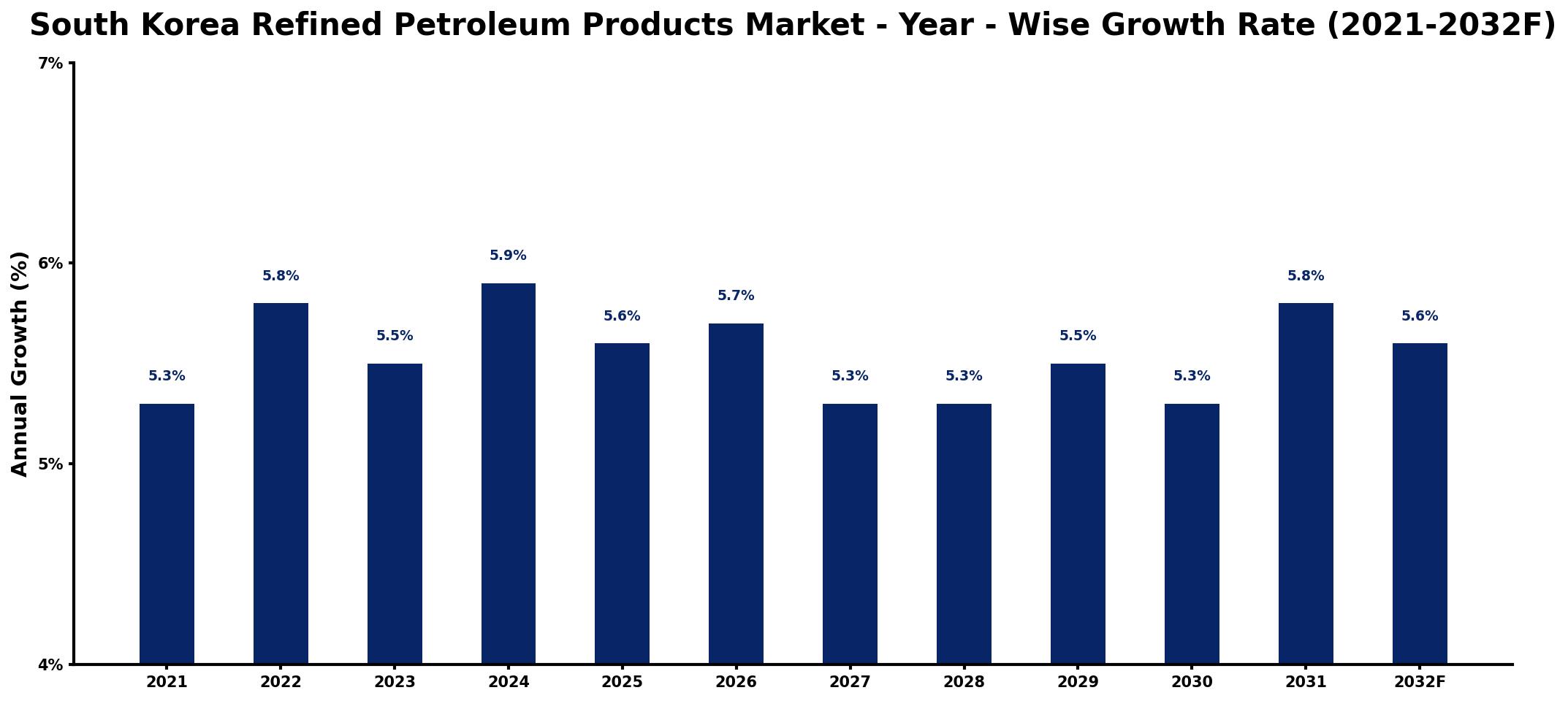
The table below presents the year‑wise growth rates along with the key drivers influencing the market
| Year | Growth Rate | Major Drivers |
| 2021 | 5.3% | Rising industrial energy demand |
| 2022 | 5.8% | Increased transportation sector activity |
| 2023 | 5.5% | Growth in urbanization trends |
| 2024 | 5.9% | Expansion of logistics networks |
| 2025 | 5.6% | Surge in electric vehicle adoption |
| 2026 | 5.7% | Investment in infrastructure projects |
| 2027 | 5.3% | Boost in tourism and travel |
| 2028 | 5.3% | Technological advancements in delivery |
| 2029 | 5.5% | Growing exports of machinery |
| 2030 | 5.3% | Development of regional trade agreements |
| 2031 | 5.8% | Increased consumer spending habits |
| 2032 | 5.6% | Enhanced energy efficiency initiatives |
Note: Market size estimations and growth projections presented in this report are based on 6Wresearch's proprietary forecasting methodology, utilizing the latest available industry data, government publications, and primary research inputs.
South Korea Refined Petroleum Products Market Synopsis
The strongest force shaping the South Korea Refined Petroleum Products Market today is the increasing demand for sustainable and eco-friendly alternatives. As environmental regulations tighten, both consumers and businesses are progressively turning to cleaner energy sources, making innovation in fuel production a priority.
Moreover, the competitive landscape is characterized by significant investments in technology aimed at enhancing operational efficiencies. Companies are leveraging digital tools and data analytics to optimize refining processes, which not only boosts productivity but also aligns with the market's shift towards sustainability.
South Korea Refined Petroleum Products Market Key Takeaways
- The market's growth is primarily driven by rising industrial activities and transportation demands.
- There is a significant shift towards cleaner energy solutions, including biofuels and hydrogen fuel technologies.
- Technological advancements are reshaping operational efficiency in the refining sector.
- Intense competition among domestic players necessitates continuous innovation and strategic partnerships.
- Government policies are fostering a regulatory environment conducive to sustainable energy practices.
Evaluation of Restraints in South Korea Refined Petroleum Products Market
The South Korea Refined Petroleum Products Market faces certain restraints that could impact its growth trajectory. One significant challenge is the fluctuating global oil prices, which can erode profit margins for refiners. Furthermore, stringent environmental regulations require substantial investments in technology and infrastructure, imposing financial burdens on players in the market. Additionally, geopolitical tensions can disrupt supply chain logistics, complicating the import of crude oil essential for domestic refining processes.
South Korea Refined Petroleum Products Market Trends
Emerging trends in the South Korea Refined Petroleum Products Market include a growing preference for specialty petroleum products that cater to evolving consumer demands. With the government promoting alternative fuels, biofuels are gaining significant traction, driving manufacturers to innovate continuously. The integration of digital technologies such as AI and IoT is enhancing refining efficiencies, streamlining operations, and reducing waste, leading to a more sustainable production model.
South Korea Refined Petroleum Products Market Opportunities
Investment opportunities are abundant within the South Korea Refined Petroleum Products Market, particularly in sectors focused on refining and distributing petroleum products. Companies that specialize in renewable fuels and energy efficiency technologies are well-positioned to capitalize on the government's clean energy initiatives. Furthermore, investments in infrastructure development, including storage and distribution capabilities, offer pathways to leverage the growing demand for refined petroleum products.
Government Initiatives in the South Korea Refined Petroleum Products Market
The South Korean government plays a crucial role in shaping the refined petroleum landscape through various regulations and initiatives. Policies aimed at promoting energy efficiency include taxes on petroleum products, incentivizing reduced environmental impact. Additionally, the government enforces strict fuel quality standards to ensure safety and reliability. Initiatives supporting the transition to alternative fuels signify a commitment to creating a sustainable market that balances economic growth with environmental stewardship.
Future Insights of the South Korea Refined Petroleum Products Market
Looking ahead to 2026-2032, the South Korea Refined Petroleum Products Market is poised for continued growth, fueled by increasing demand for petrochemicals and government initiatives promoting sustainability. The nations strategic position as a key shipping hub amplifies its potential for market expansion. Advancements in refining technology are anticipated to enhance operational efficiency further, providing players in the market with opportunities to meet consumer preferences for cleaner products.
South Korea Refined Petroleum Products Market Latest Developments (2025 - 2026)
Recent developments in the South Korea Refined Petroleum Products Market indicate a strong push towards innovation and sustainability. Companies are increasingly adopting advanced technologies to optimize their refining processes, while there is a noticeable rise in partnerships aimed at developing alternative fuel sources. Furthermore, ongoing discussions regarding regulatory frameworks are shaping the future of the market, promoting cleaner energy initiatives and ensuring compliance with environmental standards.
South Korea Refined Petroleum Products Market - Key Attractiveness of the Report
- 10 Years of Market Numbers
- Historical Data Starting from 2022 to 2025
- Base Year: 2025
- Forecast Data until 2032
- Key Performance Indicators Impacting the Market
- Major Upcoming Developments and Projects
Key Highlights of the Report:
- South Korea Refined Petroleum Products Market Outlook
- Market Size of South Korea Refined Petroleum Products Market, 2025
- Forecast of South Korea Refined Petroleum Products Market, 2032
- Historical Data and Forecast of South Korea Refined Petroleum Products Revenues & Volume for the Period 2022-2032F
- South Korea Refined Petroleum Products Market Trend Evolution
- South Korea Refined Petroleum Products Market Drivers and Challenges
- South Korea Refined Petroleum Products Price Trends
- South Korea Refined Petroleum Products Porter's Five Forces
- South Korea Refined Petroleum Products Industry Life Cycle
- Historical Data and Forecast of South Korea Refined Petroleum Products Market Revenues & Volume By Product Type for the Period 2022-2032F
- Historical Data and Forecast of South Korea Refined Petroleum Products Market Revenues & Volume By Diesel for the Period 2022-2032F
- Historical Data and Forecast of South Korea Refined Petroleum Products Market Revenues & Volume By Gasoline for the Period 2022-2032F
- Historical Data and Forecast of South Korea Refined Petroleum Products Market Revenues & Volume By Fuel Oils for the Period 2022-2032F
- Historical Data and Forecast of South Korea Refined Petroleum Products Market Revenues & Volume By Kerosene for the Period 2022-2032F
- Historical Data and Forecast of South Korea Refined Petroleum Products Market Revenues & Volume By Others for the Period 2022-2032F
- Historical Data and Forecast of South Korea Refined Petroleum Products Market Revenues & Volume By Application for the Period 2022-2032F
- Historical Data and Forecast of South Korea Refined Petroleum Products Market Revenues & Volume By Fuel for the Period 2022-2032F
- Historical Data and Forecast of South Korea Refined Petroleum Products Market Revenues & Volume By Chemical for the Period 2022-2032F
- Historical Data and Forecast of South Korea Refined Petroleum Products Market Revenues & Volume By Others for the Period 2022-2032F
- Historical Data and Forecast of South Korea Refined Petroleum Products Market Revenues & Volume By Fraction for the Period 2022-2032F
- Historical Data and Forecast of South Korea Refined Petroleum Products Market Revenues & Volume By Light Distillates for the Period 2022-2032F
- Historical Data and Forecast of South Korea Refined Petroleum Products Market Revenues & Volume By Middle Distillates for the Period 2022-2032F
- Historical Data and Forecast of South Korea Refined Petroleum Products Market Revenues & Volume By Heavy Oils for the Period 2022-2032F
- South Korea Refined Petroleum Products Import Export Trade Statistics
- Market Opportunity Assessment By Product Type
- Market Opportunity Assessment By Application
- Market Opportunity Assessment By Fraction
- South Korea Refined Petroleum Products Top Companies Market Share
- South Korea Refined Petroleum Products Competitive Benchmarking By Technical and Operational Parameters
- South Korea Refined Petroleum Products Company Profiles
- South Korea Refined Petroleum Products Key Strategic Recommendations






































