South Korea Remote Asset Management Market Size & Growth Rate (2026-2032)
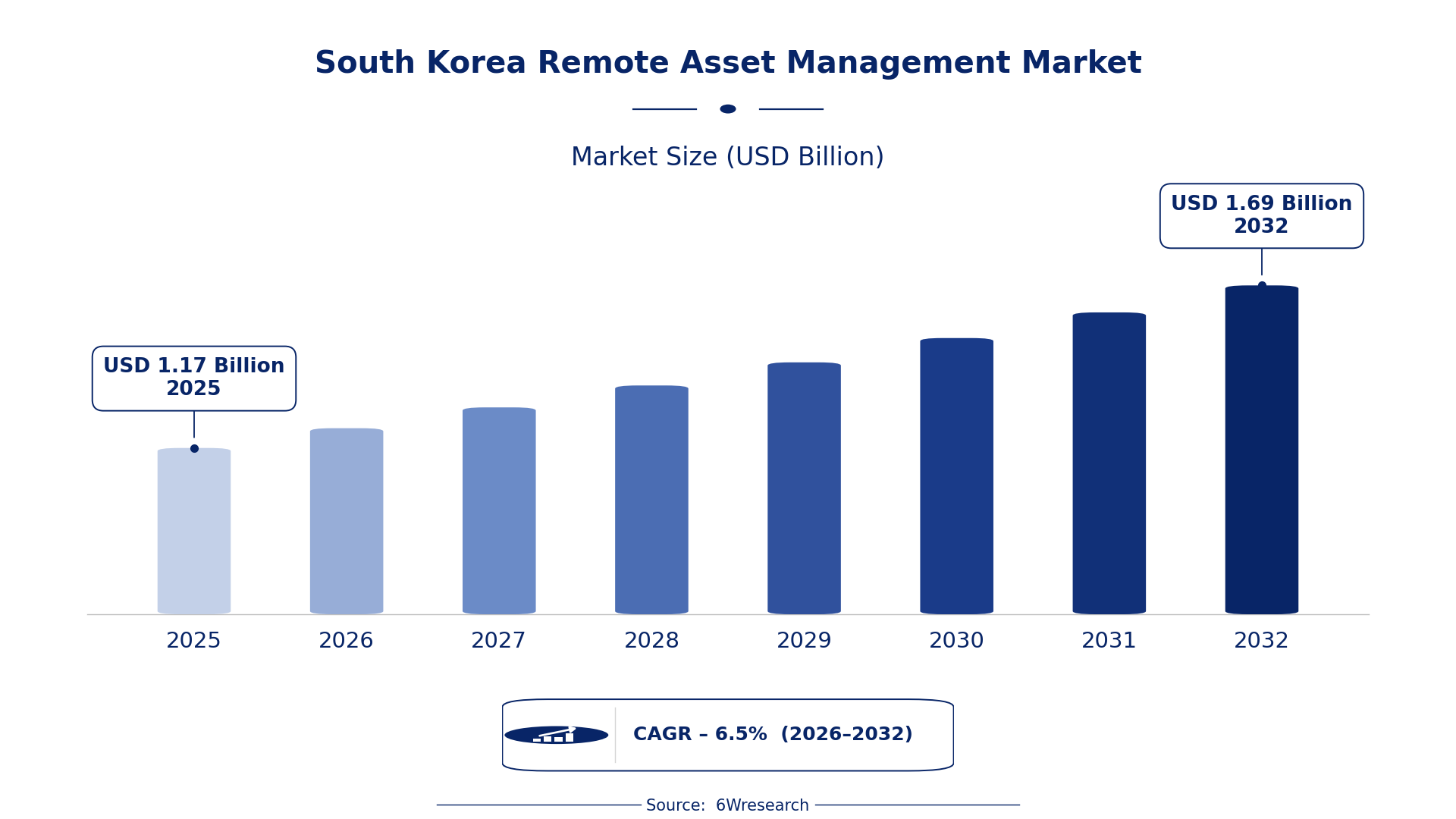
The South Korea Remote Asset Management Market was estimated at USD 1173 Million in 2025 and is projected to reach USD 1689 Million by 2032, growing at a CAGR of 6.5% from 2026 to 2032.
South Korea Remote Asset Management Market Synopsis
The remote asset management market in South Korea is rapidly evolving, driven by the increasing integration of IoT technologies across various industries. Businesses are prioritizing solutions that enhance operational efficiency and reduce costs, making remote monitoring and management essential for asset-intensive sectors.
As companies in manufacturing, transportation, and energy embrace digital transformation, the demand for real-time asset tracking has surged. This trend reflects a broader push for predictive maintenance, compliance with regulatory standards, and improved supply chain management, indicating a market ripe with potential.
South Korea Remote Asset Management Market Year-wise Growth Rate and Key Drivers
This graph illustrates the annual growth rates of the South Korea Remote Asset Management Market from 2021 to 2032, highlighting a steady upward trajectory and projected expansion over the forecast period.
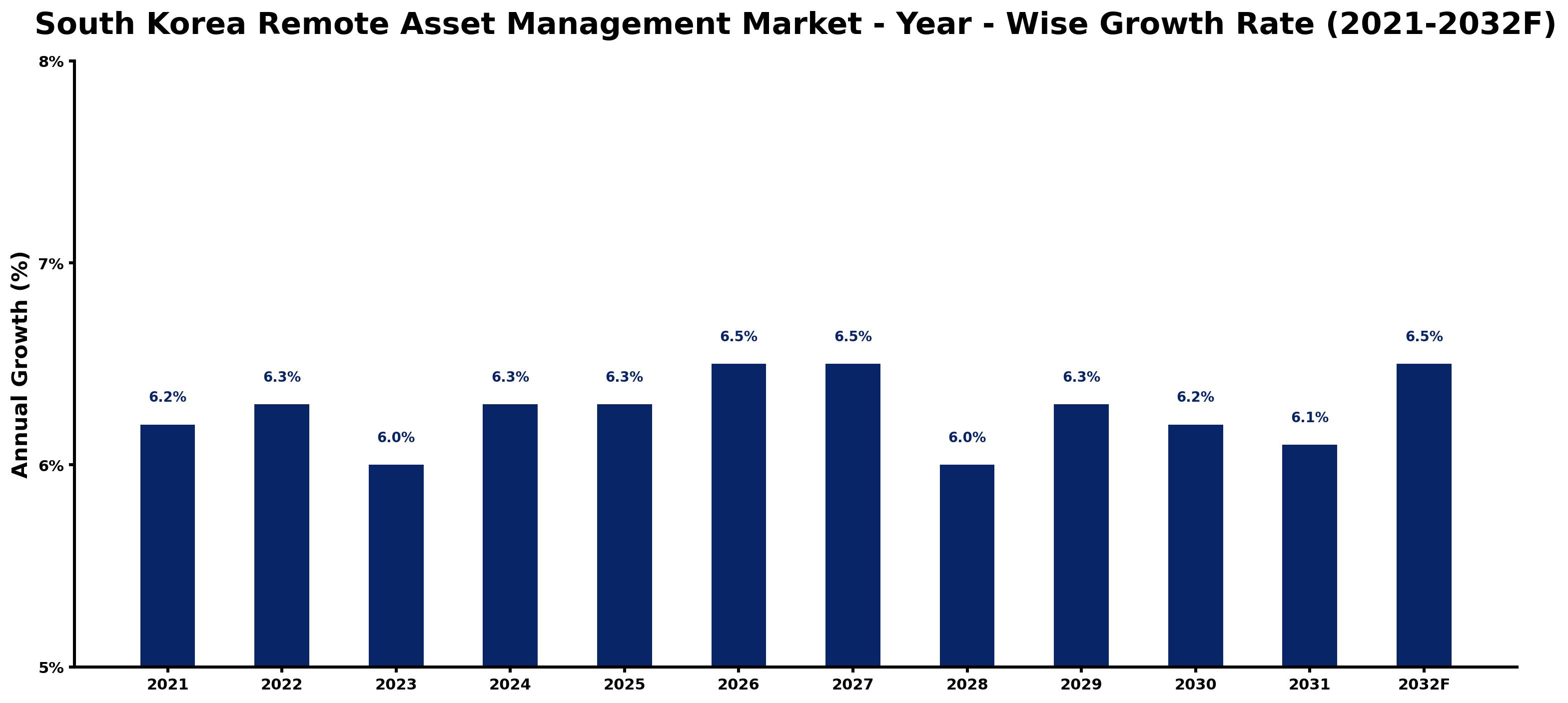
The table below presents the year‑wise growth rates along with the key drivers influencing the market
| Year | Growth Rate | Major Drivers |
| 2021 | 6.2% | Increased IoT adoption drives remote asset efficiency. |
| 2022 | 6.3% | Smart factory initiatives enhance remote management capabilities. |
| 2023 | 6.0% | Government regulations promote digital asset monitoring standards. |
| 2024 | 6.3% | Rising logistics costs fuel demand for remote oversight. |
| 2025 | 6.3% | Shift towards eco-friendly operations boosts asset management technology. |
| 2026 | 6.5% | 5G rollout enhances real-time asset tracking capabilities. |
| 2027 | 6.5% | Growing e-commerce needs elevate asset management solutions. |
| 2028 | 6.0% | Aging infrastructure necessitates efficient remote monitoring. |
| 2029 | 6.3% | Cybersecurity concerns drive adoption of asset protection measures. |
| 2030 | 6.2% | Government grants support advanced remote management innovations. |
| 2031 | 6.1% | Burgeoning fintech sector pushes asset transparency tools. |
| 2032 | 6.5% | Increased urbanization demands efficient asset utilization strategies. |
Note: Market size estimations and growth projections presented in this report are based on 6Wresearch's proprietary forecasting methodology, utilizing the latest available industry data, government publications, and primary research inputs.
South Korea Remote Asset Management Market Key Takeaways
Below are some of the specific key takeaways from the market, including:
- Integration of IoT technologies is a primary growth driver in the market.
- Real-time monitoring solutions are critical for operational efficiency.
- Predictive maintenance is gaining traction as a key application area.
- Government policies are increasingly supporting the adoption of remote asset management.
- Data security and interoperability remain significant challenges for the market.
Evaluation of Restraints in South Korea Remote Asset Management Market
Despite promising growth, the South Korea remote asset management market faces notable restraints. Data security concerns are paramount, as the increasing connectivity of assets raises the risk of cyber threats. Companies are challenged to implement robust cybersecurity measures while managing the complexities of interoperability among diverse systems. on top of that, scalability issues can arise as the number of connected devices expands, necessitating reliable infrastructure and advanced analytics capabilities. Addressing these challenges is crucial for realizing the full potential of remote asset management solutions.
South Korea Remote Asset Management Market Trends
Several trends are shaping the South Korea remote asset management market. The shift towards predictive maintenance is gaining momentum, allowing businesses to anticipate equipment failures before they occur. This trend is complemented by the rise in demand for data-driven decision-making tools that provide actionable insights.
Additionally, the convergence of artificial intelligence and machine learning with remote asset management platforms is enhancing their capabilities. This integration allows for smarter analytics and improved forecasting, making asset management more efficient and effective.
South Korea Remote Asset Management Market Opportunities
The remote asset management market in South Korea presents numerous growth opportunities. Industries are increasingly investing in digital solutions, which provides a fertile ground for innovative technologies. Companies can capitalize on the need for enhanced predictive maintenance solutions, particularly in sectors like manufacturing and transportation.
on top of that, as regulatory frameworks evolve to support remote monitoring, businesses that offer compliant and secure asset management solutions are likely to gain a competitive edge. Collaborations between technology providers and industry players will further unlock potential within this market.
Government Initiatives in the South Korea Remote Asset Management Market
The South Korean government is actively promoting the adoption of remote asset management technologies across various sectors. With an emphasis on enhancing efficiency and innovation, public policies are being designed to support this transformation. Current initiatives focus on funding, regulatory frameworks, and industry collaboration to facilitate the integration of advanced monitoring solutions.
- A recently completed initiative aimed to fund pilot projects in the transportation sector, enhancing real-time asset tracking capabilities.
- Currently ongoing is a national digital infrastructure upgrade programme designed to improve connectivity for remote monitoring systems.
- A planned public-private initiative is expected to address interoperability standards and promote industry collaboration by 2028.
- In 2025, a regulatory framework was introduced to ensure data privacy and security in remote asset management practices.
- Ongoing incentives are being offered to companies investing in predictive maintenance technologies across various industries.
Future Insights of the South Korea Remote Asset Management Market
Looking ahead to 2026-2032, the South Korea remote asset management market is set to expand significantly. The convergence of advanced technologies like AI and IoT will drive the development of smarter, more efficient management solutions. As industries increasingly prioritize digital transformation, we can expect a surge in investments aimed at upgrading existing infrastructure to support remote monitoring capabilities.
on top of that, regulatory support will likely foster an environment conducive to innovation and growth. Companies that adapt quickly to these changes and invest in robust cybersecurity measures will be better positioned to thrive in this evolving market.
South Korea Remote Asset Management Market Latest Developments
In the past year, the South Korea remote asset management market has witnessed a flurry of activity, as companies strive to enhance their operational efficiencies. The focus has been on integrating advanced technologies and expanding service offerings to meet growing demands. The competitive dynamics are intensifying as firms seek to solidify their presence in this promising market.
- A major technology vendor launched a new remote monitoring platform in early 2025, designed to enhance predictive maintenance capabilities.
- An initiative that began in mid-2025 and remains underway focuses on developing a comprehensive cybersecurity framework for remote asset management solutions.
- A rollout expected to begin in the second half of 2026 aims to implement interoperability standards across various industries.
- In Q1 2025, a leading regional operator expanded its service portfolio to include AI-driven analytics for better asset performance insights.
- A partnership was announced in late 2025 between technology providers to co-develop solutions for enhancing real-time data processing in asset management.
South Korea Remote Asset Management Market - Key Attractiveness of the Report
- 10 Years of Market Numbers
- Historical Data Starting from 2022 to 2025
- Base Year: 2025
- Forecast Data until 2032
- Key Performance Indicators Impacting the Market
- Major Upcoming Developments and Projects
Key Highlights of the Report:
- South Korea Remote Asset Management Market Outlook
- Market Size of South Korea Remote Asset Management Market, 2025
- Forecast of South Korea Remote Asset Management Market, 2032
- Historical Data and Forecast of South Korea Remote Asset Management Revenues & Volume for the Period 2022-2032F
- South Korea Remote Asset Management Market Trend Evolution
- South Korea Remote Asset Management Market Drivers and Challenges
- South Korea Remote Asset Management Price Trends
- South Korea Remote Asset Management Porter's Five Forces
- South Korea Remote Asset Management Industry Life Cycle
- Historical Data and Forecast of South Korea Remote Asset Management Market Revenues & Volume By Component for the Period 2022-2032F
- Historical Data and Forecast of South Korea Remote Asset Management Market Revenues & Volume By Solution for the Period 2022-2032F
- Historical Data and Forecast of South Korea Remote Asset Management Market Revenues & Volume By Services for the Period 2022-2032F
- Historical Data and Forecast of South Korea Remote Asset Management Market Revenues & Volume By Asset Type for the Period 2022-2032F
- Historical Data and Forecast of South Korea Remote Asset Management Market Revenues & Volume By Fixed Asset for the Period 2022-2032F
- Historical Data and Forecast of South Korea Remote Asset Management Market Revenues & Volume By Mobile Asset for the Period 2022-2032F
- Historical Data and Forecast of South Korea Remote Asset Management Market Revenues & Volume By Deployment Modes for the Period 2022-2032F
- Historical Data and Forecast of South Korea Remote Asset Management Market Revenues & Volume By On-premises for the Period 2022-2032F
- Historical Data and Forecast of South Korea Remote Asset Management Market Revenues & Volume By Cloud for the Period 2022-2032F
- Historical Data and Forecast of South Korea Remote Asset Management Market Revenues & Volume By Organization Size for the Period 2022-2032F
- Historical Data and Forecast of South Korea Remote Asset Management Market Revenues & Volume By SMEs for the Period 2022-2032F
- Historical Data and Forecast of South Korea Remote Asset Management Market Revenues & Volume By Large Enterprises for the Period 2022-2032F
- Historical Data and Forecast of South Korea Remote Asset Management Market Revenues & Volume By Verticals for the Period 2022-2032F
- Historical Data and Forecast of South Korea Remote Asset Management Market Revenues & Volume By Building Automation for the Period 2022-2032F
- Historical Data and Forecast of South Korea Remote Asset Management Market Revenues & Volume By Manufacturing for the Period 2022-2032F
- Historical Data and Forecast of South Korea Remote Asset Management Market Revenues & Volume By Healthcare for the Period 2022-2032F
- Historical Data and Forecast of South Korea Remote Asset Management Market Revenues & Volume By Retail for the Period 2022-2032F
- Historical Data and Forecast of South Korea Remote Asset Management Market Revenues & Volume By Energy and Utilities for the Period 2022-2032F
- Historical Data and Forecast of South Korea Remote Asset Management Market Revenues & Volume By Transportation and Logistics for the Period 2022-2032F
- Historical Data and Forecast of South Korea Remote Asset Management Market Revenues & Volume By Metal and Mining for the Period 2022-2032F
- Historical Data and Forecast of South Korea Remote Asset Management Market Revenues & Volume By Others for the Period 2022-2032F
- South Korea Remote Asset Management Import Export Trade Statistics
- Market Opportunity Assessment By Component
- Market Opportunity Assessment By Asset Type
- Market Opportunity Assessment By Deployment Modes
- Market Opportunity Assessment By Organization Size
- Market Opportunity Assessment By Verticals
- South Korea Remote Asset Management Top Companies Market Share
- South Korea Remote Asset Management Competitive Benchmarking By Technical and Operational Parameters
- South Korea Remote Asset Management Company Profiles
- South Korea Remote Asset Management Key Strategic Recommendations






































