South Korea Seafood Processing Market Size, Share & Growth Rate
The South Korea Seafood Processing Market was estimated at USD 284 Million in 2025 and is projected to reach USD 381 Million by 2032, growing at a CAGR of 4.3% from 2026 to 2032. This growth trajectory is primarily driven by the increasing domestic demand for high-quality seafood, underpinned by health consciousness and the popularity of ready-to-eat products. As consumer preferences shift toward convenience, the sector is witnessing innovative processing techniques and packaging solutions to meet the evolving landscape.
South Korea Seafood Processing Market Year-wise Growth Rate and Key Drivers
This graph highlights how the South Korea Seafood Processing Market has steadily grown over the years, supported by major growth factors.
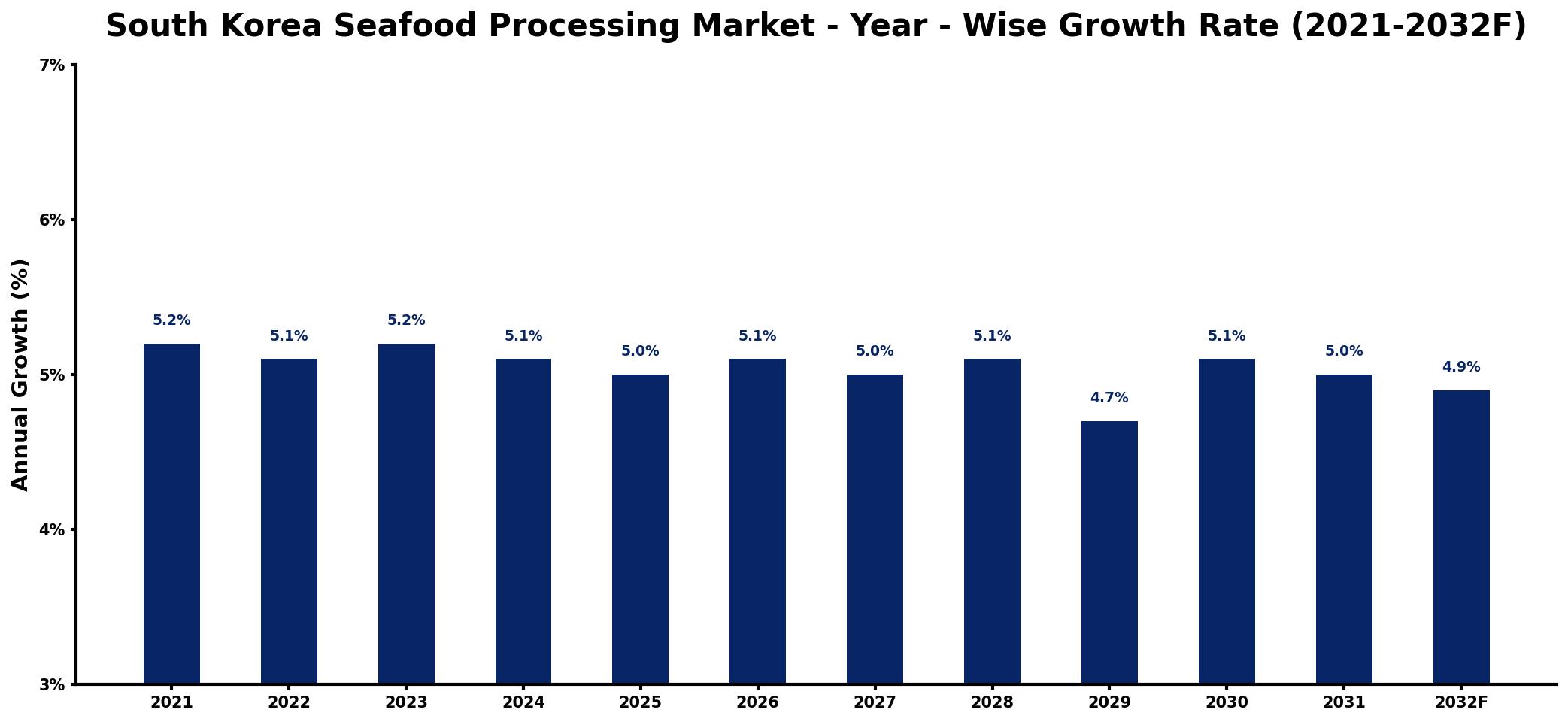
The table below presents the year‑wise growth rates along with the key drivers influencing the market
| Year | Growth Rate | Major Drivers |
| 2021 | 5.2% | Rising consumer health consciousness |
| 2022 | 5.1% | Increased demand for convenience foods |
| 2023 | 5.2% | Expansion of online delivery services |
| 2024 | 5.1% | Growth in sustainable sourcing practices |
| 2025 | 5.0% | Investment in automation technologies |
| 2026 | 5.1% | Surge in export market opportunities |
| 2027 | 5.0% | Emergence of new culinary trends |
| 2028 | 5.1% | Focus on premium product offerings |
| 2029 | 4.7% | growing emerging market penetration |
| 2030 | 5.1% | Strengthening of regional trade agreements |
| 2031 | 5.0% | Adoption of innovative packaging solutions |
| 2032 | 4.9% | growing downstream application demand |
Note: Market size estimations and growth projections presented in this report are based on 6Wresearch's proprietary forecasting methodology, utilizing the latest available industry data, government publications, and primary research inputs.
South Korea Seafood Processing Market Synopsis
With a coastline exceeding 12,000 kilometers, South Korea boasts unparalleled access to a diverse array of seafood, including fish, shellfish, and seaweed. The countrys seafood processing industry has flourished, utilizing advanced techniques like freezing, canning, and drying to cater to both traditional tastes and modern culinary innovations.
Consumer demand is significantly influenced by a growing interest in sustainable seafood. As public awareness regarding environmental issues rises, the market is adapting, with an increasing focus on responsibly sourced products, thereby aligning with global sustainability trends.
South Korea Seafood Processing Market Key Takeaways
- The market is characterized by a strong focus on high-quality, sustainable seafood products.
- Convenience-driven innovations in product formats are gaining traction among consumers.
- Government policies support sustainable practices, enhancing the industry's growth prospects.
- Health consciousness is shaping product development, with consumers preferring nutritious options.
- The industry's adaptability to trends is key to maintaining its competitive edge in the global market.
Evaluation of Restraints in South Korea Seafood Processing Market
Despite its growth potential, the South Korea seafood processing market faces several constraints. The industry is confronted with intense competition from international seafood suppliers, which pressures local producers to innovate and enhance quality. Fluctuating global seafood prices can impact profitability, while stringent food safety regulations necessitate ongoing compliance efforts. Moreover, rising labor costs and the need for technological investments further complicate operational efficiency, challenging companies to balance cost management with quality and sustainability.
South Korea Seafood Processing Market Trends
A pronounced trend in the South Korea seafood processing market is the rising consumer demand for organic and eco-friendly products. This reflects a broader shift toward sustainable consumption, with consumers increasingly aware of the environmental impact of their food choices. Additionally, innovations in packaging, such as vacuum sealing and modified atmosphere packaging, are enhancing product shelf life while meeting the demand for convenience. The trend toward healthy eating is leading to a preference for seafood high in omega-3 fatty acids, lower in fat, and with no added preservatives.
South Korea Seafood Processing Market Opportunities
Investment opportunities in the South Korea seafood processing market are robust, especially as the appetite for high-quality, value-added seafood products rises. The increasing focus on health and wellness presents a lucrative market for ready-to-eat meals, frozen seafood, and gourmet products. Furthermore, the country's reputation for food safety and quality positions it as an attractive destination for investments in processing facilities. With a favorable geographic location in East Asia, South Korea provides efficient access to essential seafood resources, enhancing supply chain capabilities.
Government Initiatives in the South Korea Seafood Processing Market
The South Korean government actively regulates the seafood processing market through stringent food safety standards and sustainable fishing policies. These measures aim to preserve marine ecosystems and ensure the long-term viability of seafood resources. Moreover, the government offers support to processing companies, including financial incentives and grants, to enhance their competitiveness and encourage exports. Such initiatives underscore the commitment to safeguarding public health while promoting industry growth.
Future Insights of the South Korea Seafood Processing Market
Looking ahead to 2026-2032, the South Korea Seafood Processing Market is anticipated to continue its upward trajectory, fueled by shifting consumer preferences toward health and convenience. Technological advancements will play a pivotal role, improving efficiency and product quality across the supply chain. As awareness of sustainable fishing practices grows, the market is expected to witness further innovation in product development, ensuring that South Korea remains a significant player in the global seafood processing landscape.
South Korea Seafood Processing Market Latest Developments (2025 - 2026)
In recent months, the South Korea seafood processing market has seen a wave of innovation aimed at enhancing product offerings. Companies are increasingly focusing on sustainable sourcing practices and investing in automation technologies to streamline operations. Additionally, collaborations between processing firms and environmental organizations have emerged to promote responsible fishing practices. The trend towards convenience has led to the introduction of new ready-to-eat seafood products that cater to the fast-paced lifestyle of modern consumers.
South Korea Seafood Processing Market - Key Attractiveness of the Report
- 10 Years of Market Numbers
- Historical Data Starting from 2022 to 2025
- Base Year: 2025
- Forecast Data until 2032
- Key Performance Indicators Impacting the Market
- Major Upcoming Developments and Projects
Key Highlights of the Report:
- South Korea Seafood Processing Market Outlook
- Market Size of South Korea Seafood Processing Market, 2025
- Forecast of South Korea Seafood Processing Market, 2032
- Historical Data and Forecast of South Korea Seafood Processing Revenues & Volume for the Period 2022-2032F
- South Korea Seafood Processing Market Trend Evolution
- South Korea Seafood Processing Market Drivers and Challenges
- South Korea Seafood Processing Price Trends
- South Korea Seafood Processing Porter's Five Forces
- South Korea Seafood Processing Industry Life Cycle
- Historical Data and Forecast of South Korea Seafood Processing Market Revenues & Volume By Equipment Type for the Period 2022-2032F
- Historical Data and Forecast of South Korea Seafood Processing Market Revenues & Volume By Gutting Equipment for the Period 2022-2032F
- Historical Data and Forecast of South Korea Seafood Processing Market Revenues & Volume By Sealing Equipment for the Period 2022-2032F
- Historical Data and Forecast of South Korea Seafood Processing Market Revenues & Volume By Filleting Equipment for the Period 2022-2032F
- Historical Data and Forecast of South Korea Seafood Processing Market Revenues & Volume By Deboning Equipment for the Period 2022-2032F
- Historical Data and Forecast of South Korea Seafood Processing Market Revenues & Volume By other Equipment for the Period 2022-2032F
- Historical Data and Forecast of South Korea Seafood Processing Market Revenues & Volume By Category for the Period 2022-2032F
- Historical Data and Forecast of South Korea Seafood Processing Market Revenues & Volume By Single-Function Equipment for the Period 2022-2032F
- Historical Data and Forecast of South Korea Seafood Processing Market Revenues & Volume By Multi-Function Equipment for the Period 2022-2032F
- Historical Data and Forecast of South Korea Seafood Processing Market Revenues & Volume By Seafood Type for the Period 2022-2032F
- Historical Data and Forecast of South Korea Seafood Processing Market Revenues & Volume By Fish for the Period 2022-2032F
- Historical Data and Forecast of South Korea Seafood Processing Market Revenues & Volume By Crustaceans for the Period 2022-2032F
- Historical Data and Forecast of South Korea Seafood Processing Market Revenues & Volume By Mollusks for the Period 2022-2032F
- Historical Data and Forecast of South Korea Seafood Processing Market Revenues & Volume By others for the Period 2022-2032F
- South Korea Seafood Processing Import Export Trade Statistics
- Market Opportunity Assessment By Equipment Type
- Market Opportunity Assessment By Category
- Market Opportunity Assessment By Seafood Type
- South Korea Seafood Processing Top Companies Market Share
- South Korea Seafood Processing Competitive Benchmarking By Technical and Operational Parameters
- South Korea Seafood Processing Company Profiles
- South Korea Seafood Processing Key Strategic Recommendations






































