South Korea Shaving and Hair Removal Products Market Summary
The south korea shaving and hair removal products market was estimated at USD 1150 Million in 2025 and is projected to reach USD 2162 Million by 2032, growing at a CAGR of 10.9% from 2026 to 2032.
South Korea Shaving and Hair Removal Products Market Year-wise Growth Rate and Key Drivers
This graph highlights how the South Korea Shaving and Hair Removal Products Market has steadily grown over the past five years, supported by major growth factors.
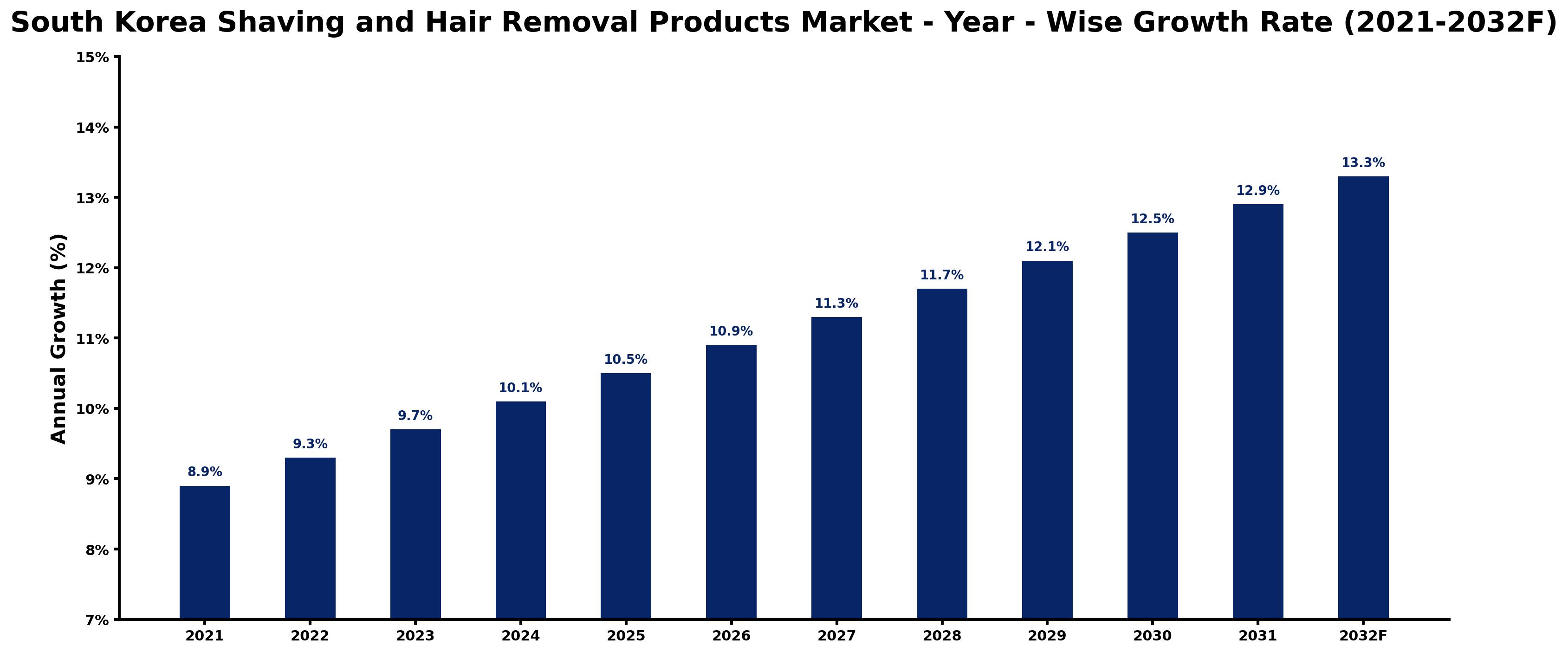
The table below presents the year wise growth rates along with the key drivers influencing the market
| Year | Growth Rate | Major Drivers |
| 2021 | 8.9% | Post-lockdown retail projects shifted consumer focus towards hygiene and grooming products. |
| 2022 | 9.3% | Innovative marketing strategies targeted millennials seeking premium grooming experiences. |
| 2023 | 9.7% | Natural and organic product trends gained traction among health-conscious consumers. |
| 2024 | 10.1% | Online shopping platforms expanded, making products widely accessible across demographics. |
| 2025 | 10.5% | Celebrity endorsements and influencer marketing boosted brand visibility and consumer trust. |
| 2026 | 10.9% | Men's grooming products evolved, reflecting changing societal norms and expectations. |
| 2027 | 11.3% | Sustainability initiatives gained popularity, prompting brands to adopt eco-friendly packaging. |
| 2028 | 11.7% | Emerging technologies like AI personalized consumer shopping experiences and recommendations. |
| 2029 | 12.1% | Aging population necessitated hair removal solutions catering to diverse needs. |
| 2030 | 12.5% | Local brands emerged, emphasizing cultural relevance in product offerings and marketing. |
| 2031 | 12.9% | Health and wellness trends propelled interest in skincare-infused shaving products. |
| 2032 | 13.3% | E-commerce growth persisted, reshaping traditional retail dynamics and consumer behavior. |
Note - Market size estimations and growth projections presented in this report are based on 6Wresearch's advanced forecasting approach, validated with industry datasets as of June 2026.
South Korea Shaving and Hair Removal Products Market Synopsis
The South Korea Shaving and Hair Removal Products Market is projected to reach 10.9% and witness significant growth during the forecast period (2026-2032). This market is experiencing a robust compound annual growth rate (CAGR) of 5.1%, driven by a rising consciousness around personal grooming among diverse demographic groups, including men, women, and children. As the culture of grooming becomes more ingrained in South Korean society, the demand for shaving and hair removal products is set to increase.
South Korea Shaving and Hair Removal Products Market Growth Drivers
The growth of the South Korea Shaving and Hair Removal Products Market can be attributed to several key factors:
- The increasing focus on personal grooming among both genders is reshaping consumer behaviors, creating a heightened demand for effective shaving and hair removal solutions.
- A surge in the popularity of body waxing and advanced hair removal techniques has led to a corresponding increase in sales of related products, further propelling market growth.
- Innovations in product offerings, such as multi-blade razors and specialized hair removal gels, are catering to evolving consumer preferences and enhancing the overall user experience.
- The penetration of e-commerce platforms has made it easier for consumers to access a broad range of shaving and hair removal products, contributing to market expansion.
- Shifts in societal norms regarding grooming and beauty standards are encouraging increased expenditures on personal care among the South Korean population.
South Korea Shaving and Hair Removal Products Market Trends and Opportunities
In the South Korea Shaving and Hair Removal Products Market, specific trends and opportunities are emerging:
- The advent of eco-friendly and organic products is gaining traction as consumers become more environmentally conscious, presenting an opportunity for brands to differentiate themselves.
- Smart grooming devices integrated with technology for personalized hair removal experiences are on the rise, attracting a tech-savvy consumer base.
- Gender-neutral product lines are emerging, appealing to a broader audience and reflecting changing attitudes towards grooming across diverse demographics.
- Subscription services for grooming products are gaining popularity, offering convenience for consumers while ensuring consistent brand engagement.
- Increasing participation in beauty and grooming events is providing platforms for businesses to showcase new products and connect with consumers directly.
South Korea Shaving and Hair Removal Products Market Challenges and Restraints
Despite favorable growth prospects, the market faces several challenges:
- Intense competition among various brands can lead to price wars, impacting profit margins and the overall sustainability of smaller enterprises.
- A potential economic downturn could shift consumer spending priorities, adversely affecting sales in the non-essential grooming segment.
- The prevalence of counterfeit products in the market can undermine brand trust and consumer loyalty, affecting legitimate product sales.
- Rapid changes in consumer preferences may render existing products obsolete, necessitating continuous innovation and agility from manufacturers.
- Regulatory hurdles regarding product safety and ingredient transparency can pose challenges for companies looking to launch new shaving and hair removal products.
South Korea Shaving and Hair Removal Products Market Government Investment and Initiatives
The South Korean government plays an influential role in supporting the shaving and hair removal products market through various initiatives:
- Government policies aimed at promoting the beauty and personal care industry are creating a conducive environment for market growth.
- Investments in research and development to foster innovation in personal care products are being encouraged to enhance global competitiveness.
- Promotional programs and incentives for businesses participating in trade exhibitions and events are being implemented to boost market visibility.
- Regulatory frameworks are being established to ensure product safety and consumer protection, thereby fostering trust in the market.
- Public health initiatives focusing on personal hygiene are indirectly promoting the use of shaving and hair removal products across demographic segments.
South Korea Shaving and Hair Removal Products Market Latest Developments (May 2025 - June 2026)
Recent industry developments in the South Korea Shaving and Hair Removal Products Market indicate a dynamic landscape:
- Innovative product lines have emerged, showcasing advanced technologies aimed at improving user convenience and satisfaction in grooming routines.
- Marketing strategies have increasingly shifted towards digital platforms, enhancing engagement with target demographics and expanding brand reach.
- Collaborations with beauty influencers and social media campaigns have been utilized to amplify product visibility and resonate with consumer preferences.
- Brands are placing greater emphasis on sustainability, with many introducing eco-friendly packaging solutions and natural ingredient formulations.
- Surveyed consumer feedback has driven product adaptations, with companies responding to calls for more personalized and versatile grooming solutions.
South Korea Shaving and Hair Removal Products Market - Key Attractiveness of the Report
- 10 Years of Market Numbers
- Historical Data Starting from 2022 to 2025
- Base Year: 2025
- Forecast Data until 2032
- Key Performance Indicators Impacting the Market
- Major Upcoming Developments and Projects
Key Highlights of the Report:
- South Korea Shaving and Hair Removal Products Market Outlook
- Market Size of South Korea Shaving and Hair Removal Products Market, 2025
- Forecast of South Korea Shaving and Hair Removal Products Market, 2032F
- Historical Data and Forecast of South Korea Shaving and Hair Removal Products Revenues & Volume for the Period 2022-2032F
- South Korea Shaving and Hair Removal Products Market Trend Evolution
- South Korea Shaving and Hair Removal Products Market Drivers and Challenges
- South Korea Shaving and Hair Removal Products Price Trends
- South Korea Shaving and Hair Removal Products Porter's Five Forces
- South Korea Shaving and Hair Removal Products Industry Life Cycle
- Historical Data and Forecast of South Korea Shaving and Hair Removal Products Market Revenues & Volume By Product Types for the Period 2022-2032F
- Historical Data and Forecast of South Korea Shaving and Hair Removal Products Market Revenues & Volume By Shave Gels for the Period 2022-2032F
- Historical Data and Forecast of South Korea Shaving and Hair Removal Products Market Revenues & Volume By Shave Foams for the Period 2022-2032F
- Historical Data and Forecast of South Korea Shaving and Hair Removal Products Market Revenues & Volume By Shaving and Hair Removal Creams for the Period 2022-2032F
- Historical Data and Forecast of South Korea Shaving and Hair Removal Products Market Revenues & Volume By Sprays for the Period 2022-2032F
- Historical Data and Forecast of South Korea Shaving and Hair Removal Products Market Revenues & Volume By Lotions for the Period 2022-2032F
- Historical Data and Forecast of South Korea Shaving and Hair Removal Products Market Revenues & Volume By Waxes for the Period 2022-2032F
- Historical Data and Forecast of South Korea Shaving and Hair Removal Products Market Revenues & Volume By Wax Strips for the Period 2022-2032F
- Historical Data and Forecast of South Korea Shaving and Hair Removal Products Market Revenues & Volume By End-Users for the Period 2022-2032F
- Historical Data and Forecast of South Korea Shaving and Hair Removal Products Market Revenues & Volume By Salon for the Period 2022-2032F
- Historical Data and Forecast of South Korea Shaving and Hair Removal Products Market Revenues & Volume By Personal Use for the Period 2022-2032F
- South Korea Shaving and Hair Removal Products Import Export Trade Statistics
- Market Opportunity Assessment By Product Types
- Market Opportunity Assessment By End-Users
- South Korea Shaving and Hair Removal Products Top Companies Market Share
- South Korea Shaving and Hair Removal Products Competitive Benchmarking By Technical and Operational Parameters
- South Korea Shaving and Hair Removal Products Company Profiles
- South Korea Shaving and Hair Removal Products Key Strategic Recommendations






































