South Korea Smart Learning Market Size & Growth Rate (2026-2032)
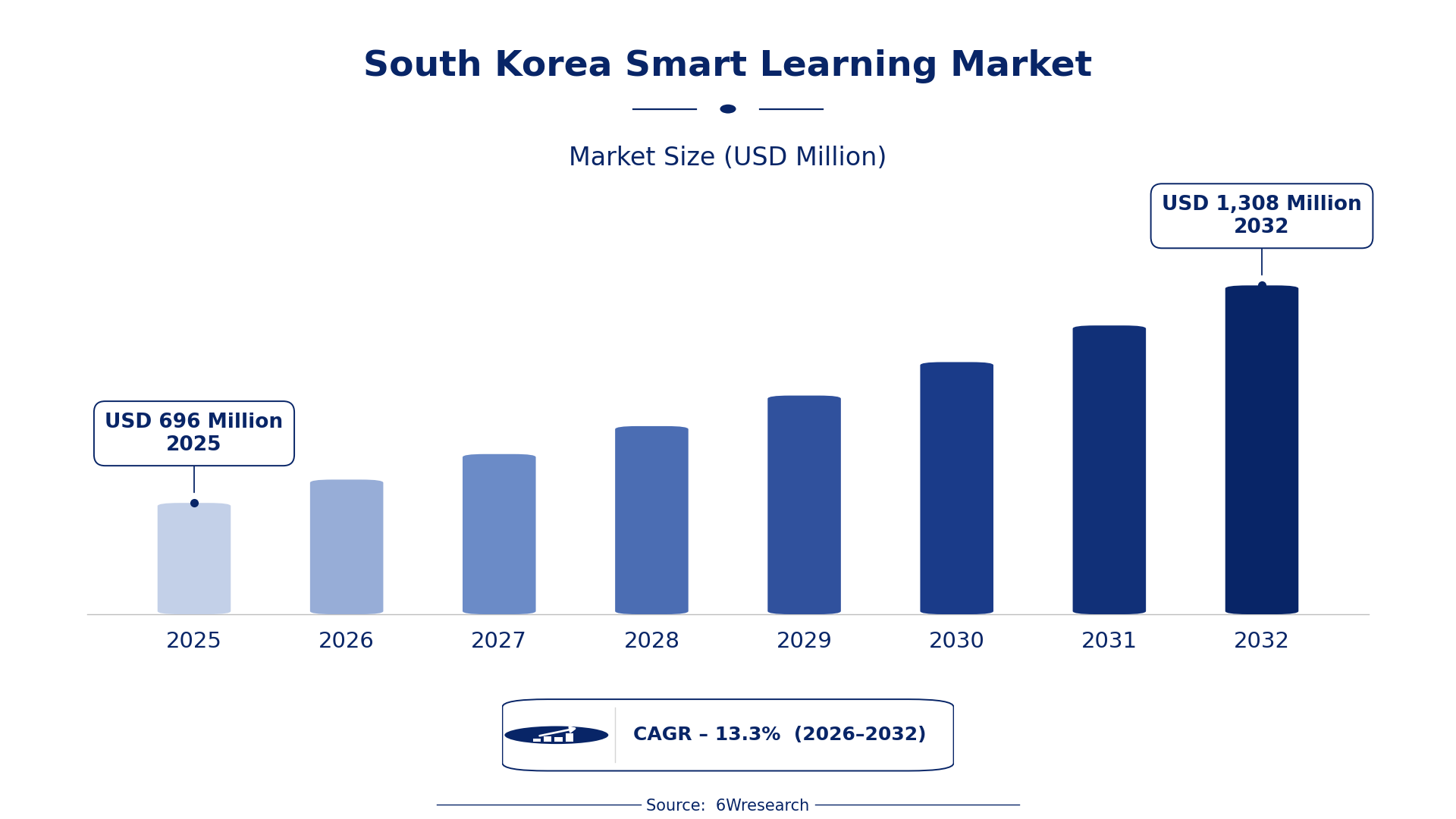
The South Korea Smart Learning Market was estimated at USD 696 Million in 2025 and is projected to reach USD 1308 Million by 2032, growing at a CAGR of 13.3% from 2026 to 2032.
South Korea Smart Learning Market Synopsis
The rapid integration of digital technologies into education is the strongest force shaping the South Korea Smart Learning Market today. Schools, universities, and corporations are increasingly adopting smart learning solutions that enhance both engagement and educational outcomes.
Government initiatives promoting digital education, combined with high internet penetration rates, are further propelling the demand for innovative learning tools. As the education sector evolves, smart learning solutions are becoming essential for meeting the diverse needs of learners across various demographics.
South Korea Smart Learning Market Year-wise Growth Rate and Key Drivers
This graph illustrates the annual growth rates of the South Korea Smart Learning Market from 2021 to 2032, highlighting a steady upward trajectory and projected expansion over the forecast period.
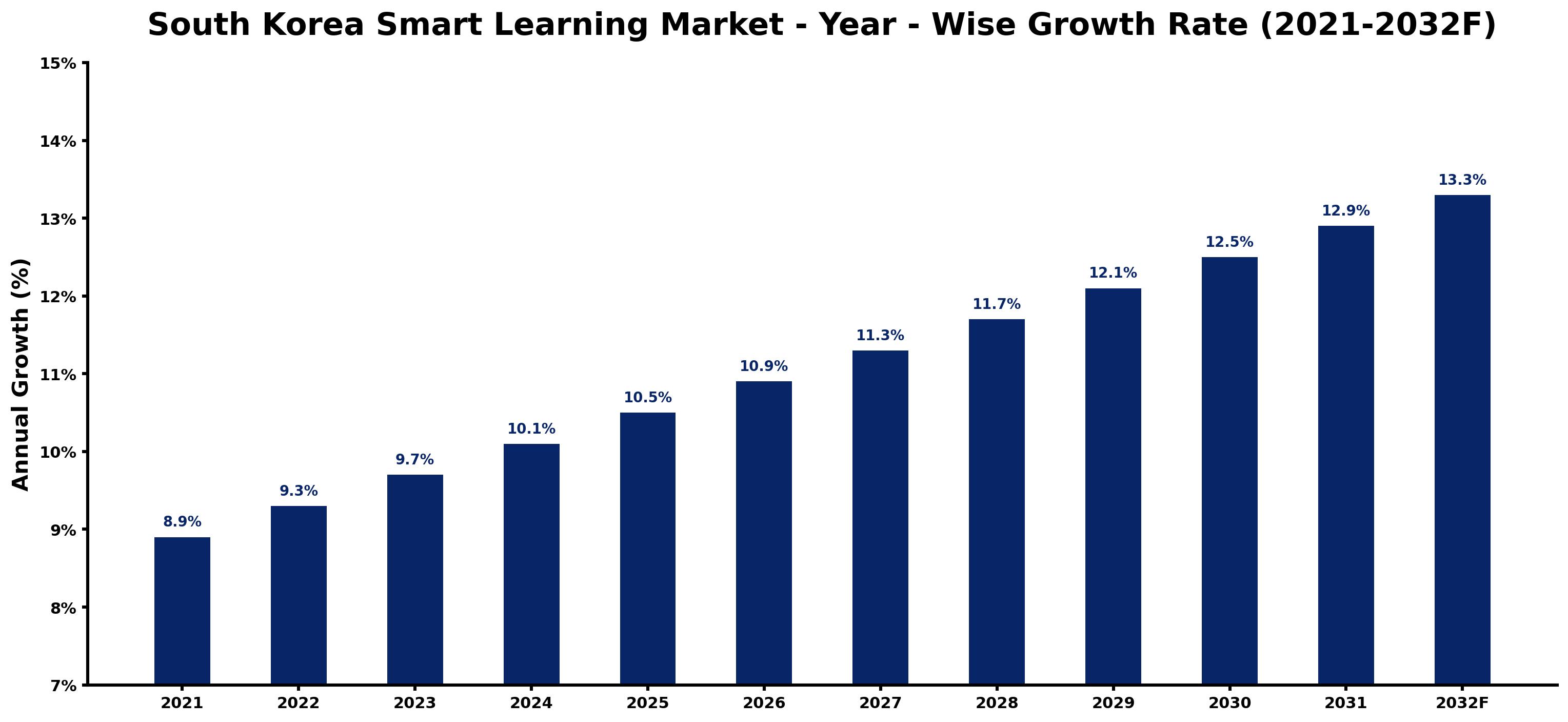
The table below presents the year‑wise growth rates along with the key drivers influencing the market
| Year | Growth Rate | Major Drivers |
| 2021 | 8.9% | Government incentives for digital education innovation initiatives. |
| 2022 | 9.3% | Increased focus on cybersecurity in educational technology solutions. |
| 2023 | 9.7% | Growing adoption of mobile learning applications among students. |
| 2024 | 10.1% | Launch of national curriculum emphasizing digital literacy skills. |
| 2025 | 10.5% | Rising popularity of gamified learning platforms in education. |
| 2026 | 10.9% | Enhancements in infrastructure for high-speed internet access nationwide. |
| 2027 | 11.3% | Support from South Korean Ministry of Education for VR tools. |
| 2028 | 11.7% | Collaborations with technology firms for augmented reality learning. |
| 2029 | 12.1% | Increasing enrollment in STEM-focused smart learning programs. |
| 2030 | 12.5% | Government policy promoting lifelong learning through digital platforms. |
| 2031 | 12.9% | Surge in online course registrations post-pandemic educational shifts. |
| 2032 | 13.3% | Increased use of analytics for personalized student learning pathways. |
Note: Market size estimations and growth projections presented in this report are based on 6Wresearch's proprietary forecasting methodology, utilizing the latest available industry data, government publications, and primary research inputs.
South Korea Smart Learning Market Key Takeaways
Below are some of the specific key takeaways from the market, including:
- High growth expected due to increased adoption of digital education technologies.
- Government policies are actively encouraging smart learning initiatives across educational institutions.
- Personalized and interactive learning solutions are becoming increasingly popular.
- The integration of AI and machine learning is enhancing user experiences and educational outcomes.
- Challenges related to technology implementation costs and digital literacy remain significant.
Evaluation of Restraints in South Korea Smart Learning Market
Despite the positive momentum, the South Korea Smart Learning Market faces several restraints. One of the primary challenges is the high cost associated with implementing advanced educational technologies, which can be a barrier for some institutions. Additionally, limited access to high-speed internet in rural areas hampers equitable access to digital learning resources.
The traditional focus on rote memorization in the education system also poses a challenge, making it difficult for innovative teaching methods to take root. on top of that, disparities in digital literacy skills among students and educators can hinder the effectiveness of smart learning solutions, making comprehensive training and support crucial for success.
South Korea Smart Learning Market Trends
The South Korea Smart Learning Market is witnessing a transformative shift towards personalized and interactive learning experiences. The adoption of mobile learning, gamification, and virtual reality tools is on the rise, catering to diverse learner needs. Educational platforms are increasingly incorporating artificial intelligence and machine learning to deliver tailored learning experiences, providing educators with valuable insights derived from data analytics.
on top of that, the push for continuous skill development among both students and professionals is driving demand for innovative online learning programs. These trends are creating fertile ground for growth and investment in the smart learning sector.
South Korea Smart Learning Market Opportunities
The South Korea Smart Learning Market is ripe with opportunities, especially for companies willing to invest in the development of innovative educational content and platforms. The expansion of online learning programs aimed at reaching remote and underserved communities is a crucial area for growth.
Partnerships between educational institutions and edtech companies also present a promising avenue for enhancing learning experiences. The focus on creating customized solutions to accommodate various learning styles will likely yield significant returns for market players.
Government Initiatives in the South Korea Smart Learning Market
Government support is a cornerstone of the South Korea Smart Learning Market. The South Korean government has been proactive in promoting digital education, emphasizing the importance of integrating technology into the learning environment. This regulatory support provides a conducive atmosphere for edtech companies to innovate and grow.
- A recently completed initiative focused on establishing the Smart Education Master Plan aims to integrate technology in schools nationwide.
- Current efforts include the Education Innovation Project, which is enhancing digital infrastructure to facilitate personalized learning experiences.
- Planned initiatives involve the rollout of a national digital infrastructure upgrade program expected to begin in early 2026.
- Ongoing investments in online resource accessibility aim to bridge the digital divide across various regions.
- Regulatory frameworks are being developed to ensure data security and privacy in educational technologies.
Future Insights of the South Korea Smart Learning Market
Looking ahead to 2026-2032, the South Korea Smart Learning Market is on a growth trajectory driven by technological advancements and increasing demand for personalized learning solutions. The emphasis on interactive and engaging educational experiences will continue to fuel investments in smart learning technologies across various sectors, including education and corporate training.
As the education sector adapts to the demands of the digital age, South Korea is well-positioned to become a leader in the global smart learning market, leveraging its strong technological infrastructure and commitment to innovation.
South Korea Smart Learning Market Latest Developments
In the last year, the South Korea Smart Learning Market has seen substantial activity as educational institutions and technology providers continue to collaborate on innovative solutions. The drive for modernization in education has led to various initiatives aimed at enhancing the learning experience through technology.
- A major technology vendor launched an advanced e-learning platform in mid-2025, focusing on AI-driven personalized learning pathways.
- Ongoing partnerships between universities and edtech startups are fostering the development of interactive learning content, with several pilot programs currently underway.
- A significant rollout of a virtual classroom initiative is expected to commence in Q1 2026, aimed at providing remote learning solutions to underserved areas.
- Another technology provider is enhancing its existing platforms with gamification features, with updates scheduled for late 2025.
- A collaboration between government agencies and tech companies is working to improve cybersecurity measures in digital education tools, currently in the planning phase for late 2025.
South Korea Smart Learning Market - Key Attractiveness of the Report
- 10 Years of Market Numbers
- Historical Data Starting from 2022 to 2025
- Base Year: 2025
- Forecast Data until 2032
- Key Performance Indicators Impacting the Market
- Major Upcoming Developments and Projects
Key Highlights of the Report:
- South Korea Smart Learning Market Outlook
- Market Size of South Korea Smart Learning Market, 2025
- Forecast of South Korea Smart Learning Market, 2032
- Historical Data and Forecast of South Korea Smart Learning Revenues & Volume for the Period 2022-2032F
- South Korea Smart Learning Market Trend Evolution
- South Korea Smart Learning Market Drivers and Challenges
- South Korea Smart Learning Price Trends
- South Korea Smart Learning Porter's Five Forces
- South Korea Smart Learning Industry Life Cycle
- Historical Data and Forecast of South Korea Smart Learning Market Revenues & Volume By Component for the Period 2022-2032F
- Historical Data and Forecast of South Korea Smart Learning Market Revenues & Volume By Hardware for the Period 2022-2032F
- Historical Data and Forecast of South Korea Smart Learning Market Revenues & Volume By Software for the Period 2022-2032F
- Historical Data and Forecast of South Korea Smart Learning Market Revenues & Volume By Services for the Period 2022-2032F
- Historical Data and Forecast of South Korea Smart Learning Market Revenues & Volume By End User for the Period 2022-2032F
- Historical Data and Forecast of South Korea Smart Learning Market Revenues & Volume By Academic for the Period 2022-2032F
- Historical Data and Forecast of South Korea Smart Learning Market Revenues & Volume By Enterprises for the Period 2022-2032F
- Historical Data and Forecast of South Korea Smart Learning Market Revenues & Volume By Government for the Period 2022-2032F
- Historical Data and Forecast of South Korea Smart Learning Market Revenues & Volume By Learning type for the Period 2022-2032F
- Historical Data and Forecast of South Korea Smart Learning Market Revenues & Volume By Synchronous learning for the Period 2022-2032F
- Historical Data and Forecast of South Korea Smart Learning Market Revenues & Volume By Asynchronous learning for the Period 2022-2032F
- Historical Data and Forecast of South Korea Smart Learning Market Revenues & Volume By Services for the Period 2022-2032F
- Historical Data and Forecast of South Korea Smart Learning Market Revenues & Volume By Consulting for the Period 2022-2032F
- Historical Data and Forecast of South Korea Smart Learning Market Revenues & Volume By Implementation for the Period 2022-2032F
- Historical Data and Forecast of South Korea Smart Learning Market Revenues & Volume By Support and maintenance for the Period 2022-2032F
- South Korea Smart Learning Import Export Trade Statistics
- Market Opportunity Assessment By Component
- Market Opportunity Assessment By End User
- Market Opportunity Assessment By Learning type
- Market Opportunity Assessment By Services
- South Korea Smart Learning Top Companies Market Share
- South Korea Smart Learning Competitive Benchmarking By Technical and Operational Parameters
- South Korea Smart Learning Company Profiles
- South Korea Smart Learning Key Strategic Recommendations






































