South Korea Sports Equipment Market Size, Share & Growth Rate
The South Korea Sports Equipment Market was estimated at USD 300 Million in 2025 and is projected to reach USD 414 Million by 2032, growing at a CAGR of 4.7% from 2026 to 2032. This robust growth is driven by an increasing focus on health and fitness, amplified by government initiatives that promote active lifestyles. Coupled with rising disposable incomes and a burgeoning e-commerce sector, the market is poised for sustained expansion.
South Korea Sports Equipment Market Year-wise Growth Rate and Key Drivers
This graph highlights how the South Korea Sports Equipment Market has steadily grown over the years, supported by major growth factors.
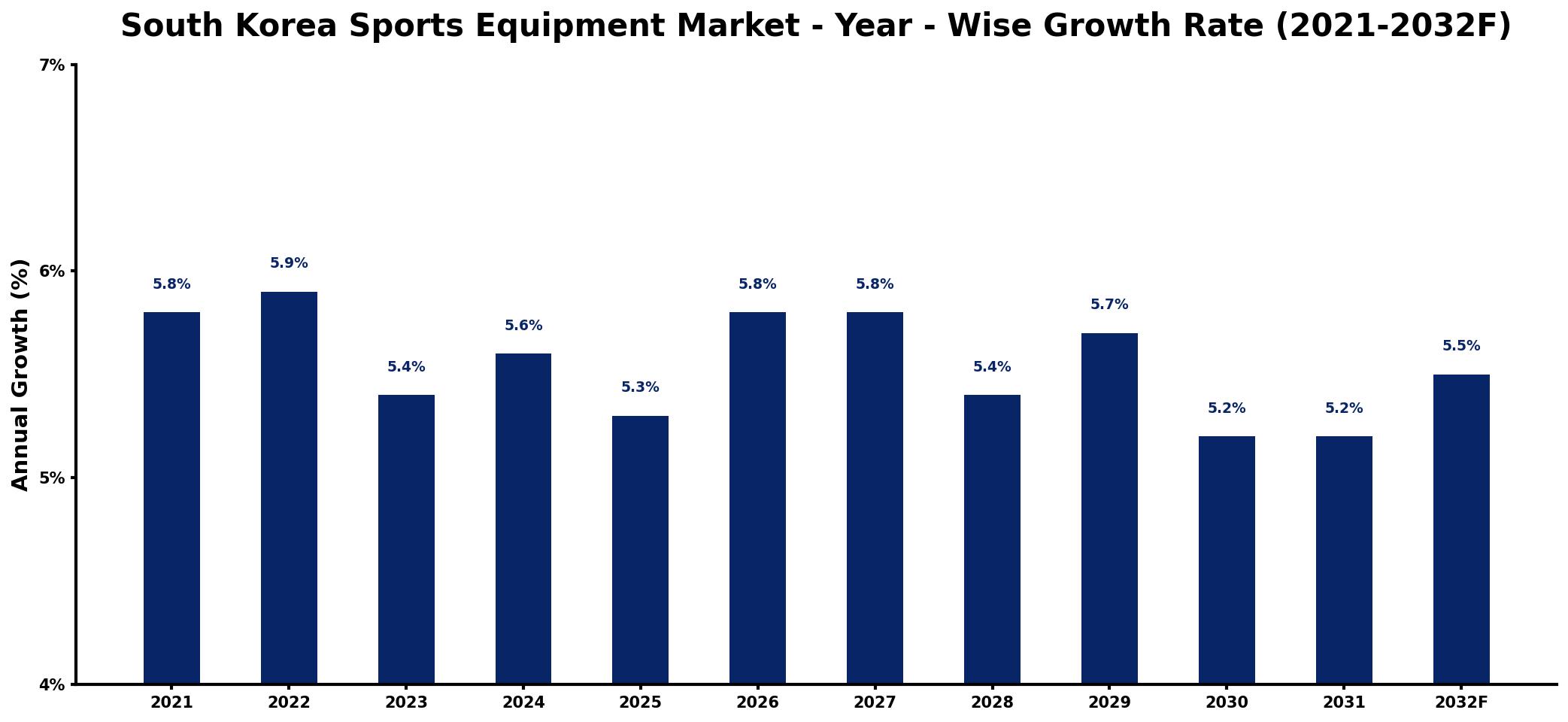
The table below presents the year‑wise growth rates along with the key drivers influencing the market
| Year | Growth Rate | Major Drivers |
| 2021 | 5.8% | Rising consumer health awareness |
| 2022 | 5.9% | Increased participation in fitness |
| 2023 | 5.4% | Growing online retail channels |
| 2024 | 5.6% | Expansion of fitness facilities |
| 2025 | 5.3% | Enhanced focus on sustainability |
| 2026 | 5.8% | Emergence of new fitness trends |
| 2027 | 5.8% | Investment in recreational infrastructure |
| 2028 | 5.4% | Surge in youth engagement programs |
| 2029 | 5.7% | Development of smart technologies |
| 2030 | 5.2% | Strengthening community wellness initiatives |
| 2031 | 5.2% | Boost in corporate wellness programs |
| 2032 | 5.5% | Growing popularity of outdoor activities |
Note: Market size estimations and growth projections presented in this report are based on 6Wresearch's proprietary forecasting methodology, utilizing the latest available industry data, government publications, and primary research inputs.
South Korea Sports Equipment Market Synopsis
The South Korea sports equipment market is experiencing a transformative phase, propelled by a cultural shift towards health and wellness. This trend is fostering a demand for a diverse array of sports gear, from running shoes to fitness technology.
With outdoor activities gaining traction, consumers are increasingly seeking high-quality and innovative equipment to enhance their sports experience. The rise of e-commerce is further reshaping the landscape, allowing for greater accessibility and variety in sports product offerings.
South Korea Sports Equipment Market Key Takeaways
- The market is benefiting from increasing health consciousness and participation in sports activities.
- Technological advancements are driving demand for innovative sports equipment and wearables.
- E-commerce channels are rapidly growing, transforming the shopping experience for consumers.
- There is a notable trend towards sustainable and eco-friendly sports gear among consumers.
- Government policies are fostering a supportive environment for sports participation and equipment production.
Evaluation of Restraints in South Korea Sports Equipment Market
While the South Korea sports equipment market holds significant promise, it faces several restraints. Intense competition among both domestic and international brands often leads to price wars, squeezing profit margins. Additionally, rapidly shifting consumer preferences, influenced by new technologies and lifestyle changes, necessitate constant innovation from companies. Regulatory hurdles, including stringent quality standards and market entry requirements, can complicate operations. Furthermore, economic fluctuations may impact consumer spending, influencing overall market demand.
South Korea Sports Equipment Market Trends
A noticeable trend within the South Korea sports equipment market is the growing popularity of outdoor recreational activities, like hiking and cycling, which fuels demand for specialized gear. Health-conscious consumers are also gravitating towards fitness equipment, including wearables that track performance and well-being. Additionally, the desire for personalization in sports products is emerging, encouraging brands to innovate further in customization options. Sustainability remains a pivotal focus, as environmentally friendly products gain traction among a more conscious consumer base.
South Korea Sports Equipment Market Opportunities
Investors in the South Korea sports equipment market can explore numerous opportunities. The increasing interest in health and fitness among consumers creates a solid demand for technologically advanced sports gear, such as smart apparel and performance-enhancing equipment. Collaborating with local brands and tapping into niche markets that focus on customized products can yield substantial returns. Expanding distribution channels, especially through e-commerce platforms, can further position brands to meet the needs of an evolving consumer landscape.
Government Initiatives in the South Korea Sports Equipment Market
The South Korean government actively supports the sports equipment market through various initiatives aimed at promoting physical activity. These include tax incentives for manufacturers, subsidies for building sports facilities, and programs encouraging community engagement in sports. The regulatory framework ensures that safety and quality standards are maintained, bolstering consumer trust and fostering a healthy marketplace.
Future Insights of the South Korea Sports Equipment Market
Looking ahead to 2026-2032, the South Korea sports equipment market is on track for steady growth. The combination of a health-conscious populace and increasing disposable incomes will fuel demand for diverse sports offerings. Enhanced governmental support aimed at promoting sports participation and infrastructure development is likely to further bolster market prospects. As new sports trends emerge and the athleisure movement continues to thrive, brands that prioritize innovation and sustainability will find themselves well-positioned in this evolving landscape.
South Korea Sports Equipment Market Latest Developments (2025 - 2026)
Recent developments in the South Korean sports equipment market reflect a strategic pivot towards digital transformation and sustainability. Companies are increasingly investing in e-commerce capabilities, enhancing their online presence to meet changing consumer shopping behaviors. Additionally, there is a growing emphasis on the development of eco-friendly products, as brands respond to environmental concerns raised by consumers. These trends indicate a significant shift towards innovation and environmental responsibility within the market.
South Korea Sports Equipment Market - Key Attractiveness of the Report
- 10 Years of Market Numbers
- Historical Data Starting from 2022 to 2025
- Base Year: 2025
- Forecast Data until 2032
- Key Performance Indicators Impacting the Market
- Major Upcoming Developments and Projects
Key Highlights of the Report:
- South Korea Sports Equipment Market Outlook
- Market Size of South Korea Sports Equipment Market, 2025
- Forecast of South Korea Sports Equipment Market, 2032
- Historical Data and Forecast of South Korea Sports Equipment Revenues & Volume for the Period 2022-2032F
- South Korea Sports Equipment Market Trend Evolution
- South Korea Sports Equipment Market Drivers and Challenges
- South Korea Sports Equipment Price Trends
- South Korea Sports Equipment Porter's Five Forces
- South Korea Sports Equipment Industry Life Cycle
- Historical Data and Forecast of South Korea Sports Equipment Market Revenues & Volume By Product for the Period 2022-2032F
- Historical Data and Forecast of South Korea Sports Equipment Market Revenues & Volume By Ball over net games for the Period 2022-2032F
- Historical Data and Forecast of South Korea Sports Equipment Market Revenues & Volume By Ball games for the Period 2022-2032F
- Historical Data and Forecast of South Korea Sports Equipment Market Revenues & Volume By Fitness/Strength equipment for the Period 2022-2032F
- Historical Data and Forecast of South Korea Sports Equipment Market Revenues & Volume By Athletic training equipment for the Period 2022-2032F
- Historical Data and Forecast of South Korea Sports Equipment Market Revenues & Volume By Others for the Period 2022-2032F
- Historical Data and Forecast of South Korea Sports Equipment Market Revenues & Volume By Distribution Channel for the Period 2022-2032F
- Historical Data and Forecast of South Korea Sports Equipment Market Revenues & Volume By Online retail for the Period 2022-2032F
- Historical Data and Forecast of South Korea Sports Equipment Market Revenues & Volume By Specialty & sports shops for the Period 2022-2032F
- Historical Data and Forecast of South Korea Sports Equipment Market Revenues & Volume By Department & discount stores for the Period 2022-2032F
- South Korea Sports Equipment Import Export Trade Statistics
- Market Opportunity Assessment By Product
- Market Opportunity Assessment By Distribution Channel
- South Korea Sports Equipment Top Companies Market Share
- South Korea Sports Equipment Competitive Benchmarking By Technical and Operational Parameters
- South Korea Sports Equipment Company Profiles
- South Korea Sports Equipment Key Strategic Recommendations






































