South Korea Synthetic Fiber Market Size Growth Rate
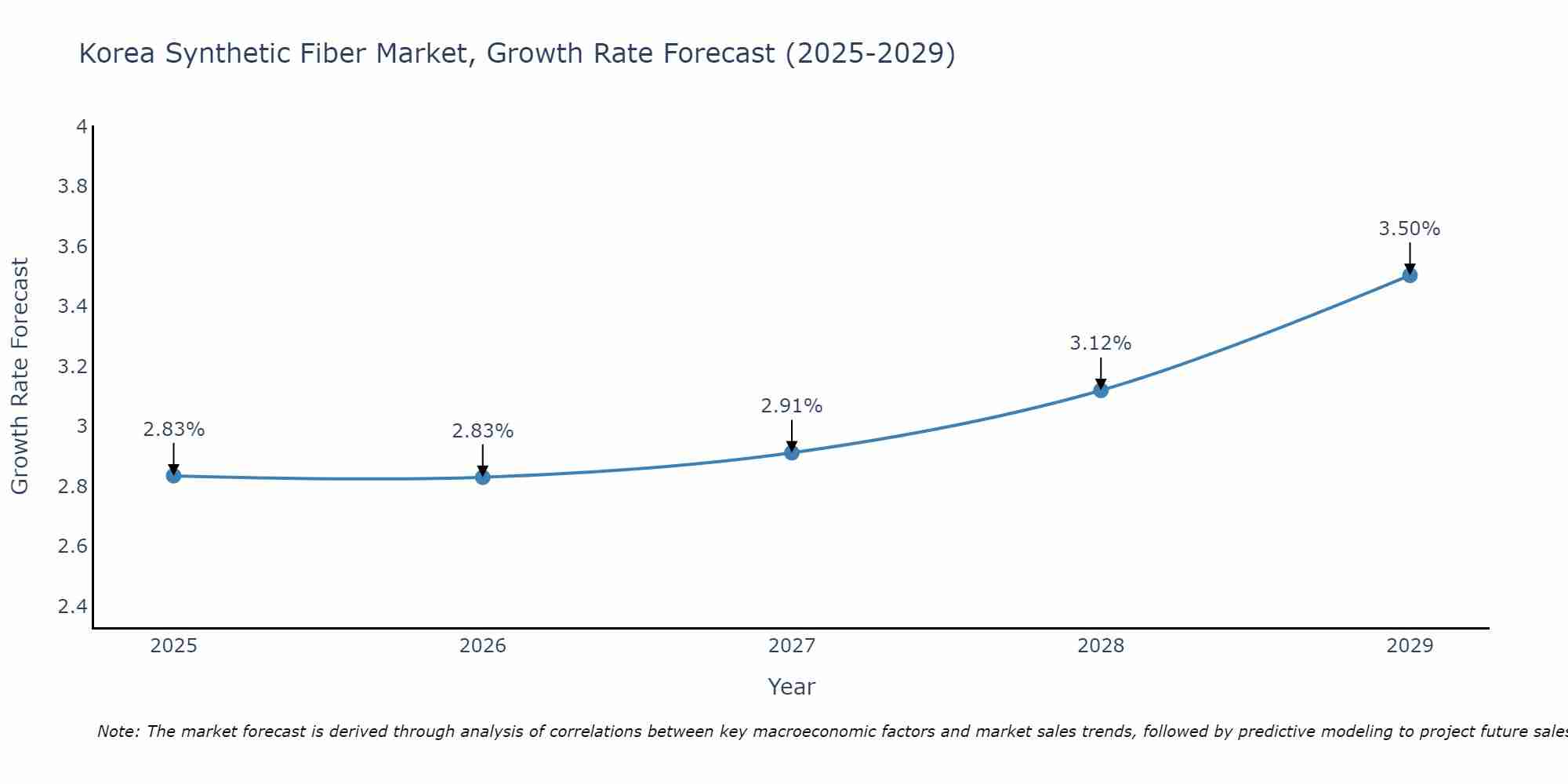
The South Korea Synthetic Fiber Market is projected to witness mixed growth rate patterns during 2025 to 2029. From 2.83% in 2025, the growth rate steadily ascends to 3.50% in 2029.
South Korea Synthetic Fiber Market Synopsis
The South Korea Synthetic Fiber Market is a dynamic and rapidly growing sector fueled by factors such as the country`s strong manufacturing base, technological advancements, and increasing demand for high-performance textiles. Polyester and nylon are the most widely used synthetic fibers in South Korea, with applications across various industries including apparel, automotive, and home textiles. The market is driven by a shift towards sustainable and eco-friendly fibers, leading to a growing demand for recycled and bio-based synthetic fibers. Key players in the South Korea Synthetic Fiber Market include Hyosung, Kolon Industries, Huvis, and Samyang Corporation, who are investing in research and development to innovate new products and cater to changing consumer preferences. Overall, the market is poised for continued growth driven by innovation, sustainability, and evolving consumer trends.
South Korea Synthetic Fiber Market Trends
The South Korea synthetic fiber market is witnessing several key trends. One prominent trend is the growing demand for eco-friendly and sustainable synthetic fibers as consumers become more environmentally conscious. Manufacturers are increasingly focusing on developing fibers made from recycled materials or bio-based sources to cater to this demand. Another trend is the rising popularity of functional synthetic fibers that offer enhanced performance features such as moisture-wicking, UV protection, and anti-bacterial properties. Additionally, there is a shift towards digitalization and automation in production processes to improve efficiency and reduce costs. The market is also seeing collaborations between manufacturers and fashion designers to create innovative and unique fiber blends for use in various industries including apparel, automotive, and home textiles.
South Korea Synthetic Fiber Market Challenges
In the South Korea Synthetic Fiber Market, some of the key challenges include intense competition from other Asian countries, such as China and Japan, which often have lower production costs. Additionally, fluctuating raw material prices and the need for continuous innovation to meet changing consumer demands pose challenges for companies operating in this market. Strict environmental regulations and sustainability concerns also impact the industry, requiring companies to invest in eco-friendly production processes. Furthermore, the market faces challenges related to counterfeit products, intellectual property protection, and the need to adapt to rapidly evolving technologies. Overall, companies in the South Korea Synthetic Fiber Market must navigate these challenges to stay competitive and sustainable in the long term.
South Korea Synthetic Fiber Market Investment Opportunities
The South Korea synthetic fiber market presents promising investment opportunities due to the country`s strong manufacturing base and technological advancements in the textile industry. With a growing demand for synthetic fibers in various applications such as apparel, automotive, and home furnishings, investors can capitalize on this trend by investing in companies involved in the production of synthetic fibers or related manufacturing equipment. Additionally, the government`s support for the textile industry through initiatives promoting innovation and sustainability further enhances the attractiveness of investing in this sector. By leveraging South Korea`s expertise in synthetic fiber production and its strategic location in the Asia-Pacific region, investors can tap into a market poised for growth and expansion.
Jordan Agar Market Government Policies
The South Korean government has implemented various policies to support the growth of the synthetic fiber market in the country. These policies focus on promoting research and development in the industry, providing financial support to companies for technology upgrades and innovation, and encouraging sustainable practices and environmental protection. Additionally, the government has introduced trade policies to facilitate exports of synthetic fibers and reduce import tariffs on raw materials. Furthermore, there are regulations in place to ensure product quality and safety standards are met, as well as to prevent unfair competition practices. Overall, these government policies aim to enhance the competitiveness of the South Korean synthetic fiber market both domestically and internationally.
South Korea Synthetic Fiber Market Future Outlook
The South Korea Synthetic Fiber Market is poised for steady growth in the coming years, driven by factors such as increasing demand for sustainable and eco-friendly textile materials, technological advancements in fiber production, and the growing popularity of synthetic fibers in various industries including textiles, automotive, and healthcare. The market is expected to witness a shift towards innovative and high-performance synthetic fibers to cater to evolving consumer preferences for comfort, durability, and functionality in clothing and other products. Additionally, government initiatives promoting the use of synthetic fibers over natural fibers due to their cost-effectiveness and versatility are likely to further propel market growth. Overall, the South Korea Synthetic Fiber Market is anticipated to expand, offering opportunities for market players to innovate and diversify their product offerings to meet the changing market demands.
Key Highlights of the Report:
- South Korea Synthetic Fiber Market Outlook
- Market Size of South Korea Synthetic Fiber Market, 2021
- Forecast of South Korea Synthetic Fiber Market, 2031
- Historical Data and Forecast of South Korea Synthetic Fiber Revenues & Volume for the Period 2018 - 2031
- South Korea Synthetic Fiber Market Trend Evolution
- South Korea Synthetic Fiber Market Drivers and Challenges
- South Korea Synthetic Fiber Price Trends
- South Korea Synthetic Fiber Porter's Five Forces
- South Korea Synthetic Fiber Industry Life Cycle
- Historical Data and Forecast of South Korea Synthetic Fiber Market Revenues & Volume By Type for the Period 2018 - 2031
- Historical Data and Forecast of South Korea Synthetic Fiber Market Revenues & Volume By Polyester for the Period 2018 - 2031
- Historical Data and Forecast of South Korea Synthetic Fiber Market Revenues & Volume By Nylon for the Period 2018 - 2031
- Historical Data and Forecast of South Korea Synthetic Fiber Market Revenues & Volume By Acrylics for the Period 2018 - 2031
- Historical Data and Forecast of South Korea Synthetic Fiber Market Revenues & Volume By Polyolefin for the Period 2018 - 2031
- Historical Data and Forecast of South Korea Synthetic Fiber Market Revenues & Volume By Others for the Period 2018 - 2031
- Historical Data and Forecast of South Korea Synthetic Fiber Market Revenues & Volume By Application for the Period 2018 - 2031
- Historical Data and Forecast of South Korea Synthetic Fiber Market Revenues & Volume By Clothing for the Period 2018 - 2031
- Historical Data and Forecast of South Korea Synthetic Fiber Market Revenues & Volume By Home Furnishing for the Period 2018 - 2031
- Historical Data and Forecast of South Korea Synthetic Fiber Market Revenues & Volume By Automotive for the Period 2018 - 2031
- Historical Data and Forecast of South Korea Synthetic Fiber Market Revenues & Volume By Filtration for the Period 2018 - 2031
- Historical Data and Forecast of South Korea Synthetic Fiber Market Revenues & Volume By Others for the Period 2018 - 2031
- South Korea Synthetic Fiber Import Export Trade Statistics
- Market Opportunity Assessment By Type
- Market Opportunity Assessment By Application
- South Korea Synthetic Fiber Top Companies Market Share
- South Korea Synthetic Fiber Competitive Benchmarking By Technical and Operational Parameters
- South Korea Synthetic Fiber Company Profiles
- South Korea Synthetic Fiber Key Strategic Recommendations






































