South Korea Unified Communications as a Service Market Size, Share & Growth Rate
The South Korea Unified Communications as a Service Market was estimated at USD 496 Million in 2025 and is projected to reach USD 658 Million by 2032, growing at a CAGR of 4.1% from 2026 to 2032. This growth trajectory is primarily fueled by the increasing preference for cloud-based communication solutions that enhance business collaboration and operational efficiency. As organizations continue to embrace digital transformation and remote work paradigms, the demand for integrated platforms that offer voice, video, messaging, and conferencing capabilities will only intensify.
South Korea Unified Communications as a Service Market Year-wise Growth Rate and Key Drivers
This graph highlights how the South Korea Unified Communications as a Service Market has steadily grown over the years, supported by major growth factors.
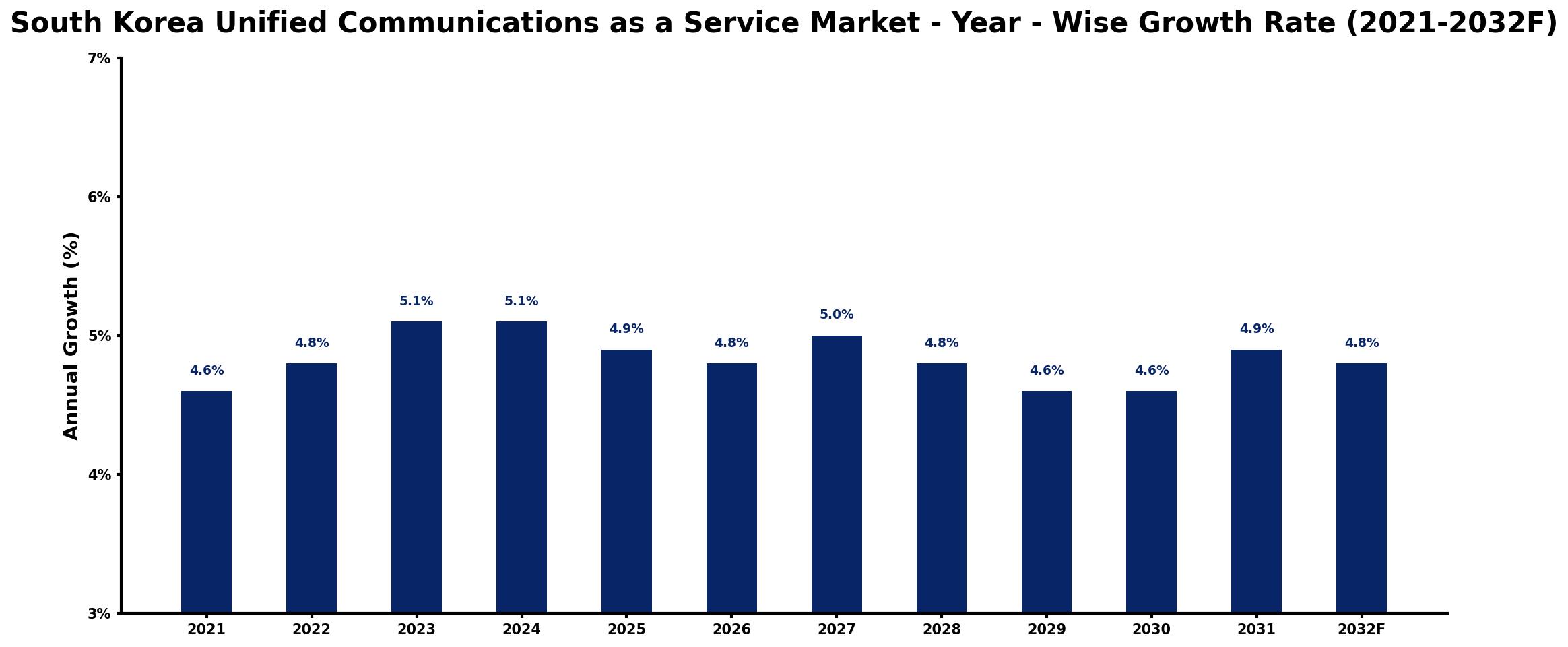
The table below presents the year‑wise growth rates along with the key drivers influencing the market
| Year | Growth Rate | Major Drivers |
| 2021 | 4.6% | Increased remote work adoption trends |
| 2022 | 4.8% | Surge in cloud technology investments |
| 2023 | 5.1% | Rising demand for digital collaboration |
| 2024 | 5.1% | Expansion of enterprise mobility solutions |
| 2025 | 4.9% | expanding manufacturing base activity |
| 2026 | 4.8% | Enhanced focus on cybersecurity measures |
| 2027 | 5.0% | Emergence of AI-driven applications |
| 2028 | 4.8% | Strengthened integration of IoT devices |
| 2029 | 4.6% | Widespread adoption of video conferencing |
| 2030 | 4.6% | Increased reliance on mobile platforms |
| 2031 | 4.9% | Development of new collaboration tools |
| 2032 | 4.8% | Rising importance of user experience |
Note: Market size estimations and growth projections presented in this report are based on 6Wresearch's proprietary forecasting methodology, utilizing the latest available industry data, government publications, and primary research inputs.
South Korea Unified Communications as a Service Market Synopsis
In South Korea, businesses are increasingly seeking unified communication solutions that deliver flexibility and scalability, essential in todays dynamic work environment. The convergence of technology and communication strategies not only enhances productivity but also allows organizations to maintain competitive advantages in an ever-evolving market.
Moreover, with the rapid advancements in cloud technology, organizations are now able to deploy these solutions with less complexity. The South Korean market has seen a significant uptick in the adoption of UCaaS, driven by the need for reliable, robust, and cost-effective communication tools that can accommodate a hybrid work model.
South Korea Unified Communications as a Service Market Key Takeaways
- Cloud-based solutions are at the forefront of driving UCaaS adoption among businesses.
- Integrating various communication modalities into one platform enhances organizational productivity.
- The shift towards remote work continues to propel demand for seamless communication solutions.
- Data security and privacy regulations are pivotal considerations for service providers.
- Market saturation necessitates innovation to ensure differentiation and profitability.
Evaluation of Restraints in South Korea Unified Communications as a Service Market
The South Korea Unified Communications as a Service market faces notable restraints that hinder its expansion. High service reliability expectations create pressure on providers to maintain consistent performance, while interoperability issues can complicate integration with existing systems. Furthermore, data privacy concerns remain a critical focus for both providers and consumers, as businesses must navigate the complexities of regulations in a digital landscape increasingly fraught with cybersecurity threats. These factors, coupled with intense market competition and pricing pressures, pose significant challenges that must be addressed for sustainable growth.
South Korea Unified Communications as a Service Market Trends
Several trends are shaping the landscape of the South Korea Unified Communications as a Service market. The integration of Artificial Intelligence (AI) into UCaaS solutions is enhancing user experiences through features like intelligent virtual assistants and advanced analytics. Additionally, the adoption of mobile-first approaches caters to the increasing number of remote workers, ensuring accessibility and flexibility. Collaborative tools, particularly those that promote real-time communication and project management, are also becoming central to how teams operate in this digital age.
South Korea Unified Communications as a Service Market Opportunities
The South Korea Unified Communications as a Service market is ripe with opportunities for growth and innovation. As more businesses undergo digital transformation, there is a substantial demand for customized solutions that can cater to specific industry needs. Furthermore, the push for enhanced collaboration tools in sectors like education and healthcare presents avenues for tailored UCaaS applications. Investment in security features will also be crucial as companies seek to mitigate risks associated with data breaches and compliance issues, making this an area where providers can differentiate themselves.
Government Initiatives in the South Korea Unified Communications as a Service Market
The South Korean government is proactively fostering an environment conducive to the growth of UCaaS through various initiatives aimed at promoting digital transformation and enhancing cybersecurity measures. Programs designed to improve broadband infrastructure and support research and development in communication technologies are underway. The government also emphasizes data privacy, encouraging organizations to adopt best practices that align with national standards and promote industry-wide interoperability. These efforts create a favorable landscape for the expansion of UCaaS solutions across different sectors.
Future Insights of the South Korea Unified Communications as a Service Market
Looking ahead to 2026-2032, the South Korea Unified Communications as a Service market is expected to experience robust growth driven by the continued evolution of workplace dynamics. Organizations will prioritize flexible communication solutions that support both in-person and remote working arrangements. The anticipated advancements in artificial intelligence and machine learning will facilitate even more intuitive interfaces, transforming how employees engage with UCaaS platforms. As organizations increasingly recognize the value of streamlined communication and collaboration, the market is positioned for significant evolution and investment.
South Korea Unified Communications as a Service Market Latest Developments (2025 - 2026)
In the latest developments within the South Korea Unified Communications as a Service market, there has been a noticeable shift toward enhanced collaboration tools that integrate seamlessly with existing digital ecosystems. Service providers are focusing on developing advanced features that leverage AI for improved customer engagement and operational efficiency. Partnerships among tech firms are increasingly common, aimed at creating comprehensive UCaaS solutions that meet the evolving demands of businesses in a post-pandemic landscape.
South Korea Unified Communications as a Service Market - Key Attractiveness of the Report
- 10 Years of Market Numbers
- Historical Data Starting from 2022 to 2025
- Base Year: 2025
- Forecast Data until 2032
- Key Performance Indicators Impacting the Market
- Major Upcoming Developments and Projects
Key Highlights of the Report:
- South Korea Unified Communications as a Service Market Outlook
- Market Size of South Korea Unified Communications as a Service Market, 2025
- Forecast of South Korea Unified Communications as a Service Market, 2032
- Historical Data and Forecast of South Korea Unified Communications as a Service Revenues & Volume for the Period 2022-2032F
- South Korea Unified Communications as a Service Market Trend Evolution
- South Korea Unified Communications as a Service Market Drivers and Challenges
- South Korea Unified Communications as a Service Price Trends
- South Korea Unified Communications as a Service Porter's Five Forces
- South Korea Unified Communications as a Service Industry Life Cycle
- Historical Data and Forecast of South Korea Unified Communications as a Service Market Revenues & Volume By Component for the Period 2022-2032F
- Historical Data and Forecast of South Korea Unified Communications as a Service Market Revenues & Volume By Telephony for the Period 2022-2032F
- Historical Data and Forecast of South Korea Unified Communications as a Service Market Revenues & Volume By Unified Messaging for the Period 2022-2032F
- Historical Data and Forecast of South Korea Unified Communications as a Service Market Revenues & Volume By Conferencing for the Period 2022-2032F
- Historical Data and Forecast of South Korea Unified Communications as a Service Market Revenues & Volume By Collaboration Platforms And Applications for the Period 2022-2032F
- Historical Data and Forecast of South Korea Unified Communications as a Service Market Revenues & Volume By Organization Size for the Period 2022-2032F
- Historical Data and Forecast of South Korea Unified Communications as a Service Market Revenues & Volume By SMEs for the Period 2022-2032F
- Historical Data and Forecast of South Korea Unified Communications as a Service Market Revenues & Volume By Large Enterprises for the Period 2022-2032F
- Historical Data and Forecast of South Korea Unified Communications as a Service Market Revenues & Volume By Vertical for the Period 2022-2032F
- Historical Data and Forecast of South Korea Unified Communications as a Service Market Revenues & Volume By BFSI for the Period 2022-2032F
- Historical Data and Forecast of South Korea Unified Communications as a Service Market Revenues & Volume By Telecom and IT for the Period 2022-2032F
- Historical Data and Forecast of South Korea Unified Communications as a Service Market Revenues & Volume By Consumer Goods and Retail for the Period 2022-2032F
- Historical Data and Forecast of South Korea Unified Communications as a Service Market Revenues & Volume By Healthcare for the Period 2022-2032F
- Historical Data and Forecast of South Korea Unified Communications as a Service Market Revenues & Volume By Public Sector and Utilities for the Period 2022-2032F
- Historical Data and Forecast of South Korea Unified Communications as a Service Market Revenues & Volume By Logistics and Transportation for the Period 2022-2032F
- Historical Data and Forecast of South Korea Unified Communications as a Service Market Revenues & Volume By Travel and Hospitality for the Period 2022-2032F
- Historical Data and Forecast of South Korea Unified Communications as a Service Market Revenues & Volume By Others (Education, Media and Entertainment, and Manufacturing) for the Period 2022-2032F
- South Korea Unified Communications as a Service Import Export Trade Statistics
- Market Opportunity Assessment By Component
- Market Opportunity Assessment By Organization Size
- Market Opportunity Assessment By Vertical
- South Korea Unified Communications as a Service Top Companies Market Share
- South Korea Unified Communications as a Service Competitive Benchmarking By Technical and Operational Parameters
- South Korea Unified Communications as a Service Company Profiles
- South Korea Unified Communications as a Service Key Strategic Recommendations






































