Spain Advertising Market Size, Share & Growth Rate
The Spain Advertising Market was estimated at USD 123 Million in 2025 and is projected to reach USD 144 Million by 2032, growing at a CAGR of 2.3% from 2026 to 2032. This growth trajectory is largely propelled by the increased emphasis on digital advertising, with businesses gravitating towards platforms that offer precision targeting and measurable results. The swift adoption of social media marketing and the expansion of e-commerce further drive demand, indicating a robust transition from traditional to digital avenues.
Spain Advertising Market Year-wise Growth Rate and Key Drivers
This graph highlights how the Spain Advertising Market has steadily grown over the years, supported by major growth factors.
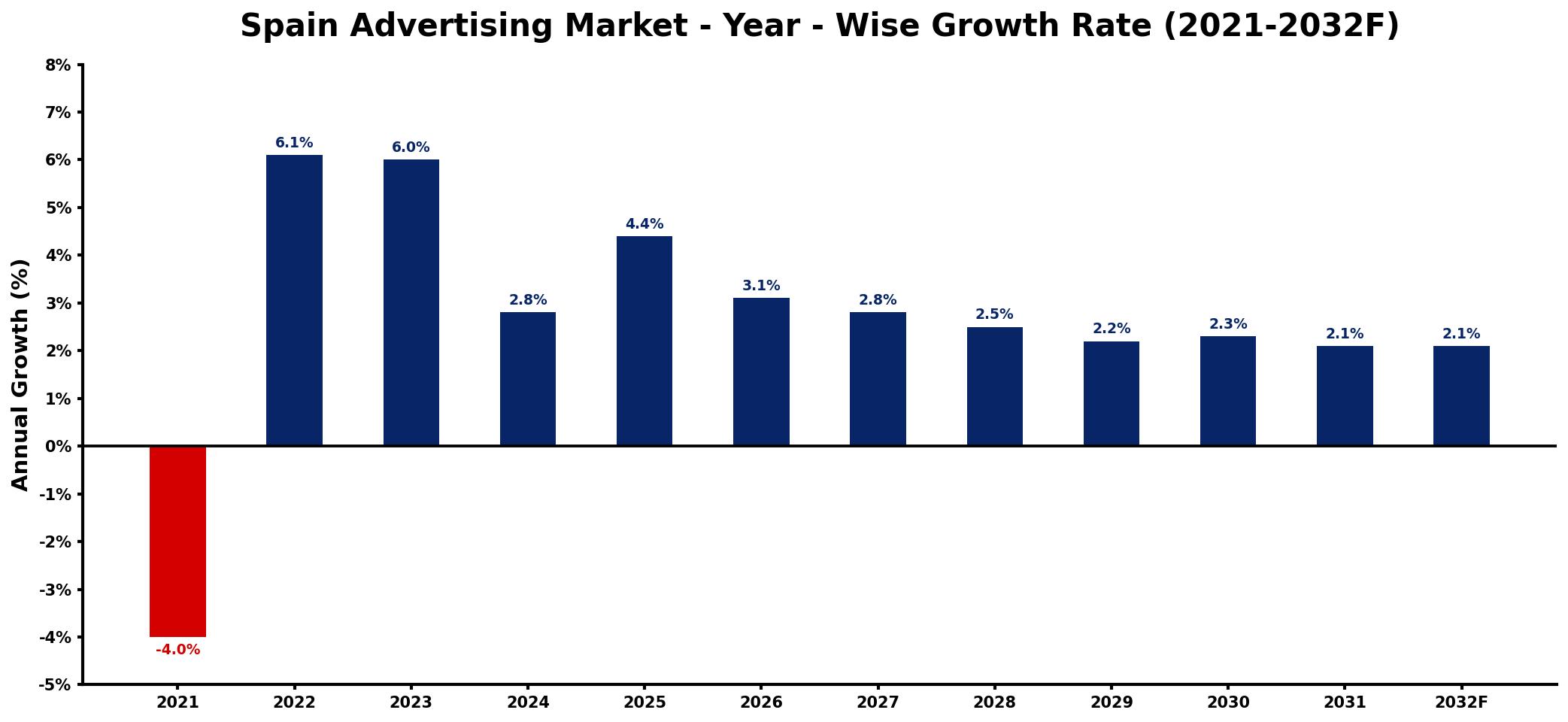
The table below presents the year‑wise growth rates along with the key drivers influencing the market
| Year | Growth Rate | Major Drivers |
| 2021 | -4.0% | decreased consumer spending power |
| 2022 | 6.1% | rise in digital media consumption |
| 2023 | 6.0% | growth in e-commerce platforms |
| 2024 | 2.8% | increased investment in technology |
| 2025 | 4.4% | expansion of social media channels |
| 2026 | 3.1% | increased domestic production output |
| 2027 | 2.8% | greater focus on sustainability initiatives |
| 2028 | 2.5% | development of personalized marketing |
| 2029 | 2.2% | adoption of immersive technologies |
| 2030 | 2.3% | strengthening brand loyalty programs |
| 2031 | 2.1% | emergence of new market segments |
| 2032 | 2.1% | broadening influencer marketing reach |
Note: Market size estimations and growth projections presented in this report are based on 6Wresearch's proprietary forecasting methodology, utilizing the latest available industry data, government publications, and primary research inputs.
Spain Advertising Market Synopsis
The demand for digital advertising in Spain has surged, fueled by a younger demographic that is increasingly active on social media platforms. As traditional media platforms decline, advertisers are pivoting towards innovative digital strategies that prioritize consumer engagement. This shift is underscored by the rising popularity of influencer marketing, which allows brands to tap into niche audiences effectively.
Conversely, television remains a significant player in the Spanish advertising landscape, securing a considerable share of ad spend despite the rise of digital alternatives. Meanwhile, outdoor advertising continues to resonate, particularly in urban centers where creative campaigns can effectively capture the attention of passersby. As the market evolves, a blend of traditional and digital methods is becoming essential for advertisers.
Spain Advertising Market Key Takeaways
- Digital advertising is increasingly dominating the market, driven by high social media engagement.
- Television still holds a strong foothold, attracting a substantial portion of advertising budgets.
- Outdoor advertising is thriving in high-traffic urban areas, offering unique consumer engagement opportunities.
- Marketers are leveraging programmatic advertising for enhanced targeting and efficiency.
- Corporate social responsibility is becoming a pivotal theme in advertising strategies.
Evaluation of Restraints in Spain Advertising Market
Despite the promising growth trajectory, the Spain advertising market faces notable constraints. The competition among advertising agencies has intensified, leading to an oversaturated market where differentiation becomes increasingly challenging. Fragmentation of audiences across digital platforms complicates the targeting of specific consumer segments, making efficient ad placement a concern. Additionally, economic fluctuations can impact advertisers' budgets, creating uncertainty in spending patterns. Navigating regulations around data privacy and advertising content poses further complexities that brands must adapt to in order to thrive.
Spain Advertising Market Trends
Current trends in the Spain advertising market emphasize a marked shift toward personalization and interactivity. Brands are investing in personalized content strategies, leveraging user data to create targeted campaigns that resonate with consumers on a deeper level. Mobile advertising is seeing exponential growth as more users engage with content through smartphones and tablets, indicating a need for businesses to prioritize mobile-optimized strategies. Moreover, sustainability is gaining traction, as brands increasingly align their messaging with consumer values around environmental and social consciousness.
Spain Advertising Market Opportunities
Significant investment opportunities abound in the Spain advertising market, particularly within the digital landscape. The growth of social media advertising and influencer partnerships offers lucrative prospects for businesses aiming to elevate their online presence. Companies that focus on innovative outdoor advertising solutions can capitalize on consumer footfall in urban centers. Additionally, the burgeoning interest in mobile and video advertising opens avenues for investment in specialized firms that can deliver engaging, high-quality content. As advertisers seek to navigate this digital evolution, there is ample room for innovative solutions that bridge traditional and digital approaches.
Government Initiatives in the Spain Advertising Market
The Spanish government has established a robust framework of policies and regulations aimed at promoting ethical advertising practices. Legislation mandates transparency in advertising, requiring brands to disclose sponsored content and avoid misleading information. Restrictions on advertising specific industries, such as alcohol and tobacco, are also in place to prioritize public health. Organizations like the Spanish Advertising Self-Regulation Association (Autocontrol) play a pivotal role in upholding advertising standards, fostering a responsible and competitive environment for advertisers in Spain.
Future Insights of the Spain Advertising Market
Looking ahead to 2026-2032, the Spain advertising market is positioned for steady growth, primarily driven by escalating digital ad expenditures in mobile and video segments. The rise of programmatic advertising will enhance targeting capabilities, enabling brands to engage consumers more effectively. Additionally, as e-commerce continues to thrive, the demand for sophisticated digital advertising services will likely intensify. While traditional media such as television and print face challenges, the ongoing transition towards digital strategies is expected to yield opportunities for innovation and greater consumer connection.
Spain Advertising Market Latest Developments (2025 - 2026)
In recent months, the advertising landscape in Spain has witnessed a surge in collaborations between brands and digital influencers, showcasing a shift towards more authentic marketing methods. Companies are increasingly prioritizing sustainable practices in their advertising strategies, reflecting a broader societal trend towards environmental consciousness. Additionally, the implementation of new technologies for programmatic advertising has enhanced targeting accuracy, prompting advertisers to leverage these innovations for improved campaign performance. Overall, a dynamic evolution is evident, adapting to changing consumer expectations and technological advancements.
Spain Advertising Market - Key Attractiveness of the Report
- 10 Years of Market Numbers
- Historical Data Starting from 2022 to 2025
- Base Year: 2025
- Forecast Data until 2032
- Key Performance Indicators Impacting the Market
- Major Upcoming Developments and Projects
Key Highlights of the Report:
- Spain Advertising Market Outlook
- Market Size of Spain Advertising Market, 2025
- Forecast of Spain Advertising Market, 2032
- Historical Data and Forecast of Spain Advertising Revenues & Volume for the Period 2022-2032F
- Spain Advertising Market Trend Evolution
- Spain Advertising Market Drivers and Challenges
- Spain Advertising Price Trends
- Spain Advertising Porter's Five Forces
- Spain Advertising Industry Life Cycle
- Historical Data and Forecast of Spain Advertising Market Revenues & Volume By Type for the Period 2022-2032F
- Historical Data and Forecast of Spain Advertising Market Revenues & Volume By Television for the Period 2022-2032F
- Historical Data and Forecast of Spain Advertising Market Revenues & Volume By Print (Newspaper and Magazine) for the Period 2022-2032F
- Historical Data and Forecast of Spain Advertising Market Revenues & Volume By Radio for the Period 2022-2032F
- Historical Data and Forecast of Spain Advertising Market Revenues & Volume By Outdoor for the Period 2022-2032F
- Historical Data and Forecast of Spain Advertising Market Revenues & Volume By Internet (Search, Display, Classified, Video) for the Period 2022-2032F
- Historical Data and Forecast of Spain Advertising Market Revenues & Volume By Mobile for the Period 2022-2032F
- Historical Data and Forecast of Spain Advertising Market Revenues & Volume By Cinema for the Period 2022-2032F
- Spain Advertising Import Export Trade Statistics
- Market Opportunity Assessment By Type
- Spain Advertising Top Companies Market Share
- Spain Advertising Competitive Benchmarking By Technical and Operational Parameters
- Spain Advertising Company Profiles
- Spain Advertising Key Strategic Recommendations






































