Spain Automotive Chassis Market Size, Share & Growth Rate
The Spain Automotive Chassis Market was estimated at USD 101 Million in 2025 and is projected to reach USD 119 Million by 2032, growing at a CAGR of 2.4% from 2026 to 2032. This growth trajectory is primarily driven by the escalating demand for lightweight and fuel-efficient vehicles, as manufacturers strive to meet stringent environmental regulations. Additionally, the increasing incorporation of advanced technologies in chassis design significantly enhances vehicle performance, contributing to the market's steady expansion.
Spain Automotive Chassis Market Year-wise Growth Rate and Key Drivers
This graph highlights how the Spain Automotive Chassis Market has steadily grown over the years, supported by major growth factors.
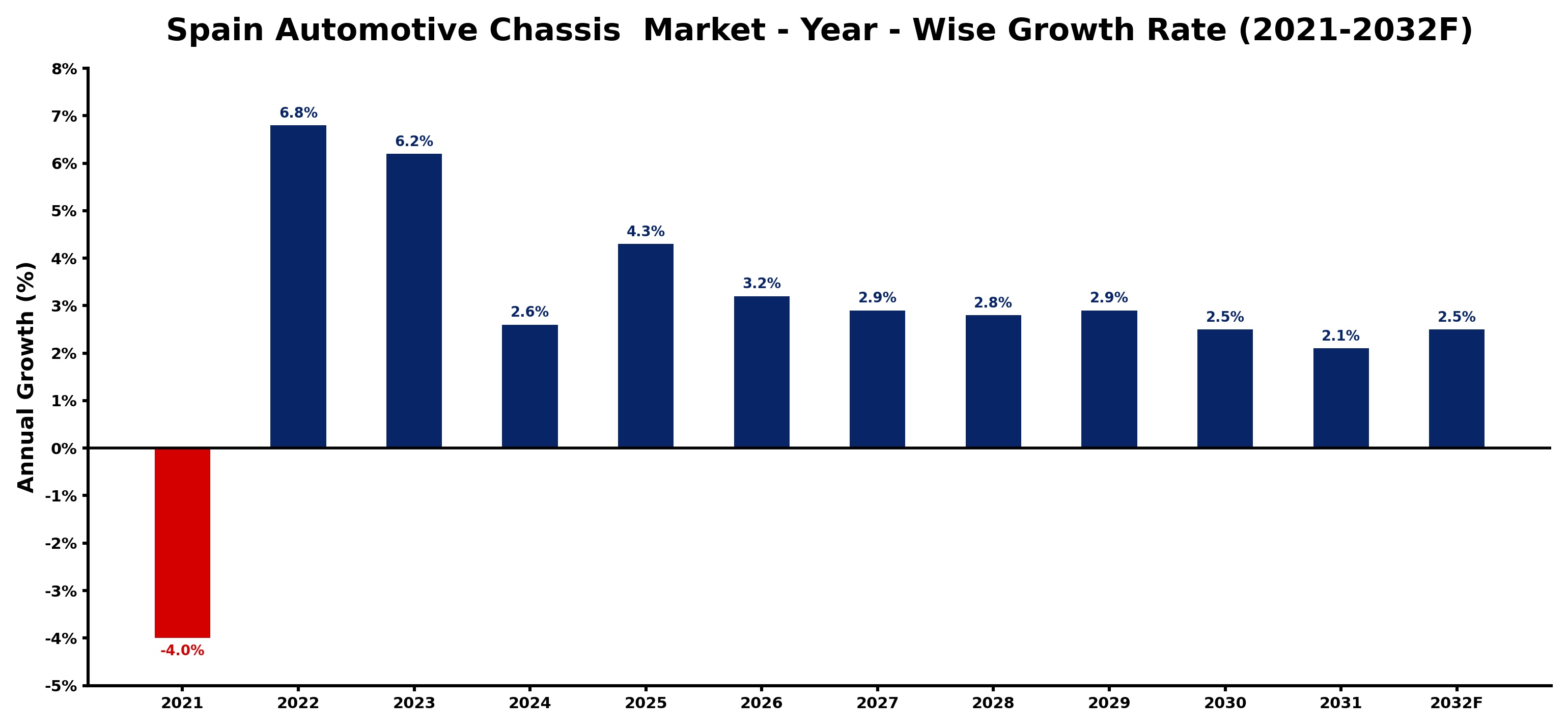
The table below presents the year‑wise growth rates along with the key drivers influencing the market
| Year | Growth Rate | Major Drivers |
| 2021 | -4.0% | Supply chain disruptions limited production |
| 2022 | 6.8% | Electric vehicle adoption accelerated growth |
| 2023 | 6.2% | Sustainability initiatives drove innovation |
| 2024 | 2.6% | Technological advancements enhanced efficiency |
| 2025 | 4.3% | Consumer demand for safety features |
| 2026 | 3.2% | Investment in lightweight materials increased |
| 2027 | 2.9% | Collaboration with tech firms expanded |
| 2028 | 2.8% | Rising demand for customization options |
| 2029 | 2.9% | Government incentives boosted electric vehicles |
| 2030 | 2.5% | Focus on autonomous vehicle technology |
| 2031 | 2.1% | Expansion of manufacturing capabilities |
| 2032 | 2.5% | Global partnerships enhanced market reach |
Note - Market size estimations and growth projections presented in this report are based on 6Wresearch’s advanced forecasting approach, validated with industry datasets as of June 2026.
Spain Automotive Chassis Market Synopsis
The strongest force shaping the Spain Automotive Chassis Market today is the shift towards electric and hybrid vehicles. This transition requires innovative chassis designs that can accommodate new powertrain technologies while ensuring optimal performance and safety. As manufacturers respond to these evolving requirements, there's an increasing emphasis on lightweight materials to enhance fuel efficiency.
In addition to the growing focus on electric mobility, technological advancements in chassis systems are redefining vehicle dynamics. Enhanced performance features, such as active suspension and electronic stability control, are gaining traction, reflecting a broader trend towards integrating sophisticated technologies that prioritize driver safety and comfort. Together, these factors are steering the market toward a promising future.
Spain Automotive Chassis Market Key Takeaways
- The Spain Automotive Chassis Market is poised for growth, with an emphasis on lightweight materials and sustainability.
- Technological advancements are leading to enhanced vehicle safety and performance through innovative chassis systems.
- There's a notable shift towards modular chassis platforms, allowing for flexibility in vehicle design and production.
- Investment opportunities lie in the development of chassis solutions tailored for electric and autonomous vehicles.
- Government regulations are influencing market dynamics, fostering innovation while enforcing safety and emissions standards.
Evaluation of Restraints in Spain Automotive Chassis Market
Despite the positive outlook, the Spain Automotive Chassis Market faces several restraints. Increasingly stringent regulations regarding safety and emissions are compelling manufacturers to invest heavily in research and development. This demand for compliance often leads to heightened production costs, which could impact pricing strategies across the sector. Moreover, fluctuations in raw material prices and potential supply chain disruptions remain significant concerns, particularly as the industry transitions toward new technologies for electric and autonomous vehicles. Adapting existing chassis designs to meet these evolving requirements, while ensuring cost competitiveness, poses ongoing challenges for stakeholders in this market.
Spain Automotive Chassis Market Trends
Current trends within the Spain Automotive Chassis Market highlight a marked shift toward lightweight materials, which are essential for improving fuel efficiency and complying with emissions standards. The integration of advanced technologies, including active suspension and electronic stability control systems, is enhancing vehicle handling and safety. Additionally, there is a growing interest in modular chassis platforms, enabling automotive manufacturers to streamline production processes and adapt designs for various vehicle models more efficiently. Finally, the increasing emphasis on electric vehicle chassis design underscores the transition towards sustainable mobility solutions.
Spain Automotive Chassis Market Opportunities
The Spain Automotive Chassis Market offers several lucrative investment opportunities. The increasing demand for lightweight, fuel-efficient vehicles is prompting manufacturers to explore innovative chassis materials and technologies. Collaboration with automotive OEMs and suppliers can lead to the development of advanced chassis systems that not only enhance vehicle performance but also align with stringent environmental regulations. Moreover, the focus on sustainability provides a fertile ground for the introduction of new chassis solutions that reduce emissions and improve overall vehicle efficiency. Investors are encouraged to engage in research and development of next-generation chassis systems tailored to the shifting automotive landscape.
Government Initiatives in the Spain Automotive Chassis Market
The Spanish government is actively supporting the automotive chassis market through a range of policies and initiatives aimed at promoting sustainability and innovation. These efforts include stringent environmental regulations designed to curb emissions and enhance vehicle safety. Additionally, incentives and subsidies are being offered to companies investing in the research and development of cutting-edge chassis technologies. The regulatory framework established ensures compliance with safety standards and quality control measures, all contributing to a competitive and growth-oriented environment within the automotive chassis industry in Spain.
Future Insights of the Spain Automotive Chassis Market
Looking ahead to 2026-2032, the Spain Automotive Chassis Market is anticipated to evolve significantly. A continued increase in demand for lightweight and fuel-efficient vehicles will drive innovation in chassis design and materials. Advanced composites, such as carbon fiber and aluminum, are expected to become more prevalent, enhancing performance while reducing overall vehicle weight. Additionally, the growth of electric and hybrid vehicles will foster new opportunities for innovative chassis solutions that accommodate alternative powertrains. As technology advances, the emphasis on sustainability, safety, and efficiency will reshape the future of automotive chassis in Spain.
Spain Automotive Chassis Market Latest Developments (May 2025 - June 2026)
Recent developments within the Spain Automotive Chassis Market indicate a proactive industry responding to the dual challenges of sustainability and technological advancement. Manufacturers are increasingly exploring lightweight materials and designs that enhance vehicle performance and comply with evolving regulations. Moreover, there has been a noticeable uptick in collaborative efforts among manufacturers and technology firms aimed at integrating advanced systems into chassis designs, signaling a shift towards more sophisticated vehicle dynamics. This momentum reflects a broader commitment to innovating while addressing safety and environmental concerns.
Spain Automotive Chassis Market - Key Attractiveness of the Report
- 10 Years of Market Numbers
- Historical Data Starting from 2022 to 2025
- Base Year: 2025
- Forecast Data until 2032
- Key Performance Indicators Impacting the Market
- Major Upcoming Developments and Projects
Key Highlights of the Report:
- Spain Automotive Chassis Market Outlook
- Market Size of Spain Automotive Chassis Market, 2025
- Forecast of Spain Automotive Chassis Market, 2032
- Historical Data and Forecast of Spain Automotive Chassis Revenues & Volume for the Period 2022-2032F
- Spain Automotive Chassis Market Trend Evolution
- Spain Automotive Chassis Market Drivers and Challenges
- Spain Automotive Chassis Price Trends
- Spain Automotive Chassis Porter's Five Forces
- Spain Automotive Chassis Industry Life Cycle
- Historical Data and Forecast of Spain Automotive Chassis Market Revenues & Volume By ChassisType for the Period 2022-2032F
- Historical Data and Forecast of Spain Automotive Chassis Market Revenues & Volume By Backbone for the Period 2022-2032F
- Historical Data and Forecast of Spain Automotive Chassis Market Revenues & Volume By Ladder for the Period 2022-2032F
- Historical Data and Forecast of Spain Automotive Chassis Market Revenues & Volume By Monocoque for the Period 2022-2032F
- Historical Data and Forecast of Spain Automotive Chassis Market Revenues & Volume By Modular for the Period 2022-2032F
- Historical Data and Forecast of Spain Automotive Chassis Market Revenues & Volume By Material for the Period 2022-2032F
- Historical Data and Forecast of Spain Automotive Chassis Market Revenues & Volume By Steel for the Period 2022-2032F
- Historical Data and Forecast of Spain Automotive Chassis Market Revenues & Volume By Aluminum Alloy for the Period 2022-2032F
- Historical Data and Forecast of Spain Automotive Chassis Market Revenues & Volume By Carbon Fiber Composite for the Period 2022-2032F
- Historical Data and Forecast of Spain Automotive Chassis Market Revenues & Volume By Electric Vehicle for the Period 2022-2032F
- Historical Data and Forecast of Spain Automotive Chassis Market Revenues & Volume By BEV for the Period 2022-2032F
- Historical Data and Forecast of Spain Automotive Chassis Market Revenues & Volume By PHEV for the Period 2022-2032F
- Historical Data and Forecast of Spain Automotive Chassis Market Revenues & Volume By HEV for the Period 2022-2032F
- Historical Data and Forecast of Spain Automotive Chassis Market Revenues & Volume By Vehicle Type for the Period 2022-2032F
- Historical Data and Forecast of Spain Automotive Chassis Market Revenues & Volume By PC for the Period 2022-2032F
- Historical Data and Forecast of Spain Automotive Chassis Market Revenues & Volume By CV for the Period 2022-2032F
- Spain Automotive Chassis Import Export Trade Statistics
- Market Opportunity Assessment By ChassisType
- Market Opportunity Assessment By Material
- Market Opportunity Assessment By Electric Vehicle
- Market Opportunity Assessment By Vehicle Type
- Spain Automotive Chassis Top Companies Market Share
- Spain Automotive Chassis Competitive Benchmarking By Technical and Operational Parameters
- Spain Automotive Chassis Company Profiles
- Spain Automotive Chassis Key Strategic Recommendations






































