Topics Covered in Spain Automotive Engineering Services Outsourcing Market Report
Spain Automotive Engineering Services Outsourcing Market Report thoroughly covers the market by vehicle type, location type and application. Spain Automotive Engineering Services Outsourcing Market Outlook report provides an unbiased and detailed analysis of the ongoing Spain Automotive Engineering Services Outsourcing Market trends, opportunities/high growth areas, and market drivers. This would help stakeholders devise and align their market strategies according to the current and future market dynamics.
Spain Automotive Engineering Services Outsourcing Market Synopsis
The Spain automotive engineering services outsourcing market witnessed substantial growth between 2022 and 2025, supported by the country’s strong automotive manufacturing ecosystem, accelerating vehicle electrification, and increasing adoption of Industry 4.0 technologies. Spain is one of Europe’s major automotive manufacturing hubs, with large-scale vehicle production supported by multiple assembly and powertrain facilities, including growing electric vehicle manufacturing capacity. The automotive sector plays a significant role in the national economy, contributing notably to GDP and exports while also supporting a large employment base through its extensive industrial ecosystem.
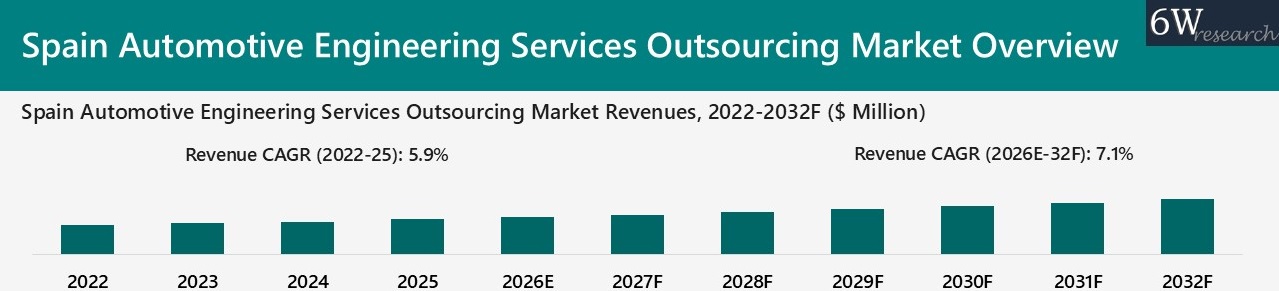
According to 6Wresearch, the Spain Automotive Engineering Services Outsourcing Market is projected to grow at a CAGR of 7.1% from 2026-2032F, driven by the increasing scale of automotive industry as manufacturers accelerate electrification, digitalization, and advanced mobility initiatives. Under Spain’s PNIEC roadmap, electric vehicles on roads are targeted to reach at a high number by 2030, while public charging infrastructure is expected to expand. Simultaneously, battery manufacturing capacity is anticipated to increase by 2030, supported by major investments from Volkswagen-PowerCo and Stellantis-CATL. These developments are expected to generate substantial demand for outsourced engineering services across product design, battery validation, embedded software development, vehicle testing, homologation, and manufacturing optimization.
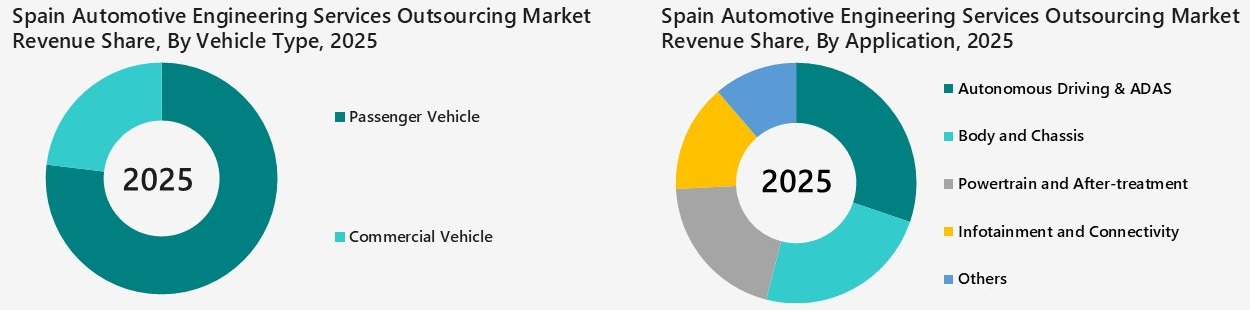
Market Segmentation By Vehicle Type
Commercial Vehicles are expected to register the highest growth, supported by rising demand for fleet-specific engineering, payload-based validation, homologation support, and ADAS/safety compliance. Although Passenger Vehicles continue to dominate market revenues due to Spain’s large passenger vehicle production base, Commercial Vehicles are projected to outpace the market as engineering requirements become more complex across logistics, utility, construction, and special-purpose vehicle applications.
Market Segmentation By location Type
Off-Shore is expected to experience the highest growth rate, during the period 2026-2032. As the value of a vehicle shifts from mechanical hardware to software (which can be coded and tested anywhere in the world), OEMs are rapidly changing their outsourcing models. Spanish automotive players are increasingly offshoring tasks such as embedded software coding, AI algorithm training, and digital twin simulation to highly specialized, cost-effective global talent pools.
Market Segmentation By Application
Autonomous Driving & ADAS is expected to record the highest growth, supported by increasing demand for sensor integration, camera/radar calibration, software validation, functional safety testing, cybersecurity compliance, and real-world performance validation. As vehicles become more software-defined and safety regulations become stricter, OEMs and suppliers are expected to outsource a larger share of ADAS-related engineering activities to specialized service providers.
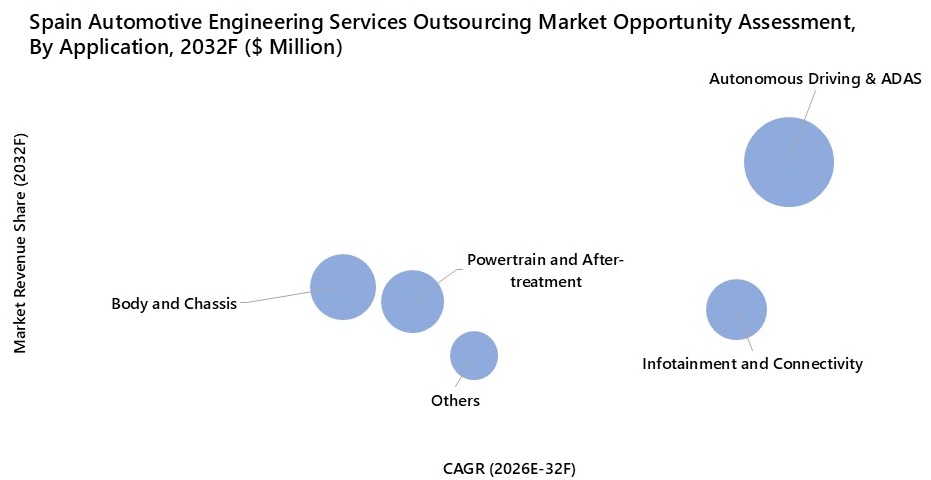
Spain Automotive Engineering Services Outsourcing Market Trends:
Past Trends:
- During 2010–2020, Spain’s Automotive Engineering Services Outsourcing market was largely driven by conventional mechanical design and physical prototyping for internal combustion engine (ICE) passenger and commercial vehicles. Adoption was mainly concentrated in on-shore hubs near major OEM manufacturing plants, focusing heavily on body and chassis engineering, traditional powertrain calibration, and basic vehicle testing.
- The market relied on time-intensive physical validation cycles, while smaller tier-suppliers utilized localized capacity augmentation rather than strategic co-innovation due to limited digital integration and a narrower focus on early CAD/CAE tools.
Present Trends
- During 2021–2026, the market experienced stronger adoption momentum, heavily driven by the rapid shift toward Software-Defined Vehicles (SDVs) and the government's PERTE VEC initiative, which mobilized billions to transform Spain into a European electromobility hub. This accelerated demand for outsourced expertise in electric powertrains, battery cell integration, and infotainment connectivity.
- The market also shifted toward virtual validation and complex Electrical & Electronics (E/E) architectures, as OEMs actively leveraged both on-shore domain expertise and off-shore delivery models to efficiently scale autonomous driving (ADAS) capabilities and optimize costs.
Future Trends
- Beyond 2026, the market is expected to expand rapidly as European zero-emission mandates tighten, accelerating demand for specialized engineering outsourcing partners that support advanced zonal E/E architectures, battery thermal management, and AI-driven autonomous vehicle algorithms.
- The market would witness tighter integration of "virtual-first" digital twins, significantly reducing the need for physical prototyping during homologation and testing. Continued regional gigafactory developments would further strengthen high-value engineering adoption across passenger and commercial EV platforms, cementing Spain's strategic role in sustainable mobility.
Key Attractiveness of the Report
- 10 Years Market Numbers.
- Historical Data Starting from 2022 to 2025
- Base Year: 2025
- Forecast Data until 2032
- Key Performance Indicators Impacting the Market.
- Major Upcoming Developments and Projects.
Key Highlights of the Report:
- Spain Automotive Engineering Services Outsourcing Market Overview
- Spain Automotive Engineering Services Outsourcing Market Outlook
- Spain Automotive Engineering Services Outsourcing Market Forecast
- Historical Data and Forecast of Spain Automotive Engineering Services Outsourcing Market Revenues for the Period 2022-2032F
- Historical Data and Forecast of Spain Automotive Engineering Services Outsourcing Market Revenues, By Vehicle Type for the Period 2022-2032F
- Historical Data and Forecast of Spain Automotive Engineering Services Outsourcing Market Revenues, By Location Type for the Period 2022-2032F
- Historical Data and Forecast of Spain Automotive Engineering Services Outsourcing Market Revenues, By Application for the Period 2022-2032F
- Porter’s Five Force Analysis
- Spain Automotive Engineering Services Outsourcing Market Drivers and Restraints
- Spain Automotive Engineering Services Outsourcing Market Trends
- Spain Automotive Engineering Services Outsourcing Market Opportunity Assessment, By Vehicle Type
- Spain Automotive Engineering Services Outsourcing Market Opportunity Assessment, By Location Type
- Spain Automotive Engineering Services Outsourcing Market Opportunity Assessment, By Application
- Spain Automotive Engineering Services Outsourcing Market Revenue Ranking, By Top 3 Companies
- Market Competitive Benchmarking
- Company Profiles
Market Scope and Segmentation
The report provides a detailed analysis of the following market segments:
By Vehicle Type
- Passenger Vehicle
- Commercial Vehicle
By Location Type
- On-Shore
- Off-Shore
By Application
- Autonomous Driving & ADAS
- Body and Chassis
- Powertrain and After-treatment
- Infotainment and Connectivity
- Others (Vehicle Testing, Validation & Homologation, Electrical & Electronics (E/E) Architecture)






































