Spain Electrical Equipment Market Summary
The spain electrical equipment market was estimated at USD 148 Million in 2025 and is projected to reach USD 174 Million by 2032, growing at a CAGR of 3.0% from 2026 to 2032.
Spain Electrical Equipment Market Year-wise Growth Rate and Key Drivers
This graph highlights how the Spain Electrical Equipment Market has steadily grown over the past five years, supported by major growth factors.
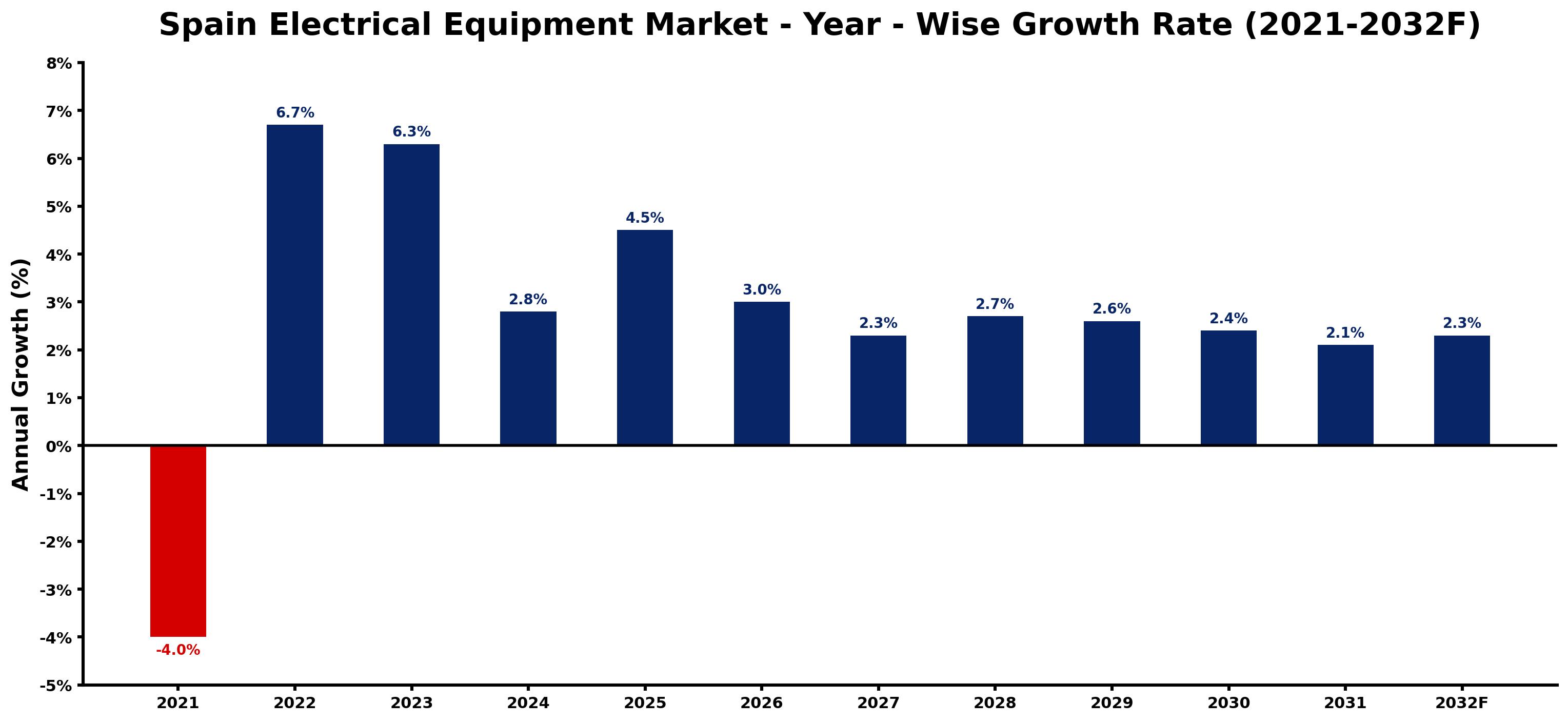
The table below presents the year wise growth rates along with the key drivers influencing the market
| Year | Growth Rate | Major Drivers |
| 2021 | -4.0% | Supply chain disruptions led to shortages, adversely affecting manufacturing capabilities and sales in the electrical equipment sector. |
| 2022 | 6.7% | Energy-efficient solutions gained traction as businesses prioritized sustainability measures alongside modernization. |
| 2023 | 6.3% | Corporate investments in smart grid technologies reflected an industry response to increasing energy demands. |
| 2024 | 2.8% | Emerging renewable energy sectors prompted a shift toward innovative electrical equipment solutions. |
| 2025 | 4.5% | Manufacturers embraced IoT integration, enhancing operational efficiency throughout the electrical supply chain. |
| 2026 | 3.0% | Infrastructure upgrades became essential to meet rising urbanization trends across major Spanish cities. |
| 2027 | 2.3% | Smart home technology adoption created new opportunities in residential electrical equipment markets. |
| 2028 | 2.7% | Increased emphasis on energy storage solutions resulted from fluctuating renewable energy generation patterns. |
| 2029 | 2.6% | Collaboration between tech firms and traditional manufacturers fueled development of advanced electrical systems. |
| 2030 | 2.4% | Regulatory frameworks encouraged investment in electrical safety upgrades across existing constructions. |
| 2031 | 2.1% | Consumer preferences shifted towards integrated systems, driving demand for multifunctional electrical devices. |
| 2032 | 2.3% | Electric vehicle infrastructure expansion significantly influenced electrical equipment market dynamics across Spain. |
Note - Market size estimations and growth projections presented in this report are based on 6Wresearch's advanced forecasting approach, validated with industry datasets as of June 2026.
Spain Electrical Equipment Market Synopsis
The Spain Electrical Equipment Market is projected to reach 3.0% and witness significant growth during the forecast period (2026-2032). This dynamic industry is characterized by an increasing demand for energy-efficient solutions driven by technological advancements, heightened environmental awareness, and substantial investments in modernizing infrastructure. A key factor in this growth is the rising adoption of smart home technologies, alongside a growing commitment to renewable energy sources. As consumers prioritize sustainability, the market sees a shift towards eco-friendly electrical products, which are becoming increasingly critical in consumer purchasing decisions.
Spain Electrical Equipment Market Growth Drivers
The evolution of the Spain Electrical Equipment Market is primarily buoyed by several growth drivers:
- The demand for energy-efficient products is surging, as consumers and businesses alike are increasingly conscious of their energy consumption and environmental impact. This trend fosters growth in the market for energy-saving electrical equipment.
- Technological advancements, particularly in automation and smart systems, are revolutionizing the market. Devices with connectivity features that enhance user experience are becoming essential, propelling further innovation.
- The transition towards renewable energy sources is gaining momentum as Spain seeks to comply with EU directives, encouraging investments in solar, wind, and other green technologies that are embedded within the electrical equipment sector.
- Regulatory changes are driving compliance towards stricter safety and efficiency standards, which encourages manufacturers to innovate and improve product offerings to meet market requirements.
- Modernization of infrastructure, including upgrades to electrical grids and public facilities, presents substantial opportunities for expansion, driving demand for advanced electrical equipment.
Spain Electrical Equipment Market Trends and Opportunities
The Spain Electrical Equipment Market is witnessing a variety of trends that highlight the shifting landscape:
- There is an increasing integration of smart technology within electrical equipment, which promotes automation and connectivity, thus enhancing operational efficiency.
- The focus on sustainability continues to grow, leading to an uptick in the manufacture and adoption of eco-friendly products, including solar-powered devices and energy-efficient appliances.
- The surge in investments in infrastructure and utility improvements is compelling stakeholders to explore opportunities in the development of smart grids and next-generation energy distribution systems.
- Manufacturers are prioritizing product reliability and safety, investing in rigorous testing and certification processes to align with evolving regulations and consumer expectations.
- As electric vehicles gain traction, the need for supporting infrastructure, such as charging stations and related equipment, is anticipated to create new market segments and opportunities.
Spain Electrical Equipment Market Challenges and Restraints
Despite its growth potential, the Spain Electrical Equipment Market faces several notable challenges:
- Intense competition from both local and international manufacturers necessitates differentiation strategies, compelling companies to focus on innovation, quality, and competitive pricing.
- The dynamic regulatory environment presents a challenge, as compliance with increasingly stringent safety and environmental standards can strain operational capabilities.
- Fluctuations in raw material prices pose a risk to profitability, as they can directly impact production costs and affect supply chain stability.
- Supply chain disruptions, influenced by global events, continue to challenge manufacturers' abilities to deliver products on time, affecting market dynamics.
- Economic uncertainties, such as inflation or shifts in market demand, may hinder investments and slow down market uptake, complicating strategic planning for stakeholders.
Spain Electrical Equipment Market Investment Opportunities
Looking ahead, the Spain Electrical Equipment Market presents numerous investment opportunities across various segments:
- Investment in renewable energy technologies remains a highly promising avenue, particularly companies focused on solar panel production, wind turbines, and energy storage systems.
- The expansion of smart grid solutions is crucial for modernizing energy management, presenting opportunities for technology development in smart meters and related software applications.
- Energy efficiency products, including LED lighting and energy-efficient HVAC systems, are in high demand, aligning with both consumer preferences and regulatory goals.
- The electric vehicle sector offers robust growth potential, especially in the development of charging infrastructure and related electrical solutions.
- There is increasing interest in research and development aimed at innovative electrical solutions, where investors can engage with companies working on cutting-edge technologies.
Spain Electrical Equipment Market Government Investment and Initiatives
The Spanish government has instituted several initiatives to promote a vibrant Electrical Equipment Market.
- The Energy Efficiency and Renewable Energy Plan serves as a significant regulatory framework encouraging investment in energy-efficient technologies and the adoption of renewable energy sources.
- Government spending on infrastructure development is directed toward upgrading electrical grids, which includes funding for innovative solutions that enhance the reliability of power distribution.
- Regulations ensuring compliance with EU standards provide a benchmark for quality and safety, fostering a competitive marketplace aligned with best practices.
- Support for research and development initiatives has been bolstered through funding programs aimed at collaborating with industry stakeholders to drive innovation in the electrical equipment sector.
- The government's commitment to sustainability encourages manufacturers to innovate and transition towards environmentally friendly practices, as part of the broader EU climate objectives.
Spain Electrical Equipment Market Latest Developments (May 2025 - June 2026)
Recent developments within the Spain Electrical Equipment Market reflect a transition towards more sustainable practices and innovative technologies. Various initiatives have been undertaken to support the integration of renewable energy into the national grid. Legislative measures have been enacted to further incentivize the adoption of energy-efficient products among both consumers and businesses. Efforts to modernize infrastructure continue to gain traction, with significant public funding allocated to electrical grid upgrades. Moreover, the rise of electric vehicles has catalyzed new investments centered on charging infrastructure. Finally, trends indicate increasing collaboration between tech firms and the electrical equipment sector, as smart technology integration becomes vital for market participants.
Spain Electrical Equipment Market - Key Attractiveness of the Report
- 10 Years of Market Numbers
- Historical Data Starting from 2022 to 2025
- Base Year: 2025
- Forecast Data until 2032
- Key Performance Indicators Impacting the Market
- Major Upcoming Developments and Projects
Key Highlights of the Report:
- Spain Electrical Equipment Market Outlook
- Market Size of Spain Electrical Equipment Market, 2025
- Forecast of Spain Electrical Equipment Market, 2032F
- Historical Data and Forecast of Spain Electrical Equipment Revenues & Volume for the Period 2022-2032F
- Spain Electrical Equipment Market Trend Evolution
- Spain Electrical Equipment Market Drivers and Challenges
- Spain Electrical Equipment Price Trends
- Spain Electrical Equipment Porter's Five Forces
- Spain Electrical Equipment Industry Life Cycle
- Historical Data and Forecast of Spain Electrical Equipment Market Revenues & Volume By Types for the Period 2022-2032F
- Historical Data and Forecast of Spain Electrical Equipment Market Revenues & Volume By Electronic and electrical wires and cables for the Period 2022-2032F
- Historical Data and Forecast of Spain Electrical Equipment Market Revenues & Volume By Batteries and accumulators for the Period 2022-2032F
- Historical Data and Forecast of Spain Electrical Equipment Market Revenues & Volume By Wiring devices for the Period 2022-2032F
- Historical Data and Forecast of Spain Electrical Equipment Market Revenues & Volume By Electric lighting equipment for the Period 2022-2032F
- Historical Data and Forecast of Spain Electrical Equipment Market Revenues & Volume By Others for the Period 2022-2032F
- Historical Data and Forecast of Spain Electrical Equipment Market Revenues & Volume By Applications for the Period 2022-2032F
- Historical Data and Forecast of Spain Electrical Equipment Market Revenues & Volume By Residential end-users for the Period 2022-2032F
- Historical Data and Forecast of Spain Electrical Equipment Market Revenues & Volume By Non-residential end-users for the Period 2022-2032F
- Spain Electrical Equipment Import Export Trade Statistics
- Market Opportunity Assessment By Types
- Market Opportunity Assessment By Applications
- Spain Electrical Equipment Top Companies Market Share
- Spain Electrical Equipment Competitive Benchmarking By Technical and Operational Parameters
- Spain Electrical Equipment Company Profiles
- Spain Electrical Equipment Key Strategic Recommendations






































