Spain Food Retail Market Summary
The spain food retail market was estimated at USD 238 Million in 2025 and is projected to reach USD 326 Million by 2032, growing at a CAGR of 5.9% from 2026 to 2032.
Spain Food Retail Market Year-wise Growth Rate and Key Drivers
This graph highlights how the Spain Food Retail Market has steadily grown over the past five years, supported by major growth factors.
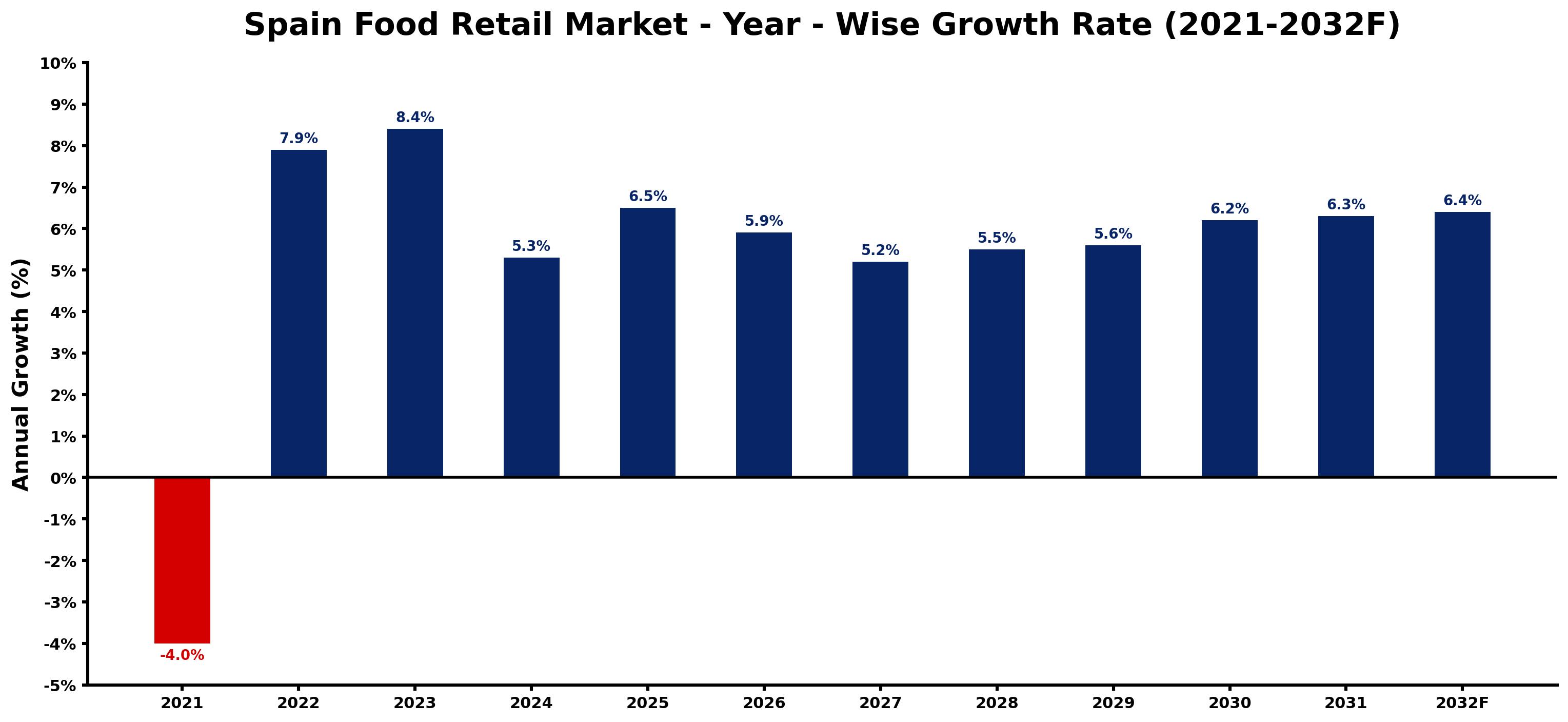
The table below presents the year wise growth rates along with the key drivers influencing the market
| Year | Growth Rate | Major Drivers |
| 2021 | -4.0% | Pandemicrelated restrictions significantly altered consumer purchasing habits, diminishing instore shopping experiences and overall sales. |
| 2022 | 7.9% | Consumer preferences highlighted a notable switch towards organic and sustainable food products. |
| 2023 | 8.4% | Supply chain adaptations created new opportunities in local sourcing and farm-to-table services. |
| 2024 | 5.3% | Technological integration in stores enhanced customer experiences and streamlined purchasing processes. |
| 2025 | 6.5% | Rising health consciousness influenced demand for functional foods and nutritional supplements. |
| 2026 | 5.9% | E-commerce platforms expanded their reach, reshaping traditional food retail dynamics significantly. |
| 2027 | 5.2% | The influx of international brands diversified product offerings across various retail channels. |
| 2028 | 5.5% | Urbanization trends fueled the growth of convenience stores in densely populated areas. |
| 2029 | 5.6% | Innovative marketing strategies targeted younger demographics focused on experiences and ethics. |
| 2030 | 6.2% | Sustainability practices became integral to operations, appealing to environmentally conscious consumers. |
| 2031 | 6.3% | Investments in automation improved operational efficiency, reducing costs across the supply chain. |
| 2032 | 6.4% | Collaborations between retail and tech companies revolutionized the customer shopping journey. |
Note - Market size estimations and growth projections presented in this report are based on 6Wresearch's advanced forecasting approach, validated with industry datasets as of June 2026.
Spain Food Retail Market Synopsis
The Spain Food Retail Market is projected to reach 5.9% and witness significant growth during the forecast period (2026-2032). This market is characterized by a vibrant and competitive landscape, including traditional grocery outlets, supermarkets, and hypermarkets. As consumer preferences evolve, the market is increasingly influenced by the demand for organic, healthy, and locally sourced products, with retailers adapting their offerings to meet these changing needs.
Spain Food Retail Market Growth Drivers
Several factors are fueling growth within the Spain Food Retail Market. Firstly, a notable shift toward health-conscious eating has led consumers to prioritize organic foods, resulting in greater availability of such options in retail locations. Secondly, the convenience of online shopping has gained traction, as consumers gravitate toward e-commerce platforms for grocery purchases. Thirdly, the increasing consumer preference for local products fosters support for regional producers, enhancing their presence in retail offerings. Furthermore, the food retail sector is benefiting from innovative technologies that streamline operations and enhance customer experience. Lastly, there is a growing interest in sustainability, prompting retailers to adopt environmentally friendly practices in response to consumer demand for sustainable options.
Spain Food Retail Market Trends and Opportunities
The Spain Food Retail Market is undergoing transformative trends that present numerous opportunities for growth. Rising health awareness among consumers is prompting retailers to expand their ranges of organic and nutritious products, effectively capturing a growing segment of health-focused shoppers. As online grocery shopping becomes more prevalent, retailers are investing in advanced e-commerce solutions and delivery services, providing potential avenues for business expansion. Additionally, the trend of supporting local producers is encouraging retailers to collaborate with regional suppliers, thereby appealing to eco-conscious consumers. Experiential shopping is gaining popularity, with retailers creating unique in-store experiences such as cooking demonstrations and tastings, which can significantly enhance customer engagement. Lastly, the integration of technology, including mobile applications and contactless payment options, is poised to redefine the consumer shopping experience.
Spain Food Retail Market Challenges and Restraints
While the Spain Food Retail Market presents numerous opportunities, it is not without challenges. The competition among traditional retail and online platforms is intense, creating a dynamic environment where retailers must continuously innovate to maintain market share. Additionally, fluctuations in consumer preferences, particularly toward healthy and sustainable options, require retailers to be agile and responsive. Economic uncertainties, such as those stemming from geopolitical events, can also impact consumer spending habits, potentially affecting market growth. Compliance with stringent food safety regulations poses further challenges, requiring retailers to invest in quality controls and ensure adherence to safety standards. Lastly, as e-commerce continues to rise, retailers must enhance their digital presence to effectively reach and engage consumers.
Spain Food Retail Market Investment Opportunities
The Spain Food Retail Market offers substantial investment opportunities as demand for high-quality products continues to rise. Specialty food stores and gourmet markets are seeing increased consumer interest, making them attractive investment avenues for those looking to capitalize on the growing demand for unique and artisanal offerings. The expansion of online grocery shopping creates opportunities for businesses to develop robust e-commerce platforms and efficient delivery services. Additionally, investing in sustainable retail concepts, such as zero-waste stores and plant-based food options, aligns with changing consumer preferences, making these ventures appealing to environmentally conscious investors. Establishing partnerships with local farmers and producers can further differentiate retail offerings, fostering customer loyalty and enhancing brand value. Overall, innovative and forward-thinking investments within this market can yield significant returns.
Spain Food Retail Market Government Investment and Initiatives
The Spanish government plays a crucial role in shaping the food retail sector through policies aimed at ensuring food safety, fair competition, and consumer protection. Regulations surrounding food labeling, advertising, and quality standards are rigorously enforced, bolstering consumer confidence in food products. There is also a significant focus on promoting sustainable practices within the industry, with government initiatives offering subsidies and incentives to support local producers. Public spending is directed towards enhancing transportation and logistics infrastructure, which benefits food distribution channels. Furthermore, policies designed to prevent unfair pricing practices help maintain a level playing field in the market. The government's commitment to fostering sustainable growth within the Spain Food Retail Market contributes to an environment conducive to innovation and investment.
Spain Food Retail Market Latest Developments (May 2025 - June 2026)
Recent developments in the Spain Food Retail Market reflect the sector's adaptability to consumer trends and technological advances. During this period, there has been a marked increase in the adoption of online shopping platforms, with retailers enhancing their digital interfaces and delivery systems to cater to a growing consumer base looking for convenience. The trend toward local sourcing has also seen a rise, with retailers seeking to expand their partnerships with regional suppliers to meet consumer demand for fresh and sustainable products. Additionally, many retailers are investing in experiential shopping initiatives aimed at improving customer engagement through interactive experiences. Innovations in supply chain management technology have further streamlined operations, reducing costs and improving efficiency. Overall, these developments indicate a robust and evolving landscape within the Spain Food Retail Market, positioning it for continued growth.
Spain Food Retail Market - Key Attractiveness of the Report
- 10 Years of Market Numbers
- Historical Data Starting from 2022 to 2025
- Base Year: 2025
- Forecast Data until 2032
- Key Performance Indicators Impacting the Market
- Major Upcoming Developments and Projects
Key Highlights of the Report:
- Spain Food Retail Market Outlook
- Market Size of Spain Food Retail Market, 2025
- Forecast of Spain Food Retail Market, 2032F
- Historical Data and Forecast of Spain Food Retail Revenues & Volume for the Period 2022-2032F
- Spain Food Retail Market Trend Evolution
- Spain Food Retail Market Drivers and Challenges
- Spain Food Retail Price Trends
- Spain Food Retail Porter's Five Forces
- Spain Food Retail Industry Life Cycle
- Historical Data and Forecast of Spain Food Retail Market Revenues & Volume By Product Types for the Period 2022-2032F
- Historical Data and Forecast of Spain Food Retail Market Revenues & Volume By Unpackaged Food for the Period 2022-2032F
- Historical Data and Forecast of Spain Food Retail Market Revenues & Volume By Packaged Food for the Period 2022-2032F
- Historical Data and Forecast of Spain Food Retail Market Revenues & Volume By Drinks for the Period 2022-2032F
- Historical Data and Forecast of Spain Food Retail Market Revenues & Volume By Household Products for the Period 2022-2032F
- Historical Data and Forecast of Spain Food Retail Market Revenues & Volume By Packaging Types for the Period 2022-2032F
- Historical Data and Forecast of Spain Food Retail Market Revenues & Volume By Boxes for the Period 2022-2032F
- Historical Data and Forecast of Spain Food Retail Market Revenues & Volume By Cans for the Period 2022-2032F
- Historical Data and Forecast of Spain Food Retail Market Revenues & Volume By Cellophane Wrapping for the Period 2022-2032F
- Historical Data and Forecast of Spain Food Retail Market Revenues & Volume By Cylindrical Cardboard for the Period 2022-2032F
- Spain Food Retail Import Export Trade Statistics
- Market Opportunity Assessment By Product Types
- Market Opportunity Assessment By Packaging Types
- Spain Food Retail Top Companies Market Share
- Spain Food Retail Competitive Benchmarking By Technical and Operational Parameters
- Spain Food Retail Company Profiles
- Spain Food Retail Key Strategic Recommendations






































