Spain Orphan Drugs Market Size, Share & Growth Rate
The Spain Orphan Drugs Market was estimated at USD 238 Million in 2025 and is projected to reach USD 282 Million by 2032, growing at a CAGR of 2.5% from 2026 to 2032. This upward trajectory is primarily driven by an increasing prevalence of rare diseases, a growing awareness within the medical community, and strong governmental initiatives aimed at fostering orphan drug development. Moreover, the supportive regulatory framework is propelling research and development investments, further bolstering the market's potential.
Spain Orphan Drugs Market Year-wise Growth Rate and Key Drivers
This graph highlights how the Spain Orphan Drugs Market has steadily grown over the years, supported by major growth factors.
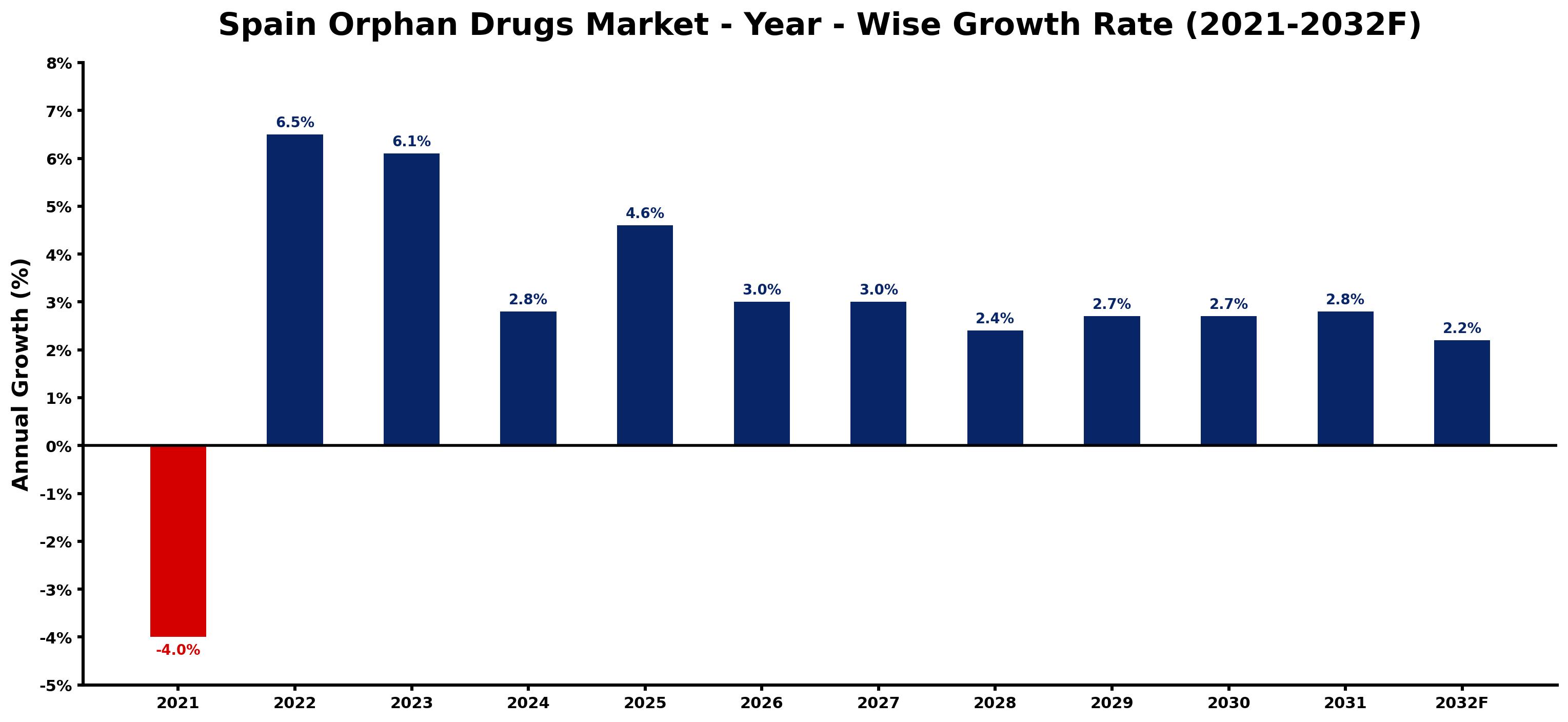
The table below presents the year‑wise growth rates along with the key drivers influencing the market
| Year | Growth Rate | Major Drivers |
| 2021 | -4.0% | Growing renewable energy integration projects |
| 2022 | 6.5% | Increasing smart city development projects |
| 2023 | 6.1% | Government infrastructure modernization initiatives |
| 2024 | 2.8% | Expansion of transportation and logistics networks |
| 2025 | 4.6% | Increasing industrial infrastructure investments |
| 2026 | 3.0% | Increasing industrial automation investments |
| 2027 | 3.0% | Growing urbanization and commercial development |
| 2028 | 2.4% | Increasing adoption of advanced technologies |
| 2029 | 2.7% | Expansion of commercial construction activities |
| 2030 | 2.7% | Increasing industrial infrastructure investments |
| 2031 | 2.8% | Growing urbanization and commercial development |
| 2032 | 2.2% | Growing urbanization and commercial development |
Note - Market size estimations and growth projections presented in this report are based on 6Wresearch’s advanced forecasting approach, validated with industry datasets as of June 2026.
Spain Orphan Drugs Market Synopsis
Recent momentum within the Spain orphan drugs market illustrates a robust growth pattern, reflecting heightened recognition of rare diseases and the associated treatment needs. However, as the market continues to expand, it faces the ongoing challenge of ensuring affordability and access for these specialized drugs.
Looking ahead, the Spain orphan drugs market appears set for progressive evolution, with anticipated increases in orphan drug approvals and a rise in collaborative efforts across the sector. As the healthcare landscape shifts towards personalized medicine, innovative therapies are expected to play an integral role in meeting the needs of patients with rare diseases.
Spain Orphan Drugs Market Key Takeaways
- The market is fueled by a surge in rare disease awareness and diagnosis.
- Government policies significantly support orphan drug research and development.
- Increasing collaborations among pharma companies, research institutes, and advocacy groups are shaping the future.
- Personalized medicine trends, including gene and cell therapies, are gaining momentum.
- Investment opportunities abound due to the high pricing and extended market exclusivity of orphan drugs.
Evaluation of Restraints in Spain Orphan Drugs Market
While the Spain orphan drugs market is expanding, it faces several key constraints that could limit growth. The high development costs associated with orphan drugs often create hurdles in achieving reimbursement and market approval. Additionally, the small patient populations for each rare disease complicate clinical trial processes and the generation of real-world data necessary to validate the efficacy and safety of these treatments. Enhanced education and awareness around the significance of orphan drugs among healthcare professionals and patients are also needed to fully realize the market's potential.
Spain Orphan Drugs Market Trends
The market is witnessing several notable trends. A significant increase in the number of orphan drug designations and approvals, especially in oncology and genetic disorders, is evident. Furthermore, the shift towards personalized medicine, driven by advancements in biotechnology, is allowing for more targeted and effective treatment solutions. Collaborative efforts between industry players and patient advocacy groups are intensifying, facilitating quicker research and development cycles. These trends indicate a promising outlook as the market adapts to the evolving landscape of rare disease treatment.
Spain Orphan Drugs Market Opportunities
The Spain orphan drugs market presents substantial investment opportunities, particularly due to the escalating demand for innovative treatments. Pharmaceutical companies are increasingly directing resources toward orphan drug R&D, encouraged by favorable government policies that incentivize innovation. Investors are poised to benefit from the high market exclusivity and potential returns associated with orphan drugs. Additionally, as public awareness and understanding of rare diseases grow, the appetite for novel therapies will likely expand, further enhancing investment prospects in this niche market.
Government Initiatives in the Spain Orphan Drugs Market
Government policies in Spain are highly supportive of the orphan drugs market, with several initiatives designed to facilitate drug development and improve patient access. These include financial incentives like tax credits, fee reductions, and extended market exclusivity for companies engaged in orphan drug research. Regulatory bodies like the Spanish Agency of Medicines and Medical Devices (AEMPS) streamline approval processes and provide essential support for clinical trials. Moreover, reimbursement schemes are in place to ensure affordability and accessibility for patients requiring these specialized treatments.
Future Insights of the Spain Orphan Drugs Market
The future of the Spain orphan drugs market appears promising, driven by anticipated advancements in healthcare technology and a growing recognition of rare diseases. As the number of orphan drug approvals is expected to rise, coupled with government incentives that foster innovation, the market is likely to experience significant expansion. Collaborative efforts between the pharmaceutical industry and public health initiatives aimed at improving access to orphan drugs will be key to addressing the unmet medical needs of patients. Overall, the landscape for orphan drugs in Spain looks increasingly bright for the next several years.
Spain Orphan Drugs Market Latest Developments (May 2025 - June 2026)
The Spain orphan drugs market has seen a series of notable developments recently. There is a growing focus on advancing research partnerships among pharmaceutical companies and academic institutions to expedite drug development timelines. Additionally, regulatory authorities are streamlining approval pathways, making it easier for innovative therapies to reach the market. Stakeholder discussions around reimbursement policies have also intensified, underscoring the importance of patient access to these vital medications.
Spain Orphan Drugs Market - Key Attractiveness of the Report
- 10 Years of Market Numbers
- Historical Data Starting from 2022 to 2025
- Base Year: 2025
- Forecast Data until 2032
- Key Performance Indicators Impacting the Market
- Major Upcoming Developments and Projects
Key Highlights of the Report:
- Spain Orphan Drugs Market Outlook
- Market Size of Spain Orphan Drugs Market, 2025
- Forecast of Spain Orphan Drugs Market, 2032
- Historical Data and Forecast of Spain Orphan Drugs Revenues & Volume for the Period 2022-2032F
- Spain Orphan Drugs Market Trend Evolution
- Spain Orphan Drugs Market Drivers and Challenges
- Spain Orphan Drugs Price Trends
- Spain Orphan Drugs Porter's Five Forces
- Spain Orphan Drugs Industry Life Cycle
- Historical Data and Forecast of Spain Orphan Drugs Market Revenues & Volume By Drugs for the Period 2022-2032F
- Historical Data and Forecast of Spain Orphan Drugs Market Revenues & Volume By Revlimid for the Period 2022-2032F
- Historical Data and Forecast of Spain Orphan Drugs Market Revenues & Volume By Rituxan for the Period 2022-2032F
- Historical Data and Forecast of Spain Orphan Drugs Market Revenues & Volume By Opdivo for the Period 2022-2032F
- Historical Data and Forecast of Spain Orphan Drugs Market Revenues & Volume By Keytruda for the Period 2022-2032F
- Historical Data and Forecast of Spain Orphan Drugs Market Revenues & Volume By Imbruvica for the Period 2022-2032F
- Historical Data and Forecast of Spain Orphan Drugs Market Revenues & Volume By Soliris for the Period 2022-2032F
- Historical Data and Forecast of Spain Orphan Drugs Market Revenues & Volume By Other Orphan Drugs for the Period 2022-2032F
- Historical Data and Forecast of Spain Orphan Drugs Market Revenues & Volume By Drug Type for the Period 2022-2032F
- Historical Data and Forecast of Spain Orphan Drugs Market Revenues & Volume By Biologics for the Period 2022-2032F
- Historical Data and Forecast of Spain Orphan Drugs Market Revenues & Volume By Non-Biologics for the Period 2022-2032F
- Historical Data and Forecast of Spain Orphan Drugs Market Revenues & Volume By Therapy Class for the Period 2022-2032F
- Historical Data and Forecast of Spain Orphan Drugs Market Revenues & Volume By Oncology for the Period 2022-2032F
- Historical Data and Forecast of Spain Orphan Drugs Market Revenues & Volume By Blood for the Period 2022-2032F
- Historical Data and Forecast of Spain Orphan Drugs Market Revenues & Volume By Endocrine for the Period 2022-2032F
- Historical Data and Forecast of Spain Orphan Drugs Market Revenues & Volume By Central Nervous Systems for the Period 2022-2032F
- Historical Data and Forecast of Spain Orphan Drugs Market Revenues & Volume By Cardiovascular for the Period 2022-2032F
- Historical Data and Forecast of Spain Orphan Drugs Market Revenues & Volume By Respiratory for the Period 2022-2032F
- Spain Orphan Drugs Import Export Trade Statistics
- Market Opportunity Assessment By Drugs
- Market Opportunity Assessment By Drug Type
- Market Opportunity Assessment By Therapy Class
- Spain Orphan Drugs Top Companies Market Share
- Spain Orphan Drugs Competitive Benchmarking By Technical and Operational Parameters
- Spain Orphan Drugs Company Profiles
- Spain Orphan Drugs Key Strategic Recommendations






































