Spain Waste Management Market (2026-2032) | Analysis, Companies, Growth, Outlook, Value, Share, Trends, Competitive Landscape, Industry, Size & Revenue, Forecast, Segmentation
Market Forecast By Type (Municipal Waste, Industrial Waste, Hazardous Waste), By Services (Collection, Disposal) And Competitive Landscape
| Product Code: ETC9460162 | Publication Date: Sep 2024 | Updated Date: May 2026 | Product Type: Market Research Report | |
| Publisher: 6Wresearch | Author: Vasudha | No. of Pages: 70 | No. of Figures: 35 | No. of Tables: 5 |
Spain Waste Management Market Growth Rate
According to 6Wresearch internal database and industry insights, the Spain Waste Management Market is estimated to grow at a compound annual growth rate (CAGR) of 6% during the forecast period (2026–2032).
Spain Waste Management Market Year-wise Growth Rate and Key Drivers
This graph highlights how the Spain Waste Management Market has steadily grown over the past five years, supported by major growth factors.
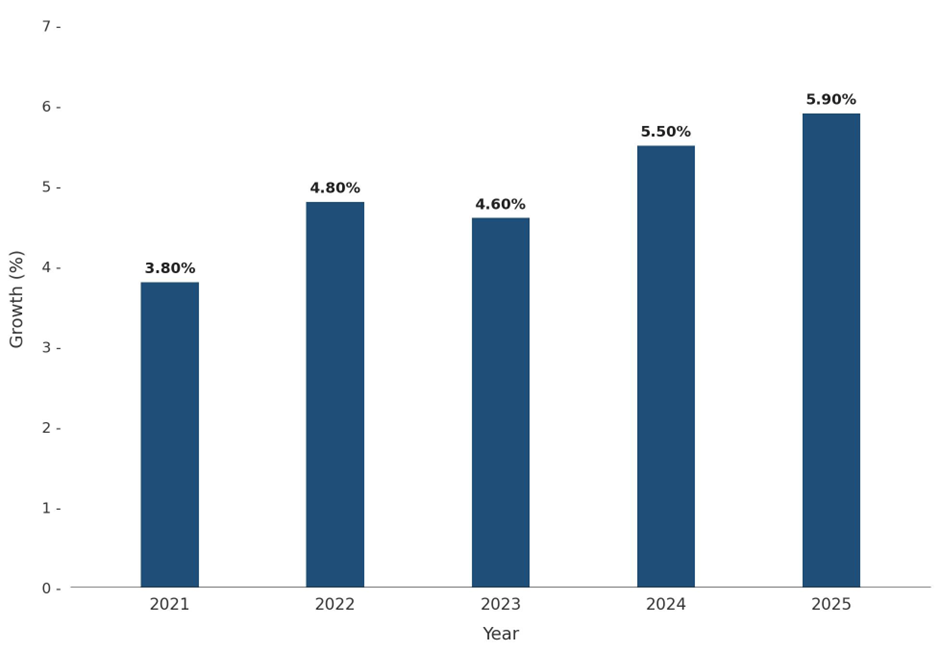
The table below presents the year‑wise growth rates along with the key drivers influencing the market
| Years | Est. Annual Growth (%) | Growth Drivers |
| 2021 | 3.8% | Phased recovery of municipal waste volumes and augmenting recycling awareness among authorities. |
| 2022 | 4.8% | Execution of strict directives issued by the authorities and increasing investments in recycling infrastructure. |
| 2023 | 4.6% | Development of circular economy initiatives and increased plastic waste collection programs. |
| 2024 | 5.5% | Establishment of Waste-to-Energy (WTE) plants by the Government and implementation of landfill reduction targets. |
| 2025 | 5.9% | Booming industrial sector and construction waste recycling methods driven by urban redevelopment projects. |
Topics Covered in the Spain Waste Management Market Report
The Spain Waste Management Market report broadly covers the market by type and services. The report provides a comprehensive analysis of ongoing market trends, opportunities/high-growth areas, and market drivers that will be pivotal for various stakeholders to align their strategies based on current and future market dynamics.
Spain Waste Management Market Highlights
| Report Name |
Spain Waste Management Market |
| Forecast period | 2026-2032 |
| CAGR | 6% |
| Market Size |
Recycling & Waste-to-Energy |
Spain Waste Management Market Synopsis
Spain Waste Management Market is anticipated to witness firm expansion during the forecast period due to the country’s strong alignment with sustainability goals and circular economy policies implemented by the European Union. The gradual focus on reducing dependency on landfill and elevating recycling rates are driving investments in advanced waste management technologies. The gradual shift toward renewable sources of energy is also stimulating the development of waste-to-energy plants, contributing further to Spain waste management market growth.
Evaluation of Growth Drivers in Spain Waste Management Market (2026-2032)
Given below are some of the major drivers and their influence on Spain Waste Management market dynamics:
| Drivers | Primary Segment Affected | Why It Matters (Evidence) |
| EU Circular Economy Policies | Recycling | Spain objective to recycle over 55% of municipal waste, driving investments in sorting and processing infrastructure. |
| Waste-to-Energy Expansion | Energy Recovery | Adoption of Waste-to-Energy plants for electricity generation diminishes dependency on landfills. |
| Mounting Urban Waste Generation | Municipal Waste | Rapid urbanization and tourism significantly enhance daily waste volumes. |
| Rigid Environmental Regulations | Compliance & Observation | Stringent landfill reduction targets push municipality authorities toward adoption of numerous sustainable waste treatment methods for waste management. |
| Technological Advancements | Smart Waste Management | Adoption of AI based sorting, and IoT-enabled bins further refines efficiency and reduces operational costs. |
Spain Waste Management Market is expected to proliferate, exhibiting a CAGR of 6% during the forecast period (2026–2032). The country’s firm commitment to achieve EU recycling and landfill reduction targets is expected to play a crucial role in shaping market expansion. Further, Spain’s alignment with circular economy principles is reassuring stakeholders to invest heavily in advanced waste segregation, recycling, and recovery infrastructure. Moreover, investments boost in modern waste processing technologies are significantly optimizing operational efficiency and waste recovery rates. The waste-to-energy facilities is additionally contributing to the waste management system of Spain by transforming non-recyclable waste into electricity which further reduces reliance on landfills.
Evaluation of Restraints in the Spain Waste Management Market
Below are some of the major restraints and their influence on market dynamics:
| Restraints | Primary Segment Affected | What This Means (Evidence) |
| Mounting Operational Costs | Collection & Processing | Modernistic recycling and waste treatment techniques require substantial capital inflow which makes the incorporation difficult for smaller municipal authorities. |
| Public Resistance to Waste-to-Energy Plants | Energy Recovery | Local resistance to incineration facilities due to environmental issues can delay approvals and project execution by the authorities. |
| Regional Distinctiveness | Infrastructure | Deviations in waste management efficiency across numerous autonomous regions makes the uniform implementation of national waste policies difficult for Government. |
| Sophisticated Regulatory Framework | Compliance | Implementing the regulations imposed by both the EU and the National Government enhance administrative burden, which further delays project timelines. |
| Finite Landfill Alternatives | Disposal | Progressive closure of landfills without adequate alternative treatment capacity creates burden on existing waste processing systems. |
Spain Waste Management Market Challenges
Despite promising growth prospects, the Spain Waste Management Industry faces challenges with respect to achieving steady recycling rates across nation. Rural and underdeveloped areas often lack adequate infrastructure which creates inefficiencies in waste collection and processing. Moreover, administering waste materials which is hazardous in nature remains a concern for local authorities due to the need for specialized treatment facilities. The unification of advanced technologies also requires skilled labour force and constant investment, which may stand as a challenge for smaller municipalities and private operators.
Spain Waste Management Market Trends
Given below are some major trends in Spain Waste Management Market:
- Shift Toward Circular Economy and Sustainable Practices: Spain is gradually aligning with circular economy policies established by the European Union for recovery, reuse, and recycling of waste material. Municipal and industrial programs insist on diversion of waste from landfills to high‑value recycling streams.
- Growth in Urban Waste Collection and Selective Sorting: Urban centres of Madrid, Barcelona, Valencia, and regions such as Costa del Sol are punching in notable increases in selective waste collection methods. Selective collection of packaging material rose in early 2026, demonstrating large scale participation of citizens in waste segregation.
- Technological Adoption Throughout the Value Chain: Innovation such as sensor‑equipped containers, IoT‑enabled bins, digital traceability systems, collection vehicle’s smart route plan, and trailblazing sorting technologies are gaining traction to optimize operations, and improve recycling techniques.
- Integration of Biowaste and Organic Recycling: Plans such as the “Residuo Cero” strategies implemented in the city of Gijón constitutes enhanced separation of biowaste and organics. Spain drives efficiently toward recycling benchmarks established by the European Union.
Investment Opportunities in the Spain Waste Management Market
Mentioned below are the Investment Opportunities in Spain Waste Management Market:
- Recycling Infrastructure and Material Recovery Facilities: There is a substantial investment potential in expanding sorting lines of specialized recycling plants and advanced material recovery facilities keeping in mind the stronger regulatory targets to exceed 50% recycling rates.
- Waste‑to‑Energy and Renewable Generation Projects: WTE facilities that convert non‑recyclable waste into electricity are gaining traction due to their dual environmental and energy‑security benefits.
- Smart Waste Management Technologies: Potential investors can leverage opportunities in digital solutions that refine collection logistics, enable real‑time bin monitoring, and offer data analytics for efficiency improvements.
- Public‑Private Partnerships (PPPs): Alliance between local authorities and private firms can establish long‑term investment prospects, especially in infrastructure builds, and integrated system for waste management.
Top 5 Leading Players in Spain Waste Management Market
Given below is a list of leading companies dominating the Spain Waste Management Market:
1. Ferrovial Servicios
| Company Name | Ferrovial Servicios |
|---|---|
| Established Year | 1950 |
| Headquarters | Amsterdam, Netherlands (global); Madrid, Spain (operational) |
| Official Website | Click Here |
An infrastructure and services company specializing in comprehensive waste management and environmental solutions programs. Ferrovial’s waste division looks after the collection, transport, treatment, and recycling services.
2. FCC Medio Ambiente
| Company Name | FCC Medio Ambiente |
|---|---|
| Established Year | 1911 |
| Headquarters | Barcelona/Madrid, Spain |
| Official Website | - |
As an integral part of FCC Group, this is one of Spain’s largest waste management companies, offering urban waste collection, treatment, and recycling services across nation.
3. Urbaser
| Company Name | Urbaser |
|---|---|
| Established Year | 1990 |
| Headquarters | Madrid, Spain |
| Official Website | Click Here |
A waste collection and environmental services operator with strong footing in municipal and industrial waste management offering collection, transport, treatment, and recycling services across the globe.
4. Veolia España
| Company Name | Veolia España (Subsidiary of Veolia Environnement) |
|---|---|
| Established Year | 1853 |
| Headquarters | Aubervilliers |
| Official Website | Click Here |
The Spanish subsidiary of global environmental services giant, operational in waste collection, recycling, treatment, and energy from waste solutions.
5. Valoriza Servicios Medioambientales
| Company Name | Valoriza Servicios Medioambientales |
|---|---|
| Established Year | 1982 |
| Headquarters | Madrid, Spain |
| Official Website | Click Here |
Constituent of Sacyr Group, Valoriza is a prominent player in waste collection, street cleaning, and advanced waste treatment operations, focusing on sustainability and integrated waste solutions.
Government Initiatives being implemented in the Spain Waste Management Market
According to Spanish Government Data, the state has implemented initiatives which include forming national strategies, implementing regulatory actions, and running programs to support sustainable waste handling. The Government enacted Waste and Contaminated Soil Law 2023 focusing on reducing overall waste generation and amplifying recycling efforts. A National Circular Economy Strategy called ‘España Circular 2030’ provides a long‑term framework to transform production and consumption model toward a circular economy whose focus is to maintain the value of materials through reuse and recycling.
Future Insights of the Spain Waste Management Market
The waste management market of Spain will witness sustained growth directed by increasing waste volumes, regulatory pressure, and investments in infrastructure, with a notable increase in market value by 2032. The projected growth is fuelled by demand for municipal, industrial, and hazardous waste services. The market will witness technology-driven transformation with adoption of IoT-enabled systems, AI for waste sorting, and robotics for recycling. Large-scale waste management projects will be funded through Public-Private Partnerships. The above-mentioned insights indicates that the Spain Waste Management Market will be shaped by sustainability trends, and technology unification creating both opportunities and challenges for stakeholders.
Market Segmentation Analysis
The report offers a comprehensive study of the following market segments and their leading categories:
By Waste Type – Municipal Waste Dominate the Market
According to Sachin, Senior Research Analyst, 6Wresearch, municipal waste dominates Spain waste management market share. This segment includes household and community waste collected from residential areas, commercial establishments. This type of waste represents one of the largest volumes to urbanization, consumption patterns, and robust collection systems.
By Service – Collection Services to lead the Market
The Spain Waste management market is also categorized by the services provided which includes collection services encompasses of all activities including the transfer of waste from source to facility. The dominating sub‑segment is collection and transportation which account for the largest share because waste must first be gathered from sources before any other processing can initiate.
Key Attractiveness of the Report
- 10 Years of Market Numbers
- Historical Data Starting from 2022 to 2025
- Base Year: 2025
- Forecast Data until 2032
- Key Performance Indicators Impacting the Market
- Major Upcoming Developments and Projects
Key Highlights of the Report:
- Spain Waste Management Market Outlook
- Market Size of Spain Waste Management Market, 2025
- Forecast of Spain Waste Management Market, 2032
- Historical Data and Forecast of Spain Waste Management Revenues & Volume for the Period 2022- 2032
- Spain Waste Management Market Trend Evolution
- Spain Waste Management Market Drivers and Challenges
- Spain Waste Management Price Trends
- Spain Waste Management Porter's Five Forces
- Spain Waste Management Industry Life Cycle
- Historical Data and Forecast of Spain Waste Management Market Revenues & Volume by Type for the Period 2022- 2032
- Historical Data and Forecast of Spain Waste Management Market Revenues & Volume by Municipal Waste for the Period 2022- 2032
- Historical Data and Forecast of Spain Waste Management Market Revenues & Volume by Industrial Waste for the Period 2022- 2032
- Historical Data and Forecast of Spain Waste Management Market Revenues & Volume by Hazardous Waste for the Period 2022- 2032
- Historical Data and Forecast of Spain Waste Management Market Revenues & Volume by Services for the Period 2022- 2032
- Historical Data and Forecast of Spain Waste Management Market Revenues & Volume by Collection for the Period 2022- 2032
- Historical Data and Forecast of Spain Waste Management Market Revenues & Volume by Disposal for the Period 2022- 2032
- Spain Waste Management Import Export Trade Statistics
- Market Opportunity Assessment by Type
- Market Opportunity Assessment by Services
- Spain Waste Management Top Companies Market Share
- Spain Waste Management Competitive Benchmarking by Technical and Operational Parameters
- Spain Waste Management Company Profiles
- Spain Waste Management Key Strategic Recommendations
Market Covered
The report offers a comprehensive study of the following market segments:
By Type
- Municipal Waste
- Industrial Waste
- Hazardous Waste
By Services
- Collection
- Disposal
Spain Waste Management Market (2026-2032): FAQs
Spain Waste Management Market is expected to grow at a growth rate of 6% during the forecast period 2026-2032.
Some of the emerging trends includes urban waste collection and selective sorting, and integration of biowaste and organic recycling.
Regulatory actions are implemented by government to support sustainable waste handling. Also, waste prevention plans have been administered with an aim cut food waste by up to 50% by 2030.
Some of leading players in Spain Waste Management Market are Ferrovial Servicios, FCC Medio Ambiente, Urbaser, and Veolia España.
6Wresearch actively monitors the Spain Waste Management Market and publishes its comprehensive annual report, highlighting emerging trends, growth drivers, revenue analysis, and forecast outlook. Our insights help businesses to make data-backed strategic decisions with ongoing market dynamics. Our analysts track relevent industries related to the Spain Waste Management Market, allowing our clients with actionable intelligence and reliable forecasts tailored to emerging regional needs.
Yes, we provide customisation as per your requirements. To learn more, feel free to contact us on sales@6wresearch.com
| 1 Executive Summary |
| 2 Introduction |
| 2.1 Key Highlights of the Report |
| 2.2 Report Description |
| 2.3 Market Scope & Segmentation |
| 2.4 Research Methodology |
| 2.5 Assumptions |
| 3 Spain Waste Management Market Overview |
| 3.1 Spain Country Macro Economic Indicators |
| 3.2 Spain Waste Management Market Revenues & Volume, 2022 & 2032F |
| 3.3 Spain Waste Management Market - Industry Life Cycle |
| 3.4 Spain Waste Management Market - Porter's Five Forces |
| 3.5 Spain Waste Management Market Revenues & Volume Share, By Type, 2022 & 2032F |
| 3.6 Spain Waste Management Market Revenues & Volume Share, By Services, 2022 & 2032F |
| 4 Spain Waste Management Market Dynamics |
| 4.1 Impact Analysis |
| 4.2 Market Drivers |
| 4.2.1 Increasing urbanization and industrialization leading to higher waste generation |
| 4.2.2 Growing focus on sustainability and environmental regulations driving demand for efficient waste management solutions |
| 4.2.3 Government initiatives and investments in waste management infrastructure and technologies |
| 4.3 Market Restraints |
| 4.3.1 Lack of proper waste segregation and recycling facilities |
| 4.3.2 High initial investment costs for advanced waste management technologies |
| 4.3.3 Limited public awareness and participation in waste management practices |
| 5 Spain Waste Management Market Trends |
| 6 Spain Waste Management Market, By Types |
| 6.1 Spain Waste Management Market, By Type |
| 6.1.1 Overview and Analysis |
| 6.1.2 Spain Waste Management Market Revenues & Volume, By Type, 2022- 2032F |
| 6.1.3 Spain Waste Management Market Revenues & Volume, By Municipal Waste, 2022- 2032F |
| 6.1.4 Spain Waste Management Market Revenues & Volume, By Industrial Waste, 2022- 2032F |
| 6.1.5 Spain Waste Management Market Revenues & Volume, By Hazardous Waste, 2022- 2032F |
| 6.2 Spain Waste Management Market, By Services |
| 6.2.1 Overview and Analysis |
| 6.2.2 Spain Waste Management Market Revenues & Volume, By Collection, 2022- 2032F |
| 6.2.3 Spain Waste Management Market Revenues & Volume, By Disposal, 2022- 2032F |
| 7 Spain Waste Management Market Import-Export Trade Statistics |
| 7.1 Spain Waste Management Market Export to Major Countries |
| 7.2 Spain Waste Management Market Imports from Major Countries |
| 8 Spain Waste Management Market Key Performance Indicators |
| 8.1 Percentage of waste recycled or diverted from landfills |
| 8.2 Number of waste management facilities in operation |
| 8.3 Adoption rate of advanced waste management technologies |
| 8.4 Compliance with environmental regulations |
| 8.5 Reduction in per capita waste generation |
| 9 Spain Waste Management Market - Opportunity Assessment |
| 9.1 Spain Waste Management Market Opportunity Assessment, By Type, 2022 & 2032F |
| 9.2 Spain Waste Management Market Opportunity Assessment, By Services, 2022 & 2032F |
| 10 Spain Waste Management Market - Competitive Landscape |
| 10.1 Spain Waste Management Market Revenue Share, By Companies, 2025 |
| 10.2 Spain Waste Management Market Competitive Benchmarking, By Operating and Technical Parameters |
| 11 Company Profiles |
| 12 Recommendations |
| 13 Disclaimer |
Global Go To Market Strategy - 2030
Export potential enables firms to identify high-growth global markets with greater confidence by combining advanced trade intelligence with a structured quantitative methodology. The framework analyzes emerging demand trends and country-level import patterns while integrating macroeconomic and trade datasets such as GDP and population forecasts, bilateral import–export flows, tariff structures, elasticity differentials between developed and developing economies, geographic distance, and import demand projections. Using weighted trade values from 2020–2024 as the base period to project country-to-country export potential for 2030, these inputs are operationalized through calculated drivers such as gravity model parameters, tariff impact factors, and projected GDP per-capita growth. Through an analysis of hidden potentials, demand hotspots, and market conditions that are most favorable to success, this method enables firms to focus on target countries, maximize returns, and global expansion with data, backed by accuracy.
By factoring in the projected importer demand gap that is currently unmet and could be potential opportunity, it identifies the potential for the Exporter (Country) among 190 countries, against the general trade analysis, which identifies the biggest importer or exporter.
To discover high-growth global markets and optimize your business strategy:
Click Here
Pricing
- Single User License$ 1,995
- Department License$ 2,400
- Site License$ 3,120
- Global License$ 3,795

Leadership Perspectives from Industry Events
Search
Thought Leadership and Analyst Meet





Our Clients








6WResearch In News
- Doha a strategic location for EV manufacturing hub: IPA Qatar
- Demand for luxury TVs surging in the GCC, says Samsung
- Empowering Growth: The Thriving Journey of Bangladesh’s Cable Industry
- Demand for luxury TVs surging in the GCC, says Samsung
- Video call with a traditional healer? Once unthinkable, it’s now common in South Africa
- Intelligent Buildings To Smooth GCC’s Path To Net Zero
Latest Reports
- Taiwan Airport Wireless Infrastructure Market (2026-2032)
- Vietnam Airport Wireless Infrastructure Market (2026-2032)
- Thailand Airport Wireless Infrastructure Market (2026-2032)
- South Korea Airport Wireless Infrastructure Market (2026-2032)
- Romania Airport Wireless Infrastructure Market (2026-2032)
- Qatar Airport Wireless Infrastructure Market (2026-2032)
- Philippines Airport Wireless Infrastructure Market (2026-2032)
- Japan Airport Wireless Infrastructure Market (2026-2032)
- Taiwan Airport Winter Services Market (2026-2032)
- Vietnam Airport Winter Services Market (2026-2032)
Industry Events and Analyst Meet

HIMTEX 2026

India Refining Summit 2026

India EV Show 2026

EV tech India Expo 2026

Auto Tech Asia 2026
Whitepaper
- Middle East & Africa Commercial Security Market Click here to view more.
- Middle East & Africa Fire Safety Systems & Equipment Market Click here to view more.
- GCC Drone Market Click here to view more.
- Middle East Lighting Fixture Market Click here to view more.
- GCC Physical & Perimeter Security Market Click here to view more.


